TL;DR
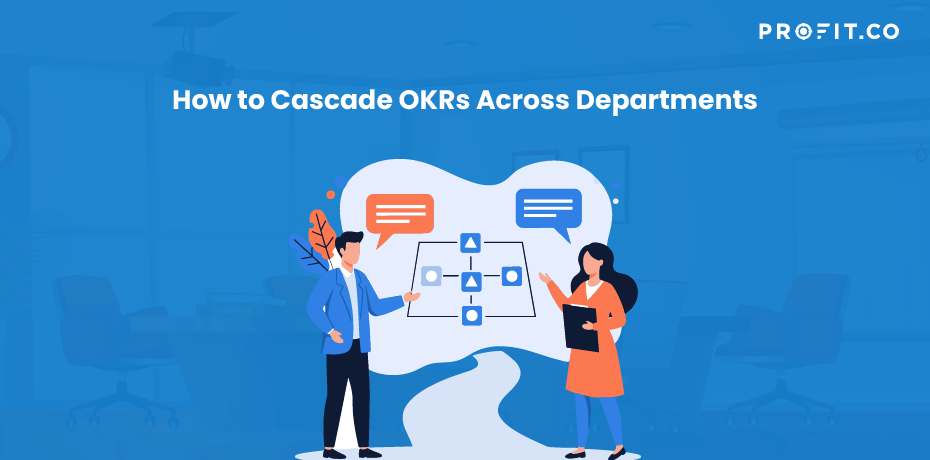
Cascading OKRs is the method of carrying company-level objectives down through departments, teams, and individuals, where each level adopts and drives the key results it can directly influence. By translating strategic priorities into owned outcomes at every layer, cascading keeps teams moving in the same direction and reduces siloed effort across the organizationConsider this example of a CEO who says that the company’s goal is to double its market share. Marketing initiates a brand awareness campaign. Sales primarily caters to business clients. Product builds features for small businesses. Customer service puts response time ahead of keeping customers. Everyone is busy. Everyone is putting in significant effort. But no one is going in the same direction.
Cascading OKRs fixes this problem with alignment. When goals are clearly communicated from the top down to departments and then to individual employees, a sales rep who closes deals knows exactly how their work fits into the company’s mission. An engineer who sends a code knows how their feature fits into the bigger picture. A marketer who is planning campaigns can see how their metrics are directly related to their revenue goals.
What Are Cascading OKRs, Anyway?
Cascading OKRs start at the top, your company’s strategic goals, and flow down, splitting into smaller departmental goals and finally reaching individual team member goals. Each level is responsible for certain goals while staying connected to the primary goal. But effective OKR cascading is about aligning strategies while giving teams freedom. “Cascading makes an operation more coherent,” John Doerr wrote in his book Measure What Matters. It directs efforts and coordination, connecting different parts of the business and giving the whole thing a purpose. If these departments aren’t aligned, they might accidentally work against each other, which would lessen the impact of everyone’s hard work.What it means to have cascading OKRs
- Cascading OKRs is the way that goals move through a company in a planned way
- Company OKRs say what the business needs to do to reach its goals
- Department OKRs show how each part will help reach those goals
- Team and sometimes individual OKRs turn departmental goals into the work that gets done
Each level clarifies matters and grants individuals greater control. A department should adapt the company’s KR as its own goals, not just copy it.
“We all need people who will give us feedback . That’s how we improve.”

Two Ways to Cascade OKRs
1) The Old Way of Cascading from the Top Down
Executives set company OKRs, and then each level turns the parent KRs into their objectives and measurable KRs.When to use this:
- You are in a crisis that needs close coordination
- The way is clear, and the speed of execution is most important.
- The organization is small, and there aren’t many levels of hierarchy
- Strict alignment is needed for compliance or regulation
2) Cascading in a Distributed Modern Way
Executives write down the company’s OKRs and strategic context. Then, teams quickly write down their OKRs, get feedback from their peers, and sign off on them.When to use this:
- You have 100 to 200 people, and getting approvals takes a long time.
- Teams are good at making decisions about “how.”
- The market changes a lot.
- Experimenting and coming up with new ideas are important
Most businesses do best with a mix of top-down direction and middle-level freedom
OKRs help you measure what matters
A Useful Cascade Framework With Examples
Step 1: Company OKRs (for the top level)
Start with one goal for each quarter and two to four key results that are measurable.For example, a B2B SaaS company
Company goal: Increase revenue from the middle market while retaining customers.Key Results for the Company:
- KR1: Grow the number of mid-market customers from 150 to 350
- KR2: Increase the annual recurring revenue (ARR) in the middle market from $3 million to $7 million.
- KR3: Raise the retention rate for mid-market customers from 78% to 88%
Step 2: Department OKRs (Level of Translation)
Each department chooses the company’s KRs, which can have a big impact and turn them into results it can own. For example, the Product Department owns retention KR3.Department Goal: Make it easier for mid-market customers to get started.
Company goal: Increase revenue from the middle market while retaining customers.Key Results for the Department:
- KR1: Cut the time it takes to get the first value from 14 days to 5 days
- KR2: Raise the percentage of people who use the new features in the first month from 35% to 60%
- KR3: Lower the number of support tickets that cause customers to leave from 8 to 3 per month.
For example, the Sales Department owns the number of customers in KR1 and the ARR in KR2.
Department Goal: Establish a reusable mid-market pipeline and closing engine.
Key Results for the Department:
- KR1: Increase the number of qualified mid-market leads from 60 to 180
- KR2: Raise the close rate from 18% to 30%
- KR3: Cut the average sales cycle from 90 days to 50 days
For example, the Marketing Department (supports pipeline and ARR)
Goal of the department: Make demand in the middle market more predictable.
Key Results for the Department:
- KR1: Raise the number of mid-market MQLs from 120 to 300 each month
- KR2: Raise the percentage of MQLs that turn into SQLs from 12% to 25%
- KR3: Increase the number of demo requests from 20 to 60 a month
Step 3: Team and Individual OKRs (Level of Execution)
Teams pick the departmental KRs they can move and make tactical OKRs with clear starting points.Example: The Product Onboarding Team, helps with Product KR1–KR2
Team Goal: Help new mid-market users do well in their first week.
Results for the Team:
- KR1: Raise the rate of completing onboarding from 40% to 75%.
- KR2: Cut the number of people who give up on setup from 55% to 20%.
- KR3: Raise the rate of “first workflow created” from 30% to 65%.
For example, the Content and Webinars Team helps with marketing KR1–KR3.
Team Goal: Create proof-based content that drives qualified demand.
Results for the Team:
- KR1: Get more people to sign up for webinars, from 0 to 150 per event
- KR2: Increase the number of clicks on case-study CTAs from 2% to 6%
- KR3: Raise the conversion rate of organic demos from 1.2% to 2.5%
Another example is a regional retail chain.
Goal of the company: Boost sales at the same stores while keeping customers loyal.Key Results for the Company:
- KR1: Increase revenue from the same store from ₹42 Cr to ₹52 Cr
- KR2: Raise the rate of repeat purchases from 28% to 38%
- KR3: Raise the net promoter score from 41 to 55
Goal of the Operations Department: To make the in-store experience better and build loyalty.
KRs for operations:
- KR1: Cut the time it takes to check out from 8 minutes to 4 minutes.
- KR2: Make shelves more available, going from 86% to 95%
- KR3: Get 100% of staff to finish their training
Store Team Goal: Provide faster service and cleaner work every day
Store Team KRs:
- KR1: Cut the number of “out-of-stock” events from 14 to 5 per week
- KR2: Raise the score on the mystery audit from 72 to 88.
- KR3: Make it so that 80% of customer problems are solved within 24 hours, up from 50%.
Notice how each level is aligned, measurable, and owned by the people who can change it?
The Critical Rules for Successful OKR Cascading
1. Speed Trumps Perfection
It should take 48 to 72 hours to go from company OKRs to team OKRs. This tight timeline prevents analysis paralysis and gets everyone learning by doing. If it takes more than a week, alignment becomes paperwork2. Input from Below Is Non-Negotiable
Executives shouldn’t dictate tactics. If you want to control people’s activities, don’t use OKRs. Only use them if you want to direct people toward outcomes and trust them to figure out how.3. Outcomes Must Be Key Results
Cascaded OKRs should become more specific at every level. If a department repeats a company KR as its objective, the cascade didn’t happen. Furthermore, avoid activity-based KRs like “hire,” “launch,” or “implement.” Those are initiatives. Key results must capture the measurable outcome those initiatives create4. Not Every Team Needs Department-Level OKRs
Service departments like Engineering, Design, Legal, or Customer Service often support multiple teams and work on requests. Choices: Set OKRs only for the small part of the business that they are responsible for. Set OKRs for areas they want to improve. Use health metrics to maintain steady-state quality Skip OKRs entirely if they’re pure service teams5. Let things overlap
Let two teams support the same company, KR. Early overlap is fine. You won’t know which approach will work until teams try. Because there’s no way to predict which team will succeed or how. It’s more important to be effective than efficient. Efficiency can kill innovation occasionally6. Balance Top-Down and Bottom-Up
Healthy organizations strike a balance. Too much top-down creates rigidity and stifles innovation. Too much bottom-up can lead to misalignment and wasted effort. The sweet spot? Clear strategic direction from the top with tactical autonomy at the team level.7. Feedback instead of approval
Instead of approval chains, use a short peer-review window. Feedback helps things line up without slowing down the launch.A quick quality check for OKRs that have been cascaded
Before locking OKRs, ask:- Does this KR clearly help a parent KR?
- Is one group responsible for it?
- Can you measure it from a real starting point to a real goal?
- Does it differ from the parent?
- Could the team make this change within the quarter?
If the answer to any of these questions is “no,” please consider making the necessary adjustments.
A Schedule That Keeps You Out of Trouble
1. Two weeks before the end of the quarterRate the current OKRs. The leaders decide what changes will be made in the next quarter.
2. One week before the end of the quarter
The executive team puts out the company’s OKRs for the next quarter. Departments talk about the situation and their limits.
3. Next 48 hours
Departments and teams write OKRs that are connected to the goals of the company.
4. Next 24 hours
Feedback from peers across teams. Dependencies came up early.
5. Last 24 hours
Teams make changes to and lock OKRs.
6. The first day of the new quarter
The execution begins. Weekly check-ins are about how things are going, not rewriting OKRs.
Common Reasons OKR Cascading Fails
- Slow cascade: If it takes more than two weeks to set goals, the execution will be bad.
- Micromanagement: When leaders tell teams what to do, teams stop being responsible for the results
- Task KRs: When KRs are just tasks, it’s hard to see how far you’ve come
- Too many layers: If there are more than three levels, the focus is usually less clear
- Hidden OKRs: If teams can’t see each other’s goals, they can’t work together.
Cascading OKRs only works when three things are true:
- You have capable people who can own outcomes
- Leaders set direction, not methods
- Teams are trusted to learn and adjust without being controlled.
Without these, OKRs look like they’re in line, but they act like red tape
Ready to try OKRs
Cascading is a vertical structure that goes from the company to the department to the team. The result is alignment, which can happen through cascading or working together with other teams
Most modern organizations take 48 to 72 hours. Longer than a week usually means there are too many layers or not enough trust.
Not always. For roles that require teamwork, team OKRs work better. Individual OKRs are helpful when someone is responsible for results (like sales, account management, or a single specialist)
Let them do it early on. Taking more than one shot raises your chances of finding a useful answer. Only rationalize when there is a real capacity conflict
No. OKRs are for doing things. First, ensure that the strategy is clear
Strategy can be yearly. Execution should happen every three months to speed things up and help people learn.
A healthy range is about 60/40, but it can change depending on the situation. Crises tend to go from the top down, while innovation cycles tend to go from the bottom up.
Related Articles
-
OKR Software with Mobile App: Track Your Goals Anywhere
TL;DR OKR software with a mobile app keeps your team aligned and productive wherever they are. Profit.co's mobile app allows... Read more
-
Top OKR Tools That Integrate Seamlessly with Microsoft 365
TL;DR If your company runs on Microsoft 365, your OKR tool should too. The best platforms integrate deeply with Teams,... Read more
-
The 6 Biggest Goal Management Challenges During M&A And How to Solve Them
TL;DR M&A integrations create unique goal management challenges that don't exist in normal operations: cultural conflicts, system incompatibility, talent loss,... Read more
-
6 Adaptations Required to Implement OKRs in Government
TL;DR The Objectives and Key Results (OKR) framework helps organizations align strategy, measure outcomes, and improve execution. However, government agencies... Read more