Eswaramoorthy Gandhan S Strategy Execution Manager | OKR Coach & Consultant Published Date: Dec 05, 2025 Key Insights Strategy isn’t just what you plan, but more about what you prioritize Organizations lose alignment not because of poor strategy, but due to fragmented execution Demand will always exceed capacity. Strategic alignment is about making deliberate choices… Read more
Key Takeaways Hoshin Kanri works best as the strategic backbone that unites other frameworks OKRs, Balanced Scorecard, and Lean all complement Hoshin Kanri when used with clarity of purpose Integration prevents duplication, conflicting metrics, and fragmented execution The key is defining clear roles for each framework within a unified system Introduction Most organizations already have… Read more
Summary: How to get all of your departments to work together without micromanaging. The department cadence, which is the rhythm of planning, doing, and reviewing across functions, often gets out of sync, which causes chaos in the organization. The Balanced Scorecard gives you a way to plan and coordinate the pace of your departments while… Read more
Summary: Most efforts to boost productivity fail because they focus on activity instead of results. Teams get better at doing things the wrong way. The Balanced Scorecard fixes this by linking productivity to strategic goals from four different points of view. This makes sure that every gain in efficiency really helps the business reach its… Read more
Key Takeaways A digital X-Matrix boosts visibility, collaboration, and agility in Hoshin Kanri. Real-time updates prevent lag in decision-making Integration with other business tools creates a single source of truth. Digital platforms make catchball and cascading more seamless. AI will further enhance predictive insights and alignment suggestions Introduction Hoshin Kanri has traditionally been implemented with… Read more
OKRs (Objectives and Key Results) are one of the most powerful ways to connect strategy with execution. Whether you’re a business leader, team manager, or someone exploring modern goal-setting frameworks, this beginner-friendly OKR FAQ brings together 38 of the most commonly asked questions, explained clearly and concisely, all in one place. Use this guide as… Read more
Quick Summary The balanced scorecard shouldn’t be in a strategy plan but a system where strategy, individual performance, and organizational goals all connect by combining it with AI-powered performance reviews and OKRs. This blog post will show you how to get these frameworks to work together without the usual corporate headache. To be honest, most… Read more
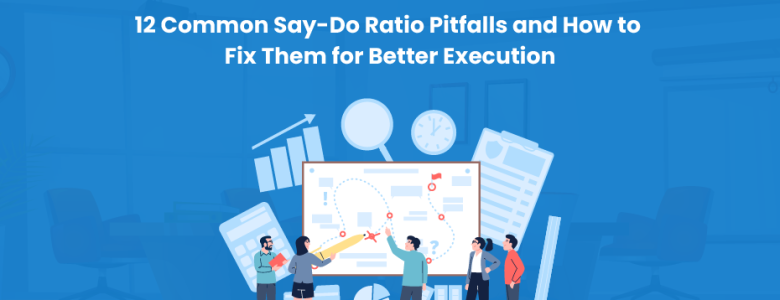
Your Say–Do ratio shows how well your team delivers on promises. Most teams have problems not because they aren’t good at what they do, but because they make common mistakes like making too many promises, being vague, and missing important tasks. This guide shows 12 mistakes that make teams less reliable and the easy fixes… Read more
How to measure the business impact of managing strategic goals in big companies and set up the systems that show how value is being created Important Points ROI measurement is not an administrative task; it is a strategic one.It’s not just about checking the impact of OKRs; it’s also about making sure that strategic execution… Read more
Work has changed.People no longer see their jobs as simply a paycheck or a place to clock in and out. Instead, they want work that helps them grow, that challenges them, and that makes them feel like they’re moving forward. Employees are looking for purpose and progress, and not just promotions. That’s why career development… Read more
Agile teams live on a steady diet of promises and proof. At sprint planning the promise is made, and at sprint review the proof arrives. The Say-Do Ratio in Agile sits right between those two moments by asking a simple question with big consequences: did we deliver what we said we would deliver? It sounds… Read more
Many companies begin discussing mergers and acquisitions with meticulous plans and comprehensive financial models. But soon after the deal is done, big problems start to show up: less innovation, unclear ownership, slower decision-making, and unexpected turnover among important employees. The strategic rationale or financial structure is not usually the cause of these problems. Cultural friction… Read more