Table of Contents
-
What is Dynamic Performance Management?
-
The Four Performance Management Archetypes
-
Why Organizations Are Shifting to Dynamic PM
-
Key Technologies Enabling Dynamic PM
-
Implementation Framework
-
Benefits and ROI
-
Getting Started
What is Dynamic Performance Management?
Dynamic Performance Management (DPM) represents a fundamental shift from traditional, periodic performance reviews to a technology-enabled, data-driven approach that provides real-time insights into employee performance.According to recent Gartner research, DPM is “an emerging approach in data-rich organizations. By leveraging technology to collect and synthesize validated performance indicators, DPM refocuses the manager’s role on resolving barriers to improved performance by removing the data collection and visibility challenges with other approaches.”
What are the 5 Key Characteristics of Dynamic Performance Management?
Unlike traditional performance reviews that are backward-looking and often too infrequent, Dynamic Performance Management (DPM) takes a proactive, data-driven, and adaptive approach. It equips organizations with real-time insights, enabling leaders to guide teams effectively and employees to stay aligned with business goals.The following five characteristics define a truly dynamic performance management system:
- Technology-Enabled Data Collection: Instead of relying on manual check-ins and subjective assessments, DPM uses automated systems to gather performance indicators from various sources like project management tools, collaboration platforms, customer feedback systems, and more.
- Role-Based Performance Metrics: Rather than one-size-fits-all evaluations, DPM creates customized performance indicators based on specific job functions, ensuring relevance and accuracy.
- Manager Role Transformation: Managers shift from being data collectors to performance coaches, focusing on removing obstacles and providing strategic guidance.
- Real-Time Visibility: Performance insights are available continuously, not just during annual or quarterly review cycles.
- Predictive Analytics: Advanced systems can identify performance trends and potential issues before they become problems.
What are the Four Performance Management Archetypes?
Performance management has evolved dramatically over the past two decades. To understand where Dynamic Performance Management (DPM) fits, it helps to step back and see the four archetypes organizations use today.Each of them is shaped by its era, culture, and priorities. To understand where Dynamic PM fits in the broader landscape, it’s essential to recognize the four distinct approaches organizations use today.
1. Accountable Performance Management (APM)
Current adoption: 23% of organizations
APM represents the traditional approach that most organizations have used for decades. As Gartner notes, “APM follows a traditional, periodic approach centered on documenting performance evaluations. APM prioritizes efficiently meeting compliance-centric requirements for organizations that address employee engagement and upskilling through other activities.”
Characteristics:
- Annual evaluations with formal ratings
- Heavy focus on documentation and compliance
- Hierarchical feedback structure
- Risk-averse approach to performance discussions
Best for: Highly regulated industries, large bureaucratic organizations, and companies with strong compliance requirements.
2. Continuous Performance Management (CPM)
Current adoption: 65% of organizations
CPM is currently the most popular approach, representing the “modern” performance management that many organizations adopted in the 2010s. “CPM emphasizes systematic feedback in addition to performance appraisals. CPM leverages regular interactions (formal check-ins, midyear reviews, or informal feedback) to shape employee behavior and work prioritization in alignment with organizational priorities.”
Characteristics:
- Regular check-ins and feedback sessions
- Goal setting and tracking
- Multi-directional feedback
- Structured but flexible approach
Best for: Most traditional organizations seeking to modernize their approach while maintaining structure.
3. Gentle Performance Management (GPM)
Current adoption: 6% of organizations
GPM takes a relationship-focused approach, prioritizing employee development over formal evaluation. “GPM leverages relationships to manage and improve employee performance through ongoing developmental feedback. This approach does not differentiate performance or enable pay-for-performance. It requires a strong culture of feedback.”
Characteristics:
- No formal ratings or rankings
- Emphasis on developmental conversations
- Peer-to-peer feedback focus
- A high-trust environment is required
Best for: Creative industries, startups, organizations with strong collaborative cultures.
4. Dynamic Performance Management (DPM)
Current adoption: 6% of organizations (projected to reach 35% by 2029)
DPM represents the future of performance management, enabled by advances in AI, analytics, and workplace technology. The approach “leverages technology to collect and synthesize validated performance indicators, DPM refocuses the manager role on resolving barriers to improved performance by removing the data collection and visibility challenges with other approaches.”
Characteristics:
- Automated data collection and analysis
- Real-time performance insights
- Predictive performance modeling
- Technology-enabled coaching support
- Reduced administrative burden on managers
Best for: Technology-forward organizations, data-rich environments, companies prioritizing efficiency and objectivity.
To make the differences clearer, here’s a side-by-side view of the four performance management archetypes:
| Archetype | Adoption % | Characteristics | Best For |
|---|---|---|---|
| APM | 23% | Annual reviews, compliance focus, hierarchical feedback | Regulated, bureaucratic orgs |
| CPM | 65% | Regular check-ins, goal tracking, multi-directional feedback | Most modernizing orgs |
| GPM | 6% | Development-first, no ratings, peer feedback, high-trust | Startups, creative teams |
| DPM | 6% (→ 35% by 2029) | Real-time data, predictive insights, AI-enabled coaching | Tech-driven, data-rich orgs |
Why Are Organizations Shifting to Dynamic Performance Management?
The movement toward Dynamic Performance Management is driven by fundamental changes in how work gets done and what organizations need from their performance management systems.The Acceleration Timeline
Gartner research reveals a dramatic shift coming in the next few years. While only 6% of organizations currently use Dynamic PM, this figure is projected to jump to 35% by 2029, nearly a six-fold increase in just four years.“The entrepreneur always searches for change , responds to it , and exploits it as an opportunity.”

So, what’s fueling this transformation?
Key Drivers of This Shift
1. Technology Maturation
Recent advances in AI and workplace analytics have made sophisticated performance tracking both affordable and accessible. Tools that once required massive IT investments are now available as user-friendly SaaS solutions.
2. Remote and Hybrid Work Challenges
Traditional performance management relies heavily on in-person observation and informal feedback. With distributed teams, organizations need objective, data-driven methods to assess performance fairly.
3. Manager Effectiveness Crisis
Research consistently shows that managers struggle with performance conversations. By automating data collection and providing coaching prompts, DPM helps managers focus on developing people.
4. Demand for Real-Time Feedback
Modern workers, especially younger generations, expect continuous feedback rather than waiting months for formal reviews. DPM enables this through automated insights and alerts.
5. Competitive Advantage
Organizations using DPM report significant improvements in performance visibility, manager effectiveness, and employee engagement, creating a competitive advantage in talent management.
Industry Adoption Patterns
DPM adoption isn’t happening everywhere at once. It’s spreading in waves, starting with industries that are naturally data-rich and tech-forward, and expanding outward:- Early Adopters (Now): Tech companies, consulting firms, and sales-driven organizations, all environments where performance data is abundant and fast-moving.
- Next Wave (2025–2027): Financial services, healthcare, and manufacturing, industries seeking more objectivity, fairness, and operational efficiency.
- Mass Adoption (2027–2029): Traditional enterprises, government agencies, and non-profits modernizing their legacy systems to stay competitive and efficient.
What are the Key Technologies Enabling Dynamic Performance Management?
Dynamic Performance Management is powered by a technology stack that makes continuous, objective performance management possible at scale. These tools work together to give organizations real-time visibility, reduce the admin burden on managers, and enable a culture of ongoing feedback and improvement.Core Technology Stack
1. AI-Powered Analytics
AI is the engine that moves DPM from reactive reporting to proactive insight. By analyzing performance data at scale, AI helps managers spot patterns and act before issues spiral.Modern DPM systems use artificial intelligence to:
- Identify performance patterns across large datasets
- Predict future performance trends
- Suggest personalized development recommendations
- Flag potential performance issues before they escalate
Instead of waiting for quarterly reviews, leaders get early warning signals and tailored coaching insights in real time.
2. Integration Platforms
DPM only works if it pulls data from where the work actually happens. Integration platforms connect performance management systems with the tools teams already use every day to gather performance data:- Project management software (Asana, Monday.com, Jira)
- Communication platforms (Slack, Microsoft Teams)
- CRM systems (Salesforce, HubSpot)
- Time tracking tools (Toggl, Harvest)
- Customer feedback platform
Integrations eliminate data silos by centralizing performance evidence into one connected system.
3. Real-Time Dashboards
Dashboards translate raw data into a clear picture of performance at both the individual and team levels. They give leaders and employees a dynamic visual map of progress.Sophisticated visualization tools provide:
- Individual performance scorecards
- Team performance comparisons
- Goal progress tracking
- Predictive performance modeling
- Manager coaching prompts
Visibility shifts from static reports to a dynamic dashboard that supports better, faster decisions.
4. Automated Feedback Systems
Feedback is at the heart of performance, but gathering it has traditionally been slow and inconsistent. Automation makes it seamless and continuous.Technology enables:
- Peer feedback collection
- Customer satisfaction integration
- 360-degree feedback automation
- Real-time recognition systems
Feedback becomes timely, balanced, and scalable, creating a culture of recognition and growth instead of once-a-year input.
| Technology | Role in Dynamic PM |
|---|---|
| AI-Powered Analytics | Powers predictive insights that turn DPM into a proactive system rather than reactive reviews. |
| Integration Platforms | Feed real-time data from daily work tools into DPM, eliminating silos and manual updates. |
| Real-Time Dashboards | Provide the always-on visibility DPM requires, turning strategy and performance into a living system. |
| Automated Feedback Systems | Deliver the continuous input DPM needs, ensuring feedback, recognition, and coaching never pause. |
Which Emerging Technologies Will Transform Dynamic Performance Management by 2027?
Dynamic PM is already transforming performance management, but the next wave of innovation will take it even further. According to Gartner, several emerging technologies are poised to enhance DPM between 2025 and 2027, moving it from real-time tracking to intelligent, adaptive performance enablement.Generative AI in Performance Management
Generative AI is set to handle the “heavy lifting” of performance documentation and personalization. Instead of managers spending hours writing reviews or development plans, AI will do it for them.- Automated performance summaries that synthesize data into ready-to-use reports.
- Personalized development plans generated based on individual skills, goals, and performance patterns.
- Natural language goal setting, allowing employees to state goals conversationally while AI converts them into measurable KPIs.
- Intelligent coaching suggestions tailored to both employee needs and manager style.
| S.No | How Generative AI Will Help Dynamic Performance Management |
|---|---|
| 1 | Automated performance summaries |
| 2 | Personalized development plan creation |
| 3 | Natural language goal setting |
| 4 | Intelligent coaching suggestions |
Agentic AI in HR
If Generative AI writes and summarizes, Agentic AI acts. These autonomous systems won’t just provide insights; they’ll initiate actions that improve performance outcomes.- Proactive performance interventions when KPIs fall behind.
- Automated career pathing recommendations based on role evolution and skills data.
- Intelligent workload balancing that reallocates tasks to prevent burnout.
- Predictive turnover prevention using behavioral signals and engagement data.
Agentic AI makes DPM adaptive by stepping in to remove barriers and optimize performance in real time.
| S.No | How Agentic AI Will Help Dynamic Performance Management |
|---|---|
| 1 | Proactive performance interventions |
| 2 | Automated career pathing recommendations |
| 3 | Intelligent workload balancing |
| 4 | Predictive turnover prevention |
Digital Coaching Technology
Performance conversations are no longer confined to quarterly reviews or even monthly check-ins. Digital coaching platforms bring real-time, personalized coaching to every employee, at scale.- AI-powered coaching conversations available on demand.
- Personalized skill development paths aligned with career goals.
- Behavioral change tracking to measure progress over time.
- Virtual mentoring systems that connect employees with peers, leaders, or AI-driven mentors.
Digital coaching democratizes development, giving every employee access to tailored growth opportunities, something previously limited to executives or high-potentials.
| S.No | How Digital Coaching Technology Will Help Dynamic Performance Management |
|---|---|
| 1 | AI-powered coaching conversations |
| 2 | Personalized skill development paths |
| 3 | Behavioral change tracking |
| 4 | Virtual mentoring systems |
How to Implement Dynamic Performance Management?
A 5 Phase Implementation Framework for Successfully Implementing Dynamic Performance Management| Phase 1: Assessment and Planning (Months 1-2) | Phase 2: Foundation Building (Months 3-4) | Phase 3: Pilot Implementation (Months 5-6) | Phase 4: Full Deployment (Months 7-12) |

Phase 1: Assessment and Planning (Months 1–2)
Every transformation starts with a clear baseline. In this phase, organizations evaluate their current state and define their goals.1. Current State Analysis:
Review existing performance processes, tech stack, and pain points
- Evaluate existing performance management processes
- Assess technology infrastructure and capabilities
- Identify key stakeholders and change champions
- Document current pain points and desired outcomes
2. Readiness Assessment:
Ask, What’s driving our performance management shift? How data-rich are we today? What constraints do we face?
- What is the primary driver of our performance management needs?
- What constraints do we face (regulatory, cultural, technological)?
- How data-rich is our current work environment?
- What level of change management will be required?
3. Technology Selection:
Look for solutions that integrate seamlessly, scale with growth, and are user-friendly enough to encourage adoption.
- Integration capabilities with existing systems
- Scalability for your organization’s size
- User experience and adoption likelihood
- Vendor support and implementation services
- Total cost of ownership
What is your Phase 1 Implementation Checklist?
Before moving to foundation building, make sure you’ve checked these boxes:Current State Analysis
Readiness Assessment
Technology Selection
Phase 2: Foundation Building (Months 3–4)
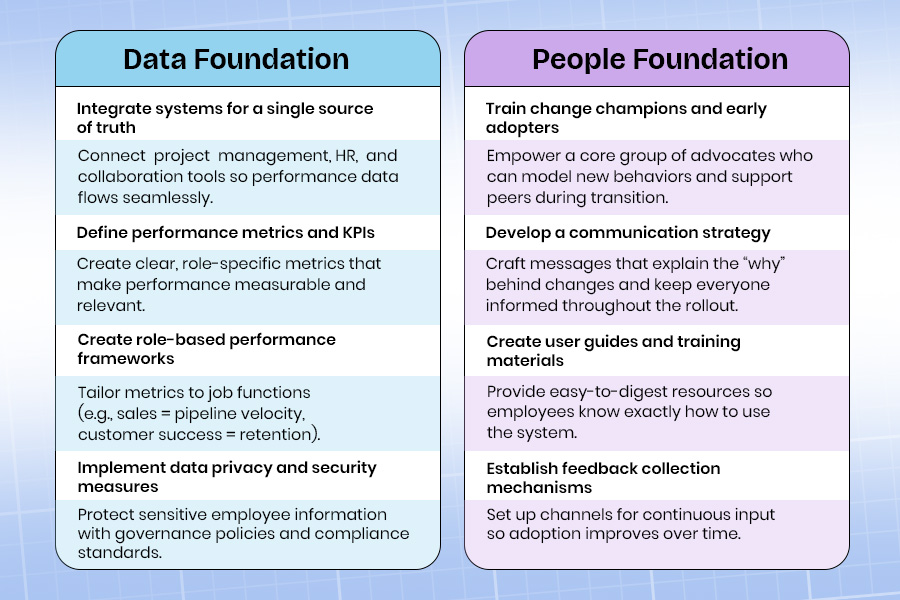
With the assessment and planning phase complete, the organization now knows where it stands and where it wants to go. The next step is turning that strategy into a solid foundation that can actually support Dynamic PM at scale. This means getting both the data layer and the people layer ready.| Data Foundation | People Foundation |
|---|---|
| Integrate systems for a single source of truth Connect project management, HR, and collaboration tools so performance data flows seamlessly. |
Train change champions and early adopters Empower a core group of advocates who can model new behaviors and support peers during transition. |
| Define performance metrics and KPIs Create clear, role-specific metrics that make performance measurable and relevant. |
Develop a communication strategy Craft messages that explain the “why” behind changes and keep everyone informed throughout the rollout. |
| Create role-based performance frameworks Tailor metrics to job functions (e.g., sales = pipeline velocity, customer success = retention). |
Create user guides and training materials Provide easy-to-digest resources so employees know exactly how to use the system. |
| Implement data privacy and security measures Protect sensitive employee information with governance policies and compliance standards. |
Establish feedback collection mechanisms Set up channels for continuous input so adoption improves over time. |
Phase 3: Pilot Implementation (Months 5–6)
With the foundation in place, it’s time to move from planning to practice. We start small. A pilot phase allows you to test, learn, and refine before scaling across the organization.Limited Rollout
The goal here is to introduce Dynamic Performance Management in a controlled, supportive environment:
- Select pilot groups (ideally 50–100 employees) who represent a mix of roles and teams.
- Implement core DPM functionality, not every feature at once, but enough to test how it works in the flow of daily work.
- Provide intensive training and support so pilot users feel confident, not overwhelmed.
- Collect detailed feedback and usage data to understand what’s working and where friction points appear.
Iteration and Improvement
Pilots are about learning fast and adjusting smart:
- Analyze pilot results and feedback to spot patterns and surface insights.
- Refine processes and configurations so the system feels natural and useful.
- Address technical issues and user concerns before they scale into bigger problems.
- Document lessons learned and best practices so future rollouts are smoother, faster, and more effective.
Phase 4: Full Deployment (Months 7–12)
After a successful pilot, it’s time to take Dynamic Performance Management enterprise-wide. This phase is about scaling the system across the organization, making sure adoption sticks, and fine-tuning for long-term impact.Phased Rollout
Rolling out to the entire organization doesn’t mean flipping a switch. Instead, expand carefully:
- Expand to additional departments or teams in waves, prioritizing groups most ready for change.
- Maintain intensive support during transition so new users feel confident, not left behind.
- Monitor adoption metrics and user satisfaction to ensure the rollout is landing as intended.
- Continue gathering feedback and making improvements so the system evolves with the people using it.
Optimization
Once the system is live across the board, shift focus to optimization. Dynamic PM matures from “working” to “working brilliantly.”
- Fine-tune performance algorithms and metrics to ensure they reflect real behaviors and outcomes.
- Enhance integrations and automation so the system fits seamlessly into daily workflows.
- Develop advanced reporting and analytics for deeper insights that guide leadership decisions.
- Plan for future technology additions to stay ahead as new tools and capabilities emerge.
Phase 5: Maturation and Evolution (Month 12+)
Phase 5 is where the system evolves, adapts, and grows with the business. The focus shifts from adoption to optimization, from proving value to expanding impact.Advanced Capabilities
Once the basics are humming, organizations can push into more sophisticated territory:
- Implement predictive analytics and AI features to spot performance trends and potential issues before they surface.
- Develop custom performance models tailored to unique business functions or industries.
- Integrate emerging technologies so DPM stays relevant in a rapidly changing tech landscape.
- Expand use cases and applications, for example, extending DPM beyond individual performance to cover team-level collaboration or enterprise-wide transformation initiatives.
Continuous Improvement
Dynamic Performance Management isn’t a “set it and forget it” system. It thrives on iteration and evolution:
- Regularly assess system effectiveness to ensure it’s delivering on strategic goals.
- Provide ongoing user training and development so employees keep growing alongside the platform.
- Keep up with technology updates and enhancements to leverage new features and avoid stagnation.
- Measure business impact and ROI to demonstrate clear value and guide future investments.
Want to see how Dynamic Performance Management could work in your organization?
What are the benefits and ROI of Dynamic Performance Management?
Organizations that adopt Dynamic Performance Management see measurable returns that touch productivity, engagement, and culture. The impact shows up in both hard numbers and human experiences.Quantifiable and Qualitative Benefits of Dynamic Performance Management
| Category | Quantifiable Benefits | Qualitative Benefits |
|---|---|---|
| Manager Time Savings | 40–60% reduction in admin tasks | Faster reviews, less documentation burden, more time for coaching |
| Performance Visibility | Real-time insights into teams & individuals | Earlier issue detection, better goal alignment |
| Decision-Making | Data-driven promotions & comparisons | Fair, transparent, and predictive workforce planning |
| Manager–Employee Relationships | More focused, bias-free conversations | Stronger trust, better engagement |
| Employee Experience | Continuous feedback & clear expectations | Higher morale, personalized growth |
| Organizational Agility | Rapid response to change, identify high performers | More resilient and adaptable organization |
What are the costs, benefits, and the expected ROI timeline for Dynamic Performance Management in an Organization?
Implementing Dynamic Performance Management is an investment. To help organizations understand the business case, here’s how to break down the costs, benefits, and the expected ROI timeline.Cost Factors
- Technology licensing and implementation → Software subscriptions, integration costs, and setup.
- Training and change management → Preparing managers and employees for adoption.
- Ongoing maintenance and support → System updates, technical support, and continuous improvements.
- Internal resource allocation → Time spent by internal teams on rollout and optimization.
Benefit Factors
- Manager time savings → Calculate hourly cost savings from reduced administrative work.
- Improved retention → Estimate cost savings from lower employee turnover and replacement costs.
- Performance improvements → Factor in productivity gains tied to better visibility and alignment.
- Reduced administrative overhead → Savings from less manual reporting and documentation.

Typical ROI Timeline
To make the impact more tangible, here’s how ROI typically unfolds over the first two years of a Dynamic Performance Management rollout.- Month 6: Break-even on implementation costs.
- Month 12: 150–200% ROI driven by efficiency gains.
- Month 24: 300–400% ROI including measurable performance improvements and retention gains.
So, what does this all mean in practice? Let’s look at how ROI builds month by month.
| X-Axis (Time in Months) | Y-Axis (ROI %) |
|---|---|
| 0 (Implementation Start) | 0% ROI |
| 6 (Month 6) | 0% ROI (Break-even) |
| 12 (Month 12) | 150–200% ROI |
| 24 (Month 24) | 300–400% ROI |
From early break-even to long-term performance gains, the ROI curve tells the story of why DPM is worth the investment.
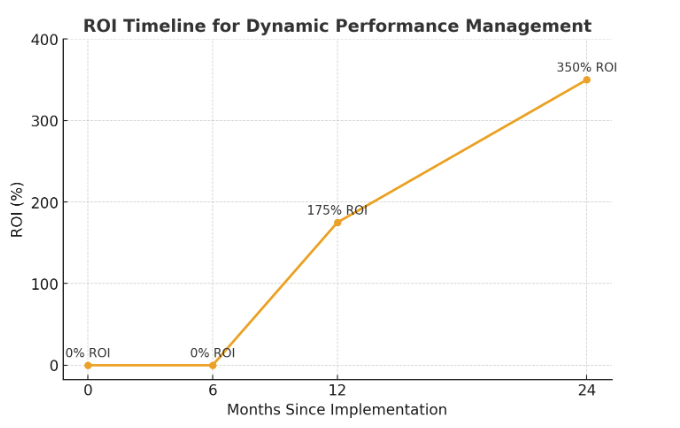
The above ROI curve illustrates a projected timeline based on aggregated benchmarks from DPM rollouts. It’s designed to show what organizations can typically expect when adoption is consistent.
What are your next steps in your Dynamic Performance Management Implementation journey?
If you’re ready to explore Dynamic Performance Management (DPM), the best way to begin is with small, structured steps. Instead of overwhelming yourself with a massive change effort, think of it as a journey broken into six clear milestones. Here’s how you can get started:Here are your six clear milestone roadmap
Immediate Actions (This Week)
Step 1: Assess Your Current State
Before you can move forward, you need to know exactly where you stand. Document your current performance management process, be honest about where it’s breaking down, and identify the biggest pain points. Is your system compliance-driven? Development-driven? Or just stuck in documentation overload? Pinpointing this now sets the stage for everything that follows.Step 2: Evaluate Your Readiness
A great strategy fails without readiness. Take a look at your current technology stack and ask: Can it support DPM? Gauge your organization’s appetite for change. Do leaders and employees have the bandwidth and mindset for it? Finally, identify your potential “change champions”, the people who will help drive adoption from the ground up.Step 3: Research Solutions
Once you know your gaps and readiness, explore what’s out there. Create a shortlist of potential DPM vendors. Review case studies from organizations similar to yours and don’t hesitate to join demos or test-drive free versions. This gives you a feel for what’s possible before you commit.Short-Term Planning (Next Month)
Step 4: Build Your Business Case
Now it’s time to turn insights into a business case. Start by calculating the current costs of your performance management system, the hours spent, the inefficiencies, and the missed opportunities. Then, estimate potential benefits and ROI with DPM. Define clear success metrics (e.g., manager time savings, employee engagement, turnover reduction) so leadership sees both the logic and the numbers.Step 5: Engage Stakeholders
Armed with data and examples, bring leadership and key stakeholders into the conversation. Share your findings, highlight the pain points, and show them the potential upside. Don’t forget to involve HR, IT, and business leaders early, their buy-in is essential for a smooth rollout.Step 6: Develop an Implementation Timeline
Finally, map the journey. Build a phased project plan with milestones, allocate budget and resources, and identify potential risks along with mitigation strategies. This turns the initiative from an idea into a tangible roadmap.Ready to take the first step?
What are the questions that guide your Dynamic Performance Management decisions?
Before jumping into implementation, it’s worth pausing to ask the right questions. Dynamic Performance Management is a shift in how your organization thinks about performance, accountability, and growth. These guiding questions can help you clarify whether your team is ready, what to prioritize, and how to measure success.Strategic Questions
These help you zoom out and see the big picture.- Does our organization have sufficient performance data to support DPM?
- Are we ready for the cultural change that DPM requires?
- How will DPM align with our broader digital transformation goals?
Practical Questions
These bring the strategy down to earth and into action.- What’s our budget and timeline for implementation?
- Which departments or roles would benefit most from DPM?
- How will we measure success and ROI?
Technology Questions
These ensure your foundation is solid before scaling.- Which existing systems need to integrate with our DPM solution?
- What level of customization and configuration will we need?
- How will we ensure data privacy and security?
Conclusion
Dynamic Performance Management represents the future of how organizations measure, manage, and improve employee performance. With Gartner predicting that 35% of organizations will adopt DPM by 2029, early movers have a significant opportunity to gain competitive advantage in talent management.The shift from traditional, subjective performance reviews to data-driven, real-time performance insights is about creating a more effective, fair, and engaging experience for both managers and employees.
As you consider implementing Dynamic Performance Management, remember that success depends not just on choosing the right technology, but on thoughtful change management, clear communication, and a commitment to continuous improvement.
The organizations that successfully implement DPM will be better positioned to attract top talent, develop their workforce more effectively, and achieve superior business results through optimized human performance.
Ready to explore Dynamic Performance Management for your organization?
Related Articles
-
Building a Dynamic Performance Rhythm That Actually Changes Behavior
TL;DR Dynamic Performance Management data only changes behavior when it's paired with a human cadence. Use daily micro-touchpoints to remove... Read more
-
How Performance Management Platforms Align Individual Goals with Company Strategy
TL;DR Performance management platforms help organizations align individual goals with company strategy by cascading objectives, tracking progress in real time,... Read more
-
Employee Recognition and Performance Management Software: The Missing Link Between Motivation and Results
TL;DR Employee recognition and performance management software bring motivation and accountability together on one platform. By connecting recognition, feedback, goals,... Read more
-
Goal & Performance Management Software
TL;DR Goal and performance management software helps organizations move from static annual reviews to continuous, outcome-driven performance. By aligning goals,... Read more