Performance management platforms align individual goals with company strategy by cascading objectives through OKR frameworks, breaking company-level targets into department goals and individual key results every contributor owns. Real-time tracking, automated check-ins, and cross-functional visibility close the gap between what leadership plans and what teams execute. Strategy flows down; goal data flows up, continuously, not once a year.
In this guide
- Why Do Most Organizations Struggle to Align Individual Goals With Company Strategy?
- How Do Performance Management Platforms Bridge the Gap Between Strategy and Execution?
- Why Does Real-Time Goal Tracking Outperform Annual Reviews?
- How Do You Make Company Strategy Tangible Through Individual Metrics?
- How Does Goal Transparency Drive Cross-Functional Collaboration?
- Why Do Continuous Feedback Loops Keep Teams More Aligned?
- What Data-Driven Insights Do Performance Platforms Surface?
- How Do You Make Goal Alignment Stick After Rollout?
- Why Is True Alignment a Measurable Competitive Advantage?
- Frequently asked questions
TL;DR
Performance management platforms help organizations align individual goals with company strategy by cascading objectives, tracking progress in real time, and enabling continuous feedback, turning strategy into execution.
In most organizations, there’s a gap between what leadership wants to achieve and what employees actually work on each day. Executives set ambitious targets. Teams stay busy. But somewhere in between, the connection gets lost.
The gap isn’t a communication failure. It’s an architecture failure. And every day it persists, teams execute against goals that stopped serving the strategy weeks ago.
When individual contributors can’t see how their daily work ladders up to company objectives, three things happen: priorities become unclear, motivation drops, and strategic initiatives stall. The result? Organizations that are incredibly busy but rarely aligned.
Modern performance management platforms solve this by creating a direct line of sight between what each person does and what the company needs to accomplish. Here’s how they’re changing the game.
Why Do Most Organizations Struggle to Align Individual Goals With Company Strategy?
Traditional performance management relied on annual reviews and static goal documents. But by the time the annual review happened, business priorities had often shifted twice over. Goals set in January were outdated by March. Employees worked hard on initiatives that no longer mattered.
Organizations where every employee can draw a direct line from their daily work to a company objective execute faster, course-correct sooner, and sustain momentum across quarters. Yet creating that clarity across 500 or 5,000 people, without it collapsing into noise, is where most companies fall short.
The challenge isn’t setting goals at the top. Leadership teams are often crystal clear on their strategic objectives. The challenge is translating those high-level ambitions into actionable work that makes sense at every level of the organization.
Consider a company with a goal to increase revenue by $50 million. What does that mean for a software engineer? For a customer success manager? For the finance team? Without a system to cascade and translate goals, each department ends up guessing.
Most companies believe alignment fails because employees don’t understand the strategy. That’s the wrong diagnosis. Employees usually understand the strategy fine. What they lack is a system that translates it into work they can act on today. Clarity without operationalization is just a slide deck.
How Do Performance Management Platforms Bridge the Gap Between Strategy and Execution?
Performance management platforms designed for strategic alignment work differently than traditional HR software. They create a cascading framework where goals flow from the top down, and progress flows from the bottom up.
Here’s what that looks like in practice:
Goal cascading links company-level objectives to department goals and individual key results, creating a traceable line between every contributor’s daily work and the organization’s strategic priorities.
Company-Level Strategy
Leadership defines the organization’s strategic objectives for the quarter or year. These might include targets around revenue growth, market expansion, product innovation, or operational efficiency.
Department Translation
Each department then creates objectives that directly support these company goals. Marketing doesn’t just “increase brand awareness” in a vacuum. They set specific targets that tie to revenue or market expansion goals.
Individual Contribution
Every team member sets goals that contribute to their department’s objectives. A content writer isn’t just producing blog posts; they’re creating assets that drive qualified leads, which support the marketing team’s pipeline goals, which feed into company revenue targets.
The Connected Execution Model
OKR cascading: from company objectives to individual key results in one visible hierarchy
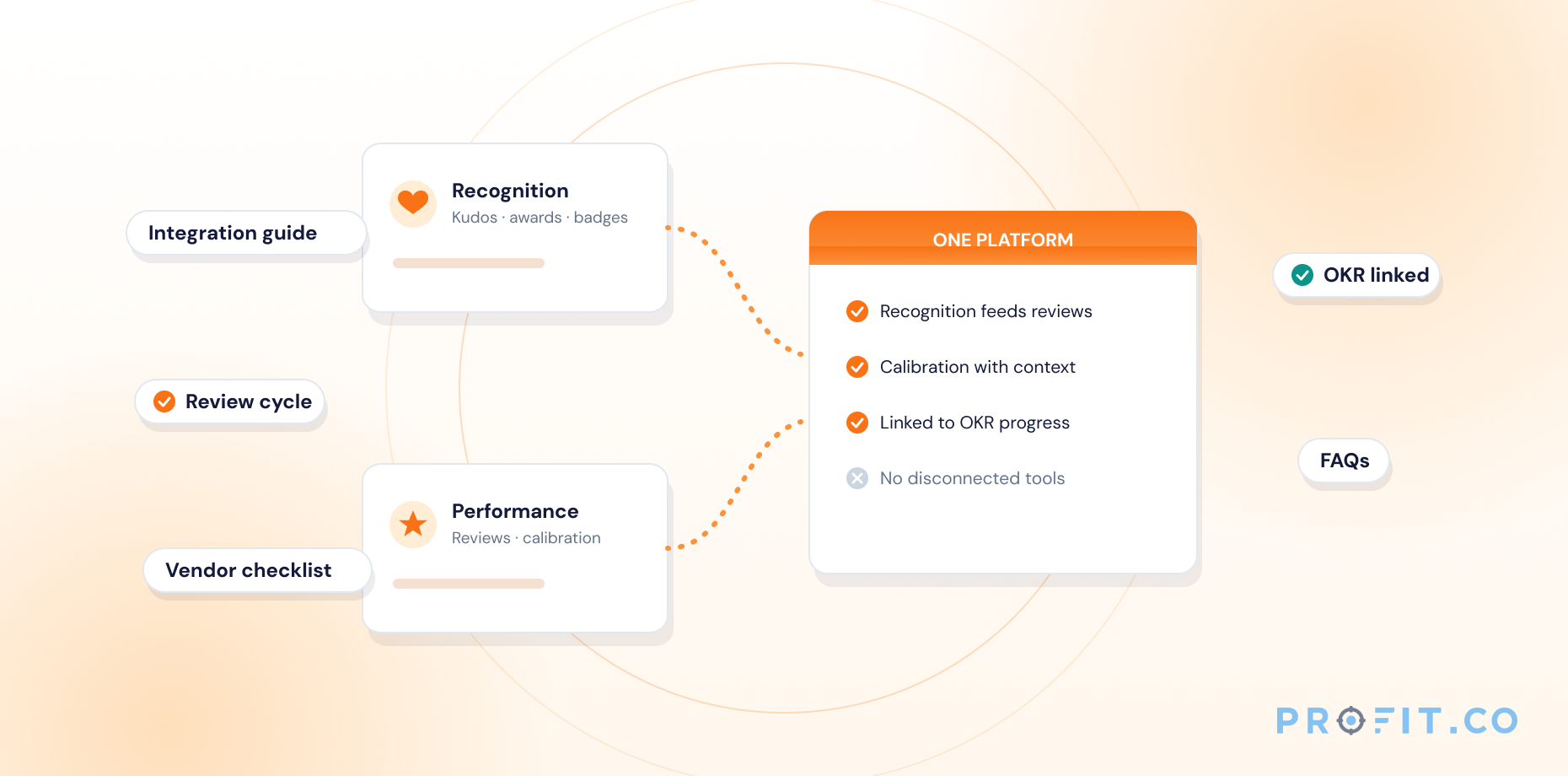
A connected performance management platform structures this cascading alignment through its OKR framework, connecting company objectives to department goals to individual key results in a single visible hierarchy. AI-assisted progress workflows automate the cadence of progress updates so alignment doesn’t depend on manual tracking discipline.
The platform makes these connections visible. When someone opens their dashboard, they don’t just see their own metrics. They can trace how their work contributes to team objectives and how those team objectives support the company’s strategic priorities. This visibility changes everything.
Connect Every Goal to Company Strategy in One Platform
Why Does Real-Time Goal Tracking Outperform Annual Reviews?
Static goal-setting documents collect dust. Performance management platforms that enable strategic alignment operate in real time.
Progress updates happen continuously, not once a year. If a key result is trending off track, stakeholders see it immediately, not three months later during a quarterly review. This creates opportunities for course correction before small issues become major setbacks.
The best platforms incorporate regular check-ins that keep goals front and center. Instead of an annual “set it and forget it” approach, teams develop a rhythm of weekly or bi-weekly updates. This consistency creates accountability without adding bureaucracy.
When goals are tracked in real time, something interesting happens: teams start to think differently about their work. Instead of completing tasks on a to-do list, they start asking whether those tasks are actually moving the needle on what matters. The platform becomes a strategic filter, not just a tracking tool.
The practical difference compounds quickly. Organizations running real-time goal check-ins at a weekly cadence surface misalignment in days, not at the end of a quarter, when course correction requires rescheduling roadmaps and resetting team priorities that have already been in motion for weeks.
How Do You Make Company Strategy Tangible Through Individual Metrics?
Vague goals kill execution. “Improve customer satisfaction” sounds nice, but it doesn’t guide daily decisions. Performance management platforms force specificity through measurable key results.
Instead of “improve customer satisfaction,” teams set targets like “increase Net Promoter Score from 45 to 60” or “reduce average response time from 4 hours to 90 minutes.” These concrete metrics make progress visible and success unambiguous.
The magic happens when these metrics cascade properly. If the company’s goal is to increase customer retention, that gets translated into specific metrics across teams:
- Product teams might track feature adoption rates that correlate with retention
- Customer success measures quarterly business reviews completed with at-risk accounts
- Support monitors resolution times for critical issues
- Engineering tracks bug fix velocity for high-priority customer-facing issues
Each metric is specific to the team’s work. But all of them ladder up to the same strategic objective. That’s alignment in action.
How Does Goal Transparency Drive Cross-Functional Collaboration?
When goals are isolated in spreadsheets or manager notebooks, silos deepen. Nobody knows what other teams are working toward. Duplicate efforts happen. Opportunities for collaboration get missed.
Performance management platforms create organizational transparency by making goals visible across departments. A sales leader can see what product is building. An engineering team can understand marketing’s pipeline targets. This visibility unlocks collaboration that would never happen otherwise.
Imagine a scenario where the product team sets a goal to launch a new enterprise feature by Q2. Marketing sees this in the platform and proactively aligns their content calendar to support the launch. Sales adjusts their pipeline targets, knowing a major competitive differentiator is coming. Customer success prepares training materials in advance.
None of this requires extra meetings. It happens because the platform creates a shared source of truth where everyone can see the broader strategy and adjust accordingly.
Why Do Continuous Feedback Loops Keep Teams More Aligned Than Quarterly Reviews?
The biggest lie in performance management is that agility means moving faster. It doesn’t. Agility means catching misalignment sooner, before a team has spent a full quarter executing against an objective that stopped mattering. Speed is a byproduct. Detection is the actual advantage.
Modern performance management platforms support agile goal management. When business priorities change, goals can be updated across the organization in real time. Teams aren’t locked into outdated targets for an entire year.
This agility extends to feedback as well. Instead of waiting for an annual review to discuss performance, managers and employees have ongoing conversations tied to real progress. The platform surfaces what’s working, what’s blocked, and where support is needed.
These continuous feedback loops create a culture of learning rather than judgment. When issues surface early, they can be addressed through coaching and resource allocation rather than being documented as failures months later.
What Data-Driven Insights Do Performance Platforms Surface for Smarter Decisions?
Performance management platforms don’t just track goals. They generate insights. Over time, organizations can see patterns in what types of goals get achieved, where teams consistently struggle, and which strategies drive the best results.
This data becomes invaluable for strategic planning. Instead of setting next quarter’s objectives based on intuition, leadership can analyze what worked, what didn’t, and why. They can identify which teams need more support, which initiatives deliver the highest ROI, and where misalignment is creating friction.
For individuals, these insights inform career development. Employees can see their track record of goal achievement, identify areas for growth, and build cases for advancement based on concrete contributions to strategic objectives.
The system transforms from a compliance tool into a strategic asset that makes the entire organization smarter over time.
The teams that use historical goal data to inform the next quarter’s OKRs set fewer objectives that get abandoned mid-cycle, because they’re building from actual completion patterns rather than aspiration. Intuition-based goal-setting is how organizations repeat the same misalignments every quarter without noticing the pattern.
How Do You Make Goal Alignment Stick After Rollout?
The most sophisticated platform in the world won’t create alignment if people don’t use it. Successful implementation requires more than just rolling out software.
Start by ensuring leadership fully buys in. When executives actively use the platform to set and track their own goals, it signals that this isn’t just an HR initiative. It’s how the business operates.
Make goal-setting collaborative, not top-down. The best results happen when individual contributors help define how they’ll contribute to team objectives. This ownership increases commitment and surfaces insights that leadership might miss.
Keep it simple at first. Organizations that try to implement complex goal frameworks on day one often overwhelm their teams. Begin with clear company objectives, department goals, and individual key results. Build sophistication over time as the practice becomes second nature.
Celebrate wins publicly. When someone achieves a goal that contributed to a major company objective, make that connection visible. Recognition that ties individual achievement to strategic success reinforces why this alignment matters.
The most predictable rollout failures: teams that skip cascading and let individuals set goals in isolation from department objectives, and organizations that configure the platform but never build the check-in habit. The technology doesn’t create alignment. The cadence does.
Why Is True Alignment a Measurable Competitive Advantage?
Companies where every person understands how their work connects to broader strategy don’t just perform better. They attract and retain better talent. People want to know their work matters. They want to see the impact of their contributions. Performance management platforms that create this visibility tap into what motivates high performers.
The organizations winning in their markets aren’t necessarily those with the best strategy on paper. They’re the ones where strategy translates into aligned execution across every team and individual. Where goals cascade clearly from boardroom to frontline. Where progress is visible, feedback is continuous, and everyone understands the part they play.
The companies winning in execution aren’t the ones with the best strategy on paper. They’re the ones where a frontline employee on a Tuesday afternoon knows exactly why their work matters, and what to do differently when it doesn’t.
Connect Individual Goals to Company Results
Frequently Asked Questions
A performance management platform is software that helps organizations set, track, and align individual, team, and company goals while supporting continuous feedback and performance reviews.
They use goal cascading and alignment features that link employee objectives to team and organizational goals, ensuring every effort supports strategic priorities.
Goal alignment improves focus, accountability, and engagement by helping employees understand how their work contributes to business outcomes.
Most platforms support OKRs (Objectives and Key Results), KPIs, and hybrid goal-setting frameworks, allowing organizations to adapt to their preferred performance management style.
These platforms are ideal for HR leaders, executives, people managers, and growing organizations looking to improve execution, transparency, and employee engagement.
Unlike annual reviews, modern platforms emphasize continuous check-ins, real-time progress tracking, and ongoing feedback aligned with strategy.