The future of employee performance management is shifting from annual ratings toward continuous development, real-time coaching, and strategy alignment, replacing once-a-year evaluations with systems that surface insights when they can still change outcomes. The gap between organizations that lead on talent and those that lag is not effort or intention. It’s the architecture of how performance is measured.
In this guide
- Why Is Poor Performance Management a System Problem, Not a People Problem?
- What Are the 5 Key Features to Look for in Modern Performance Management Software?
- What Trends Are Shaping Performance Management in 2026?
- How Is the Future of Work Redefining What Performance Management Must Accomplish?
- What Should HR Leaders Do Right Now to Modernize Performance Management?
- Frequently asked questions
TL;DR
- Annual performance reviews fail because the system is structurally disconnected from how work happens.
- High-performing organizations are moving to quarterly development conversations, not eliminating reviews.
- AI’s role is insight generation, not data entry. The distinction matters for how you evaluate tools.
- Connecting performance data to OKR progress is the highest-leverage architectural change available.
- Performance management that stands alone from strategy is not performance management. It’s documentation.
The problem with most performance management transformations is they address the symptoms, manager training, new forms, stricter review deadlines, without touching the architecture that produces those symptoms. This article examines what that architecture actually needs to include, and why the organizations getting it right aren’t running better reviews. They’re running a different system.
Why Is Poor Performance Management a System Problem, Not a People Problem?
The diagnosis most HR leaders reach when performance management fails is the wrong one. They identify manager capability, employee disengagement, or technology adoption as the root cause. These are symptoms, not the source.
Performance management fails because the system is structurally misaligned with how high-performing organizations now operate. Annual review cycles compress a year of behavioral data into a single conversation. Ratings are assigned without connection to goal outcomes. Feedback travels in one direction, once, and then disappears into a file no one reads.
A system that asks managers to evaluate a full year in 45 minutes isn’t measuring performance. It’s measuring recall.
The structural problem has three layers. First, review cycles are retrospective. They describe what happened, not what should happen next. Second, performance data is disconnected from goal data, so managers assess effort without context for outcomes. Third, the development conversation that performance management is supposed to drive is treated as an event, not a practice.
Organizations that change this architecture see measurably different results. Not because their managers became better overnight, but because the system started giving managers the information and context they needed to have better conversations. For a deeper look at how continuous feedback changes outcomes, explore the performance management resources hub.
What Are the 5 Key Features to Look for in Modern Performance Management Software?
Not all performance management software addresses the architectural problems outlined above. The five features below separate systems that change behavior from systems that document it.
1. Continuous Feedback Infrastructure
Not just a review form, but a structured channel for feedback to flow between peers, managers, and reports throughout the year. Feedback that arrives in real time can still change behavior. Feedback that arrives in December cannot.
2. Goal Integration
Performance data connected to OKR progress in real time. A manager reviewing an employee’s performance should be able to see what they accomplished against what they committed to. When data exists in two systems, decisions get made with half the picture.
3. AI-Assisted Assessments
Tools that help managers and employees write structured, evidence-based reviews without starting from a blank page. The blank page isn’t just a time problem. It’s a consistency problem. AI removes both.
4. Calibration Workflows
The ability for HR to normalize ratings across teams before finalization. Without calibration, ratings reflect manager variance as much as they reflect employee performance. Calibration removes the structural noise.
5. Pulse Survey Integration
Continuous sentiment data linked to performance cycles. HR can detect engagement risk before it surfaces as attrition, not after. The gap between knowing something is wrong and acting on it is measured in weeks, not quarters.
Connect Performance Reviews, OKRs, and AI Coaching in One Platform
What Trends Are Shaping Performance Management in 2026?
Five trends are reshaping what organizations expect from their performance management systems, and each one carries an implementation risk that leaders need to anticipate.
Trend 01
Annual Reviews Are Losing Ground to Quarterly Development Conversations
The shift isn’t from reviews to no reviews. It’s from evaluation-focused conversations to development-focused ones. Organizations replacing annual ratings with quarterly 1:1 structures don’t eliminate structure. They increase its frequency and shift its purpose.
Implementation risk: Many teams adopt the cadence without changing the conversation structure. A quarterly meeting that asks the same question as an annual review produces a status update, not a development plan.
Trend 02
AI Is Shifting from Data Entry to Insight Generation
Most organizations install performance management software. Fewer change the management behavior that software is supposed to enable. The new generation of AI tools doesn’t store feedback. It synthesizes it. An AI system that surfaces three development themes from 12 months of check-in notes is structurally different from a system that reminds managers to complete rating forms.
Implementation risk: Organizations adopt AI-assisted reviews but train managers to edit outputs rather than use them as evidence prompts. The tool changes; the conversation doesn’t.
Trend 03
Performance Data Is Connecting to Strategic Goals
The most significant architectural shift in performance management is the connection between individual performance data and organizational goal progress. When a manager sees an employee’s OKR completion rate alongside their feedback history, development gaps become visible in context, not in isolation.
Implementation risk: Goal integration requires both systems to be actively used. When OKR adoption is inconsistent, performance data still arrives without context.
Trend 04
Recognition Is Becoming a Performance Signal, Not Just a Morale Feature
Organizations tracking recognition patterns alongside performance data find that peer recognition frequency is a leading indicator of engagement and retention risk. High-performing employees who go unrecognized for extended periods show similar early attrition signals to disengaged employees. Catching this requires both datasets in the same view.
Implementation risk: Recognition programs that exist separately from performance systems produce morale data, not talent intelligence.
Trend 05
The Performance Conversation Is Replacing the Performance Review
The review as a document is giving way to the conversation as a practice. Organizations moving to this model are measuring conversation quality, not form completion, as the primary indicator of whether their performance management system is working.
Implementation risk: Conversation quality is harder to measure than form completion rates. Organizations need a structured definition of what a good manager conversation produces before they can track whether it’s happening.
How Is the Future of Work Redefining What Performance Management Must Accomplish?
Five workforce shifts are redefining what effective performance management must deliver, each one expanding what the system needs to handle beyond ratings and review cycles.
AI adoption at work
Employees are using AI tools daily, changing how their work is measured and what high performance looks like in AI-augmented roles. Performance systems built for pre-AI work patterns are already measuring the wrong things.
Hybrid and distributed teams
Proximity no longer correlates with visibility. Performance systems must work across geographies without favoring in-office staff, a structural requirement, not a policy preference.
Skills-based talent strategies
Organizations are moving from role-based to skills-based models, requiring performance systems to track capability growth, not just goal completion rate.
Generational workforce shifts
Younger employees expect continuous feedback and development visibility. Annual reviews are not a credible signal to this cohort that the organization is invested in their growth.
Manager bandwidth constraints
Managers are being asked to do more with less. Performance systems that add administrative load without adding insight are being quietly abandoned, not because managers are resistant, but because the system isn’t worth the time it costs.
The organizations that will navigate this most successfully are the ones treating performance management as the connective tissue between all five challenges, not a separate HR process running alongside them. When a manager’s coaching tool and their goal-tracking tool and their skills data are disconnected, they make decisions in isolation.
Performance Management Cannot Stand Alone
Connect performance reviews, OKRs, project delivery, and recognition in one system
The structural failures described above, disconnected data, retrospective reviews, no link to strategic goals, persist when performance is treated as an HR process separate from strategy execution.
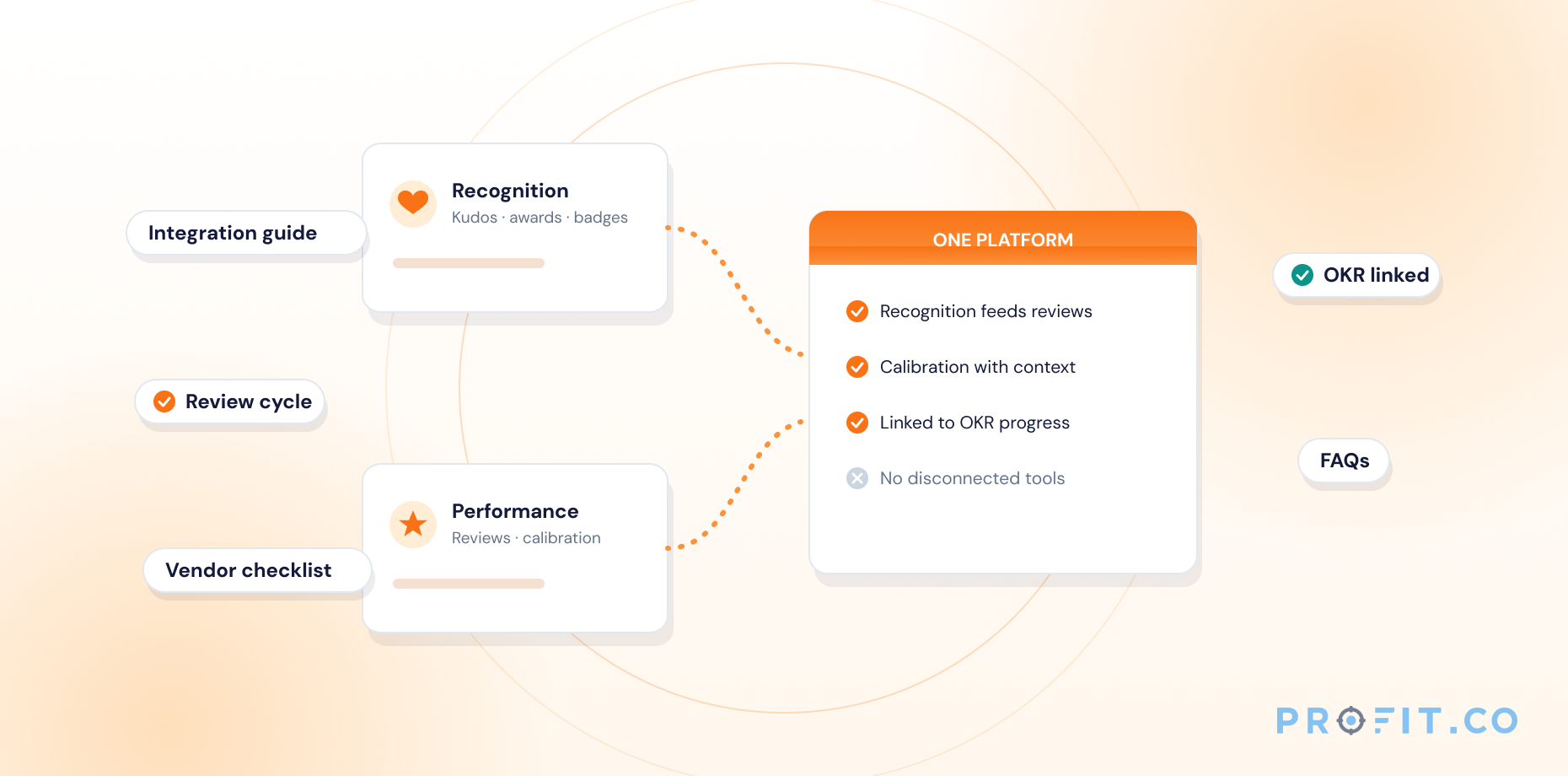
A connected performance management platform links performance reviews to OKR progress, project delivery, and peer recognition in a single system. AI-assisted review workflows reduce review preparation time by structuring evidence-based assessments from 12 months of check-in and goal data, not a blank form.
When every manager enters a review conversation already holding context, OKR completion rates, recognition history, peer feedback patterns, and development trends, the conversation changes because the information changes. Explore AI-powered performance workflows that make this architecture practical from day one.
What Should HR Leaders Do Right Now to Modernize Performance Management?
Five actions, ordered by implementation leverage. Start with the highest and work down.
Audit the connection between performance data and goal data
If your performance system and your OKR system are separate, managers are making assessment decisions without the most relevant evidence. This is the single highest-leverage structural change available. Use the OKR ROI calculator to quantify what disconnected systems cost you.
Shift your review cadence before you change your review tool
Quarterly development conversations deliver more value than annual rating cycles regardless of platform. The cadence change costs nothing and produces immediate behavioral change in managers. Start there, before any technology decision.
Define what a good manager conversation looks like
Specify what information the manager brings, what questions they ask, and what the conversation must produce. A standardized conversation structure delivers more consistent development outcomes than a standardized form.
Use AI to reduce prep time, not replace judgment
AI-assisted review drafts remove the blank-page problem. They don’t replace the manager’s judgment about what those drafts mean for the employee’s development. Train managers to use AI outputs as evidence prompts, not final assessments.
Connect recognition to performance patterns, not just milestones
Recognition that tracks against performance data, not just anniversaries and promotions, gives HR leaders a leading indicator of engagement risk before it becomes attrition. This requires the same platform to handle both.
Closing Thoughts
Performance management is not a process you run once a year. It is the operating system of your talent strategy. The organizations getting this right in 2026 are not running better performance reviews. They are building better information architecture.
When goal data, performance data, feedback data, and recognition data connect in a single system, every manager conversation becomes more grounded and every talent decision becomes more informed. That architecture is available today. The question is not whether to modernize. The question is how fast you can get the architecture right.
For the foundational principles behind building a high-performance OKR culture, the OKR University is the most comprehensive resource available.
Build performance systems that drive strategy
Frequently Asked Questions
Continuous performance management replaces annual reviews with ongoing feedback cycles, regular check-ins, and real-time goal tracking. It connects development conversations to strategic outcomes throughout the year rather than compressing assessment into a single annual event.
Performance management in 2026 is shifting toward AI-assisted assessments, goal integration, and quarterly development conversations. Organizations are connecting individual performance data to OKR progress to give managers contextual evidence before every review conversation.
Annual reviews fail because they compress a full year of behavioral data into a single retrospective conversation. Managers assess from memory rather than evidence, performance data sits disconnected from goal data, and the conversation happens too late to change outcomes.
AI in performance management synthesizes check-in notes, feedback history, and goal completion data into structured assessment drafts. It reduces manager preparation time and removes the blank-page problem without replacing the manager’s judgment about development priorities.
OKRs provide the goal context that makes performance assessments meaningful. A manager reviewing an employee’s performance alongside their OKR completion data assesses outcomes and effort together, not effort alone. This is the structural gap in most performance systems.
Modern performance management software should include continuous feedback channels, OKR integration, AI-assisted review drafting, calibration workflows, and pulse survey connectivity. These five capabilities replace the rating form with a living development system.
High-performing organizations are moving to quarterly development conversations supported by monthly or weekly check-ins. The annual review remains useful as a calibration moment but should not be the primary performance management touchpoint.
Calibration is the process of normalizing performance ratings across managers before they are finalized. It removes individual manager variance and reduces bias by giving HR leaders a structured view of how ratings distribute across teams.
Recognition frequency is a leading indicator of engagement and retention. Organizations tracking recognition patterns alongside performance data can identify disengagement risk before it surfaces as attrition, giving HR leaders time to intervene proactively.
Performance management becomes strategic when it connects individual contribution data to organizational goal progress. When performance data, OKR completion, and recognition patterns feed the same system, talent decisions are made with strategic evidence, not administrative records.