Project prioritisation is the structured process of ranking projects by strategic value, resource demand, and business impact, determining which initiatives receive funding, staffing, and scheduling priority. It converts a cluttered backlog into a deliberate sequence. Without it, teams execute more projects than capacity allows and deliver fewer results than leadership expects.
In this guide
- Why Does Project Prioritisation Break Down in Most Organisations?
- What Is a Project Prioritisation Matrix and When Should You Use One?
- Stage-Gate vs Agile: Which Prioritisation Model Is Right for Your Portfolio?
- How Do OKRs Transform Project Prioritisation from a Decision into a System?
- What Makes a Hybrid Prioritisation Model Work at Scale?
- How Do You Build a Project Prioritisation System That Does Not Expire?
- Frequently asked questions
Why Does Project Prioritisation Break Down in Most Organisations?
The conventional diagnosis is that teams prioritise the wrong projects. The actual problem is that they never stop the right ones.
Most organisations do not have a prioritisation problem. They have a re-prioritisation problem. The initial ranking made sense when it was built. The failure is that it was never updated. Strategy shifted. A market signal changed the urgency of two initiatives. A leadership decision in Q2 rendered a major project directionally irrelevant. But the project stayed in the queue, staffed, scheduled, and consuming capacity, because there was no mechanism to surface the misalignment.
This is the structural gap most prioritisation frameworks are silent about. They treat prioritisation as an intake event: score the project at the start of the year, assign it a rank, move on. What they do not provide is a way for that rank to change when the strategy that generated it changes. The framework becomes a document. The document stops getting opened. The portfolio drifts.
There is a second failure pattern that is equally common and less discussed. Organisations run too many projects simultaneously. Not because they lack the discipline to choose, but because every project has a sponsor and every sponsor can point to a legitimate business case. The result is a portfolio where everything is technically in-flight and nothing is fully resourced. Teams split attention across four initiatives and deliver none of them at the quality or speed the business needs.
Both failure modes, the stale ranking and the overcrowded portfolio, trace back to the same root cause. The prioritisation system is disconnected from the strategic layer that should be driving it. Fixing the scoring model does not solve this. Connecting prioritisation to a live strategic signal does.
What Is a Project Prioritisation Matrix and When Should You Use One?
A project prioritisation matrix is a scoring tool that evaluates proposed projects across a set of weighted criteria. The most common criteria are strategic alignment, expected ROI, implementation effort, and risk level. The output is a ranked list that replaces informal influence with a structured, repeatable decision process.
The mechanism is straightforward. Each project receives a numeric score per criterion, multiplied by a weight that reflects organisational priority, and summed to a total. Projects ranked by total score tell you which initiatives to start, which to defer, and which to kill, without those decisions being driven by whoever presents last in the planning meeting.
| Criterion | Weight | Score (1-5) | Weighted Score |
|---|---|---|---|
| Strategic alignment | 35% | 4 | 1.40 |
| Expected ROI | 30% | 3 | 0.90 |
| Implementation effort | 20% | 2 | 0.40 |
| Risk level | 15% | 3 | 0.45 |
| Total Score | 100% | – | 3.15 / 5.00 |
Sample project prioritisation matrix. Weights should reflect your organisation’s current quarterly OKRs, not fixed annual values.
The matrix is a reliable intake tool. Its hard limitation is that the strategic alignment criterion becomes stale the moment the strategy shifts. A project scoring 4 on strategic alignment in Q1 may deserve a 1 in Q3 after a pivot, but the matrix does not reflect that unless someone manually recalibrates every score across every project.
That is the critical design flaw in most matrix-based approaches. They produce a great intake ranking and a poor ongoing signal. Solving it requires anchoring strategic alignment not to a theme, but to a live key result that carries a current score and an end-of-quarter deadline.
Stage-Gate vs Agile: Which Prioritisation Model Is Right for Your Portfolio?
The instinct is to pick one. The strategic reality is that most organisations need both, and the place where they collide is where most project prioritisation frameworks quietly fail.
| Dimension | Stage-Gate | Agile |
|---|---|---|
| Prioritisation cadence | Fixed review gates (monthly or quarterly) | Continuous backlog reordering (sprint by sprint) |
| Decision authority | Portfolio steering committee | Product owner and delivery team |
| Governance strength | High: structured risk and investment control | Low: governance is implicit in sprint outcomes |
| Responsiveness to change | Low: changes wait for the next scheduled gate | High: backlog can be reordered every sprint |
| Strategic visibility | High at gates, low between gates | Low at portfolio level, story-detail not strategy |
| Best suited for | Capital-intensive, compliance-heavy, low-change projects | Software, product, and fast-moving digital initiatives |
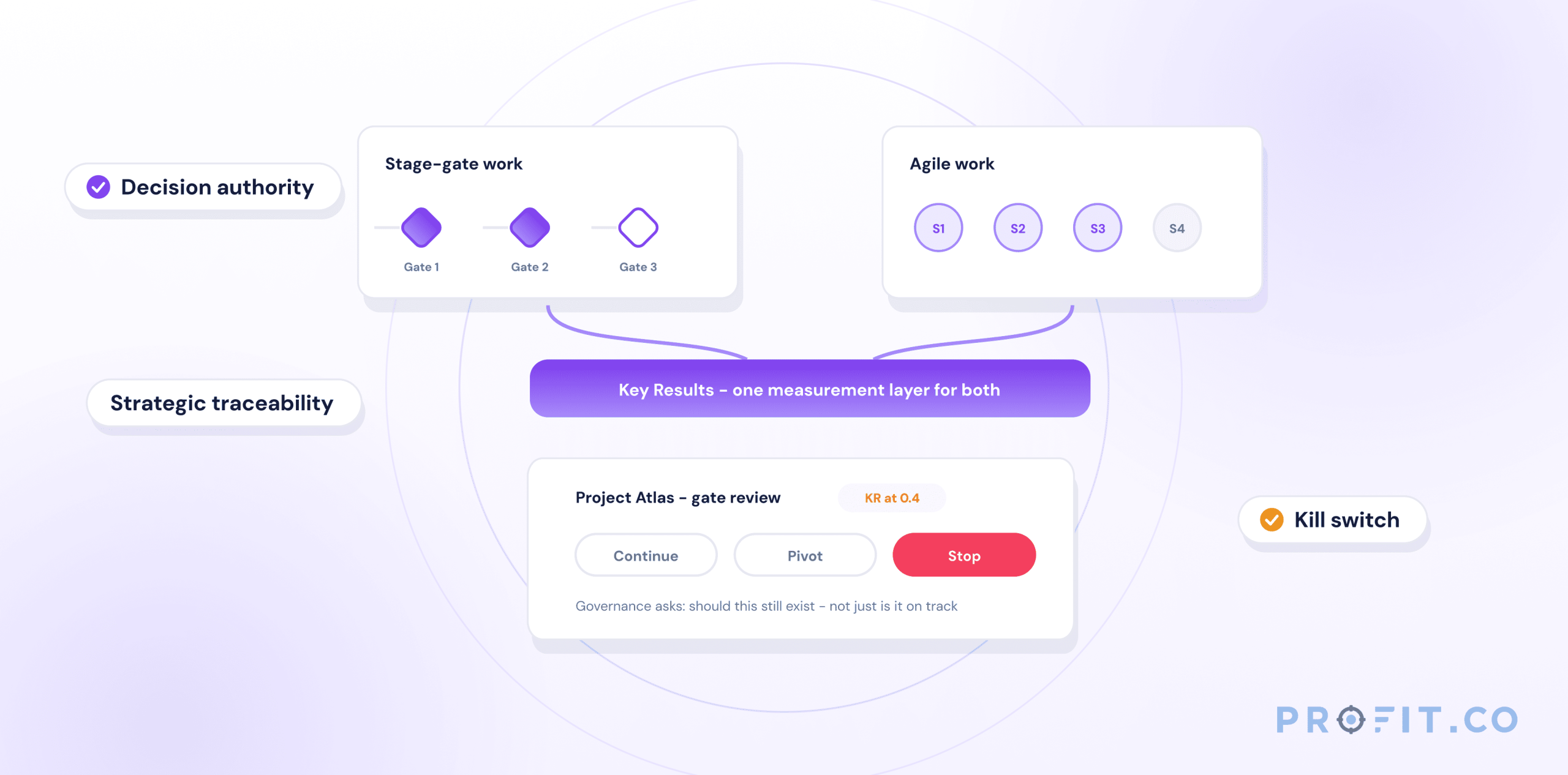
Stage-gate and agile do not actually conflict at the work level. They conflict at the authority level. Stage-gate puts portfolio decisions at the governance layer, where the steering committee decides what passes each gate. Agile pushes decisions to the team, where the product owner orders the backlog based on feedback and sprint velocity. Neither model tells the other what to optimise for. The gap between governance authority and delivery autonomy is where projects lose their strategic connection.
That gap is exactly where OKRs operate. Quarterly key results give delivery teams the strategic objective without mandating the delivery method. The sprint goal becomes the execution unit. The key result becomes the gate criterion. Both models work within one shared framework, which is why the hybrid model is the only one that does not require teams to choose between governance and speed. Understanding how the stage-gate process connects to strategic outcomes makes the hybrid model easier to implement without sacrificing compliance rigour.
How Do OKRs Transform Project Prioritisation from a Decision into a System?
Most prioritisation frameworks treat strategy as a static input, fed in once at the start of a planning cycle and left unchanged. OKRs treat strategy as a live signal that scores progress continuously, updates quarterly, and makes every project’s relevance visible in real time.
When every project in a portfolio is linked to a specific key result, not a vague strategic theme but a numbered and time-bound target, prioritisation becomes self-correcting. If a key result is deprioritised in a quarterly review, every project contributing to it surfaces for re-evaluation automatically. The portfolio stops drifting silently while strategy moves above it. For a detailed walkthrough of how this connection works in practice, the OKR management platform shows the live OKR-to-project linkage model end to end.
The four-step architecture works like this:
01: Quarterly key results become the gate criteria
Each key result represents a measurable strategic outcome the organisation needs by end of quarter. Projects must be able to name the key result they contribute to and quantify that contribution in order to enter the active portfolio. Projects that cannot are deferred or killed at intake, not after six months of execution.
02: Sprint goals become the execution unit
Agile teams translate key result targets into sprint-level objectives. The sprint backlog stays focused on what advances the key result, not just what is technically next in the feature queue. This is how agile delivery teams stay connected to portfolio-level strategy without slowing down their cadence.
03: Stage-gate reviews validate OKR progress scores
Gate criteria become OKR scores. A project advances through a gate when its contributing key result is on track, not only when it meets a milestone checklist. This converts gate reviews from schedule audits into strategic health checks.
04: Unlinked projects surface for review automatically
Any project that cannot be mapped to a live, active key result is flagged for re-evaluation. This is how zombie projects are eliminated, not through governance debates driven by politics, but through a structural rule applied consistently across every project in the portfolio.
Speed without direction is faster failure. The OKR layer provides the direction, so speed stops being a portfolio risk and becomes a competitive advantage. The guide to agile goal management covers how delivery teams translate OKR targets into sprint-level execution without losing the governance thread.
Connect Portfolio Decisions to Live OKRs
What Makes a Hybrid Prioritisation Model Work at Scale?
The Architecture Advantage
OKR Management, PPM, and Task Execution in One Platform
Profit.co connects project portfolio management and task execution to the OKR layer in a single platform, eliminating the gap where most hybrid models break down. Every project can be linked directly to a quarterly key result, not a strategic theme but a specific measurable target with a live progress score. Stage-gate review criteria are powered by live OKR scores, turning gates into strategic health checks rather than schedule compliance reviews.
AI-powered agents automate progress collection, status reporting, and check-in nudges so portfolio prioritisation stays current without weekly manual reviews. 100+ integrations pull live progress from Jira, Salesforce, HubSpot, and Azure DevOps so prioritisation signals reflect actual execution, not last week’s status report.
Use the SPM ROI Calculator to quantify how much capacity your current portfolio is consuming on projects that cannot be connected to a live strategic outcome.
How Do You Build a Project Prioritisation System That Does Not Expire?
Most prioritisation frameworks expire because they were designed as documents rather than systems. A document captures a decision at a point in time. A system updates when the inputs change. Here is the five-element architecture that treats prioritisation as the latter.
1. Confirm the strategic layer before scoring a single project
Prioritisation without a clear strategy is preference in disguise. Before any project intake meeting, confirm the current-quarter OKRs at company and function level. These become the evaluation criteria, not abstract values like customer focus, but specific, scored, time-bound targets. Any project that cannot name its contributing key result does not belong in the active portfolio.
2. Replace strategic alignment with a direct OKR linkage field
In your prioritisation matrix, remove the vague strategic alignment criterion and replace it with a direct question: which key result does this project advance, and by how much? Projects that answer this concretely score high. Projects that answer it vaguely score low. Projects that cannot answer it surface for a direct conversation about whether they belong in the portfolio at all.
3. Set an explicit work-in-progress limit
Most portfolios fail not because they picked the wrong projects but because they ran too many simultaneously. A WIP limit forces a real trade-off: if project C enters, project A must be paused or killed. That is the discipline most steering committees avoid, but every effective portfolio requires it. The limit should be set based on team capacity, not optimism about how efficiently people context-switch.
4. Tie portfolio reviews to your OKR check-in cadence
Portfolio prioritisation should be reviewed at every OKR check-in, not on a separate quarterly cycle that inevitably runs six weeks behind strategy. When a key result is reviewed and marked at-risk, every project linked to it should surface immediately. When a key result is on track, the projects contributing to it get protected. The portfolio ranking becomes a live output of strategy health, not a separate exercise.
5. Define an exit criterion for every project at intake
Zombie projects survive because no one defined what would cause them to stop. An exit criterion is not a project failure. It is a professional acknowledgement that circumstances change. If this project’s contributing key result is deprioritised, or scores below 0.3 at mid-quarter review, the project enters a two-week evaluation hold. That is a governance decision made in advance, not a political negotiation made under pressure when team morale is already low.
Most dashboards fail structurally, not visually. The portfolio view looks clean until you realise none of the projects shown connect to the strategy that changed two months ago. A prioritisation framework that expires is just a list. A system connected to live OKRs is a decision engine.
Connect Your Portfolio to the Strategy it should be Executing/h2>
Frequently Asked Questions
Project prioritisation is the structured process of ranking projects by strategic value, resource demand, and business impact to determine which initiatives receive funding, staffing, and scheduling priority in a given period.
A project prioritisation matrix scores proposed projects across weighted criteria, covering strategic alignment, expected ROI, implementation effort, and risk, to produce a ranked list that guides portfolio decisions without relying on politics or seniority.
OKRs improve project prioritisation by linking every project to a specific quarterly key result. Projects without an OKR linkage surface for review automatically, keeping the portfolio aligned to live strategic goals rather than outdated assumptions.
Stage-gate applies structured go/no-go criteria at fixed review points, favouring governance and risk control. Agile reorders the backlog continuously based on sprint feedback. A hybrid model uses OKR quarterly cycles as the governing layer for both approaches.
Most frameworks fail because they score projects at intake but never update the ranking as strategy shifts. A project ranked high in January may be irrelevant by March. Without a live OKR linkage, it stays in the queue, consuming capacity.