OKRs set forward-looking goals on a quarterly cycle, while appraisal systems evaluate past performance annually or semi-annually. Most companies run the two as separate processes, so goal-setting and performance review never share the same data. Connecting them closes that gap, especially where stage-gate governance and agile execution intersect.
In this guide
- What Is the Difference Between OKRs and Appraisal Systems?
- Why Do Most Companies Treat OKRs and Appraisals as Competing Systems?
- How Do OKRs Bridge Stage-Gate Governance and Agile Execution?
- Why Does an Annual Appraisal Cycle Break When Layered Onto Quarterly OKRs?
- What Goes Wrong When OKRs Are Used as Performance Scorecards?
- How Should OKRs and Appraisals Work Together in Practice?
- Frequently asked questions
What Is the Difference Between OKRs and Appraisal Systems?
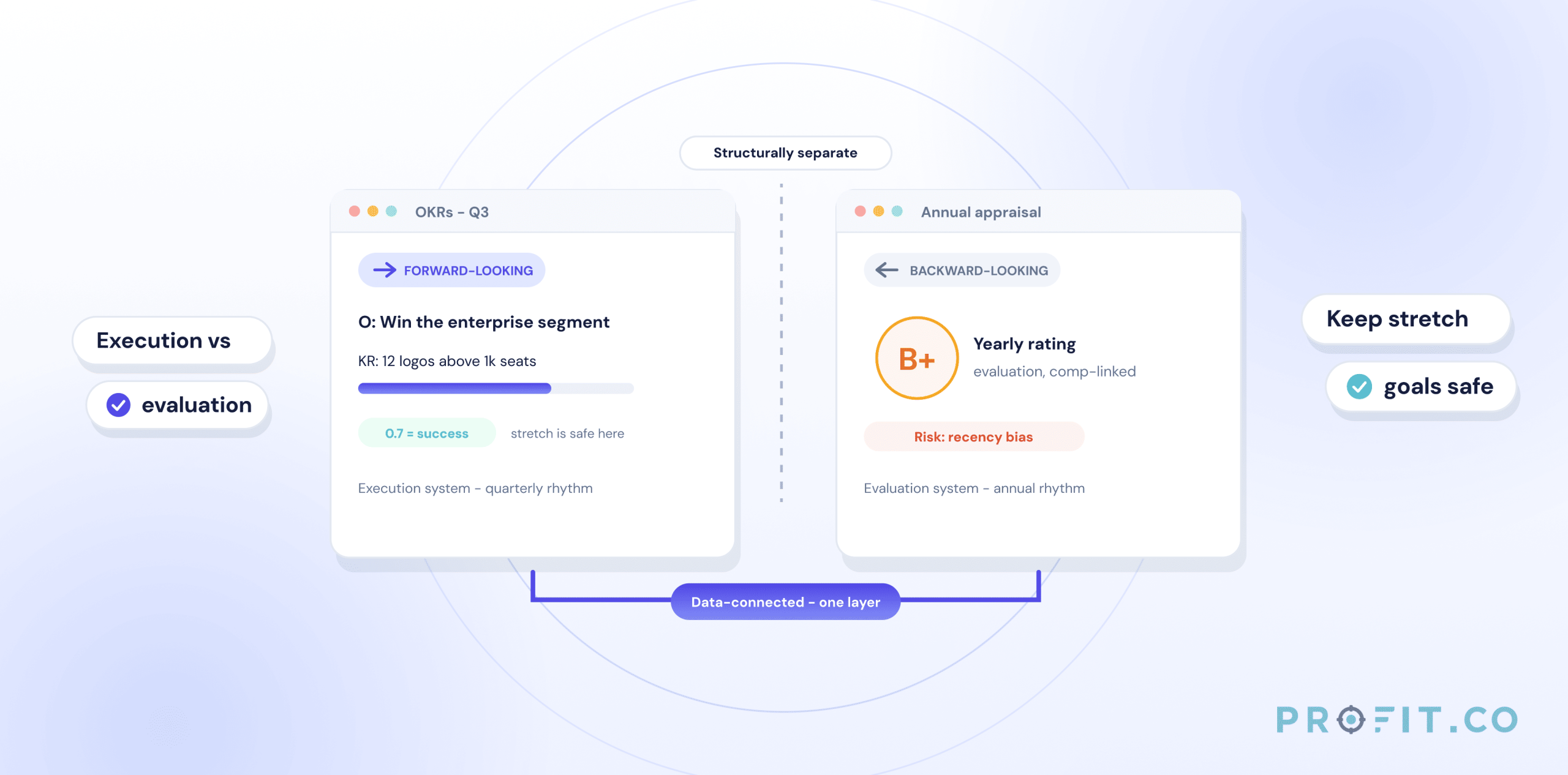
OKRs and appraisal systems answer two different questions. An OKR answers “what are we trying to achieve this quarter, and how far did we get?” An appraisal answers “how did this person perform over the past review period, and what should their rating be?” One is a planning instrument running forward. The other is an evaluation instrument running backward. Confusing the two is the root cause of most failed OKR rollouts: teams try to use a forward-looking goal system as a backward-looking scoring tool, and both processes suffer.
| OKRs | Appraisal Systems |
|---|---|
| Forward-looking: sets direction for the next quarter | Backward-looking: evaluates the past review period |
| Cadence: quarterly, sometimes monthly check-ins | Cadence: annual or semi-annual |
| Measures progress toward a goal | Measures behavior and output against a rating scale |
| Owned by the team setting the goal | Owned by the manager and HR |
| Designed to drive execution | Designed to inform compensation and promotion decisions |
Why Do Most Companies Treat OKRs and Appraisals as Competing Systems?
Most companies believe OKRs and appraisals belong in the same conversation because both involve “goals.” This is the assumption that breaks the system. OKRs are a coordination tool: they tell every team what the company is trying to do this quarter and who is accountable for which piece of it. Appraisals are a compensation tool: they decide who gets a raise, a promotion, or a difficult conversation. When a company scores OKR completion directly into a performance rating, teams stop setting ambitious goals and start setting safe ones.
A team hits 1.0 on every key result not because they executed well, but because they set targets they knew they could hit. The OKR stops measuring stretch and starts measuring caution.
How Do OKRs Bridge Stage-Gate Governance and Agile Execution?
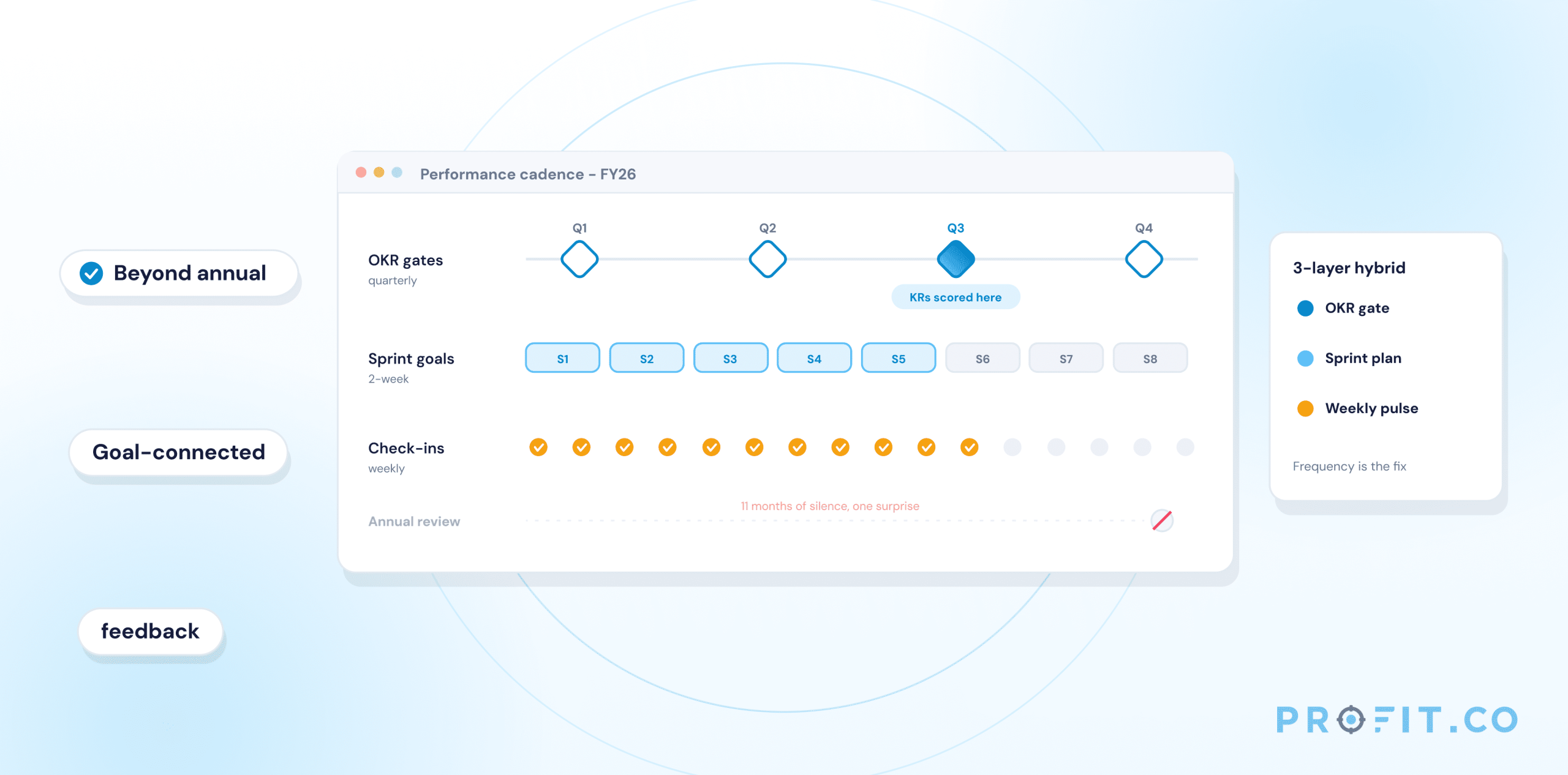
Companies running larger initiatives, such as product launches, market expansions, and system migrations, often govern that work through a stage-gate project management framework, where a project clears a defined gate before moving to the next phase. Meanwhile, the teams doing the actual work run in agile sprints, shipping in two-week cycles. These two models rarely speak the same language, and that gap is where strategic initiatives quietly stall.
OKRs are the translation layer. A quarterly key result functions as a gate criterion: the measurable bar a project must clear before governance approves the next phase. Sprint goals, in turn, are the execution units that move the key result forward week by week. The quarter becomes the gate. The sprint becomes the work inside it. A 1.0 score is not proof of execution. It’s proof the bar was set too low, and that same logic applies at the project level: a gate that always passes on the first try is not governing anything.
The Architecture Advantage
Key Result, Project Gate, and Sprint Task on One Record
This hybrid model, with stage-gate governance at the quarterly level and agile delivery at the sprint level connected through OKRs, is structurally difficult to run on separate goal, project, and task tools. A connected OKR+PPM+task management architecture keeps the key result, the project gate, and the sprint task on the same record, so a gate review and a sprint retro are reading the same number instead of reconciling two different ones.
Keep the Key Result, Project Gate, and Sprint Task on One Record
Why Does an Annual Appraisal Cycle Break When Layered Onto Quarterly OKRs?
An annual appraisal asks a manager to summarize four quarters of OKR cycles into a single rating, months after most of the context is gone. By the time review season arrives, the manager remembers the loudest project from Q4 and forgets the quiet, consistent execution from Q1. The appraisal ends up scoring recency, not performance. A once-a-year review cycle is simply too slow to catch that drift while it is still fixable.
The fix is not to abandon appraisals. It is to feed them with quarterly OKR data instead of asking a manager to reconstruct a year from memory. When OKR progress, not OKR percentage, becomes an input to the appraisal, alongside qualitative manager and peer feedback, the rating reflects a documented quarter, not a recollection of one.
What Goes Wrong When OKRs Are Used as Performance Scorecards?
The second failure pattern is the inverse of the first: instead of appraisals absorbing OKRs badly, OKRs get treated as if they were appraisals from the start. A manager sets “individual” OKRs that are really just task lists with a deadline, then grades them like a report card. This collapses the distinction between a stretch goal and a deliverable, and it removes the one thing OKRs are supposed to protect: the freedom to aim high without fear of a bad review. A 0.6 to 0.7 score, in a properly run OKR program, is a sign of healthy ambition, not underperformance. A scorecard mentality makes 0.6 look like failure, so teams stop aiming for it.
Companies that keep OKRs and appraisals structurally separate, with different cadence, different owner, and different purpose, but link them through shared progress data avoid both failure modes. The OKR stays a planning tool. The appraisal stays an evaluation tool. Neither one quietly becomes the other.
How Should OKRs and Appraisals Work Together in Practice?
A working model looks like this: OKRs run on a quarterly cycle and drive weekly or biweekly check-ins, feeding directly into the connection between OKRs and project portfolios so that gate reviews and sprint goals share one data set. Appraisals run annually or semi-annually and pull from four quarters of that same progress history, plus manager and peer input, not from a single end-of-year memory. Teams operating in sprints, rather than fixed-scope projects, apply the same logic through agile goal management for sprint teams, where the sprint goal is scoped directly from the quarter’s key result instead of being set independently.
The decision that matters is not “OKRs or appraisals.” It is whether your goal data and your review data are reading from the same source. An OKR management platform that also holds project and task data removes the manual reconciliation between the two, and removes the guesswork from every review cycle that follows.
Are OKRs and Appraisals Competing Systems or Complementary Ones?
OKRs and appraisal systems fail when they are forced to do each other’s job: OKRs scored like a report card, appraisals reconstructed from memory instead of data. They succeed when they stay structurally distinct but data-connected, with the quarter as the gate, the sprint as the work, and the appraisal as a record built from both. A connected OKR+PPM+task management platform runs stage-gate governance and agile delivery on the same key result instead of two disconnected systems trying to agree after the fact.
Connecting quarterly OKRs to stage-gate project governance and agile sprint execution in one platform is what closes the gap described above.
Run OKRs and Appraisals on One Record, Not Two
Frequently Asked Questions
OKRs set forward-looking quarterly goals and track progress toward them. Appraisal systems evaluate past performance, usually annually, to inform compensation and promotion decisions.
OKRs feed quarterly progress data into the appraisal as one input among several. The appraisal stays a separate annual evaluation, not a direct score of OKR completion.
Performance reviews and OKRs should run alongside each other. OKRs drive execution on a quarterly cycle; reviews evaluate performance using that execution data as evidence.
Scoring OKRs like a report card removes the safety to set ambitious targets. Teams set goals they know they can hit, which defeats the purpose of OKRs.
Quarterly key results act as gate criteria for stage-gate reviews, while sprint goals act as the execution units that move those key results forward week by week.