In Profit.co, you can assign owners to objectives and key results. There is a subtle, but important difference between the two.
Objective level ownership indicates who is accountable for the success of that objective, whereas the owner of the key result indicates the responsible person or department that needs to get it done.
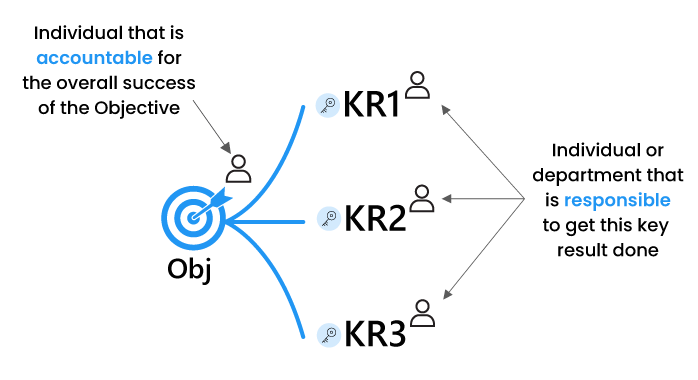
Objective ownership by default is the context in which the OKR is defined. So:
- Corporate objectives are owned by the corporation and can be assigned to one of the employees who is defined at the corporate level.
- Department objectives are owned by the department and can be assigned to one of the members of the department.
- Team objectives are owned by the team.
- Individual objectives are owned by the individual.
Certainly, we know we can assign the key results to anyone including employees from other departments. Like, for example, a corporate key result can be assigned to a department and then it cascades down and becomes an objective or key result at the department level as based on the assignment. And similarly, a department key result can be assigned to a different department or to an employee, an individual or team or whatnot. And based on that again cascades down as either objective or key result.
But the objective ownership is more to drive accountability within that particular context and hence is more restricted. So if you look at the department and the department has like 20 members in the department, the objective owner has to be somebody from within that list of 20 people. And that is because you typically want someone from within the department to be accountable for the objective even though some key results may be delivered by employees and departments outside the department.
And because of that we restrict the list of people that is available to be chosen as the owner of the objective to be, either the members within the team, if it’s a team OKR members within the department, if it’s a department OKR or if it’s a corporate OKR those who are authorized to operate and maintain corporate OKRs. They are the ones who are given ownership at the objective level.
Whereas when it comes to key results, they can be assigned to anyone, any department, any team.