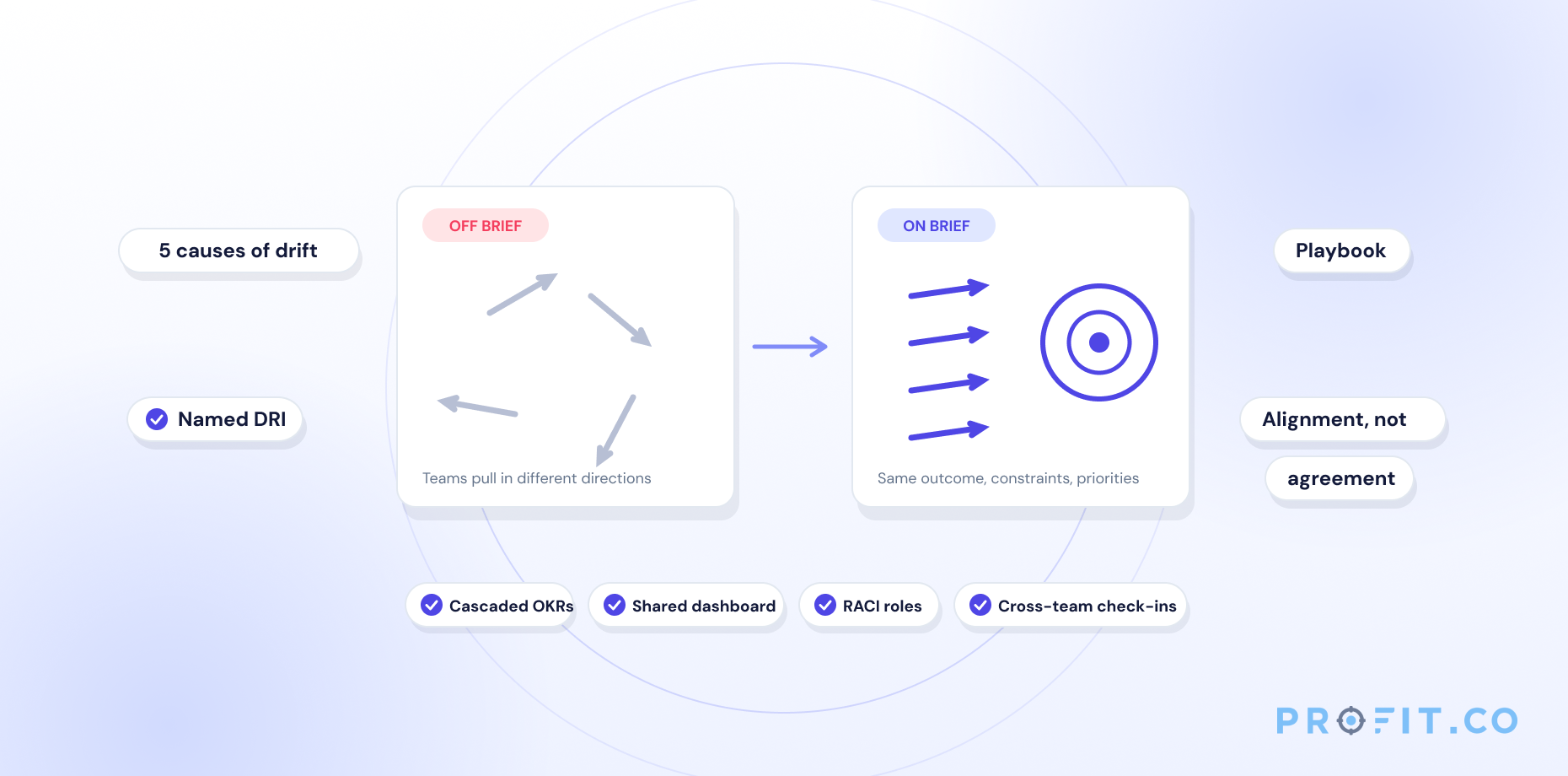
A strategic brief is the organization’s written answer to one question: what are we focused on this quarter, and why? At the point of creation, the brief is clear. Leadership reviews it, approves it, and distributes it. Thirty days later, execution teams are operating from five different local interpretations of it. This is not a communication failure in the narrow sense – the brief was sent, and teams read it. The drift happens because the brief was treated as an input to quarterly planning rather than as a live reference during execution.
Table of Contents
- Why Execution Teams Drift From the Strategic Brief
- 5 Practices That Keep Teams Aligned During Execution
- How to Cascade a Strategic Brief Into Team-Level Goals
- Signs Your Teams Have Drifted From the Brief
- Execution Alignment FAQs
This guide covers why that drift is structural rather than cultural, five practices that prevent it, how to cascade the brief into team-level goals, and five specific signs that misalignment has already set in.
Why Execution Teams Drift From the Strategic Brief
Three structural failure modes drive most execution drift, and they compound over the course of a quarter.
The Brief Lives in a Document No One Opens After Week Two
A strategy brief that exists only as a slide deck or a shared document distributed in January is an artifact, not a working tool. Teams default to what is visible, urgent, and specific. An OKR in their tracking system is visible – they check it at every check-in. An email attachment from three weeks ago is not. The moment the brief stops being the thing teams open before making decisions, it stops governing execution.
Teams Reinterpret Priorities Locally
When the brief is not regularly reinforced, individual teams adapt it to their own context. Sales reads “revenue growth” as pipeline. Marketing reads it as brand awareness. Product reads it as shipping velocity. None of these interpretations is wrong – but without a shared, enforced definition, execution diverges. By week six, three teams are aligned to three different versions of the same objective, and each believes it is executing correctly.
There Is No Single Source of Truth for “What Matters This Quarter”
When priorities exist across a strategy document, an OKR platform, a project management tool, and the most recent all-hands recording, teams synthesize their own list from whatever they have access to. That synthesis is accurate to their local knowledge – not to the organization’s actual current priorities. The result: work that feels aligned at the team level but produces fragmented outcomes at the company level.
Communication gaps between leadership and execution teams are one of the most common reasons strategy stalls. The OKRs and strategy execution best practices guide covers how communication cadence connects to execution quality more broadly.
5 Practices That Keep Teams Aligned During Execution
Maintain a Single Shared Source of Truth for Priorities
The brief – however long or short – must live in exactly one place, actively maintained. When priorities shift mid-quarter, that change happens in the same document at the same URL, not in a new email thread or a Slack message that disappears within a week.
In practice: link the brief directly to the OKR platform so the connection between the stated priority and the goal tracking is visible in one click. Priya Sharma, HR director at Clearfield Group, maintains a single pinned document containing the current quarter’s three priorities, the OKR for each, and a last-updated timestamp. “When someone asks what we’re focused on, I send one link,” she said. “The moment I’m sending two, something has gone wrong.”
Run Weekly Alignment Check-ins Tied to the Brief
There is a structural difference between a status update meeting and an alignment check-in:
| Status Update Meeting | Alignment Check-in | |
|---|---|---|
| Primary question | What did you do last week? | Does this week’s work still connect to the brief? |
| Focus | Activity and task completion | Connection between work and current priorities |
| Useful for | Project management and delivery tracking | Catching priority drift early |
| Risk if skipped | Delivery visibility gaps | Accumulating misalignment across teams |
| Cadence | Weekly or daily | Weekly – 15 minutes with a fixed format |
The first is useful for project management. The second is what prevents drift.
A weekly alignment check-in does not need to be long – fifteen minutes with a fixed format is sufficient: one update per team on what they are working on this week, one explicit statement of which part of the brief it connects to, and one flag for anything that feels unclear or in conflict with another team’s priorities. The explicit connection step is the one most teams skip – and it is the step that catches drift before it compounds. Enforcing this cadence consistently is what Profit.co’s Check-in Discipline feature is built for.
Cascade the Brief Into Team-Level OKRs
A strategic brief remains abstract until it is connected to a specific, measurable team-level goal. The cascade step – translating company-level priorities into OKRs at the department and team level – is what converts the brief from a planning document into a live execution plan.
Every team’s OKRs should trace back to at least one item in the brief in one step. If they cannot, that is evidence of misalignment: either the OKRs were set before the brief was finalized, or they have drifted since. The cascade connection should be visible in the OKR platform – not implied, but explicitly linked. For a detailed look at how OKR cascading works in practice, the OKR management platform guide covers alignment structures across team levels.
Assign a Named Owner for Each Brief Item
Every priority in the brief should have one named person responsible for it – not a team, not a department, one person. This person does not do all the work; they are responsible for tracking progress, flagging priority conflicts, and making the item visible across functions during the quarter.
Marcus Webb, operations lead at Vantage Logistics, assigned named owners to each of the five items in the company’s Q3 brief. “Before we did this, ‘customer onboarding time’ was everyone’s problem,” he said. “Which means it was no one’s problem. After, there was a person who would be in the room when the number came in. That changed the conversation.” When there is no named owner, accountability distributes evenly across everyone and effectively lands on no one. For more on why ownership is one of the core elements of execution success, see what is strategy execution and how to execute it successfully.
Build a Lightweight Escalation Path When Priorities Conflict
Mid-quarter conflicts are predictable: two brief items compete for the same engineering capacity; an unexpected customer requirement pulls resources away from the brief’s current focus; a market shift creates pressure to reprioritize. Without a clear escalation path, these conflicts are either resolved locally – by whoever has the loudest voice or the most urgency – or they generate friction that slows execution without resolving anything.
The path can be simple: any named owner who believes a brief priority is being crowded out by a competing demand brings it to the leadership team at a defined meeting – not by escalating individual emails or calling an ad hoc all-hands. The leadership team decides within forty-eight hours. The decision is documented in the brief itself, with the rationale visible to everyone.
How to Cascade a Strategic Brief Into Team-Level Goals
Connecting a top-level brief to OKRs at the team level takes three steps. The design work takes roughly an hour; it prevents weeks of confusion during execution.
Step 1: Extract Specific, Measurable Outcomes From Each Brief Item
A brief item that says “improve customer retention” is not yet executable. Before cascading, translate it: “reduce monthly churn from 3.2% to 2.5% by end of Q3.” Now there is something a team can connect to. Brief items that cannot be made specific at this step are signals that the priority itself needs more definition before it can govern execution.
Step 2: Map Each Outcome to the Teams That Influence It
A 2.5% churn target requires action from customer success (onboarding quality), product (feature adoption), and support (resolution speed). Each of those teams gets a team-level OKR that connects explicitly to the shared outcome – not a generic “improve customer experience” objective, but a specific contribution to the same number.
Example:
- Company OKR: Reduce monthly churn from 3.2% to 2.5% by Q3.
- Customer Success OKR: Increase 90-day feature adoption from 40% to 60%.
- Product OKR: Reduce time-to-first-value for new users from 14 days to 7 days.
- Support OKR: Resolve Tier 1 tickets within 4 hours, 90% of the time.
Step 3: Verify the Logic Flows Both Ways
If every team hits their OKR, does the company OKR get achieved? If the answer is unclear, the cascade is broken – either the team OKRs are too weak, or the company target needs recalibration. This sanity check takes fifteen minutes and prevents the common situation where every team reports green while the company-level metric stays flat. For broader context on connecting portfolio priorities to strategic execution, the OKR for portfolio prioritization guide covers the linkage between strategy and project investment decisions.
Signs Your Teams Have Drifted From the Brief
1. Teams Cannot Restate the Current Top Priority in One Sentence
Ask ten people across execution teams: “What is the company’s number one priority this quarter?” If you get five different answers, the brief has drifted into local interpretation. This is the earliest and most reliable signal of misalignment – and it does not require a survey or a formal review to surface.
2. Conflicting Priorities Appear Across Teams Without Anyone Flagging Them
Marketing is investing budget in a new channel that sales does not support. Engineering is building a feature that is not in the brief but came from a customer conversation two weeks ago. Both decisions might be locally rational – but if they were not checked against the brief, they are evidence that the brief is not the live governing document it was designed to be.
3. Status Updates Contain No Reference to the Brief
When teams report weekly progress without connecting it to which priority they are advancing, execution and strategy have separated. The status meeting has become a project management activity. It is no longer an alignment activity.
4. No One Can Name the Owner of a Key Initiative
“Everyone is responsible for customer retention” means customer retention has no owner. If you cannot identify the single person who will be in the room when the quarterly outcome is discussed and needs to explain it, the initiative is unowned – and unowned priorities do not move.
5. Quarterly Goals Are Unchanged From Last Quarter
If a team’s OKRs in Q3 look structurally identical to Q2 – same objectives, incrementally updated targets – it suggests the brief is not being used as the starting point for goal-setting. OKRs are supposed to respond to where the strategy is going, not simply extend what the team was already doing. Static OKRs are a sign the brief is not reaching the goal-setting process. For a structured approach to enterprise-wide alignment, the complete guide to strategic alignment in enterprise organizations covers governance structures at scale.
For the broader set of conditions that determine whether a strategy translates into results at all, see the 5 key factors for strategy execution success.
Connecting strategy to execution across distributed teams?
Execution Alignment FAQs
At minimum, monthly as a formal review to check whether priorities have shifted, and weekly as a lightweight check-in to confirm current work still connects to the brief. Monthly reviews keep the brief current; weekly check-ins catch drift before it compounds into misaligned execution. Reviewing the brief only at quarter start and end is too infrequent to serve either purpose.
The most effective combination is an OKR management platform – so priorities are connected to measurable, trackable goals – and a single live document for the brief, maintained at one URL and updated in place when priorities shift. Tools that display OKRs alongside project status reduce the interpretation gap that causes most drift. Automated check-in nudges enforce cadence without requiring managers to chase updates.
OKR tracking measures whether goals are being hit; strategic alignment ensures those goals are still the right ones – connected to the current brief, not a priority that has since shifted. A team can hit every OKR and still be misaligned if the OKRs were set against an outdated brief. Alignment is a governance question; tracking is an execution question – both matter, neither substitutes for the other.