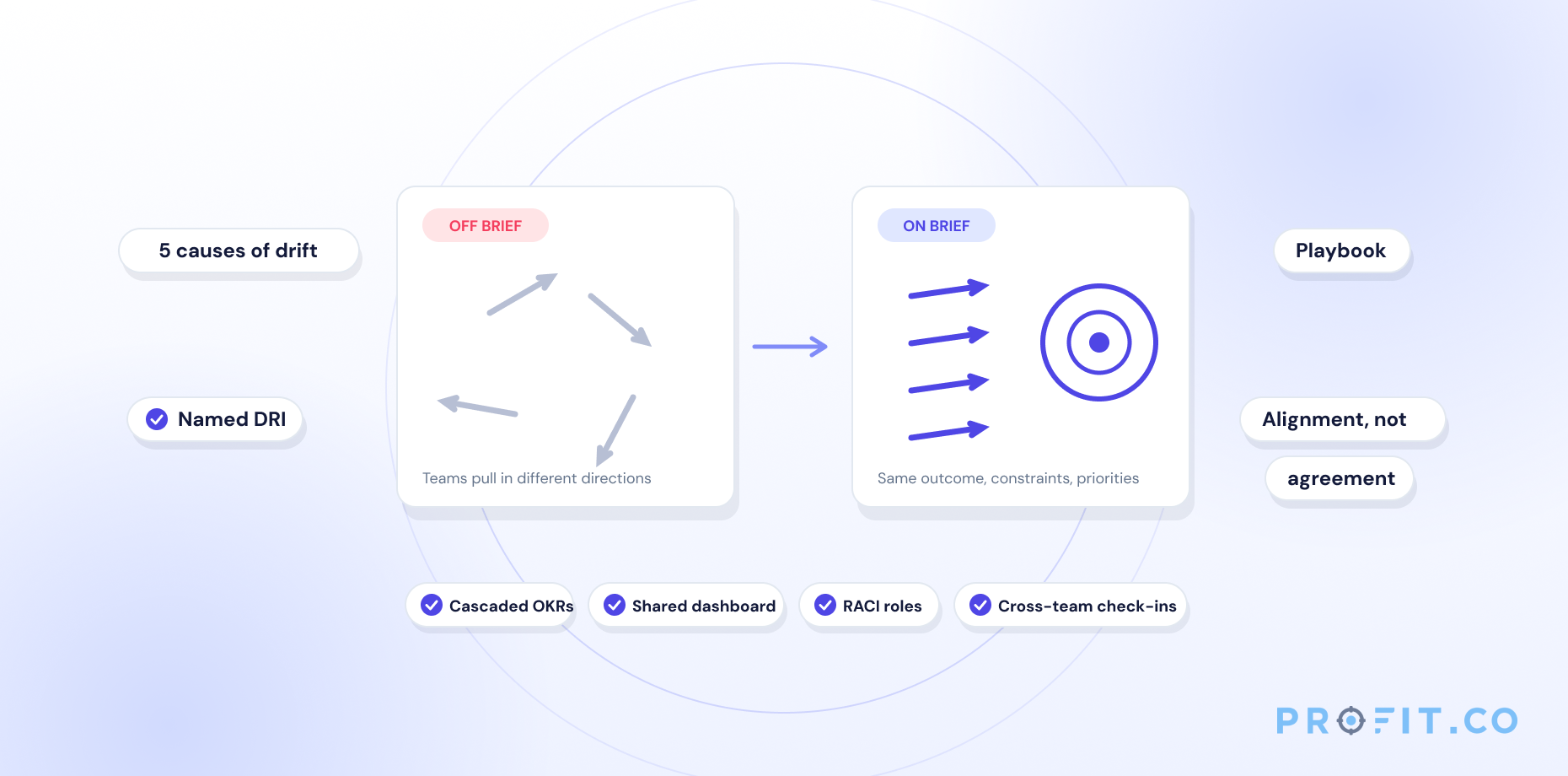
Portfolio prioritization using OKRs connects quarterly Objectives to project investment decisions, giving portfolio leaders a measurable, strategy-linked filter that replaces opinion-based ranking. Projects that advance a Key Result get funded. Projects without an OKR connection move to a backlog until the strategy changes.
In this guide
- Why does Portfolio Prioritization Fail Before the First Project Gets Approved?
- What is OKR-Driven Portfolio Prioritization?
- How do OKRs Connect Stage-Gate Governance to Agile Delivery?
- What does an OKR Portfolio Prioritization Framework Look Like?
- How do you Prioritize Projects Using OKR Scores?
- What Platform Support does OKR-Driven Portfolio Management Require?
- How do you Implement this Framework in One Quarter?
- Frequently asked questions
Why does Portfolio Prioritization Fail Before the First Project Gets Approved?
Most executives treat portfolio prioritization as a resource allocation problem. It isn’t. It’s a strategic alignment problem, and that distinction matters enormously when the same leadership team that approved twenty projects in January can’t explain which five connect to the company’s strategy by March.
The typical portfolio review scores projects against criteria that appear strategic: ROI potential, risk rating, resource availability. But those criteria are input-focused rather than outcome-focused. A project can score well on all three and still contribute nothing to this quarter’s Objectives. That is the structural flaw: portfolio governance and strategy execution run on separate tracks.
The consequence is predictable. Portfolio reviews become political. Sponsors advocate for their projects. Scoring matrices get manipulated. The projects that survive are the ones with the loudest champions, not the ones with the clearest strategic contribution.
A project without a parent OKR isn’t a priority. It’s a preference.
What is OKR-Driven Portfolio Prioritization?
OKR-driven portfolio prioritization uses quarterly Objectives and Key Results as the primary filter for every project investment decision. Instead of ranking projects against internal scoring models, portfolio leaders ask one question first: which Key Result does this project advance?
The mechanics are direct. Before the quarter begins, every proposed project is mapped to a company or team-level Key Result. Projects with a clear mapping are considered for funding. Projects without an OKR connection go to a holding list, not permanently shelved, but not resourced until the strategy expands to accommodate them.
This is not a new governance layer on top of what already exists. It replaces the existing one. The portfolio review changes from “which projects should we fund?” to “which projects are contributing to the OKRs we already committed to?” That is a faster, more honest conversation, and one that produces fewer approval regrets at quarter-end.
The discipline surfaces an uncomfortable truth quickly: most active project portfolios contain a meaningful share of projects with no clear connection to any current company Objective. Those represent misallocated capital. Finding them in week one, before another quarter passes, is the first return on OKR-driven project portfolio management.
How do OKRs Connect Stage-Gate Governance to Agile Delivery?
The tension most portfolio management teams face is a methodology mismatch. Stage-gate governance provides control at the portfolio level: projects advance only when they pass defined criteria at each phase. Agile delivery provides speed at the team level: sprints run every two weeks, priorities shift, and teams course-correct continuously. These two models appear incompatible.
They aren’t, but connecting them requires a common unit of measure at the right frequency. That unit is the quarterly Key Result. Refer to the stage-gate governance model to see how phase criteria typically flow; the table below shows how OKRs bridge both worlds.
| Dimension | Stage-Gate Governance | Agile Delivery |
|---|---|---|
| Review cadence | Phase-gate (quarterly or semi-annual) | Sprint review (bi-weekly) |
| Decision type | Go / no-go based on deliverable checklist | Backlog reprioritization each sprint |
| Accountability level | Portfolio — executive sponsors | Team — product owner and scrum master |
| Core risk | Slow response to strategic change | Losing sight of strategic outcomes |
| OKR bridge | Quarterly KR score = gate trigger | Sprint goals = KR execution units |
In a hybrid OKR-driven model, the quarterly Key Result score becomes the gate criterion. A project team runs agile sprints throughout the quarter, each sprint goal is a two-week execution step toward the parent Key Result. At quarter-end, the Key Result score (0.0-1.0) determines whether the project advances, pivots, or pauses at the next phase review.
This resolves stage-gate’s most common failure: gate reviews that approve projects based on deliverable completion regardless of whether those deliverables moved the business. A project can deliver every promised output and still score 0.3 on its parent Key Result. That score is exactly the signal a portfolio review should act on, and in most organizations without OKR-linked governance, it goes unseen. Exploring agile goal management practices shows how sprint goals can be structured to map directly to key results at every cycle.
What does an OKR Portfolio Prioritization Framework Look Like?
The framework operates across four levels. Each has a distinct owner, a distinct cadence, and a distinct strategic question. The levels cascade: a decision at Level 1 defines the boundaries within which Levels 2, 3, and 4 operate.
Company OKRs — Annual direction, quarterly execution
The C-suite sets 3-5 Objectives with 2-4 Key Results each. These are the non-negotiable priorities for the quarter. Every portfolio investment must trace back to this level. Owner: CEO / Strategy Director. Cadence: Annual direction, quarterly refinement.
Portfolio OKRs — Quarterly
Each portfolio (product, IT, operations) maps to 1-3 company Key Results. Portfolio-level OKRs define the contribution this portfolio makes to company strategy. Projects are approved only when they advance a portfolio Key Result. Owner: COO / Portfolio Director. Cadence: Quarterly.
Project Key Results — Monthly check-in
Each funded project carries a project-level Key Result that quantifies its contribution to the parent portfolio OKR. At weeks 4 and 8, a project scoring below 0.4 triggers a portfolio escalation, not cancellation, but a structured five-day decision window. Owner: Project Manager / PMO. Cadence: Monthly check-in.
Sprint Goals — Bi-weekly execution
Agile teams translate the project Key Result into sprint goals. Each sprint goal is a two-week execution unit that advances the Key Result by a measurable increment. Sprint reviews report against the Key Result, not just against the backlog. Owner: Product Owner / Scrum Master. Cadence: Bi-weekly.
Most portfolio reviews fail before the meeting starts. The problem is the wrong question on the agenda. ‘Are projects on time and on budget?’ is operational. ‘Are projects moving the Key Results we committed to?’ is strategic.
How do You Prioritize Projects Using OKR Scores?
OKR scoring converts portfolio prioritization from a political conversation into a data-driven one. The 0.0-1.0 scale provides a common language across all projects, regardless of methodology, team, or domain. Three thresholds govern portfolio decisions:
Advance — project is contributing to the Key Result
Full resource commitment is maintained. Next-stage gate is approved. Team contribution is recognized against the OKR. No escalation required.
Adjust — project is behind but recoverable
A portfolio-level review is triggered. Root cause is documented. Scope or resource adjustment is considered. The project continues with modified sprint goals for the remaining weeks.
Escalate — project is not moving the Key Result
C-suite visibility is triggered. The portfolio leader makes a kill, pause, or pivot decision within five business days. Resources are reallocated to projects scoring above 0.7.
This structure removes the need to debate project fate in a room full of sponsors. The OKR score frames the decision. The portfolio review executes it. That shift, from advocacy to evidence, is where OKR-driven portfolio management delivers its fastest return. Review the OKR University for a full guide on scoring methodology and the 0.4 escalation threshold rationale.
What Platform Support does OKR-Driven Portfolio Management Require?
The Connected OKR + PPM Architecture
One data model connecting company OKRs, portfolio projects, and sprint execution
Most OKR platforms and standalone portfolio management tools exist on separate tracks. Strategy teams manage OKRs in one system. PMO teams manage project portfolios in another. The connection between them, the critical link that makes OKR-driven prioritization work, is maintained manually in spreadsheets, when it’s maintained at all.
A connected OKR and PPM platform resolves this architecturally. OKRs, PPM, and task management are built on a single data model. A company Objective connects directly to a portfolio. A portfolio connects directly to projects. A project connects directly to sprint-level tasks. That hierarchy is live and updated continuously, not reconstructed at quarter-end from disconnected exports.
For portfolio prioritization specifically, portfolio leaders see every project’s OKR connection and current Key Result score in one view. AI-powered project monitoring tracks which projects are advancing their parent Key Results and flags at-risk projects before the quarter-end review. Stage-gate escalations trigger automatically when a project’s Key Result score drops below 0.4 for two consecutive check-ins. The portfolio review is initiated by the system, not by a project manager remembering to send an update.
Explore the OKR management platform to see how the OKR-to-portfolio architecture works across all four levels of the framework above. Speed without strategic direction is faster waste. A connected platform ensures every project sprint, every resource decision, and every portfolio review is anchored to the OKRs that define success for the quarter.
How do you Implement this Framework in One Quarter?
Ninety days is one OKR cycle, the natural implementation window. The goal is not to transform portfolio governance in one cycle. It’s to run the OKR-driven model alongside existing processes long enough to demonstrate output quality. One quarter is sufficient to surface misaligned projects, run the first score-based gate review, and build portfolio-leader confidence in evidence-driven decisions.
Days 1-15: Map every active project to an OKR
Audit the full active portfolio. For each project, document the company or team OKR it contributes to. Projects without a match go to a holding list, not cancelled, but not resourced for this quarter. Use the OKR examples library to calibrate what a well-defined project-level Key Result looks like before setting them.
Days 16-30: Set a measurable Key Result for each funded project
Each approved project gets one Key Result that quantifies its contribution to the parent portfolio OKR. The Key Result must be scoreable at weeks 4 and 8, not just at quarter-end. Avoid output Key Results (“launch feature X”). Use outcome Key Results (“increase activation rate from 22% to 30%”).
Days 31-60: Run the first mid-quarter check-in
At week 4, collect OKR scores for every active project. Apply the three thresholds: Advance, Adjust, Escalate. This is typically the first time a portfolio team has a score-driven, not opinion-driven, mid-quarter conversation. Document decisions in the same system where OKRs live, not in a separate meeting notes file.
Days 61-90: Quarter-end gate review and next-quarter planning
Final OKR scores determine which projects advance, pause, or restructure. Next-quarter project approvals are made against new OKRs, not against carry-forward momentum. The portfolio review no longer starts with “which projects are in flight?” It starts with “what are our OKRs for next quarter, and which projects advance them?”
Key Takeaways
- ✓Portfolio prioritization is a strategic alignment problem, not a resource allocation problem. OKRs solve the right version of it.
- ✓Quarterly Key Results are the natural gate criteria for stage-gate governance. They run at the right frequency and measure strategic contribution, not just deliverable completion.
- ✓Sprint goals within agile delivery map to Key Results, connecting fast execution cycles to strategic outcomes without requiring a methodology change at the team level.
- ✓The 0.4 OKR score threshold replaces sponsor advocacy as the escalation trigger. Portfolio decisions become evidence-driven, not political.
- ✓Platforms that natively connect OKRs, PPM, and task management eliminate the manual integration gap that causes most OKR-portfolio alignment failures.
Connect OKRs to Every Portfolio Decision, Automatically
Frequently Asked Questions
OKR for portfolio prioritization uses quarterly Objectives and Key Results as the scoring filter for every project investment decision. Projects advancing an active Key Result are funded. Projects with no OKR connection move to a backlog until the strategy changes.
Each project maps to a parent Key Result before the quarter starts. Portfolio leaders score it at weeks 4 and 8. Above 0.7 confirms funding. Below 0.4 triggers a portfolio review: kill, pause, or pivot within five business days.
An OKR portfolio management framework operates across four levels: company OKRs (quarterly), portfolio OKRs (quarterly), project Key Results (monthly check-in), and sprint goals (bi-weekly). Each level has a distinct owner, cadence, and decision question connected to the level above it.
In a hybrid model, the quarterly Key Result score replaces the stage-gate checklist. A project advances only when its parent Key Result is on track. Below 0.4 triggers a formal portfolio escalation, not cancellation, but a time-bound decision.
Map every active project to a company OKR in the first 15 days. Set a project-level Key Result. Score at weeks 4 and 8. Use the 0.4 threshold as the escalation trigger. Complete one full cycle before expanding the model.