

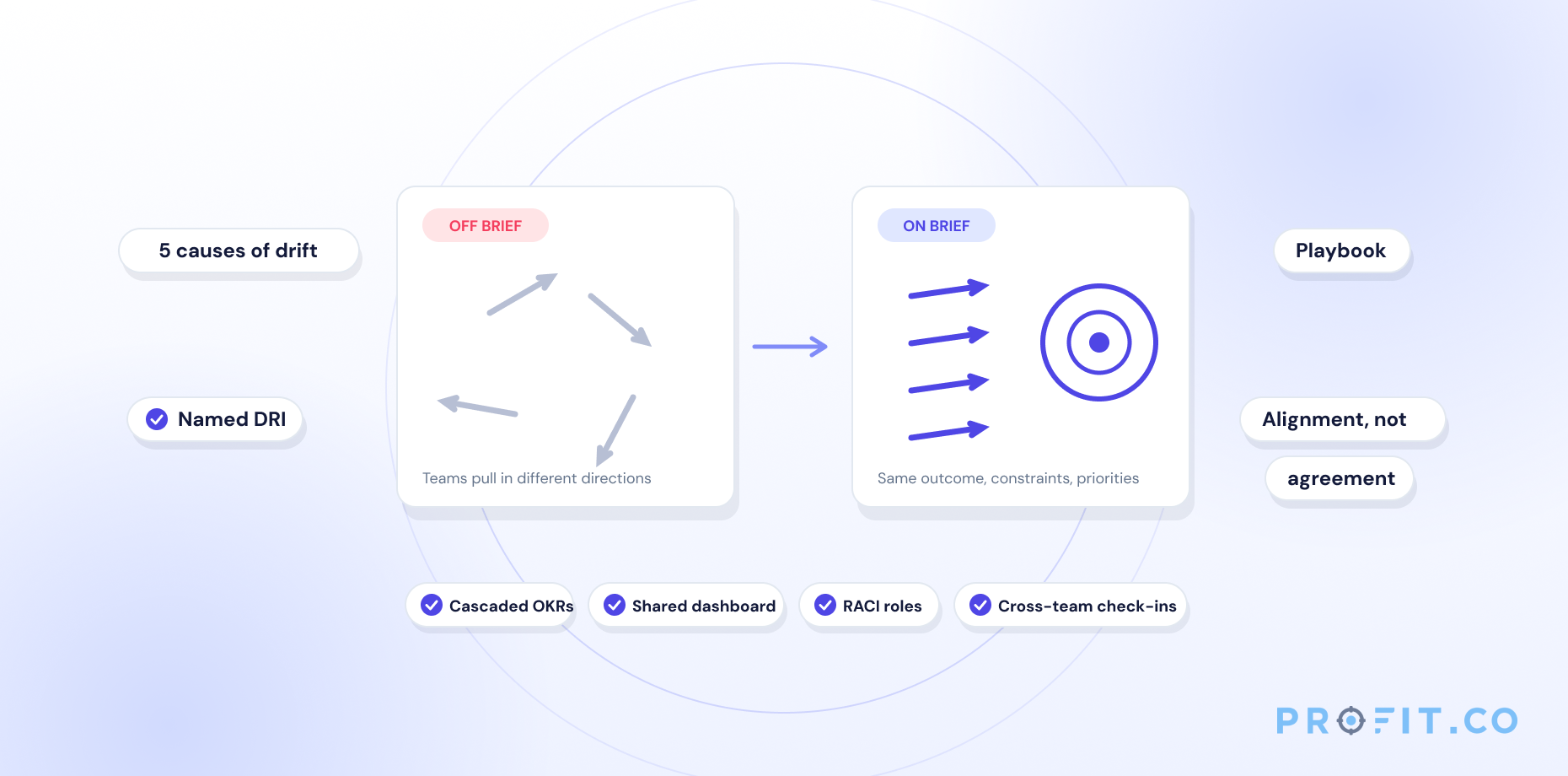
Execution alignment is the state in which every team contributing to a shared objective – regardless of department, location, or function – operates from the same understanding of what the goal is, what success looks like, what constraints apply and cannot be traded away, and which priority wins when the work conflicts with something else on the roadmap. This playbook covers the common causes of execution misalignment, the systems and tools that structurally prevent it, and how Profit.co supports cross-functional brief alignment across OKR cycles.
In this guide
- What It Means for Teams to Be “On Brief”
- Common Causes of Misalignment Across Execution Teams
- Tools and Systems That Improve Strategic Alignment
- How Profit.co Supports Cross-Functional Brief Alignment
- Execution Alignment FAQs
This guide covers why execution drift is structural rather than cultural, the three elements every team must understand to be “on brief,” five common causes of misalignment, the tools and systems that prevent it, and how Profit.co supports cross-functional alignment across OKR cycles.
What It Means for Teams to Be “On Brief”
In agency work, “on brief” means the output matches what the client asked for. In enterprise execution, it means something broader: every team member, in every function, is operating from the same understanding of three things. When execution teams are aligned to the same brief, they make better decisions faster, escalate fewer conflicts upward, and deliver more consistent outcomes. When they are not, organisations spend their coordination budget on meetings that exist to compensate for misalignment rather than advance the work.
The Outcome
What does done look like, and how will we measure it? Teams that cannot answer this question in one sentence – without consulting a manager – are not aligned on the outcome.
The Constraints
What can’t we trade away? Every initiative has a set of non-negotiables: budget ceiling, delivery date, compliance requirements, minimum quality floor. Alignment requires these to be explicit and shared, not assumed.
The Priority
When this conflicts with something else, which wins? The brief must answer this question in advance. Without a stated priority, every conflict between competing demands escalates to a senior stakeholder – and the volume of escalations is a direct measure of how misaligned the teams are.
Teams that are on brief do not need to escalate every decision – because the brief itself provides enough context to resolve tradeoffs locally. Teams that are off brief escalate constantly, because the only person who can adjudicate between two legitimate but conflicting interpretations is the person who knows what the real goal is.
The sharp line: Alignment is not agreement. Teams can disagree on approach while remaining aligned on outcome. What breaks execution is when teams pursue different outcomes – not when they disagree on the path to the same one.
Common Causes of Misalignment Across Execution Teams
The Brief Lives in One Person’s Head
The most common cause of execution drift is that the strategic intent was communicated verbally – in a kickoff meeting, a leadership all-hands, or a conversation between two people – and never translated into a shared, written reference that all contributing teams can consult.
Six weeks into execution, the Marketing team is building for awareness, the Product team is building for conversion, and the Sales team is qualifying for a customer segment that doesn’t match either. No one is wrong. They all attended the same kickoff. But they each absorbed a different brief.
Goals Are Set at the Top and Don’t Cascade
When company-level objectives exist but department-level goals are not explicitly linked to them, execution teams build their own interpretation of what matters. Each team’s goals feel locally coherent but are not externally aligned.
Kavya Nair (Sales, Meridian Software) can have a goal to “Close 20 enterprise accounts in Q3.” James Okafor (Engineering, Apex Digital) can have a goal to “Reduce deployment time by 40%.” Both goals are well-formed. Neither indicates whether Kavya’s accounts require the kind of integrations that James’s deployment improvements are supposed to serve. If the connection isn’t explicit, execution teams optimise locally and misalign globally.
Ownership Is Shared Across Functions Without a Named DRI
When a project or objective spans multiple functions and no single person has decision authority, alignment degrades as a function of time and competing priorities. Everyone is responsible, which means no one is.
This is especially visible at the handoff point – when one team finishes their piece and passes to another. Without a Directly Responsible Individual (DRI) who owns the outcome across the entire chain, handoff errors compound and accountability diffuses.
Incentives Are Misaligned
Teams that are evaluated on different metrics will, rationally, optimise for different outcomes – even when they share a stated goal.
If the Sales team is incentivised on bookings (closed contracts) and the Customer Success team is incentivised on net retention (renewals and expansions), both teams can be “winning” individually while the company loses net revenue. Aligning incentives to shared outcomes is the structural prerequisite for execution alignment – and it requires the goals to be explicit enough that the incentive structure can be designed around them.
The Brief Changes Without Propagation
Strategy shifts mid-cycle – market conditions change, a competitor moves, a key customer churns. When leadership updates the brief without a structured communication and goal-update process, execution teams keep running toward the original destination.
Tools and Systems That Improve Strategic Alignment Across Teams
How Cascaded OKRs Link Strategic Plans to Execution Outcomes
Cascaded OKRs are the most structurally effective tool for execution alignment. Each department-level objective is explicitly linked to a company-level objective – and each team-level key result is linked to a department-level objective. The brief is not described in a presentation; it is encoded in the goal system.
When goals change at the company level, the cascade makes downstream impact visible immediately: which department goals are now misaligned, which team-level key results need revision, and who needs to be notified.
| Alignment Method | Brief Visibility | Scalability | Cadence for Updates |
|---|---|---|---|
| Cascaded OKRs | High – goals linked explicitly | High – works at 10 or 10,000 employees | Quarterly goal-setting + midcycle check-in |
| Shared project briefs (documents) | Medium – depends on doc being current | Low – breaks at scale | Ad hoc, usually stale |
| All-hands communication | Low – verbal, absorbed differently | Low – fades within 2 weeks | Irregular |
| Manager-to-manager alignment calls | Medium – relationship-dependent | Low – doesn’t scale cross-functionally | Scheduled, not on-demand |
Shared Progress Dashboards
When every contributing team’s progress on a shared objective is visible in one view, misalignment is detectable before it becomes a delivery failure. A shared OKR dashboard shows – in real time – whether the Sales team’s contribution to the Q3 growth objective is on track while the Product team’s contribution is stalled.
Without a shared dashboard, that gap is invisible until the quarterly review. Profit.co’s cross-functional OKR board surfaces every team’s contribution status, last check-in date, and blocker flags in a single view – so alignment gaps appear in week three of the quarter, not week thirteen.
Decision-Rights Frameworks (RACI or Equivalent)
A RACI matrix defines who is Responsible, Accountable, Consulted, and Informed for each decision in a project or objective. It does not guarantee alignment, but it removes ambiguity about who has authority to make a call when teams disagree – which removes the single largest cause of escalation in cross-functional work.
Build a lightweight RACI at the start of any initiative that spans more than two functions. Review it when the project scope or team composition changes.
Regular Cross-Functional Check-Ins (Not Status Meetings)
The purpose of a cross-functional alignment check-in is not to report status – status should be visible on the dashboard before the meeting. The purpose is to surface decisions that one team has made that affect another team’s plan, and to resolve conflicts before they compound.
Cadence: bi-weekly for active initiatives, monthly for ongoing programs.
Agenda:
- Review shared dashboard – is each team’s contribution on track?
- What decisions has each team made since the last sync that the other teams should know?
- What does each team need from the others in the next two weeks?
Connecting strategy to execution across distributed teams?
How Profit.co Supports Cross-Functional Brief Alignment
Profit.co’s OKR platform is designed for the specific problem of cross-functional execution alignment – not just individual goal tracking.
Cascaded Goal Architecture
In Profit.co, every objective can be linked explicitly to the objective above it in the hierarchy: Company, Department, Team, Individual. The brief is not a document that gets out of date – it is the goal structure itself, visible to every contributor.
When Diana Torres (Marketing, Harrow & Associates) sets a department objective, she links it to the company-level growth objective in Profit.co. Her team’s key results automatically appear as contributions to that company goal on the shared dashboard. If the company objective changes, the system surfaces which downstream goals are now out of alignment. Explore Profit.co’s cascaded OKR management
Cross-Functional OKR Boards
Profit.co supports cross-functional OKR views that aggregate contributions from multiple departments against a single shared objective. Leaders running a Q3 initiative that spans Sales, Product, and CS can see every contributing team’s progress, check-in status, and confidence score in one view – without sending Slack messages asking for updates.
Check-In System with Blocker Flags
Every check-in in Profit.co includes an optional blocker flag. When Marcus Webb (Operations, Vantage Logistics) flags that his “Reduce order processing time” key result is blocked by a dependency on the Tech team’s API deployment, that flag surfaces on the cross-functional dashboard – not buried in a thread.
Strategic Alignment Reporting
At any point in the OKR cycle, Profit.co’s alignment reporting shows the percentage of company objectives that have active, on-track contributions from each department. This is the structural answer to the question senior leaders ask every quarter: are we actually executing against the strategy, or are we executing against something we thought was the strategy six months ago?
Aligning teams around strategy and execution?
Execution Alignment FAQs
Alignment means every team is pursuing the same outcome – the shared objective defined in the brief. Agreement means teams have the same opinion about how to get there. Teams can be aligned on outcome while disagreeing on approach, which is healthy and productive. What breaks execution is not disagreement on approach – it is teams pursuing different outcomes. Alignment is a governance question that the brief and OKRs answer; agreement is a collaboration question that team processes answer.
Cascaded OKRs encode the strategic brief into a goal structure that is visible, measurable, and updated in place when priorities shift. Because every team-level OKR is explicitly linked to a department or company objective, drift becomes visible the moment a team’s work disconnects from its linked goal. Without cascaded OKRs, teams reinterpret priorities locally – each team builds its own version of what the brief means, and misalignment compounds over the quarter without anyone detecting it until the final review.
The most common cause is that the strategic brief was communicated once – in a kickoff meeting or a distributed document – and then treated as an artifact rather than a live working reference. Teams default to what is visible and urgent: their OKR tracking system, their project board, their most recent manager conversation. A brief that stops appearing in those contexts stops governing execution. The structural fix is connecting the brief directly to the OKR platform so the link between stated priority and tracked goal is visible in one place throughout the quarter.


