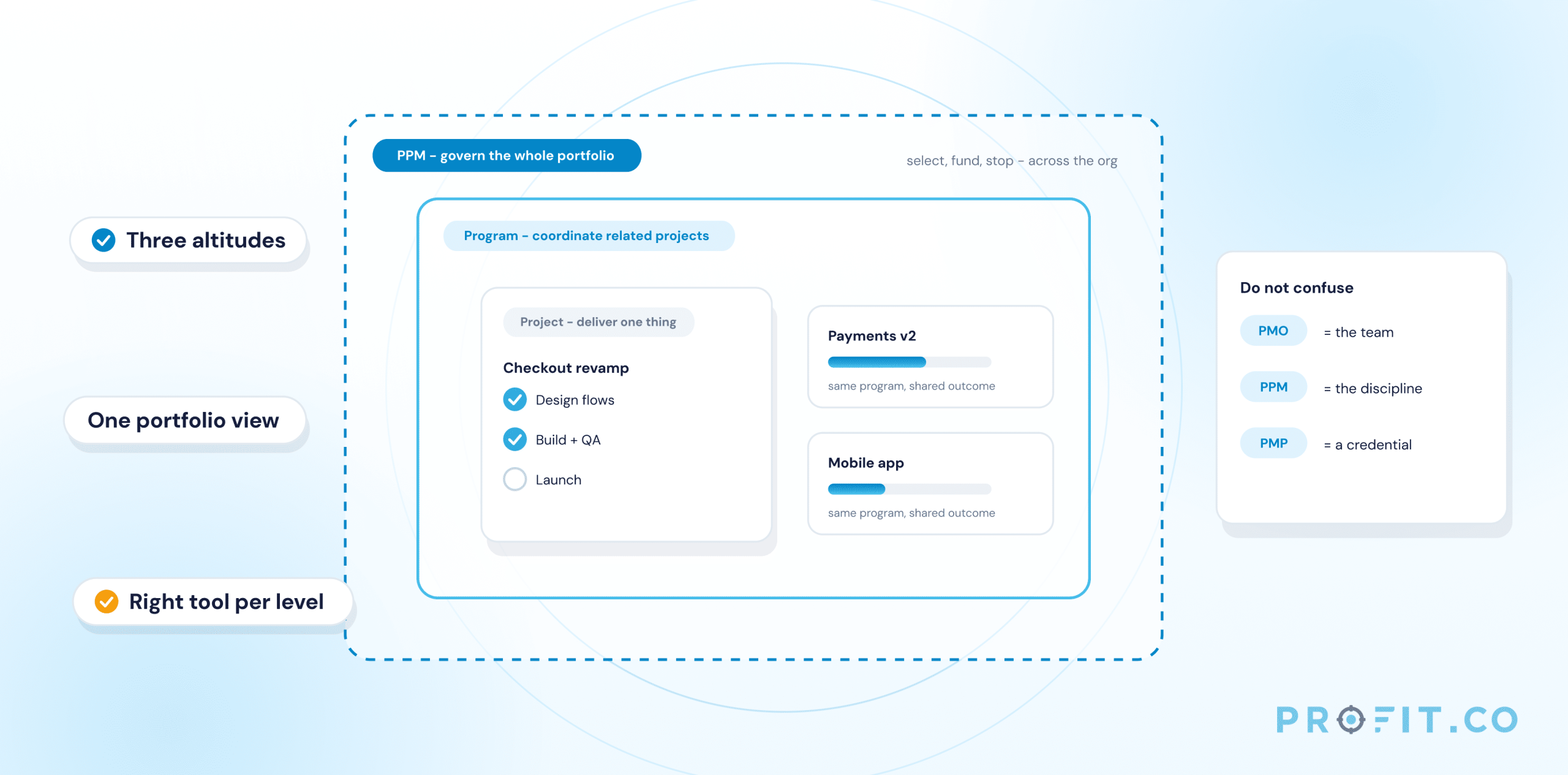
Strategic portfolio management (SPM) is the discipline of selecting, prioritizing, and governing a portfolio of projects based on their alignment to organizational strategy, not just individual project ROI. SPM determines which work gets funded, resourced, and executed each quarter, connecting capital allocation decisions directly to measurable strategic outcomes.
In this guide
- What Does Strategic Portfolio Management Actually Mean?
- How Does Strategic Portfolio Management Differ from Project Portfolio Management?
- Why Do Most Project Investments Fail to Deliver Strategic Value?
- The Stage-Gate vs. Agile Debate in SPM
- How Do OKRs Bridge Stage-Gate Governance and Agile Delivery?
- What Does Strategic Portfolio Management Software Actually Need to Do?
- Frequently asked questions
What Does Strategic Portfolio Management Actually Mean?
Most definitions reduce SPM to “managing multiple projects to maximize value.” That describes project portfolio management (PPM), not strategic portfolio management. The two disciplines are related, but confusing them costs organizations far more than any failed project ever could.
PPM asks: Are we executing projects well?
SPM asks: Are we executing the right projects?
An organization that runs PPM without SPM can deliver every project on time, on budget, and on scope, and still fail strategically. They execute with precision toward objectives that are three quarters stale. SPM prevents this by applying a strategic filter before resources are committed, not after they are already spent.
“Doing the wrong work well is still failure.”
SPM operates at the intersection of strategy and execution. It governs which initiatives receive funding in the first place, which ones get cut when conditions shift, and how the portfolio as a whole reflects strategic intent quarter after quarter. Without SPM, organizations fund what gets proposed loudest, not what the current strategy requires. The result is a portfolio that grows in size, complexity, and cost while delivering diminishing strategic returns.
The distinction matters most at scale. A 30-person team can manage portfolio alignment informally. A 500-person organization with 40 concurrent initiatives cannot. SPM is the system that prevents alignment from depending on individual memory and goodwill.
How Does Strategic Portfolio Management Differ from Project Portfolio Management?
The difference is not academic; it determines where decisions get made, by whom, and at what cadence. Treating SPM and PPM as the same function places strategic investment decisions at the project level, where they do not belong.
| Dimension | Project Portfolio Management (PPM) | Strategic Portfolio Management (SPM) |
|---|---|---|
| Primary question | Are we executing projects well? | Are we executing the right projects? |
| Decision level | Project / program level | Portfolio / enterprise level |
| Owner | PMO, project managers | C-suite, strategy directors |
| Review cadence | Weekly / sprint cycle | Quarterly / semi-annual |
| Success metric | On time, on budget, on scope | Strategic alignment, capital efficiency, outcome delivery |
| Primary input | Project charters, timelines, resources | Company OKRs, strategic priorities, capital budget |
| Key risk managed | Schedule slippage, scope creep | Strategic drift, misallocated investment |
SPM does not replace PPM; it governs it. Think of SPM as the filter that determines which projects enter the stage-gate governance model in the first place. Once a project clears the strategic bar and receives funding, PPM takes over to execute it. The two disciplines are sequential, not interchangeable, and collapsing them into one function is one of the most common reasons portfolio programs fail.
Why Do Most Project Investments Fail to Deliver Strategic Value?
Organizations do not fail at strategy execution because their project managers are incompetent. They fail because strategy and execution live in separate systems with no structural connection between them, and no mechanism to surface that disconnection until it is too late to course-correct.
Only 16% of knowledge workers say their company effectively sets and communicates goals . That is not a communication problem. It is a structural one. When strategy is documented in one system, projects are tracked in another, and performance data lives in a third, the portfolio has no way to verify alignment. Projects get funded based on who argued most convincingly in last year’s planning cycle, not based on what the current strategy requires.
“Most project portfolios fail structurally, not operationally.”
Two failure modes dominate in organizations that struggle with strategic portfolio alignment:
- Strategic drift: Projects approved in January remain fully funded in October even after the strategic objective that justified them has been deprioritized. There is no quarterly mechanism to reassess the portfolio against current priorities. The governance calendar runs annually; the strategy changes quarterly.
- Ceremonial alignment: Projects are tagged as “strategic” in the portfolio tool, but the tag has never been verified against a specific OKR, key result, or strategic objective. The label is decorative. No one in the portfolio review can answer which strategic outcome this project is designed to move, and by how much.
Ceremonial alignment is the most expensive governance failure, because it produces annual planning confidence without quarterly delivery truth.
Organizations that waste the most on project portfolios share one structural trait: they govern investment decisions annually and execute delivery weekly, with nothing systematic happening in between. The quarterly cadence, the natural operating rhythm of strategy, is where SPM lives. For most companies, that cadence is empty.
Organizations waste an average of 9.9% of every dollar invested in projects due to poor performance and misalignment. For a company with a $50M annual project budget, that is $4.95M lost each year to work that was technically delivered but strategically irrelevant. No amount of better project execution recovers that loss if the selection decision was wrong from the start.
The Stage-Gate vs. Agile Debate in Strategic Portfolio Management
The debate between stage-gate governance and agile delivery has shaped portfolio management thinking for over fifteen years. Both models have real strengths. Both have real limitations. And organizations that pick one and ignore the other tend to solve for delivery speed or governance rigidity, but not both at once.
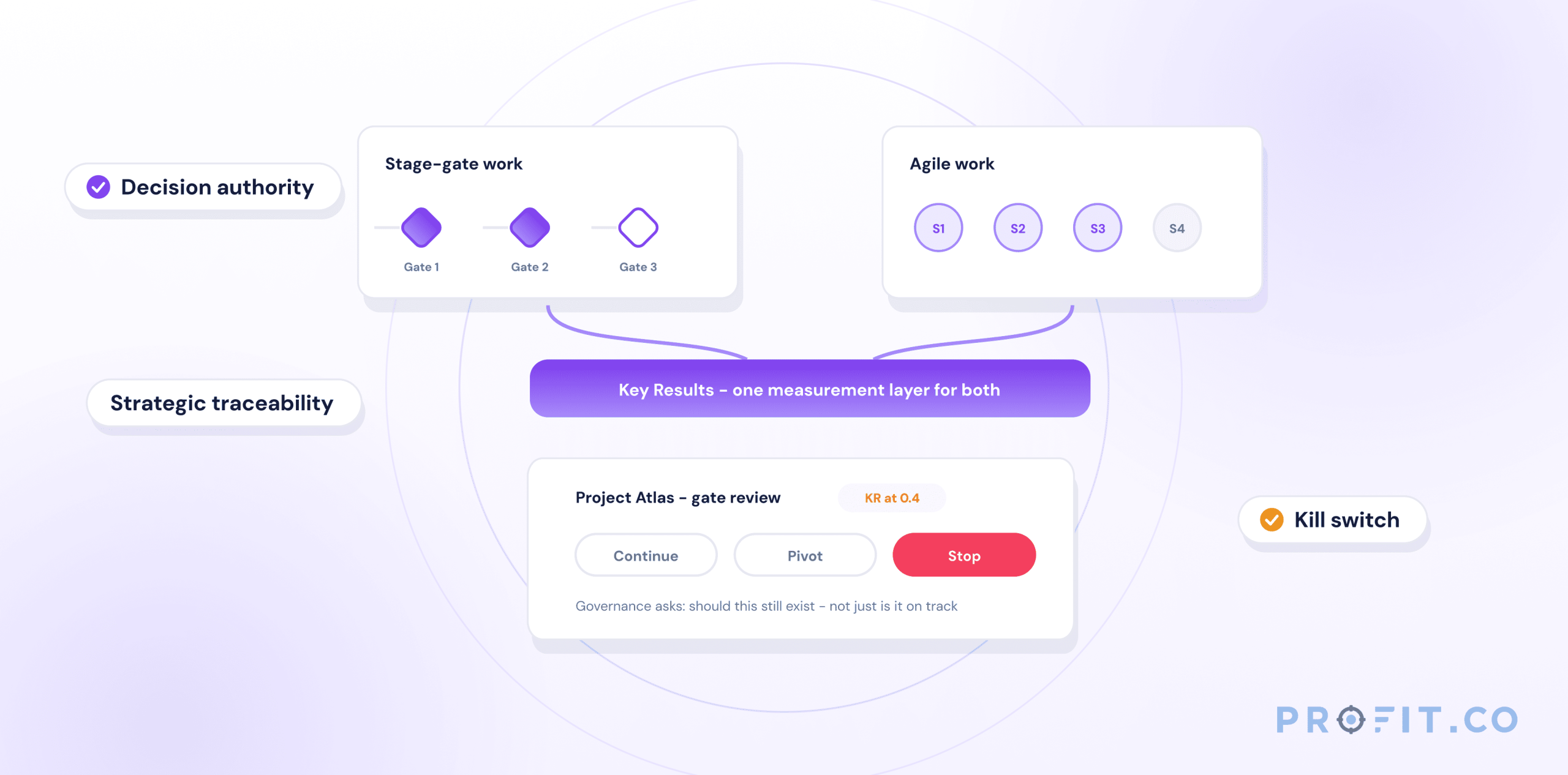
The stage-gate model brings structured governance: funding decisions, risk review, and formal go/no-go approval before a project moves to the next phase. It prevents organizations from throwing resources at initiatives that have not cleared a strategic bar. Its weakness is cadence; by the time a multi-month gate review concludes, the market context that justified the initiative may have already shifted.
Agile delivery brings adaptability: short sprints, continuous feedback, and the ability to redirect based on what teams learn during execution. Its weakness in a portfolio context is accountability; teams can sprint productively for quarters and still fail to connect their velocity to a measurable strategic outcome. Iteration without a strategic anchor is motion without direction.
The question is not which framework to use. It is what connects the two so they both move strategy forward, not just their own delivery metrics.
Choosing between the two is a false choice. The practical guide to agile vs. waterfall project management makes this clear: neither method was designed to govern a strategic portfolio on its own. Stage-gate handles investment decisions; agile handles delivery execution. The real structural challenge is not picking a method; it is identifying what connects the governance layer to the delivery layer so both operate from the same strategic signal.
Connect SPM Governance to Live OKRs, Starting this Quarter
How Do OKRs Bridge Stage-Gate Governance and Agile Delivery in Strategic Portfolio Management?
This is the structural insight most SPM frameworks miss entirely. The gap between stage-gate governance (annual or semi-annual review cycles) and agile delivery (two-week sprints) is not closed by a better tool or a longer planning meeting. It is closed by a quarterly operating rhythm, and OKRs are that rhythm.
Here is how the bridge works in practice:
- Quarterly key results become gate criteria. Instead of asking whether a project passed a formal gate review, the portfolio asks a more direct question: is this project moving the relevant key result? If the quarter ends and the key result connected to a project has not improved, that project has failed its gate, regardless of whether it delivered on scope. The strategic bar is clear, measurable, and reviewed on the same quarterly cadence that the business operates on.
- Sprint goals become execution units. Each two-week sprint is planned against the quarterly key result the project is designed to move. The sprint is not just a delivery container; it is a testable hypothesis about how to advance a specific strategic outcome. This connects daily execution to quarterly accountability in a way that neither governance reviews nor delivery retrospectives can achieve independently.
- Portfolio reviews happen quarterly, not annually. OKR review cycles create a natural cadence for portfolio reassessment. Projects connected to deprioritized or completed OKRs get flagged at the end of each quarter, not at next year’s planning event. The portfolio stays aligned to strategy as the strategy evolves, rather than drifting for twelve months between planning cycles.
This model is what connects agile goal management to portfolio governance in a structurally sound way. The key results provide the strategic anchor; the sprints provide the adaptive delivery mechanism. Neither works at portfolio scale without the other.
The Architecture Advantage
OKRs, PPM, and Task Management Connected in One Platform
A connected project portfolio management platform built on exactly this model links OKRs, PPM, and task management in a single architecture, so quarterly key results cascade directly into project plans, sprint goals, and individual tasks. The bridge between governance and delivery is structural, not procedural, and it is visible to portfolio reviewers and delivery teams in the same view.
What Does Strategic Portfolio Management Software Actually Need to Do?
Most standalone PPM tools solve for delivery visibility: which projects are on time, which are at risk, and which are overdue. That information is useful. It is not SPM. Delivery visibility without strategic context tells you that the work is progressing, not whether the work is worth progressing.
Effective strategic portfolio management requires five capabilities that generic project tools are not built to provide:
- Strategy-to-project linkage. Every initiative in the portfolio must connect to a specific OKR, balanced scorecard perspective, or strategic objective, and that link must be verifiable and visible to portfolio reviewers at all times, not just at annual planning.
- Real-time misalignment detection. When a project is progressing on schedule but the OKR it serves has been deprioritized, the system must flag that misalignment immediately, not at the next quarterly review. Strategic drift is cheapest to address when it is newest.
- Hybrid governance support. Stage-gate approval workflows and agile sprint cycles must coexist in the same portfolio view, with quarterly key results as the connective tissue that makes both layers legible to leadership.
- Automated progress collection. Portfolio reviews stall when data preparation takes longer than the strategic conversation. Direct integrations with delivery tools, Jira, Azure DevOps, Salesforce, and others, should populate project progress automatically, removing manual status updates from the review cycle entirely.
- Board-ready reporting without manual consolidation. Leadership and board reporting on portfolio performance should be a one-click export from live data. Not a quarterly spreadsheet exercise. Not a deck built from six different systems. The data should always be current enough to present without preparation.
“A portfolio tool that does not connect to strategy is just a project list.”
Organizations building this capability in 2026 are not managing the connection between their OKR software and their project management tools through exports and manual updates. They are replacing disconnected stacks with a single platform where strategy, portfolio, and task execution share the same data model, and where the quarterly OKR cadence governs investment decisions, not just goal reviews.
This is the shift that distinguishes SPM as a discipline from PPM as a function: the portfolio is not governed by project health alone, but by strategic relevance reviewed at the cadence the strategy demands.
Connect Your Strategy, Portfolio, and Execution in One Platform
Frequently Asked Questions
Strategic portfolio management (SPM) selects, prioritizes, and governs projects based on strategic alignment, not individual ROI. It connects capital allocation to strategic outcomes, ensuring the right work gets funded and resourced each quarter based on what current strategy requires.
PPM asks whether projects are executing well. SPM asks whether the right projects are being executed. SPM governs which initiatives receive funding based on strategic fit, then PPM executes them. The two disciplines are sequential, not interchangeable.
A hybrid model works best. Stage-gate governs funding and investment decisions. Agile sprints handle delivery execution. OKRs bridge the two: quarterly key results become gate criteria, and sprint goals become the execution units that move those strategic results.
Effective SPM software connects strategy, OKRs, Balanced Scorecard, to project portfolios and individual tasks in one platform, with automated progress collection via integrations, real-time misalignment detection, and automated board-ready reporting generated from live project and goal data.
Most SPM initiatives fail because strategy and execution live in separate tools, investment decisions are reviewed annually while delivery moves weekly, and there is no quarterly mechanism to flag and cut misaligned projects before resources are fully spent.