Portfolio governance is the decision-making framework that controls which projects an organization funds, continues, or cancels. It defines who approves project investments, when decisions are reviewed, and how every project connects to strategic priorities. Without it, project spending disconnects from organizational goals.
In this guide
- Why Does Portfolio Governance Fail in Most Organizations?
- What Does Portfolio Governance Actually Control?
- How Does Stage-Gate Governance Work?
- How Does Agile Delivery Change the Governance Model?
- Stage-Gate vs. Agile Governance: What Is the Actual Difference?
- What Is the Best Portfolio Governance Framework for Hybrid Organizations?
- How Do OKRs Bridge Stage-Gate Governance and Agile Delivery?
- Frequently asked questions
Why Does Portfolio Governance Fail in Most Organizations?
The standard assumption: governance means process control. Add checkpoints, approval committees, and review layers, and the portfolio manages itself. This assumption fails. It is the root cause of most portfolio governance breakdowns.
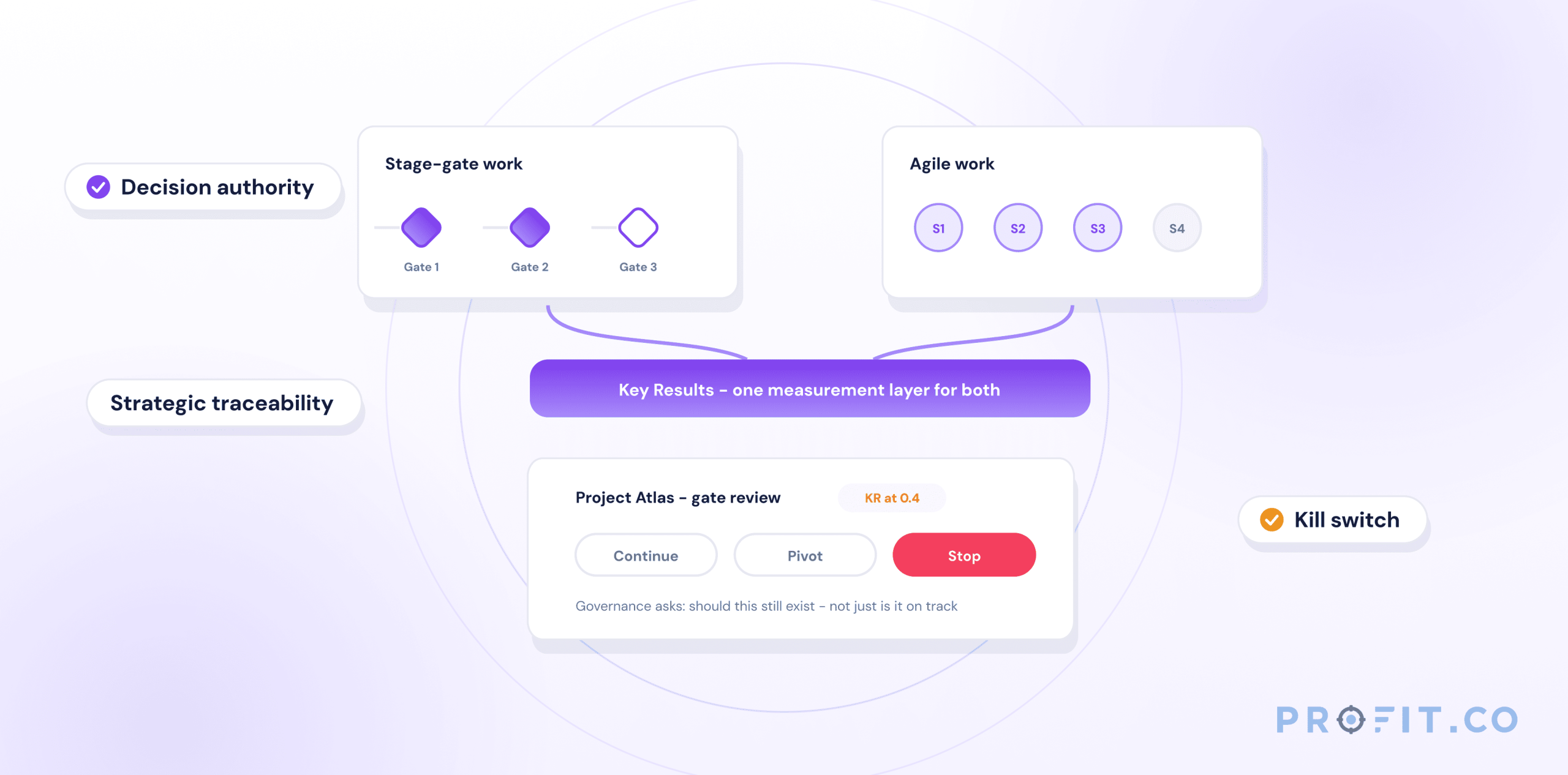
Most governance systems are built to answer one question: Is this project on track? Almost none are designed to answer the more important question: Should this project still exist?
A project can be on schedule, within budget, and completely misaligned with what the organization actually needs to achieve this quarter. Governance that only monitors compliance is watching the wrong clock.
“A project can be perfectly on track and completely misaligned. Governance that only watches schedule is watching the wrong clock.”
When strategy shifts, a market change, a new organizational priority, or a quarterly pivot, most governance frameworks do not respond. Projects continue because they were approved, not because they remain relevant. Organizations lose value twice: once when a misaligned project consumes budget, and again when the right project starves because the portfolio is already full.
Portfolio governance that checks method compliance rather than strategic outcome relevance is a primary contributor to strategy execution failure, and the pattern is consistent across industries, company sizes, and delivery methodologies. The failure mode is structural, not situational.
What Does Portfolio Governance Actually Control?
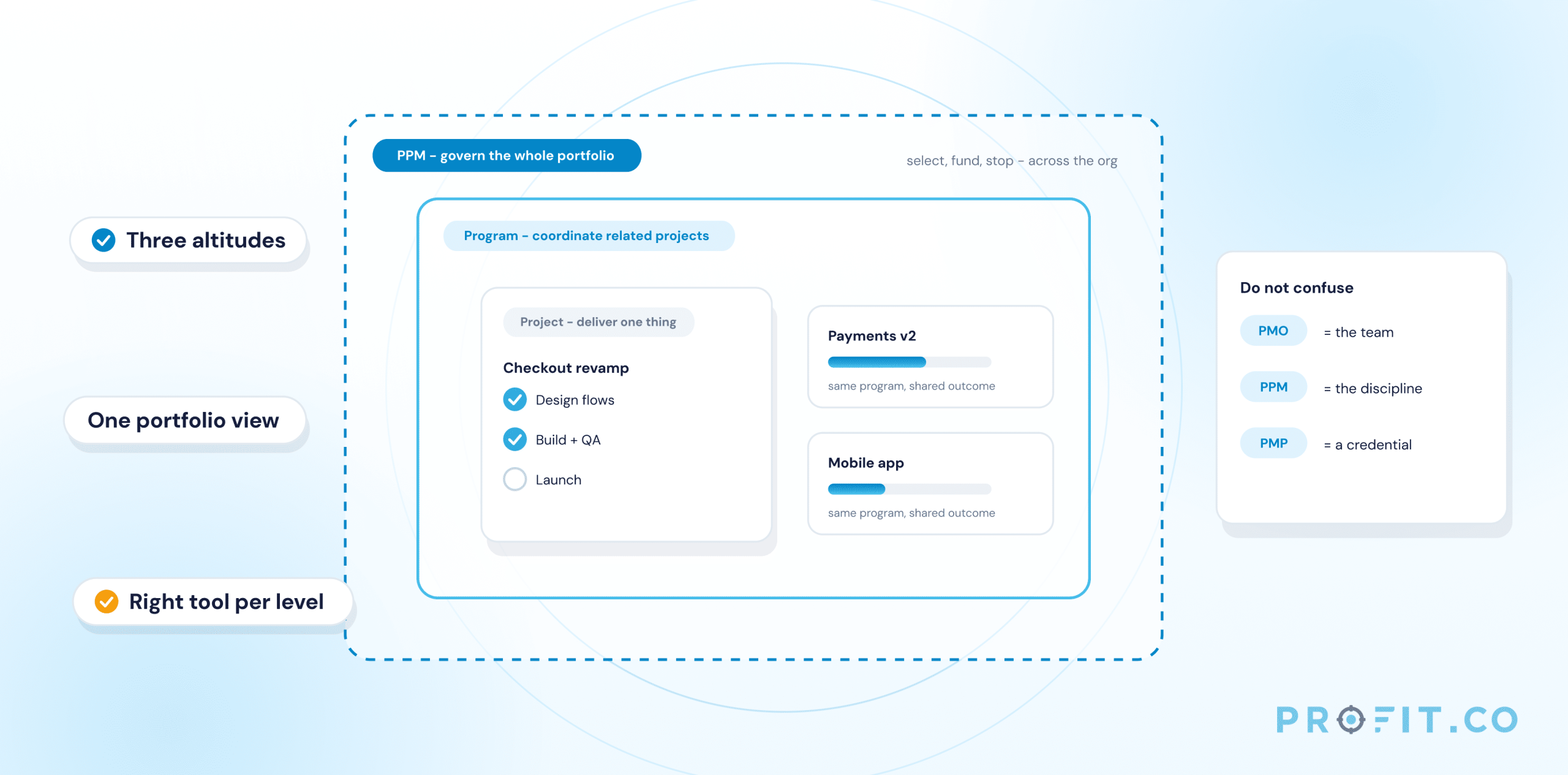
Portfolio governance is the set of rules, roles, and review processes that determine which projects receive investment approval, at what stage projects are continued or terminated, who holds decision authority at each threshold, and how projects are ranked against each other when resources are finite.
This is distinct from project management. Project management governs how an individual project is executed. Portfolio governance governs whether that project should be executed at all, and whether it still should be, as the quarter progresses.
1. Clear decision authority
Who approves what, at what investment threshold, and who can override. Without defined authority, decisions default to whoever applies the most pressure in the room, not whoever has the best strategic argument.
2. Stage-based review points
Defined moments when project continuation is reassessed, not assumed. Approval is not permanent. It is renewed at each review gate, against current strategic context, not the context that existed at the original approval.
3. Strategic traceability
Every active project connects to a measurable organizational priority. If a project cannot be traced to a current strategic objective, it requires immediate review, not a quiet continuation through inertia.
How Does Stage-Gate Governance Work?
Stage-gate governance divides a project lifecycle into sequential phases separated by formal decision checkpoints, called gates. At each gate, a review body assesses progress against defined criteria before approving resources for the next phase. No gate approval means no resource release.
The classic model has five stages: scoping, business case development, development, testing and validation, and launch. Each gate requires documented evidence that the current phase met its criteria before the next phase begins.
Stage-gate works well for capital-intensive infrastructure programs, pharmaceutical development, manufacturing initiatives, and regulated environments where compliance sign-off at each milestone is not optional. It front-loads risk assessment and prevents resource commitment before core assumptions are validated.
It breaks down when requirements change faster than the gate cycle allows, which describes most product, software, and customer-facing work running in organizations today. For a deeper look at gate decision architecture and how it connects to portfolio strategy, the stage-gate governance framework guide covers the full decision model.
How Does Agile Delivery Change the Governance Model?
Agile delivery replaces linear phase planning with iterative sprint cycles, typically two to four weeks each. Every sprint produces working output and a built-in review moment, compressing the decision loop rather than deferring it to a quarterly gate.
In an agile governance model, investment commitments are incremental rather than monolithic. Scope adjusts based on sprint outcomes. Risk is managed through iteration speed, discover what does not work early, at low cost, rather than through front-loaded analysis.
Agile governance works well for software and product development, customer-facing initiatives where requirements evolve, and any program where learning from early output should change what gets built next. The structural differences between methodologies are covered in the agile vs. waterfall project management guide.
Agile governance breaks down in regulated environments where milestone sign-off is mandatory, on large capital programs that cannot be funded incrementally, and in multi-team programs where coordinated delivery requires synchronized release gates. Neither model solves the full problem.
Stage-Gate vs. Agile Governance: What Is the Actual Difference?
Both models are right for specific contexts. Most organizations run both simultaneously and manage them in separate tools, measured against separate criteria, reviewed on separate cadences. This is where portfolio governance breaks down in practice, not from a failure of methodology, but from a failure of connection.
| Dimension | Stage-Gate Governance | Agile Governance |
|---|---|---|
| Decision cadence | Phase-based gates (weeks to months apart) | Sprint reviews every 2-4 weeks |
| Investment commitment | Full scope approved upfront | Incremental funding per sprint |
| Change tolerance | Low: changes require gate re-approval | High: backlog reprioritized each sprint |
| Best for | Capital projects, regulated environments | Product, software, fast-iteration work |
| Risk model | Front-loaded risk assessment | Continuous risk adaptation |
| Strategic alignment | Checked at gate points only | Checked at sprint review |
| Failure cost | High: late-stage failure is expensive | Low: small iterations fail fast and cheaply |
Connect Portfolio Governance to Live OKRs, Starting this Quarter
What Is the Best Portfolio Governance Framework for Hybrid Organizations?
No single methodology governs both capital project portfolios and agile delivery programs well. Organizations that run both types of work simultaneously need a governance layer that operates above both delivery methods, one that measures strategic relevance, not just process compliance.
The organizations that execute most consistently use OKRs as that connecting layer. Here is the logic:
Stage-gate teams need gate criteria. A measurable threshold that determines whether the project advances. OKR Key Results define exactly that: specific, time-bound performance targets that determine project continuation at each review point. Gate committees stop rebuilding decision criteria from scratch each quarter; the Key Result is the criteria.
Agile teams need sprint direction. An objective that guides sprint planning without dictating every task. OKR objectives provide this: a clear quarterly direction that makes sprint planning self-correcting. When each sprint is organized around advancing a measurable Key Result, alignment happens at the execution level rather than being imposed in a retrospective governance review.
“Governance that measures method compliance will always lose to governance that measures outcome relevance.”
The result: quarterly OKRs become the governance layer that binds both delivery models to the same strategic outcome. Gate criteria for stage-gate projects become Key Results. Sprint goals for agile teams align to the same quarterly objectives. Portfolio reviews stop comparing methodologies and start measuring strategic progress.
How Do OKRs Bridge Stage-Gate Governance and Agile Delivery?
The governance gap most organizations experience is not a process failure. It is a connectivity failure. Stage-gate and agile work run in parallel, managed in separate tools, measured against separate criteria, reviewed on separate cadences. The portfolio view is assembled manually; someone exports data from a project tool, copies it into a spreadsheet, and presents it to a governance committee that is already two weeks behind reality.
OKRs resolve this by introducing a common measurement layer. When quarterly Key Results define the success criteria for the entire portfolio, not just for individual projects, both stage-gate gates and agile sprint reviews answer the same strategic question every time they run: Are we advancing the Key Result?
The Architecture Advantage
OKR Management, PPM, and Portfolio Governance in One Connected Platform
The project portfolio management module connects directly to the OKR layer. Gate criteria are set as Key Results. Sprint progress updates OKR completion in real time. Portfolio reviews run from a single connected view rather than across disconnected systems, and governance committees see strategic progress, not just project status.
AI-powered agents extend this further: authoring builds Key Results from strategy prompts, progress monitoring flags delays before they become governance failures, and OKR quality scoring evaluates each goal against measurable criteria before the quarter begins.
Teams applying this to agile goal management find that sprint planning becomes faster and portfolio reviews become shorter, because alignment is visible rather than argued. A connected OKR management platform connects both layers to the same governance cadence, meaning portfolio governance stops being a reporting exercise and starts operating as a live strategic system.
The difference between organizations that execute consistently and those that do not is rarely a delivery methodology question. It is a governance architecture question: whether the system connecting strategy to project investment is live and connected, or static and assembled manually once a quarter.
Connect Your Project Portfolio to Strategic OKRs, in One Platform
Frequently Asked Questions
Portfolio governance is the decision-making framework that controls which projects an organization funds, continues, or cancels. It defines approval authority, review cadence, and the rules connecting every project investment to measurable strategic outcomes.
Portfolio governance works through defined review checkpoints, investment approval thresholds, and strategic alignment criteria. Projects are assessed at each stage against performance metrics and strategic relevance, not just schedule and budget compliance.
Project governance controls how an individual project is executed, scope, budget, timeline, and delivery quality. Portfolio governance controls whether a project should exist at all, how it ranks against competing investments, and when to continue, pause, or cancel it.
Hybrid teams running both stage-gate and agile delivery need OKRs as the connecting governance layer. Quarterly Key Results become gate criteria for stage-gate projects and sprint direction for agile teams, connecting both delivery methods to the same strategic outcomes.
OKRs improve portfolio governance by providing a shared measurement layer across delivery methods. Key Results define gate criteria for stage-gate projects and sprint objectives for agile teams, ensuring all active work connects to the same quarterly strategic priorities.