OKR in performance reviews means scoring each quarter’s Key Results as the evidence base for the review, replacing annual ratings and manager recall with traceable outcomes. Most companies layer OKRs onto an existing review cycle without changing how evidence is collected, so quarterly goals and annual ratings end up measuring two unrelated things.
In this guide
- What Is OKR in Performance Reviews?
- How Are KPIs Different From OKRs in Performance Management?
- Why Does OKR in Performance Reviews Fail for Most Companies?
- How Does OKR Performance Fit Into a Stage-Gate and Agile Hybrid Model?
- What Is the Best Way to Use OKR in Performance Reviews?
- Which Platform Supports OKR and PPM Together for Performance Reviews?
- Frequently asked questions
What Is OKR in Performance Reviews?
OKR in performance reviews is the practice of scoring an employee or team’s quarter against the Key Results they committed to, then using that score as primary input for the review: not the only input, but the anchor. Objectives state the direction; Key Results state the measurable proof. A review built on this structure asks “did the number move” before it asks “did it feel like a good quarter.”
The shift matters because most performance reviews currently run on recall. A manager tries to reconstruct twelve months of work from memory, Slack threads, and a self-assessment written the week before the deadline. The harder it is to see a clear line between daily work and a goal that matters, the less useful the resulting review tends to be. OKRs give reviews that line. KPIs and annual ratings don’t.
How Are KPIs Different From OKRs in Performance Management?
KPIs measure the health of an ongoing process. OKRs measure progress toward a defined, time-bound change. A support team’s average response time is a KPI: it should stay healthy indefinitely. “Cut average response time from 6 hours to 2 hours this quarter” is an OKR: it has a finish line. Performance reviews that confuse the two end up grading people on whether the lights stayed on, not whether anything improved.
| KPI | OKR |
|---|---|
| Ongoing health metric | Time-bound outcome with an end date |
| Stays roughly constant when things are working | Moves from a baseline to a target |
| Owned by a function or process | Owned by a team chasing a specific change |
| Good for operational dashboards | Good for performance conversations and strategic reviews |
| Tells you something is wrong | Tells you whether the quarter’s bet paid off |
In practice, a strong performance review uses both: KPIs as the guardrails that confirm nothing broke while OKRs were being chased, and OKRs as the scoreboard for whether the quarter actually moved the business forward.
Why Does OKR in Performance Reviews Fail for Most Companies?
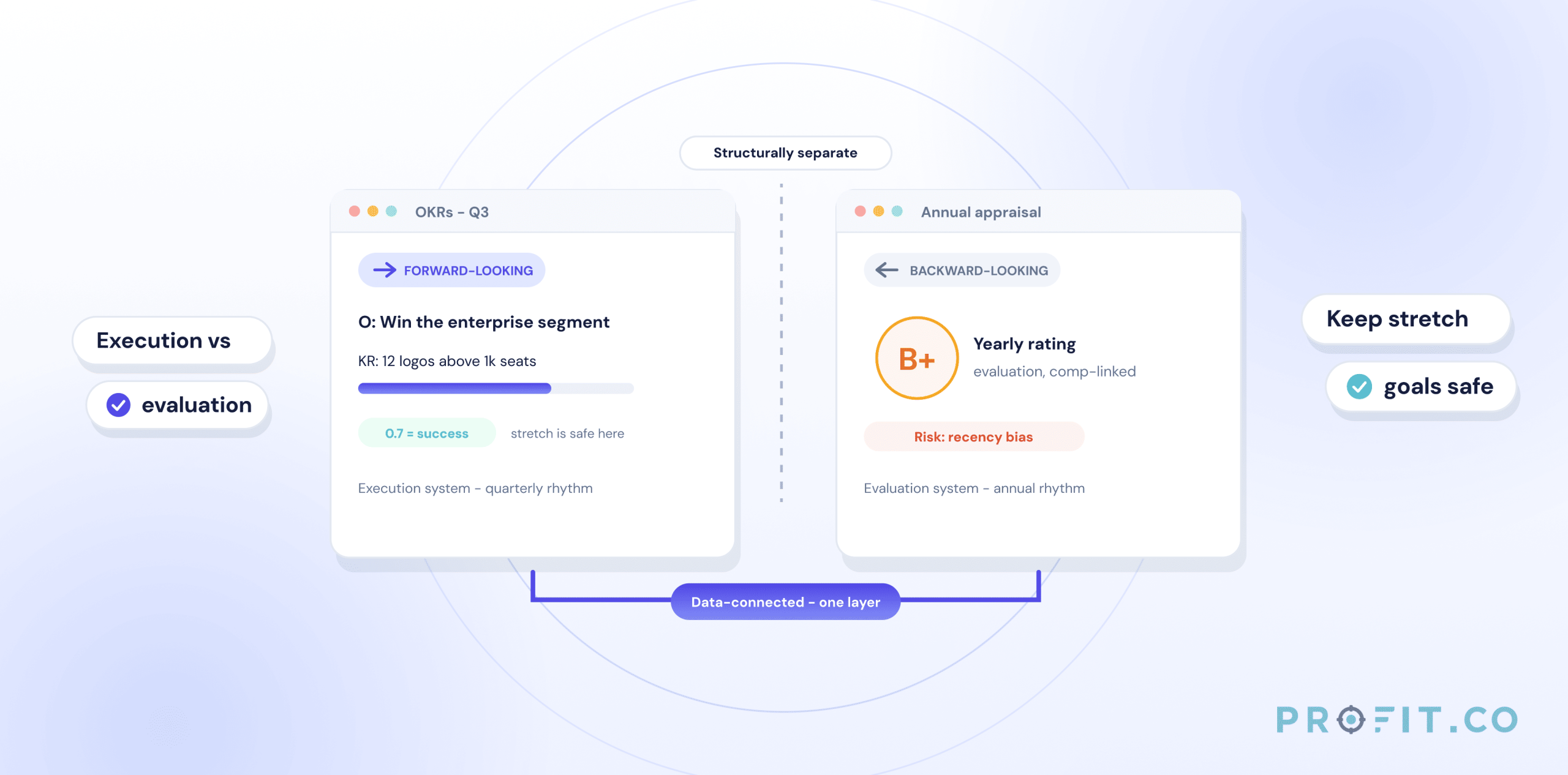
Most companies believe that introducing OKRs automatically fixes a broken review process. It doesn’t. The OKR framework only changes what gets measured: it does nothing about how reviews are conducted unless the two systems are deliberately wired together. This breaks at scale because the OKR cycle (quarterly) and the review cycle (often annual or semi-annual) run on different clocks, so by review time, three or four quarters of context have already evaporated.
When the rating supporting a review was never captured close to the work, it stops reflecting what actually happened and starts reflecting whoever spoke last in the calibration meeting. Most performance reviews fail structurally, not motivationally. The problem isn’t that managers don’t care; it’s that the system never asked them to record evidence when it happened.
A second, quieter failure: companies treat the OKR score itself as the entire review. A team that hits 0.4 on a Key Result gets penalized the same way regardless of whether they aimed too high on purpose or simply didn’t execute. Score without context produces resentment, not insight. Speed without direction is faster failure, and a low score without a “why” is just noise dressed up as data.
See Your Next Review Built on Traceable OKR Data
How Does OKR Performance Fit Into a Stage-Gate and Agile Hybrid Model?
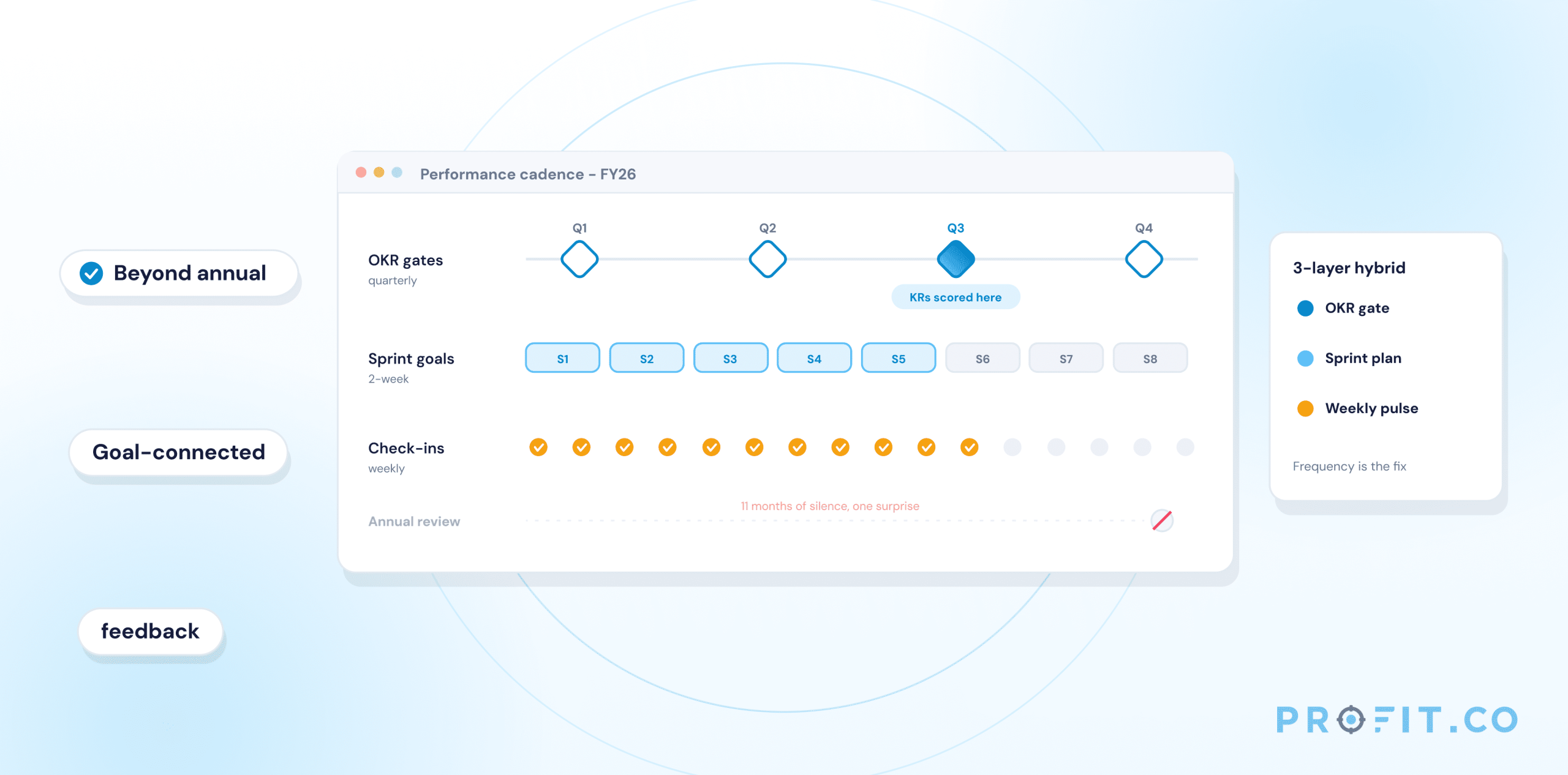
Companies running formal stage-gate project management alongside agile delivery teams usually treat OKRs as belonging to one camp or the other, but quarterly Key Results function as the gate criteria stage-gate governance has always needed, while sprint goals are the execution units that get teams there. The OKR quarter is the natural bridge between the two: it’s short enough to act like a sprint cadence, and structured enough to act like a gate review.
| Stage-gate governance | Agile delivery |
|---|---|
| Gate criteria decide whether a phase proceeds | Sprint goals decide what gets built this cycle |
| Reviewed at fixed milestones | Reviewed every sprint |
| Strong on risk control and sequencing | Strong on speed and adaptation |
| Weak on day-to-day execution visibility | Weak on long-range portfolio accountability |
Treated this way, the OKR quarter inherits the rigor of agile vs waterfall project management debates without forcing teams to pick a side. Key Results become the gate; sprints become the path through it. A goal you can’t trace to a sprint isn’t a goal, it’s a wish, and this is exactly where most hybrid attempts quietly fall apart: the OKR sits in one tool, the sprint board sits in another, and no one can trace the line between them at review time.
This is the structural gap most standalone OKR software never closes. Connecting Key Results to actual project phases and task-level execution requires OKR and PPM integration: goals, portfolios, and tasks living in the same system, scored from the same data. Without that connection, a performance review is still built on someone’s best guess about what the numbers mean.
What Is the Best Way to Use OKR in Performance Reviews?
The best approach scores three layers separately, then combines them into one conversation: the Key Result outcome (did the number move), the execution quality (was the work that drove it sound), and the context (what changed mid-quarter that the goal didn’t account for). Reviews that skip straight to the score miss the second and third layer entirely.
Tracking whether project outcomes actually delivered intended value, not just whether the project shipped on time, is what separates a rigorous review from a checklist exercise. The same logic applies to performance reviews: scoring delivery without scoring outcome value produces a review that looks rigorous and tells you almost nothing.
Teams using agile goal management practices tend to do this well because check-ins happen continuously instead of being reconstructed at quarter-end. By the time the formal review happens, there’s already a documented trail of confidence scores, blockers, and mid-quarter adjustments: the review becomes a summary of known facts, not a negotiation over disputed memory.
Which Platform Supports OKR and PPM Together for Performance Reviews?
Most OKR platforms stop at the goal layer. They track Objectives and Key Results well, but they have no visibility into the projects, tasks, or sprints actually producing the result, so the “evidence” behind a review still has to be assembled manually from a separate project tool. Most PPM tools have the opposite problem: strong on portfolios and phases, blind to whether any of it ties back to a strategic goal.
The Architecture Advantage
Key Results Scored From Live Task and Sprint Data in One Connected System
Profit.co’s OKR + PPM + task management platform closes that gap directly. Key Results are scored from live task and sprint data inside the same system, so a quarterly review pulls real execution history instead of a manager’s interpretation of it. The hybrid model, gate criteria from quarterly OKRs paired with execution units from agile sprints, runs natively, not as a workaround stitched together across disconnected tools.
AI-powered agents do the work that used to happen manually before a review: self-assessment tools help employees turn their quarter into a data-driven reflection, progress monitoring cuts reporting time so teams spend more of the quarter on results instead of status updates, alignment checks unify direction across teams and catch Key Result drift before anyone notices, and quality scoring catches vague or unmeasurable Key Results before they ever reach a review cycle. A track record of verified G2 reviews confirms this in practice, built on teams running OKRs and project execution inside one connected system.
Connect Your Next Review to Traceable OKR Data
Frequently Asked Questions
OKR in performance reviews is the practice of using quarterly Objectives and Key Results, scored against real outcomes, as the primary evidence for evaluating employee and team performance instead of annual self-recall.
KPIs track ongoing process health and stay roughly constant. OKRs track time-bound outcomes that move from a baseline to a target within a quarter, then close.
No. OKRs supply outcome evidence, but reviews also need execution quality and context. OKRs strengthen reviews; they don’t eliminate the conversation around them.
Score outcome, execution quality, and quarter-context separately, then combine them. Continuous check-ins during the quarter prevent the review from relying on reconstructed memory.
Key Results should be checked weekly or biweekly, with a formal scored review each quarter. Annual reviews should summarize four quarters of recorded OKR data, not replace them.