OKR for employee performance is the practice of scoring an individual’s quarterly contribution by measurable Key Results tied to a stated Objective, rather than by task completion. Most companies treat it as a scoring tool, which reduces performance tracking to a quarterly checklist disconnected from daily work.
In this guide
- What Is OKR for Employee Performance?
- How Does OKR Improve Employee Performance and Engagement?
- Why Do Most OKR Programs Fail to Improve Performance?
- OKR vs Traditional Performance Management
- What Is the Best Way to Combine OKRs, Stage-Gates, and Agile Sprints?
- Real OKR Work Performance Examples for Individual Contributors
- Frequently asked questions
OKRs were never meant to be a performance review template. They were built to answer one question: is the work happening right now still pointed at the outcome that matters? Most performance management systems answer a different question entirely: did the employee complete their assigned tasks. That mismatch is why so many OKR rollouts produce activity without progress.
What Is OKR for Employee Performance?
OKR for employee performance means scoring an individual’s quarterly contribution by measurable outcomes (Key Results) tied to a stated Objective, rather than by task completion or manager opinion. Instead of “improve customer support,” a Key Result reads “reduce average resolution time from 6 hours to 3 hours.” The number replaces the adjective. Performance becomes verifiable instead of negotiated.
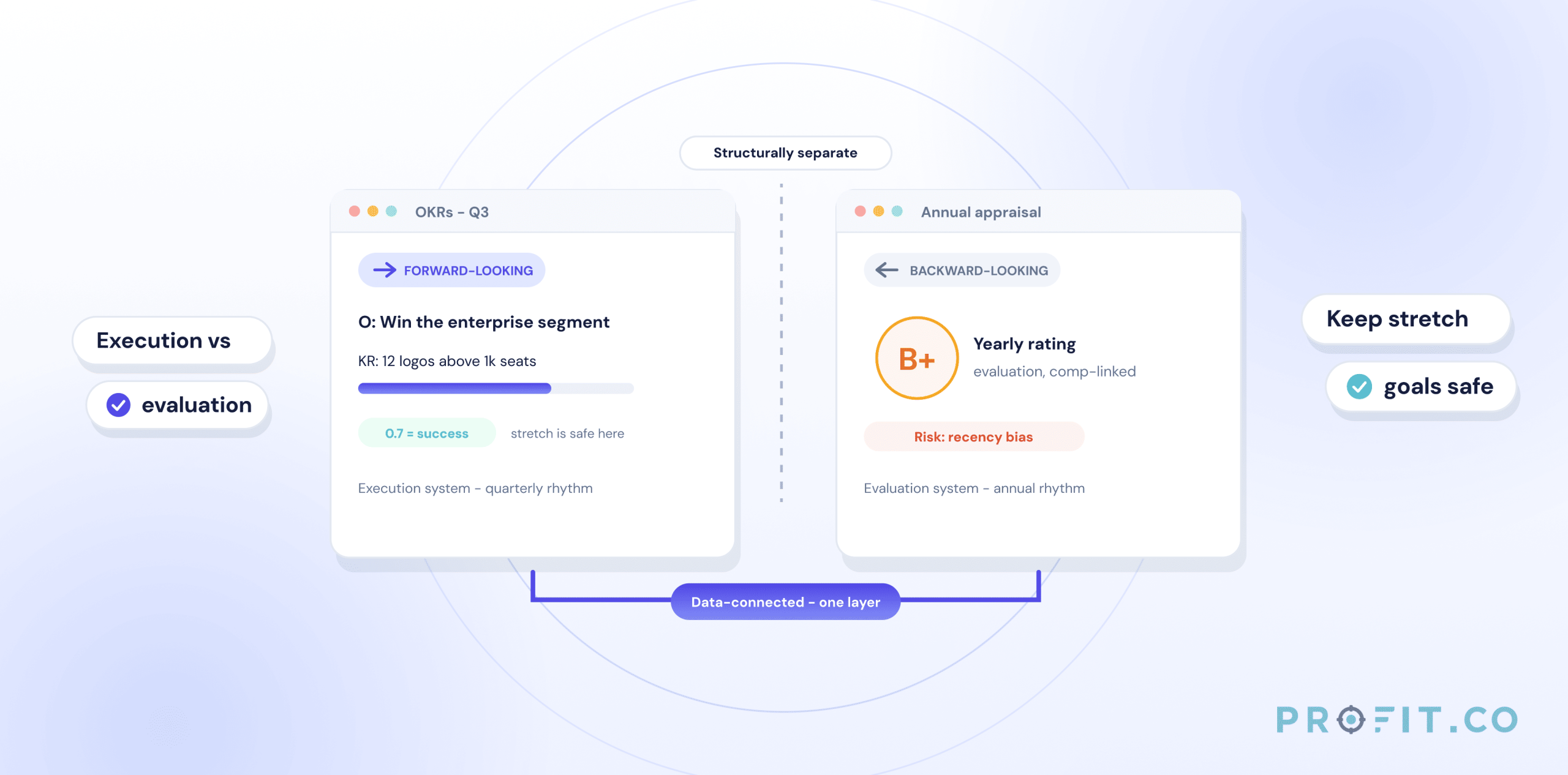
Most companies believe OKRs and performance reviews are the same exercise wearing different language. They are not. A performance review asks how someone did. An OKR asks whether the right thing got done. Conflating the two is the single most common reason OKR programs lose credibility inside the first year: employees start writing Key Results to look good in a review, not to move a number that matters.
How Does OKR Improve Employee Performance and Engagement?
OKRs improve performance by forcing clarity at three levels: company, team, and individual, and improve engagement by showing each employee exactly how their work connects to outcomes leadership cares about. Employees who clearly understand what’s expected of them tend to engage more fully with their work, because clarity removes the guesswork that quietly erodes motivation. OKRs operationalize that expectation instead of leaving it to a manager’s memory.
This breaks down at scale when companies cascade Objectives top-down without letting teams write their own Key Results. Organizations that let teams define how they’ll hit a shared target tend to see far more ownership of outcomes than organizations that simply hand down rigid, command-driven goal cascades. Ownership, not alignment, is what drives the engagement lift. Alignment without ownership produces compliance, not performance.
“Speed without direction is faster failure, and alignment without ownership is just compliance with better language.”
Why Do Most OKR Programs Fail to Improve Performance?
Most OKR programs fail not because the framework is flawed, but because companies run OKRs and project execution as two separate systems that never talk to each other. Quarterly Key Results live in a goal-tracking tool. Daily work lives in a project tracker or a stage-gate checklist. By the time a quarterly review happens, nobody can trace which sprint, task, or gate decision actually moved the Key Result.
This is a structural failure, not a motivational one. Poor alignment between strategy and execution is one of the most common reasons organizations fall short of the value a project was originally meant to deliver. Most dashboards fail structurally, not visually: the chart looks fine, but it’s measuring the wrong layer of work.
The second failure point is cadence mismatch. Stage-gate governance runs in phases that can span months. Agile delivery runs in one- or two-week sprints. A quarterly OKR sitting between them either gets ignored by agile teams (too slow) or treated as bureaucratic overhead by stage-gate teams (too vague). Neither side trusts it, so both sides route around it.
OKR vs Traditional Performance Management: Which Works for Hybrid Teams?
Traditional performance management was built for stable, annual-cycle work. Hybrid teams, running stage-gated programs with agile sprint delivery inside them, need a measurement layer that updates quarterly but reads daily. That’s the structural argument for OKRs over annual review cycles in any organization mixing governance and agile delivery.
| Dimension | Traditional Performance Management | OKR-Driven Performance Management |
|---|---|---|
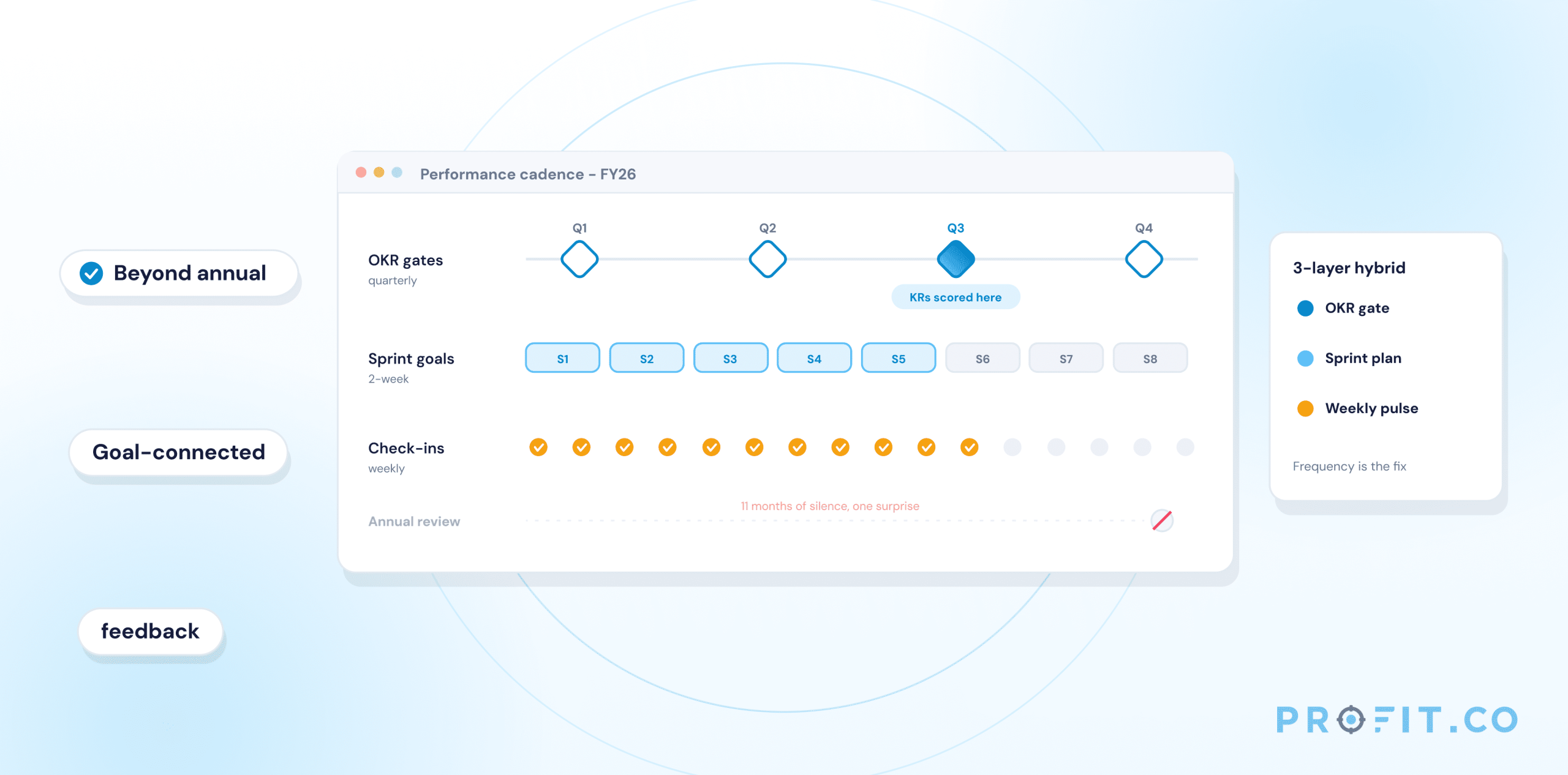
| Review cadence | Annual or semi-annual | Quarterly, with weekly check-ins |
| Measurement basis | Manager judgment, task completion | Quantified Key Results tied to outcomes |
| Link to daily work | Indirect, reconstructed at review time | Direct: sprint goals roll up into Key Results |
| Fit for governance | Strong on compliance, weak on adaptability | Quarterly Key Results double as gate criteria |
| Fit for agile delivery | Too slow to reflect sprint-level reality | Sprint goals become the execution unit under each Key Result |
See Your OKR-to-Gate Mapping in a Live Workspace
The decision is not “OKRs instead of governance” or “OKRs instead of agile.” It’s structural sequencing: which layer sets the criteria, and which layer does the work. A stage-gate project management framework answers what must be true before a phase can close. Agile vs waterfall project management answers how the work inside that phase gets built. OKRs sit between them as the measurement layer that gives both their criteria.
What Is the Best Way to Combine OKRs, Stage-Gates, and Agile Sprints for Performance Tracking?
The hybrid model that works treats quarterly Key Results as the gate criteria and sprint goals as the execution units underneath them. A gate doesn’t open because a date arrived; it opens because the Key Result tied to that phase hit its threshold. Inside the phase, agile teams run sprints toward that same Key Result, updating it weekly instead of quarterly.
This only works structurally if the OKR system, the project plan, and the task tracker share the same data layer. An OKR-native platform with built-in agile goal management capability lets a sprint task update its parent Key Result automatically, and lets that Key Result feed a stage-gate decision in the same view.
“A framework that can’t see its own execution layer isn’t measuring performance: it’s measuring paperwork.”
The Architecture Advantage
OKR and PPM Integration, Key Results Connected to Stage-Gate Phases and Sprint Boards
A connected OKR platform with OKR and PPM integration links quarterly Key Results directly to stage-gate phases and sprint boards. AI-powered agents handle work a quarterly review used to do manually: authoring turns a strategy statement into a high-impact Key Result before it ever reaches a tracker, progress monitoring converts raw check-in notes into a structured update so a gate decision is never based on a stale percentage, quality scoring flags vague or unmeasurable goals before the quarter begins, and alignment checks catch cross-team conflicts before they surface in a gate review.
More than 100 integrations pull execution data from wherever teams already work, so the Key Result reflects what actually happened in the sprint, not a manually updated percentage someone typed in the night before the review.
What Are Real OKR Work Performance Examples for Individual Contributors?
A support engineer’s Objective might be “Make resolution speed a competitive advantage,” with a Key Result of “Cut average ticket resolution time from the current baseline to a defined target.” A product manager’s Objective could be “Ship a feature customers actually adopt,” with a Key Result of “Reach a defined weekly active usage threshold for the new dashboard within a set window after launch.” Both examples share a pattern: the Key Result is a number someone can disagree with, not a sentiment someone has to interpret.
The pattern that fails: Key Results written as tasks, such as “Launch the new onboarding flow.” A launch is binary; it tells you nothing about whether the outcome happened. Rewriting it as “Increase onboarding completion rate to a defined target” keeps the task as a sprint deliverable underneath, while the Key Result measures whether the task actually worked.
See Your Key Results Connect to Gate Decisions and Sprint Boards
Frequently Asked Questions
OKR for employee performance is a method that scores individual contribution against measurable Key Results tied to a stated Objective, replacing task-completion tracking with outcome-based measurement.
OKRs improve engagement by giving employees clear visibility into how their work connects to company outcomes, which builds a stronger sense of purpose and ownership.
The best approach uses quarterly Key Results as gate criteria and sprint goals as the execution units beneath them, connected through one shared platform rather than separate tools.
Profit.co supports OKRs, project portfolio management, and task management in one OKR-native platform, connecting quarterly Key Results to stage-gate phases and sprint boards directly.
Choose OKRs when teams need quarterly, outcome-based tracking linked to daily execution; choose traditional reviews only for compliance-driven, low-change roles with stable annual goals.