Combining OKRs with performance management means feeding live OKR progress and scores directly into the formal review process, so managers evaluate strategic contribution instead of relying on memory. Most companies run these as two disconnected systems, so reviews measure activity instead of real progress against company priorities. Linking them turns every review into a data-backed discussion.
In this guide
- What Happens When OKRs and Performance Management Run Separately?
- How Does Combining OKRs With Performance Management Change the Review Itself?
- Why Do Most OKR Implementations Fail to Connect to Performance Reviews?
- What Is the Best Way to Connect OKRs to Performance Reviews?
- How Does Profit.co Connect OKRs to Performance Management Differently?
- Frequently asked questions
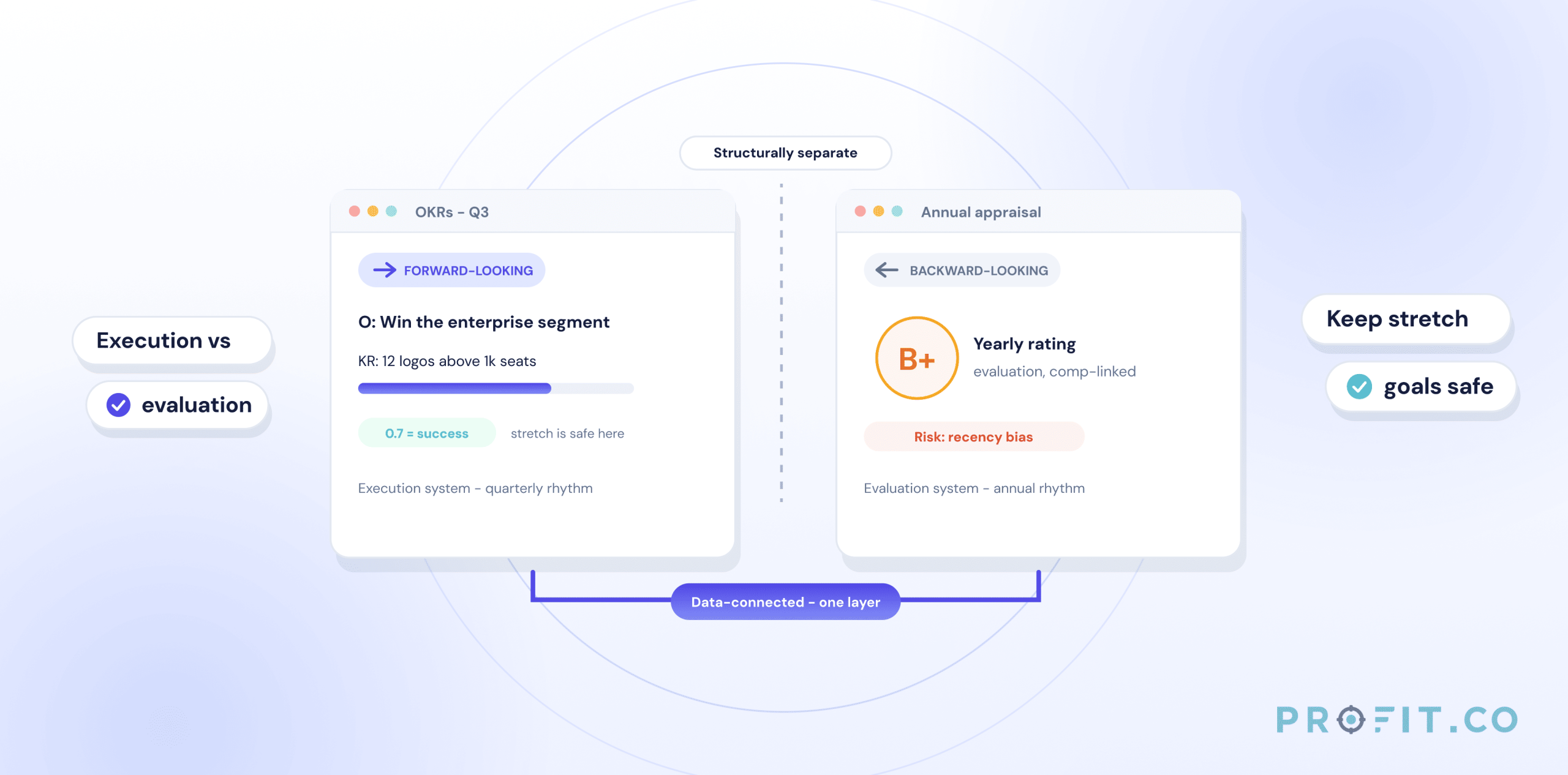
Most HR teams treat OKRs and performance reviews as separate exercises that happen to share a calendar. The OKR tool tracks what the team is trying to achieve. The performance system tracks what gets rewarded. Nobody connects the two, so the conversation a manager has in a Q3 review often has nothing to do with the Q3 OKR a direct report was actually graded against. That gap is not a tooling inconvenience: it is the reason performance reviews feel disconnected from real work.
What Happens When OKRs and Performance Management Run Separately?
When OKRs and performance management run in separate systems, managers write reviews from memory, Slack threads, and whatever the employee happens to mention in a self-assessment. The quarterly key result that defined someone’s actual priority never makes it into the review document. The goal that mattered most that quarter and the document that decides someone’s raise are produced by two systems that have never spoken to each other.
This is the structural failure most HR leaders misread as a communication problem. It is not a communication problem. It is an integration problem. Reviews drift toward recency and personality because there is no continuously updated record of what someone was actually accountable for. Manager feedback skill is not the missing variable. A continuously updated record of what someone was actually accountable for is.
How Does Combining OKRs With Performance Management Change the Review Itself?
Combining the two systems changes the review from a retrospective opinion into a documented audit of quarterly outcomes. Instead of a manager asking “how do you think this quarter went,” the review opens with the actual key results, their final scores, and the specific work items tied to each one. The conversation moves from defending effort to discussing what got in the way of the result.
That shift changes what alignment actually means inside a company. Alignment stops being a slide in a culture deck and becomes a property of the system itself: it only exists when the goal-tracking layer and the review layer pull from the same data, every quarter, without a manual handoff in between.
| Separate OKR and PMS | Combined OKR + PMS |
|---|---|
| Review based on manager memory and self-reported wins | Review pulls live OKR scores and linked work items automatically |
| OKR check-ins and review cycles run on different calendars | Quarterly OKR cycle and review cycle share the same cadence and data |
| HR cannot show the C-suite a link between goals and performance ratings | HR reports performance ratings against documented strategic contribution |
| Calibration relies on manager opinion across teams | Calibration uses comparable OKR completion data across teams |
| Recognition is disconnected from goal achievement | Recognition surfaces directly from OKR and task completion data |
Connect OKRs to Performance Reviews
Why Do Most OKR Implementations Fail to Connect to Performance Reviews?
Most OKR rollouts fail to reach the performance layer because the two systems were procured by different teams for different reasons. Operations bought the OKR tool to drive execution. HR bought the performance system to standardize reviews and stay compliant. Nobody owned the integration, so the two platforms sit side by side, each holding half the picture.
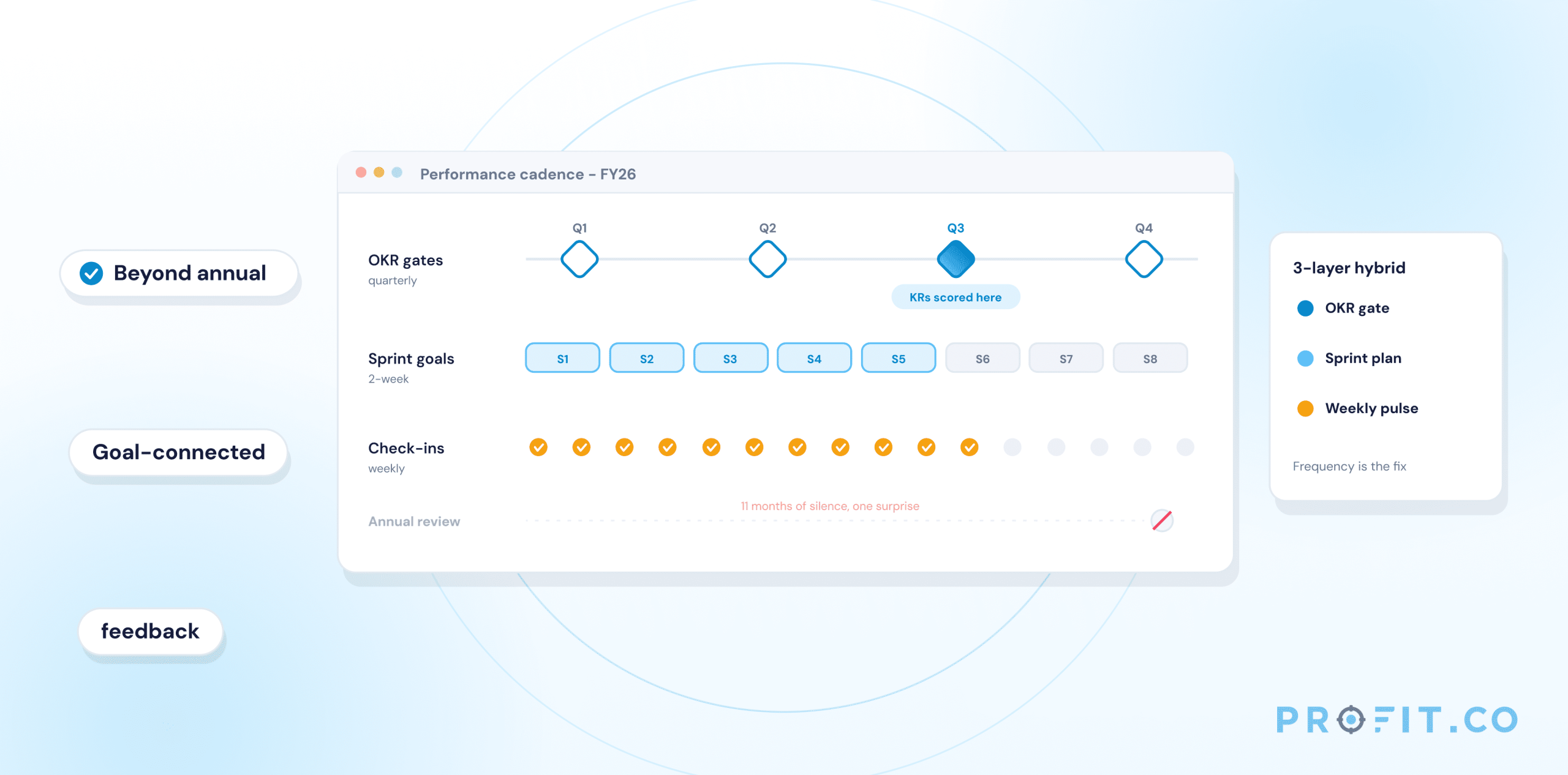
The second failure point is cadence mismatch. OKRs run quarterly. Annual or semi-annual reviews try to summarize four quarters of work in one conversation, and the detail from quarter one is gone by the time the review happens. A review that runs once a year is not a slower OKR cycle. It is a different system, evaluating different data, on a different clock.
A frequently overlooked structural fix is treating the OKR cycle itself as the bridge between two methodologies that usually compete for ownership of execution: stage-gate governance and agile delivery. Quarterly key results act as the gate criteria leadership uses to approve continued investment in an initiative, while the underlying sprint goals are the execution units teams use to hit those key results week to week. This is the same logic that separates a stage-gate project management framework from an agile vs. waterfall project management approach, except instead of forcing a choice between them, the OKR cycle gives each model the role it is actually good at.
What Is the Best Way to Connect OKRs to Performance Reviews?
The best approach links OKR scores, check-in history, and linked project or task completion data directly to the review template, so the review generates itself from real activity instead of starting from a blank page. This requires the OKR system and the performance system to share a data layer, not just a calendar.
Most companies that try to fix this manually end up building a spreadsheet bridge: someone exports OKR scores once a quarter and pastes them into the review tool. That workaround breaks the moment OKRs get updated mid-cycle, which is exactly when the review data needs to be most current. Picture a 300-person company running quarterly OKRs across 12 departments: if one HR coordinator manually exports and reconciles scores for every team before each review cycle, that is 12 separate exports, four times a year, recreated from scratch every quarter because nothing carries forward automatically. Closing that gap for good means giving managers a review screen that already shows the quarter’s OKR results before they write a single word.
How Does Profit.co Connect OKRs to Performance Management Differently?
Profit.co runs OKR management, performance reviews, and project portfolio management on one data layer, so quarterly key results, the sprint-level tasks tied to them, and the review template all draw from the same record. The OKR cycle becomes the literal bridge between stage-gate governance and agile execution: gate criteria at the quarter level, sprint goals underneath them, and that bridge only holds because OKR, PPM, and task management live in one platform instead of three.
The Architecture Advantage
OKR Progress, Project Data, and Review Templates on One Data Layer
AI-powered review agents pull OKR progress and linked task completion directly into the review draft, removing the manual data assembly that turns review season into a quarter-long scramble. This connects the goal layer, the project layer, and the review layer natively, so the agile goal management framework teams use to plan sprints is the same data a manager sees in the review.
For teams building this kind of structure, the starting point is the OKR and project portfolio management bridge, which connects the quarterly key result layer to the project and task layer before performance data ever enters the picture. From there, the OKR management platform becomes the single source of truth both systems rely on.
Connect OKRs to Performance Reviews Today
Frequently Asked Questions
Combining OKRs with performance management means feeding live OKR progress and scores directly into the formal review process, so managers evaluate contribution to strategy instead of relying on memory or self-reported summaries.
OKRs improve review quality by giving managers a documented, quarter-by-quarter record of what an employee was accountable for, replacing recency-biased opinion with verifiable progress data.
The best platform connects OKR management, performance reviews, and project portfolio management on one data layer, so review templates draw automatically from OKR scores and linked task completion. Profit.co provides this through its connected OKR, PPM, and Performance Review modules.
Choose one platform when review accuracy, calibration consistency, and HR reporting on goal-performance alignment matter more than the flexibility of point solutions. Separate tools work only when goal data and review data never need to meet.
OKRs do not replace performance reviews; they supply the evidence reviews are missing. The review still covers behavior, growth, and compensation decisions, but with OKR data anchoring the conversation to actual quarterly outcomes.