Objectives and key results (OKR) are time-bound goal-setting frameworks that help you meet your business objectives. When your OKR project expires, a retrospective reveals insight into your performance and drives future success. Retrospective OKRs are an effective tool for continuous improvement and building a constant learning and growth culture.
This guide shows you how to conduct an OKR retrospective and what you gain from this agile approach to business goals.
What is an OKR Retrospective, and why is it important?
An OKR retrospective is a look at your objectives and key results to track your project’s progress. It enables you to learn important lessons about your projects and plan strategically to improve future performance, especially if you’re using OKRs for the first time.
OKR retrospectives are ideally held quarterly for insights about your project’s accomplishments, setbacks, and improvement opportunities. Some OKR retrospective questions include:
- Did we set the right OKRs for the project?
- Did we define the right goals?
- Did we include everyone on the team?
- Did we establish clear, measurable objectives and key results?
- Did we make more, less, or as much progress as we expected?
- What did we learn from the OKR approach?
- How can we use OKRs to improve our next project?
Follow effective action with quiet reflection. From the reflection will come even more effective action.

Benefits of conducting an OKR Retrospective
An OKR retrospective helps individuals and teams to reflect on their performance, learn from mistakes, and make strategic plans for the future. To reap the full benefits of OKRs, OKR reflection or Retrospective is essential.
More specifically, OKR retrospectives:
- Prioritize your project goals to meet your company’s overall vision and mission
- Encourage transparency in the strategic planning process
- Enable collaboration throughout the OKR process
- Reveal patterns behind obstacles or challenges in project management and performance
- Provide concrete and actionable improvements for better performance
How to conduct an OKR Retrospective?
While there are many techniques to conduct an OKR retrospective, the easiest is the start-stop-continue method. It takes 30 minutes to an hour to complete and uses a straightforward structure.Step 1: Divide your team into groups to brainstorm your OKR project.
Step 2: Discuss what your team should start doing, stop doing, and continue doing about your OKR results.
Step 3: Write the answers using collaboration software, sticky notes, or a whiteboard.
Step 4: Group the answers based on similarities in theme or topic.
Step 5: Prioritize the identified issues and outline action items to overcome them for the next OKR project.
Step 6: Share the OKR retrospective results across teams and departments.
Best practices for an OKR Retrospective
Keep the following tips in mind to make your OKR retrospective easy and enjoyable for your team.
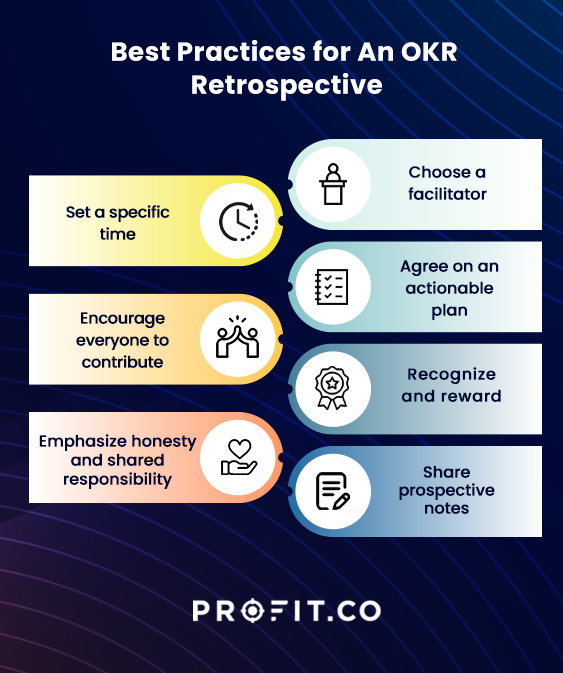
- Set the time: Establish how long your retrospective will take and how frequently you’ll conduct it. Communicate this to prepare your team for the evaluation.
- Appoint a facilitator: Choose a team member to keep time, maintain momentum, and guide the brainstorming session.
- Encourage everyone to contribute: Ensure communication flows freely during the OKR retrospective using techniques like ice-breakers, gamification, or creating a theme.
- Emphasize honesty and shared responsibility: Welcome diverse opinions, focus criticisms on the project rather than on individuals and recognize the entire team for their efforts.
- Agree on action items: Determine the essential ideas to implement in the next OKR project by the end of the prospective.
- Recognize and reward: Recognise and reward the achievement to increase employee engagement
- Share prospective notes: Distribute the insights and keep everyone informed about OKR progress.
Ready to start your OKR journey for Free?
What are the outcomes of an OKR Retrospective?
The three primary outcomes of an OKR retrospective are:
- Rewarding success,
- Lessons learned from failures
- Improvements for future OKR projects
An OKR retrospective gives you a sense of accomplishment and reveals the strengths and weaknesses of each OKR project. It also keeps your team motivated to improve their performance and maintain the discipline required to achieve their goals.
Setting OKRs every quarter provides numerous benefits for continuous improvement. Teams utilizing the OKR framework can leverage the knowledge gained from the previous quarter to improve their strategy and write more effective OKRs.
Reflecting on past performance and incorporating those learnings into the next quarter is crucial to any successful OKR program. This process is known as Reflect & Reset in Profit.co.
The Reflection Process
The reflection process is straightforward and involves answering standard questions as part of the evaluation.
Some common questions include:
- Did you meet your Objective?
- If yes, what factors contributed to your success?
- If not, what obstacles did you encounter?
- What lessons have you learned from the previous quarter that may influence your future OKRs?
- What needs to be adjusted, added, or removed from your OKRs?
- What actions from the last quarter did you dislike?
- What steps did you perform well but didn’t yield desired results?
- What is your goal for the next quarter?
Note that these questions are just examples and can be customized based on the needs of the organization or department. The most important questions at the corporate level may be less relevant at the departmental level and vice versa.
The Reset Process
Before resetting the Key Results, it’s essential to evaluate the relevance of the Objective. If the Objective is still relevant, then the Key Results can be assessed.
At the end of the quarter, each Key Result will have either been:
- Completed
- Incomplete
Based on the current business conditions, the following options are available for each Key Result:
- Continue with the Key Result
- Discontinue the Key Result
The appropriate course of action for each Key Result can be determined based on these two options.
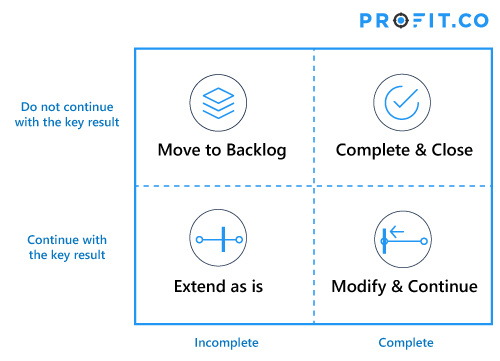
- Extend as is
The Key Result is unfinished but remains relevant, so it can continue unchanged.
- Move to Backlog
The Key Result is unfinished and irrelevant for the upcoming quarter, so it can be moved to the backlog.
- Modify & Continue
The Key Result is complete but still relevant so that the target can be modified and the Key Result can continue.
- Complete and Close
The Key Result is complete and can be closed, allowing for the celebration of the accomplishment.
FAQs
- What is an OKR Retrospective?
An OKR retrospective reviews objectives and key results at the end of a given period.
- Why is a quarterly OKR Retrospective important?
A quarterly OKR retrospective helps to focus and energize teams to work towards business goals to encourage agile and continuous performance.
- How do I run an OKR Retrospective?
Use the start-stop-continue method by discussing what your team should start doing, stop doing, and continue doing to deliver successful OKR results.
- What type of data is ideal for an OKR Retrospective?
You need both hard and soft data for an OKR retrospective. Hard data includes schedules, revenues, estimates, and KPIs, while soft data includes what your team liked, learned, lacked, and longed for (4Ls) during the project.
Conclusion
An OKR retrospective gives insights into your projects at the end of each quarter and launches you forward with concrete steps toward success. This process after an OKR quarter is vital for strengthening and improving the OKR program within a business. Maximizing the value and insights gained from this process will accelerate achieving goals and foster a more focused and motivated team.