Are you a marketer, a finance professional, a sales executive, or highly interested in learning more about subscription-based businesses?
This blog is for you. It provides valuable insights and expertise on the workings of subscription-based businesses, allowing you to enhance your skills and expertise in these industries.
Recurring revenue analytics is a critical aspect of understanding the performance of your Software as a Service (SaaS) business. With the plethora of metrics available to measure your company’s growth, it can be overwhelming to determine which ones to prioritize.
However, two of the most critical recurring revenue metrics for SaaS businesses are Monthly Recurring Revenue (MRR) and Annual Recurring Revenue (ARR).
Let us explore the power of MRR and ARR by providing you with a comprehensive understanding of these metrics and how they can help you analyze your business’s revenue analytics. We aim to provide valuable insights and actionable tips that you can use to improve your understanding of MRR and ARR and apply these metrics to drive growth in your business.
What are Recurring Revenue Metrics?
Recurring revenue metrics is a critical aspect of understanding the performance of your Software as a Service (SaaS) business. Two of the most critical recurring revenue metrics for SaaS businesses are Monthly Recurring Revenue (MRR) and Annual Recurring Revenue (ARR).
If the metrics you are looking at aren’t useful in optimizing your strategy – stop looking at them.

What is Monthly Recurring Revenue (MRR)?
Monthly Recurring Revenue, popularly referred to as MRR is a financial metric. Simply put, it is the monthly money the company expects from customers in return for their product or service regularly.
Formula
MRR = MS x ARPU
MRR = Total Monthly Recurring Revenue
ARPU = Average Revenue Per User
MS = Monthly Subscribers
What is Annual Recurring Revenue (ARR)?
Annual Recurring Revenue, popularly referred to as ARR, is also a financial metric that captures the sum of all types of recurring revenue in a year. It helps assess the yearly growth of the company.
Formula
ARR = MRR x 12
Start tracking your KPIs today with Profit.co
MRR vs. ARR: The Differences
MRR and ARR are essential metrics for measuring the performance of subscription-based businesses. Still, they differ regarding the period they cover and their use cases.
MRR helps track monthly revenue trends, identify changes, and assess a business’s stability and can be used to optimize pricing strategies and subscription plans.
ARR, on the other hand, is useful for measuring the long-term growth potential of a company and is often used by investors and analysts to evaluate the health of a subscription-based business. ARR is also useful for forecasting future revenue and setting growth targets for a business. Both metrics are essential for businesses and should be used to provide a comprehensive view of a business’s performance.
A clear example to explain the difference between MRR and ARR
A SaaS company charges $200 per user per month for their software, with 100 users paying monthly. MRR would be $20,000 ($200 x 100 users) ARR would be $240,000 ($200 x 100 users x 12 months).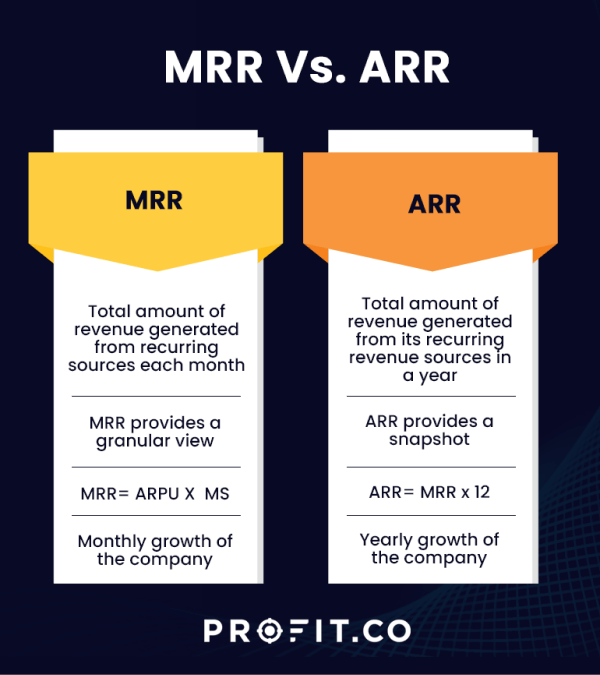
What Specific Purposes do these Metrics Serve Within a Business?
Each department can benefit from using MRR and ARR. Here are a few of them.
Sales
- Helpful in identifying the most profitable subscription plans and pricing strategies
- Monitoring customer churn rates
- Optimize sales efforts by providing added benefits
- Prioritize retention efforts
Finance
- Tracking revenue trends and forecasting future revenue
- Create financial reports and make strategic financial decisions
- Allocating resources to high-growth areas of the business
Marketing
- Identifying the most profitable customer segments and subscription plans
- Targeted marketing campaigns to attract and retain high-value customers
Customer Success
- Identifying which customers are most valuable to the business
- Prioritize support efforts
- Proactively address customer issues before they lead to churn
Conclusion
Measuring regular recurring revenue can benefit businesses regardless of size or industry. These metrics can help companies understand how their sales strategies work, identify trends in customer behavior, and make data-driven decisions to improve customer satisfaction, retention drive growth, and achieve long-term success.