

Productivity depends on how you make a project more manageable. The dream of any project manager is to meet deadlines and achieve success. A large overarching project can be intimidating during the planning phase and cause teams to lose motivation. But breaking a project into smaller tasks makes it far more accessible and easier to implement.
One reliable method of increasing project productivity is a work breakdown structure (WBS). Learn how to use a WBS in every type of project with this comprehensive guide.
Dive into the needed parts or scroll through.
- What Is a Work Breakdown Structure?
- Three Levels of Work Breakdown Structure
- Parameters of A Work Breakdown Structure
- How to Create A Work Breakdown Structure
- Frequently Asked Questions About Work Breakdown Structure
A work breakdown structure is a resource planning tool that focuses on the deliverables and phases of a project. It is a visualization tool to help all stakeholders understand their roles in the project, the tasks they’re responsible for, and the resources at their disposal.
A project management WBS is often represented as a flowchart that breaks down a project into smaller parts, removing its complexity and increasing flexibility and performance. A work breakdown structure divides a project into three levels: the parent task, dependencies, and subtasks.
- A parent task is the simplest expression of the project, usually a project objective, e.g., improving customer experience.
- Dependencies are the tasks required to achieve the objective, which can be simple or complex depending on your project scope. Using the example above, dependencies may include redesigning your UX/UI, increasing social media engagement by tracking Social Media KPIs, or collecting customer reviews from digital marketplaces.
- Subtasks are the components of each dependency that further break down the project. The UX/UI redesign dependency above includes subtasks like hiring a designer, selecting brand colors, organizing a photo shoot for products and marketing content, and editing the photos to match website requirements.
Depending on complexity and scope, you can break down your project into more levels. Use a work breakdown structure to develop actionable tasks that make your project as straightforward as possible.
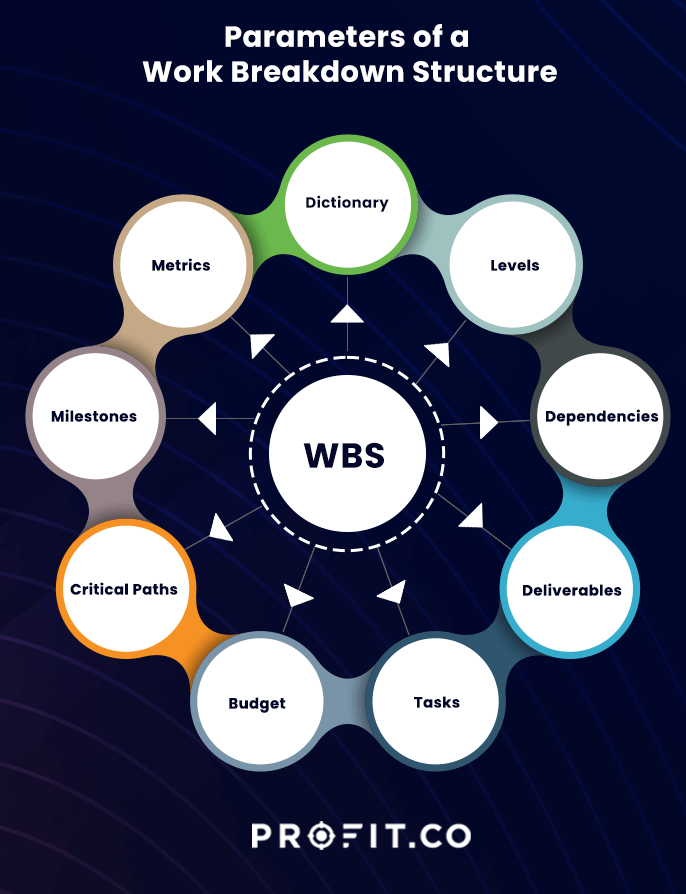
Parameters of a Work Breakdown Structure
A project management work breakdown structure has seven critical parameters or components described below:
- A WBS dictionary
This is a document containing the definitions of every part of the project. It uses simplified language to describe the project tasks and terminologies to avoid ambiguity.
- Levels and dependencies
As previously described, WBS levels outline the project’s components from a high level to detailed tasks and deliverables. Dependencies describe functions that should occur one after the other, building up to the overall deliverable.
- Deliverables
A project deliverable is the tangible or intangible outcome of the project, as your customers expect.
- Work packages
A work package is a group of tasks assigned to a team member or department. These work units are easy to budget, schedule, and deliver as they build towards the overall project objective or deliverable.
- Control accounts
A control account group work packages into an organizational unit. It connects tasks and deliverables under a department or team to improve budgeting and to report on the project.
- Critical paths
A critical path is the quickest or most efficient route to work on each task. It helps managers to estimate the time and resources required to achieve deliverables.
- Milestones
A milestone is a critical point in the project that marks significant progress, such as completing a work phase or making an important decision that drives the project forward.
Types of Project Management WBS
A work breakdown structure is either phase-based or deliverable-based. A phase-based WBS defines your project’s activities according to distinct periods, e.g., planning, design, production, or delivery phases. This approach works best for large-scale projects with many moving parts that work in sequence.
On the other hand, a deliverable-based WBS defines your project’s activities according to what you expect to produce. If your project is a digital marketing campaign, your deliverables would be photographs, videos, and blog content that target your key audiences. A deliverable-based approach is the most common work breakdown structure because it offers more concrete, measurable results.
Whichever approach you choose, your project management WBS should:
- Be easy to describe and understand
- Assign responsibility and authority to the right individuals or teams
- Offer time and budget estimates as accurately as possible
- Have clear and measurable milestones
- Adapt the project to other business functions to minimize disruptions.
Four Characteristics of WBS
Project managers can break down their projects in various methods, but not every breakdown is a WBS. A project management work breakdown structure must meet the following criteria:
- Mutual exclusivity The elements of a WBS are distinct in their scope and deliverables. Each task and level is independent, clarifying your team members, streamlining communication, and reducing duplicate work.
- Hierarchy Project management WBS is a top-down structure of lower-level activities leading to the parent level or project objective. Even though some tasks may run simultaneously, they all contribute to the top level.
- Focused on outcomes A WBS prioritizes a project’s results rather than activities or tasks. That’s why the WBS best practice is to describe your project using nouns instead of verbs. For example, if your project is in software development, your levels would be prototype design, architecture design, app testing, database implementation, content creation, and use cases.
- The 100% rule As you’ll see in the project management WBS example in this guide, all elements in the breakdown add up to 100%. Use metrics to determine how much each task contributes to the parent level.
Plan your work – work your plan. Lack of system produces that ‘!’m swamped’ feeling.

While a WBS seems easy, it takes a deep understanding of your project scope, resources, and shareholders to create an effective breakdown structure. Use these five steps to develop your project management WBS.
Step 1: Know your project scope
In project management, scope refers to objectives, deliverables, budget, timelines, and constraints. Understand your scope using your project charter and management plan to see how a WBS will affect your outcomes. Usually, a WBS is one of the final documents made at the end of the planning phase to visualize the project’s scope.
Step 2: Figure Out your key deliverables
Regardless of the project type or scope, your deliverables must meet two requirements:
- They must be critical to your project’s success
- The allocation must be to an independent team member or group
Let’s use an example of a construction project to demonstrate deliverables. Your parent goal is “build a house,” meaning your deliverables are components like the foundation, plumbing, roofing, interior design, etc. It also means that you assign a different contractor for each element, meaning that your plumbers, electricians, and others all work independently, and their roles don’t overlap.
Step 3: Define your work packages
As described before, a work package is a unit of work given to a team member or group. Work packages should be mutually exclusive, meaningful to the project objectives, and integrated with other packages to achieve measurable deliverables. Here are some tips to help you determine your work packages:
- Use a time frame: Work packages ideally take more than 8 hours but less than 80 hours to complete. Adjust your breakdown accordingly if tasks in your work package exceed these limits.
- Limit your reporting period: Each work package should fall into one reporting period, usually weekly or monthly. Break down tasks that take longer to accomplish than your designated reporting schedule.
- Use the correct terms: A work package should be a noun or adjective, while its components can be verbs. For example, describe a work package in a construction project as “flooring” and the components as “installing tiles” or “installing floor heating” to further break it down.
Step 4: Create your dictionary
A WBS dictionary defines the elements contained in a project, making it an invaluable tool for complex projects. A concrete set of terms can improve communication and clarity, particularly if you anticipate high churn during the project or prolonged implementation time. For each term in your WBS dictionary, include the following information:
- The work package name and description
- The individual, team, or department responsible for the package
- The assignment’s start and end dates
- The estimated cost and resources available
If necessary, add more details and ensure all stakeholders agree on the terms in the WBS dictionary.
Step 5: Choose the correct WBS format
A project management WBS takes many forms, from tables to flowcharts and text-based breakdowns. That’s because there are many different ways of grouping tasks into a hierarchy, which is the essence of a work breakdown structure. Choose a format that your team finds easy to understand. This could mean a colorful pyramid-type format, a sequential numbering format, or a spreadsheet format.
Work Breakdown Structure Example
Examples are always helpful in understanding a concept. See how others have applied this concept in various contexts, and you can better understand how to create your work breakdown structure for a project you are working on.
A project management WBS applies to numerous scenarios but is well suited for construction projects. Building projects are typically complex processes involving multiple contractors and phases, usually working with strict budgets and schedules. The image below is an excellent example of a house construction WBS.
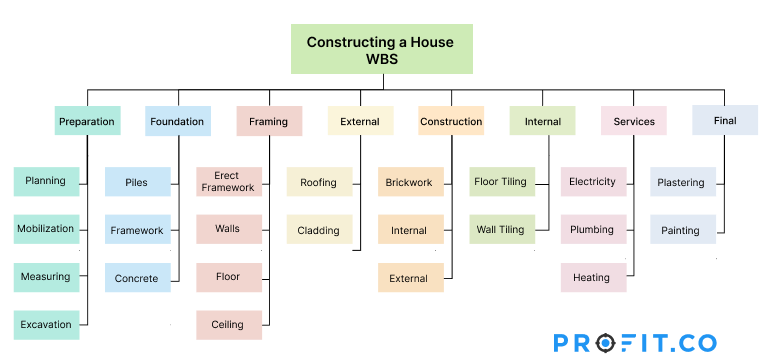
This WBS combines visuals to break down the project into work packages with nouns as headers (brickwork, finishes, etc.). This WBS view gives a building process from excavation to plastering, and each step contributes to 100% of the project.
From the above example, we can see that the key to achieving effective project management is managing all these tasks better, monitoring their progress, and organizing and optimizing them systematically. Such an activity requires more than just a simple to-do list and a schedule; this is where task management becomes an important component of project management. Profit.co Task Management module allows your objectives or goals to be broken down into measurable key results that can be tracked through everyday tasks using task boards.
Task management module of Profit.co
Key feature
- All edits and additions to tasks are updated in real time, so your colleagues always have an up-to-the-minute account of your progress and where certain items stand.
- You can leave comments and responses directly in your tasks so that unnecessary communication via email or meetings can be quickly condensed, and nothing falls through the cracks!
- Individuals and teams can create and organize tasks on department-wide Workspaces and project-specific Boards.
- Boards are completely customizable to specific project workflows using the Profit.co Stages feature.
- Users can specify due dates, priority, and attach documents.
- Individuals can associate daily tasks to important quarterly goals and OKRs so you always know how your work is affecting overall company priorities.
- This helps employees stay engaged with their important work, and helps managers identify important tasks.
Who should use it?
Teams or individuals looking to connect their day-to-day tasks to their important quarterly goals and OKRs can use Profit.co’s task management module to help better engage employees, organize responsibilities, and cut down on messy communication via emails, meetings, and instant messaging.
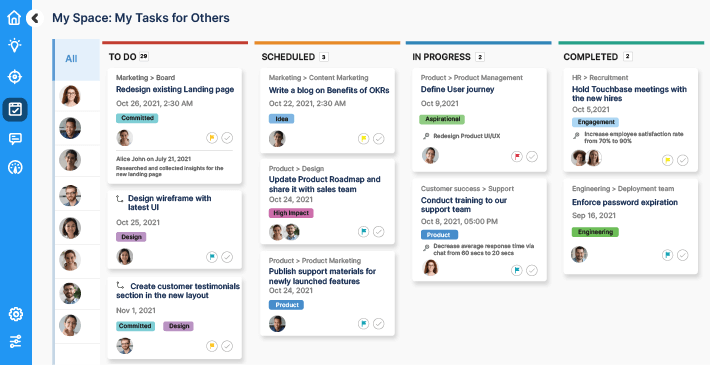
Profit.co’s Dashboard for interactive, user-friendly Task Management
To learn more about how OKR software coupled with Task Management can optimize your team’s performance!
Benefits of using a project management work breakdown structure
A WBS offers several advantages to managing project resources, including
- Clarity
A project management WBS leaves no room for ambiguity. It involves every stakeholder in the project, defines key terms in a WBS dictionary, and uses visual representations to outline the project.
- Accountability
With all the mutually exclusive WBS elements, everyone assigned to a work package becomes accountable for it from start to finish. It also means that responsibilities won’t overlap, which creates a sense of ownership of the project.
- Commitment
Teams know their responsibilities for each component in the project, meaning they become committed to accomplishing their tasks.
- Scheduling and Budgeting
When you clearly outline and define your project deliverables, it’s easier to see how they all contribute to the project’s goal and assign your resources accordingly.
Expert tips for creating a project management work breakdown structure
If facing a complex project or using the WBS framework for the first time, consider the following tips to guide your process.
- Review your project statement or charter to understand your overall objectives. Clarify your terms early in your WBS process to easily visualize the deliverables.
- Speak to department heads and experienced project managers to know how to organize your WBS correctly. This way, you eliminate overlaps and inconsistencies in your framework.
- Always gather stakeholder feedback at every step to ensure everyone is on board with the project. Create a project scope checklist before consulting with your team and review the WBS for realistic estimates and schedules for each task.
- Refrain from overloading your WBS with details, as it becomes harder to update and implement. Instead, break down tasks to follow the 8:80-hour rule, meaning your work packages should take a minimum of 8 hours and a maximum of 80 hours to complete.
- Use a project management software or template to create your WBS framework. It can make the process easier by linking tasks, integrating project documents, and sharing the WBS with stakeholders.
FAQs
- What is the work breakdown Structure?
A work breakdown structure (WBS) is a project management tool that focuses on deliverables rather than activities to budget, schedule, and implement a project.
- What are the three levels of work breakdown structure?
The three work breakdown structure levels are parent tasks, dependencies, and subtasks.
- What is a work breakdown structure example?
An example of a work breakdown structure is in construction projects where each part of the process works independently to create a building. The construction team knows their roles without overlapping responsibilities, all working to deliver a finished house.
- What is the purpose of a work breakdown structure?
The purpose of a work breakdown structure is to visualize the tasks involved in a project and allocate resources more effectively.
Conclusion
A WBS is a must-have for every project manager to increase their chances of success. It outlines every project element, visually represents the tasks and enables accurate resource allocation and productivity. Consider using a work breakdown structure if your project is complex, long-term, or requires a diverse team to implement. Remember it is a project manager’s responsibility to get input from all stakeholders and review your WBS to get the buy-in for your project to ensure seamless execution.