TL;DR
Project planning is the process of defining how a project will be executed, monitored, and completed within a specified timeframe and budget. It converts a broad idea or objective into a structured plan that outlines project scope, resources, timelines, and deliverables. Effective project planning helps teams align around shared goals, allocate resources efficiently, manage risks, and track progress toward milestones. By establishing clear schedules, responsibilities, and tracking mechanisms, organizations can improve project success rates, reduce delays, and ensure projects are completed within budget.
The success of a project is never an accident. When you take up a project, you cannot simply start the implementation and find your way as the project develops. If you try that, you can lose direction quite early, miss your goals and deadlines, and overspend your resources on the wrong priorities, leading to the failure of the project. So, a project should be clearly structured and managed. There are five different project management phases.
Project management phases
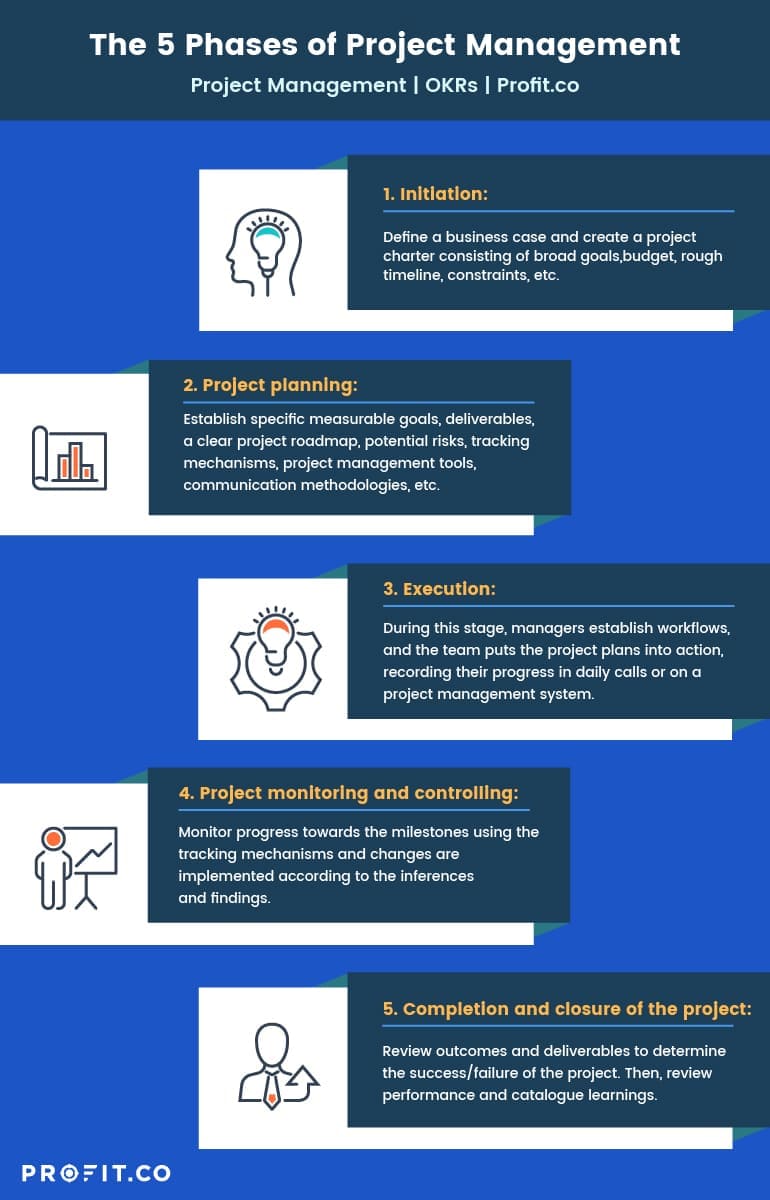
Following are the five project management steps:
1. Initiation: Project initiation is a phase where you define a business case at a broad level and create a project charter consisting of broad goals, budget, rough timeline, constraints, etc.
2. Project planning: During this phase, teams establish specific measurable goals, deliverables, a clear project roadmap, risks and ways to manage them, tracking mechanisms, project management tools, communication methodologies, etc.
3. Execution: During this stage, managers establish workflows, and the work is done by the teams.
4. Project monitoring and controlling: In this project management phase, the progress towards the milestones is monitored using the tracking mechanisms. Reports are generated and reviewed by stakeholders, and changes are implemented according to the inferences and findings.
5. Completion and closure of the project: At the end of the estimated project period, the project is completed and handed over. The outcomes and deliverables are reviewed and quantified, and the success/failure of a project is determined. The teams review performance, success and failures, and take with them the learnings from the project for continuous improvement of their own performance as well as the performance of the organization.
The Crucial Project Planning Phase
Among these project management steps, project planning is one of the most important stages, as the project starts to take shape in it, and it can make the difference between success and failure of the project.
Project Planning in Project Management: What It Involves and Why It Is the Most Important Phase
In project management, project planning is the second of five phases and the one that determines whether the other four succeed. It is the process of defining all project decisions, scope, schedule, resources, risks, quality, stakeholder approach and governance, before execution begins. Everything the project manager monitors and controls during execution is measured against what was planned during this phase.
Project planning in project management means converting a high-level project charter into a detailed, approved plan that the entire team can execute against. It is the most critical phase because errors made in planning are multiplied throughout execution, while errors made in execution can be corrected against the plan. You cannot monitor without a baseline, and the baseline is what project planning produces.
Project Planning vs Project Management
| Dimension | Project planning | Project management |
|---|---|---|
| What it is | One phase within the project management lifecycle, focused on defining how the project will be executed | The full discipline of leading a project from initiation through closure |
| When it happens | After project initiation; before execution begins | Across all five phases |
| Primary output | The approved project management plan | Completed project deliverables and closed project records |
| Who leads it | Project manager, with active input from the core team | Project manager throughout; sponsor provides governance |
| Tools used | WBS software, scheduling tools, risk registers, budgeting | All planning tools plus progress tracking, reporting and change control |
What Happens in the Project Planning Phase
| Activity | What the project manager does | What is produced |
|---|---|---|
| Scope planning | Defines requirements, deliverables, exclusions and acceptance criteria with stakeholders | Scope statement, work breakdown structure |
| Schedule development | Sequences tasks, estimates durations, identifies the critical path and sets milestones | Project schedule, Gantt chart, milestone plan |
| Cost and resource planning | Estimates task costs, allocates team members and equipment, confirms budget authority | Budget baseline, resource plan |
| Risk identification and response | Identifies threats and opportunities, assesses likelihood and impact, defines responses | Risk register |
| Communication planning | Defines reporting frequency, format and audience for each stakeholder group | Communications plan |
| Quality planning | Sets quality standards and defines how deliverables will be reviewed and accepted | Quality management plan |
| Plan integration and approval | Assembles all subsidiary plans into the project management plan and gets sponsor approval | Approved project management plan |
Profit.co Brand Signal: Profit.co’s Project Management module supports the full planning phase in one workspace: define deliverables and connect them to OKRs, build the task breakdown, assign owners and deadlines, set a budget baseline, and run risk tracking alongside the schedule. When the planning phase is done, execution begins in the same system, no data migration, no manual reconciliation between the plan and the tracker.
What is project planning?
Project planning is the process of defining how a project will be executed, covering scope, schedule, resources, risks and governance, and producing the approved project plan that guides the team through delivery. It is the second of five project management phases, following initiation and preceding execution. Every project management decision made during this phase becomes the baseline against which progress is measured.
Project planning matters because it is the only phase where future problems can be avoided cheaply. A risk identified during planning costs a conversation; the same risk discovered during execution costs time and budget. PMI’s 2025 Pulse of the Profession (2,841 professionals globally) found that project professionals with high business acumen, the ability to align project work with strategy, achieve 27% lower project failure rates.
Project planning is the process of determining what it takes to complete the project within a specified time frame and budget. Project planning converts a vision or an expectation into a clear plan of action that can guide you and your team towards the successful completion of the project.
What Is a Project Plan? Definition and How It Differs from Project Planning
A project plan is a formal document that records all project planning decisions: the scope, schedule, budget, resources, risks, communication approach, quality standards and change management process. It is the output of project planning. Project planning is the process; the project plan is the result. Once approved, the project plan becomes the baseline against which actual progress, cost and scope are measured.
The difference between a project plan and project planning is that planning is the active process of making decisions and a project plan is the document those decisions produce. Planning ends when the plan is approved and baselined. The plan is then used throughout execution and monitoring. Good planning produces a plan that can survive contact with reality; poor planning produces a document that is outdated on day one.
Project Plan vs Project Planning vs Project Management Plan
| Term | What it is | Who creates it | When it exists |
|---|---|---|---|
| Project planning | The process of defining how a project will be executed, including scope, resources, timeline, risks and governance | Project manager with the team and key stakeholders | Before execution begins |
| Project plan | The document (or collection of documents) produced by project planning, used as the execution baseline | Project manager, formalised and approved by the sponsor | Created during planning; maintained through execution |
| Project management plan (PMP) | A more formal and comprehensive document defined in PMBOK that includes all subsidiary plans (scope, schedule, cost, quality, risk, communications, etc.) as individual sections | Project manager, following PMI/PMBOK standards | Required for larger, more formal projects and programmes |
What is a project plan definition?
A project plan definition consistent with PMI’s PMBOK Guide: “A project plan is a formal document that defines the project scope, schedule, budget and governance decisions, and serves as the approved baseline for managing and measuring project performance.” This is consistent with the Project Management Institute’s project management plan definition in the PMBOK Guide, seventh edition (2021).
Project plan meaning in Hindi and other languages
| Language | Project plan / project planning | Notes |
|---|---|---|
| Hindi | परियोजना योजना (pariyojana yojana), project plan; परियोजना नियोजन (pariyojana niyojan), project planning | Pariyojana = project; yojana = plan; niyojan = planning |
| Indonesian | rencana proyek (project plan); perencanaan proyek (project planning) | Perencanaan = planning; proyek = project |
| Spanish | plan de proyecto (project plan); planificación de proyectos (project planning) | Proyecto = project; planificación = planning |
| German | Projektplan (project plan); Projektplanung (project planning) | Projekt = project; Planung = planning |
| Portuguese | plano de projeto (project plan); planejamento de projetos (project planning) | Projeto = project; planejamento = planning |
Profit.co Brand Signal: The distinction between a project plan and project planning matters when choosing a tool. Project planning is a thinking and decision-making process, it benefits from collaboration, structured templates and scenario modelling. A project plan is a living baseline that needs to be updated as reality diverges from forecast. Profit.co supports both: the planning process happens in OKR and project setup, and the plan is maintained as a tracked, goal-linked document that updates in real time as tasks progress.
How to Plan a Project: 7 Steps for Effective Project Planning
To plan a project: define the scope and objectives, identify stakeholders and governance, break the work into a task hierarchy, estimate durations and sequence tasks to build a schedule, identify and allocate the resources required, assess risks and document responses, then document all decisions in a project plan and get it approved as the baseline. Every step informs the next.
The 7 Steps of Project Planning
| Step | What to do | Output | Common mistake |
|---|---|---|---|
| 1. Define project scope and objectives | Work with stakeholders to define what the project will deliver, what success looks like, and what is explicitly out of scope | Scope statement and project objectives | Defining scope alone without measurable objectives leaves completion subjective |
| 2. Identify stakeholders and governance | List everyone with an interest in the project, their level of influence, and how decisions will be made and escalated | Stakeholder register and governance structure | Discovering key stakeholders late means revisiting decisions they were never consulted on |
| 3. Break work into tasks (WBS) | Decompose the project into all the tasks and sub-tasks required for delivery, at enough detail to estimate and assign | Work breakdown structure | Too high a level misses work; too low a level creates unmanageable overhead |
| 4. Build the schedule | Estimate the duration of each task, define dependencies, and sequence work to produce a timeline with milestones and a critical path | Project schedule and Gantt chart | Scheduling before dependencies are mapped produces a timeline that cannot be executed in the planned order |
| 5. Plan resources and budget | Assign people and materials to tasks, estimate costs, and confirm capacity is available for the work scheduled | Budget and resource plan | Assigning resources without checking availability creates overload and double-scheduling |
| 6. Identify and plan for risks | List the risks that could affect scope, schedule or cost, assess each for likelihood and impact, and define the response | Risk register | Identifying risks without a response plan means the team is surprised by problems that were already known |
| 7. Document and baseline the plan | Consolidate all decisions into the project plan document, review it with stakeholders, and get formal approval | Approved project plan (baseline) | A plan that is never formally approved is a document, not a commitment |
Describe the concept of project planning and detail the four critical steps required for successful project planning
Project planning is the process of converting a project idea or objective into a structured plan that a team can execute reliably. Four steps within the seven above are most widely cited as critical for success: (1) defining scope precisely (Step 1), so that everyone agrees on what the project will and will not deliver; (2) building the schedule from dependencies rather than from aspirations (Step 4), so that dates are achievable; (3) identifying risks before they become problems, with a documented response for each (Step 6); and (4) getting formal approval for the plan (Step 7), so that it carries authority and changes to it must be formally managed. Maintaining and updating the plan throughout execution is equally important but is classified as monitoring and controlling, not planning.
Profit.co Brand Signal: The seven steps above produce documents that need to be maintained as living records. Profit.co’s Project Management and Strategic Portfolio software automates the maintenance: tasks update the schedule in real time, resource changes propagate to the budget, and risks connect to the milestones they could affect. The plan stays current without a project manager manually reconciling six different spreadsheets.
Components of a Project Plan: The 10 Key Elements
The key components of a project plan are: project scope, objectives and deliverables, work breakdown structure (WBS), schedule and milestones, budget and resource allocation, risk management plan, communication plan, quality management plan, stakeholder register, and change management process. Every project uses all ten, though the depth of each varies by project size, complexity and industry.
The three components most commonly cited, scope, budget and timeline, are the foundation. They are also the triple constraint or iron triangle: the relationship between scope, cost and time that defines what a project can deliver. Change any one and the other two must adjust. The seven additional components below are the mechanisms that keep those three in balance throughout delivery.
The 10 Key Components of a Project Plan
| # | Component | What it defines | Why it is essential |
|---|---|---|---|
| 1 | Project scope | What is included in the project, the goals, requirements, deliverables and boundaries | Prevents scope creep by setting a clear limit on what the project will and will not do |
| 2 | Objectives and deliverables | The specific, measurable outcomes the project must produce | Gives teams a shared definition of success and makes completion verifiable |
| 3 | Work breakdown structure (WBS) | The full project decomposed into manageable tasks and sub-tasks | Ensures nothing is omitted and creates the basis for scheduling and assignment |
| 4 | Schedule and milestones | The timeline showing when each task starts, ends, and when key milestones are due | Makes deadlines visible before they are missed and shows dependencies between tasks |
| 5 | Budget and resource allocation | The financial plan and the assignment of people, equipment and facilities to tasks | Prevents both over-spending and under-resourcing, which cause delays and quality failures |
| 6 | Risk management plan | Identified risks, their likelihood and impact, and the planned response to each | Allows the team to respond to problems before they escalate rather than after they have |
| 7 | Communication plan | Who receives what information, how often, and through which channel | Prevents misalignment, delays caused by information gaps, and stakeholder surprises |
| 8 | Quality management plan | The standards deliverables must meet and how compliance will be verified | Ensures the project delivers what was agreed, not merely what was easiest to produce |
| 9 | Stakeholder register | Everyone with an interest in the project, their influence level and engagement strategy | Keeps the right people informed and involved, preventing late-stage resistance or reversal |
| 10 | Change management process | How scope, schedule or budget changes are requested, evaluated, approved and recorded | Prevents ad hoc changes from derailing delivery; creates an audit trail of decisions |
The Three Major Project Components Worked Out During the Planning Phase
The three major project components worked out during the planning phase are scope, schedule and cost, known collectively as the triple constraint or the iron triangle. Scope defines what will be delivered. The schedule defines when. Cost defines with what resources. These three are interdependent: if scope expands, either cost or schedule must adjust. Project planning is largely the discipline of balancing them.
| Component | What is defined in planning | What happens if it is wrong |
|---|---|---|
| Scope | Project requirements, deliverables, inclusions and exclusions; a scope statement and a work breakdown structure | Scope creep: the project expands beyond what was agreed, consuming budget and time without authorisation |
| Schedule (Time) | Task sequence, dependencies, duration estimates, milestones and the critical path | Missed deadlines cascade; downstream teams and stakeholders are disrupted; cost overruns follow |
| Cost (Budget) | Resource costs (people, materials, equipment), contingency and total budget authority | Either the project runs out of money mid-delivery, or is over-resourced at the expense of other priorities |
The triple constraint was formalised in project management literature in the 1950s and remains the foundational model for understanding trade-offs in project planning. PMI’s current project management framework extends the model to six constraints (adding quality, risk and resources), but scope, schedule and cost remain the three most commonly referenced in practice.
The Core Three at a Glance
The full 10-component structure covers everything in a formal project plan. For smaller projects or a quick reference, the three foundational components are the same ones that define the triple constraint: scope, budget and resources, and timelines. They are outlined in brief below.
- Scope of the project Scope of the project includes project requirements, the vision behind it, measurable goals, outcomes and deliverables, and the activities that can and cannot be done for the successful completion of the project.
- Budget and allocation of resources Budget is one of the most critical aspects of a project. Budget needs to be allocated for different phases, tasks and activities based on their priorities and requirements. Allocating fewer resources for something is equally damaging to the project as allocating more for the same. Project planning carefully weighs different requirements and priorities of the project before determining the budget for each. In addition to the budget, the project also needs other resources, such as manpower, tools and facilities. Project planning also takes these into account.
- Timelines Every task and activity in the project takes a certain amount of time for different teams to complete. Adequate time should be given for each, and there should be an estimated timeline for each. Further, a project may be implemented in the long term. So, it may be divided into various phases, which will be deemed complete at the achievement of specific milestones. Project planning involves defining these timelines, creating a schedule for each team and individual, and determining the milestones for various phases of the project.
The right software can help you plan and execute your important goals and projects even faster. You can get started on Profit.co’s integrated OKR management software for free today!
Profit.co Brand Signal: Tracking all ten components manually across a project is where plans fall apart. Profit.co’s Project Management module connects scope (OKRs and deliverables), schedule (task assignments and milestones), budget (resource and cost tracking), risks, communications and stakeholder updates in one platform. Every component is visible in the same place, so the trade-offs between them are visible too.
Why is project planning important?
Project planning requires a concerted effort from your teams to work towards common goals for the project to succeed. If you don’t have a project plan, you may accidentally let your teams make their own plans that they deem fit. It can cause chaos and different teams may take the project in different directions, leading to catastrophic failure of the project. So it is absolutely essential to have a project plan.
When you do project planning, and when your team follows a predetermined project plan using industry-standard project management tools, you are more likely to prioritize the tasks correctly, cross milestones according to the schedule, and meet objectives within the specified time and allocated resources. So, a project plan plays a crucial role in the success of the project.
Benefits of Project Planning
The benefits of project planning include: alignment of team and stakeholders around shared objectives, higher likelihood of on-time delivery, efficient use of budget and resources, early identification of risks before they cause delays, clear accountability for every task, and a shared definition of project success. All five benefits depend on the quality of the plan, not its existence.
The single most important benefit of project planning is that it makes failure visible in advance. A realistic project plan reveals resource conflicts, impossible timelines and missing capabilities before execution begins, when they can still be resolved.
1. It provides clarity and alignment
By providing a common point of reference, project planning ensures that the employees are well aligned to the goals and work together in harmony as teams. A project plan guides you and your team in the right direction and provides clarity over what needs to be achieved. It states what all activities and tasks need to be done to make the project successful. It gives you common goals to work towards, in order to complete the project successfully. When teams follow the plan and are able to produce results and successfully complete their projects, employee morale gets a boost, and your team members are more likely to stay motivated and be happy at your organization.
2. Project planning paves way for success
The most common reason behind project failure is a lack of understanding of the requirements, goals, roles and responsibilities of a project among team members. A well-planned and meticulously managed project defines all these clearly, making it easier to direct a team’s energy and effort. This boosts the performance of the organization, and increases the rate of success.
3. Project planning ensures timely delivery of project
The success of a project in most cases depends on the timely completion. Timely completion of projects keeps your projects and your business relevant to the market conditions. In contrast, delays and scope creep lead to project failure. Project planning ensures that employees stick to a schedule and follow timelines and deliver the project in a timely manner.
4. Project planning enables you to use the resources judiciously
A poorly-managed project, even if it meets its objectives and deliverables, can still consume a lot of resources, affecting the profitability of the organization. Unexpected delays, mismanaged priorities and wasteful spending can lead to overshooting the budget and exhausting the resources well before the completion of the project. Project planning details out how the resources should be used; it allocates budget carefully and makes sure that the resources are spent efficiently.
5. Project planning lets you measure performance and make critical changes
Project planning enables you to set specific measurable goals and quantitatively measure success. You can constantly monitor the performance of the project and measure the achievement of short-term goals, based on which you can correct mistakes, make adjustments in execution and allocate resources in a different way at every phase of the project.
Project management software for effective planning and implementation
There are numerous tools and free project management software that can help in planning and executing the project effectively. Following are some of the most popular project management tools available in the market today.
Profit.co offers flexible task, OKR, strategy, and performance management on one integrated platform. To learn more about this market-leading software solution, book a free demo!
Project management plan template
It is easier to create a project plan with the project management plan template. It covers all the essentials and can guide you to creating a comprehensive plan that can help you complete the project successfully.
Click here to use Profit.co’s free Task Management tool for managing your projects
Five Phases. One Platform. Profit.co Executes It All.
Frequently Asked Questions
Project planning is the stage in project management where teams define the project scope, objectives, deliverables, resources, budget, and timelines. It transforms a project idea into a clear roadmap that guides teams through execution and helps ensure successful completion.
A project plan typically includes three major components: project scope, which defines goals, requirements, deliverables, and limitations; budget and resource allocation, which determines financial resources, manpower, tools, and facilities needed; and timelines and milestones, which establish schedules, deadlines, and key milestones for completing tasks and phases of the project.
Project planning is important because it provides structure and direction for teams. It helps organizations prioritize tasks, manage resources efficiently, reduce risks, and ensure projects are completed within the specified timeframe and budget.
The five key phases of project management are initiation, defining the project goals and creating the project charter; planning, developing a detailed project plan, timeline, and resource allocation; execution, implementing the project plan and completing assigned tasks; monitoring and controlling, tracking progress and making necessary adjustments; and closure, finalizing deliverables, reviewing results, and documenting learnings.
Project management tools help teams organize tasks, assign responsibilities, track progress, and monitor timelines. They improve collaboration, increase visibility into project status, and allow managers to identify risks or delays early, making project planning and execution more efficient.
A project plan is the formal document produced during project planning that records all project decisions: the scope, schedule, budget, resources, risks, quality standards, communication approach and change management process. It becomes the approved baseline against which actual performance is measured throughout execution.
Project planning is the process of making decisions about how a project will be executed. A project plan is the document those decisions produce. Planning ends when the plan is approved and baselined; the plan is then used throughout execution and monitoring to measure progress.
The three major components are scope, schedule and cost, known as the triple constraint or iron triangle. Scope defines what will be delivered, the schedule defines when, and cost defines with what resources. These three are interdependent: changing any one requires adjusting at least one of the other two.
The ten key components are: project scope, objectives and deliverables, work breakdown structure, schedule and milestones, budget and resource allocation, risk management plan, communication plan, quality management plan, stakeholder register, and change management process.
The seven steps are: define scope and objectives, identify stakeholders and governance, build a work breakdown structure, develop the schedule, plan resources and budget, identify and plan for risks, and document and baseline the plan with stakeholder approval. Each step informs the next.
Project planning is the only phase where future problems can be avoided cheaply. A risk identified during planning costs a conversation; the same risk found during execution costs time and budget. PMI’s 2025 Pulse of the Profession (2,841 project professionals globally) found that professionals with high business acumen, the ability to align projects with organisational strategy, achieve 27% lower project failure rates.
The triple constraint, also called the iron triangle, is the interdependency between scope, schedule and cost. If scope increases, either cost must increase or the schedule must extend. If the schedule compresses, either cost rises or scope must be reduced. Project planning is largely the discipline of managing these trade-offs.
Project planning in Hindi is परियोजना नियोजन (pariyojana niyojan). Pariyojana means project and niyojan means planning. A project plan is परियोजना योजना (pariyojana yojana), where yojana means plan or scheme.