
Condition Monitoring OKR Tracker Template

Rated 4.7/5 by 500+ Leaders
Use ready-made condition monitoring OKRs to keep machine faults caught early all quarter.
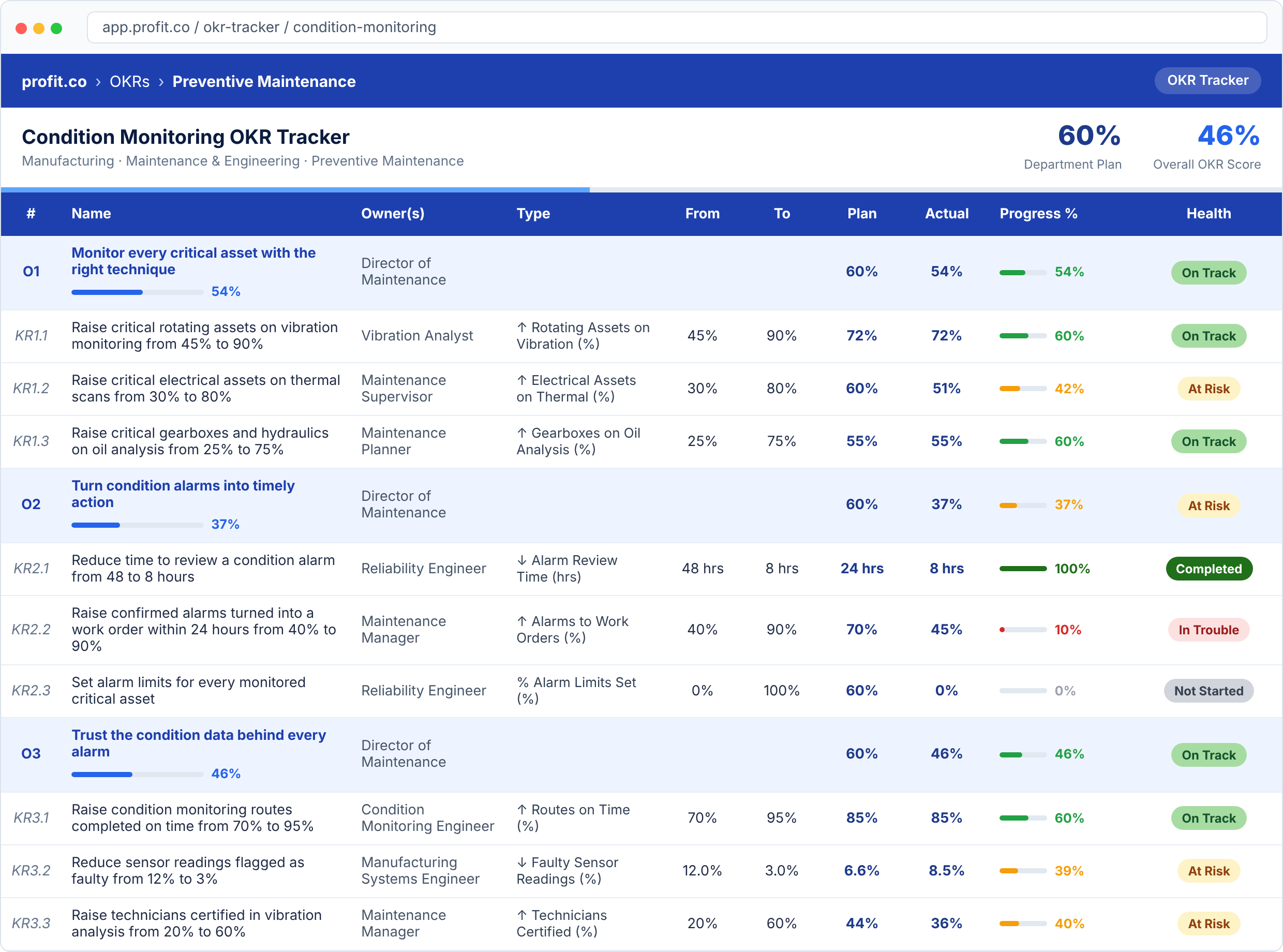
- O1: Monitor every critical asset with the right technique KR1.1: Raise critical rotating assets on vibration monitoring from X% to Y% KR1.2: Raise critical electrical assets on thermal scans from X% to Y% KR1.3: Raise critical gearboxes and hydraulics on oil analysis from X% to Y%
- O2: Turn condition alarms into timely action KR2.1: Reduce time to review a condition alarm from 48 to 8 hours KR2.2: Raise confirmed alarms turned into a work order within 24 hours from X% to Y% KR2.3: Set alarm limits for every monitored critical asset
- O3: Trust the condition data behind every alarm KR3.1: Raise condition monitoring routes completed on time from X% to Y% KR3.2: Reduce sensor readings flagged as faulty from X% to Y% KR3.3: Raise technicians certified in vibration analysis from X% to Y%
What is condition monitoring?
Tracking machine health to catch faults early.
Condition monitoring tracks machine parameters such as vibration, temperature, and oil quality to spot developing faults. ISO 17359 gives general guidelines for setting up such a program.
Condition monitoring OKRs turn that tracking into quarterly goals. Each key result, such as raising vibration coverage or speeding up alarm review, gets a measurable target and a named owner.
Why track condition monitoring with OKRs?
Catch developing machine faults before they turn into breakdowns.
Cover critical assets
Vibration, thermal, and oil analysis goals match each critical asset to the right technique.
Act on every alarm
Alarm review, work order, and limit goals turn condition data into maintenance action.
Trust the data
Route, sensor quality, and certification goals make sure every reading can be relied on.
What you'll get in this template
The real difference your team will see.
- Earlier warning of machine faults, so repairs are planned instead of rushed.
- Alarms that lead to action, with every confirmed fault tracked to a work order.
- One shared view of machine health for maintenance, reliability, and plant leaders.
How to use this template?
Four simple steps to a live quarterly plan.
- 1
See the example
Check Sheet 1 to see how it works.
- 2
Add your goals
Fill in Sheet 2 with your objectives and key results.
- 3
Update weekly
Enter your latest numbers each week.
- 4
Track your score
Progress and status update on their own.
Related templates
More OKR templates for Manufacturing teams.
Ready to track OKRs?
Start tracking your condition monitoring OKRs today
Join 1,500+ organizations using profit.co to keep machine faults caught early every quarter.