
Predictive Maintenance OKR Tracker Template

Rated 4.7/5 by 500+ Leaders
Use ready-made predictive maintenance OKRs to keep equipment fixed before it fails all quarter.
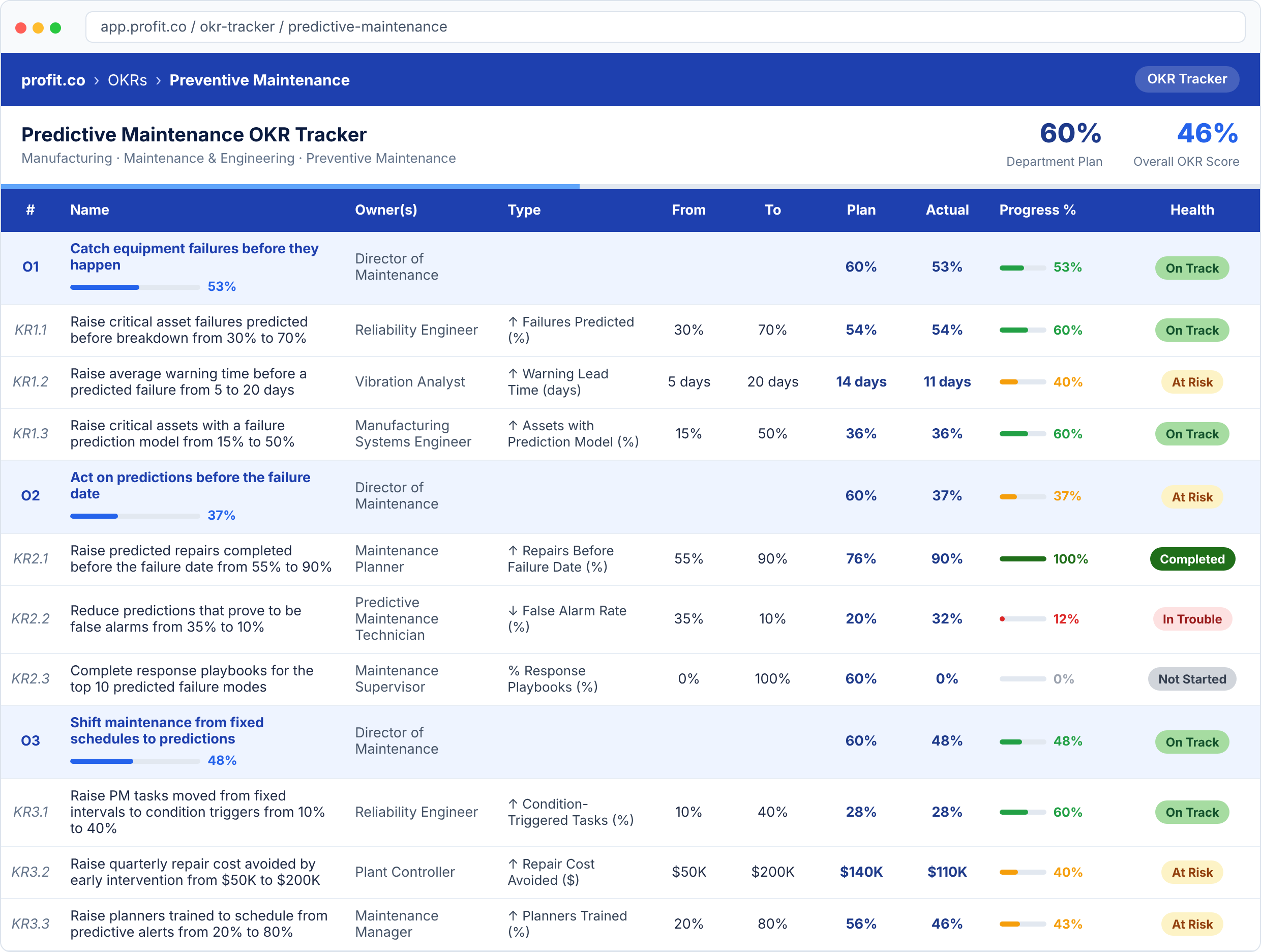
- O1: Catch equipment failures before they happen KR1.1: Raise critical asset failures predicted before breakdown from X% to Y% KR1.2: Raise average warning time before a predicted failure from 5 to 20 days KR1.3: Raise critical assets with a failure prediction model from X% to Y%
- O2: Act on predictions before the failure date KR2.1: Raise predicted repairs completed before the failure date from X% to Y% KR2.2: Reduce predictions that prove to be false alarms from X% to Y% KR2.3: Complete response playbooks for the top 10 predicted failure modes
- O3: Shift maintenance from fixed schedules to predictions KR3.1: Raise PM tasks moved from fixed intervals to condition triggers from X% to Y% KR3.2: Raise quarterly repair cost avoided by early intervention from $XK to $YK KR3.3: Raise planners trained to schedule from predictive alerts from X% to Y%
What is predictive maintenance?
Fixing equipment just before it is likely to fail.
Predictive maintenance uses condition data to forecast when equipment will fail, so work happens just before failure. Preventive maintenance follows a fixed time or usage schedule instead.
Predictive maintenance OKRs turn those forecasts into quarterly goals. Each key result, such as predicting more failures or acting before failure dates, gets a measurable target and a named owner.
Why track predictive maintenance with OKRs?
Turn equipment forecasts into planned repairs, not surprise breakdowns.
Predict more failures
Prediction rate, warning time, and model coverage goals show how early failures are seen.
Act before failure
Early repair, false alarm, and playbook goals turn each prediction into the right fix.
Move beyond fixed schedules
Condition-triggered tasks, cost avoided, and planner training goals shift work away from fixed intervals.
What you'll get in this template
The real difference your team will see.
- Repairs planned days ahead of failure instead of rushed after a breakdown.
- Fewer wasted callouts, because false alarms are tracked and cut each month.
- One shared view of equipment risk for maintenance, reliability, and finance leaders.
How to use this template?
Four simple steps to a live quarterly plan.
- 1
See the example
Check Sheet 1 to see how it works.
- 2
Add your goals
Fill in Sheet 2 with your objectives and key results.
- 3
Update weekly
Enter your latest numbers each week.
- 4
Track your score
Progress and status update on their own.
Related templates
More OKR templates for Manufacturing teams.
Ready to track OKRs?
Start tracking your predictive maintenance OKRs today
Join 1,500+ organizations using profit.co to predict equipment failures every quarter.