OKR Workshops can be a powerful tool for setting goals and measuring success. Teams can create realistic objectives while enhancing collaboration. Objectives and Key Results (OKRs) provide a framework for setting goals. As John Doerr anticipated when he discovered OKRs in the late 1970s, he claimed that OKRs are a powerful tool that can propel some of the world’s most famous companies toward success.
An OKR workshop aims to enhance motivation and engagement among team members. They can focus on high-value activities that ensure business success.
A leader or an OKR Captain is the crucial person to conduct or facilitate an OKR workshop using OKR coaches to successfully implement the OKRs in an organization.
Let’s explore the OKR workshop and how to conduct one as we discuss best practices to ensure a fruitful OKR workshop.
What is an OKR Workshop?
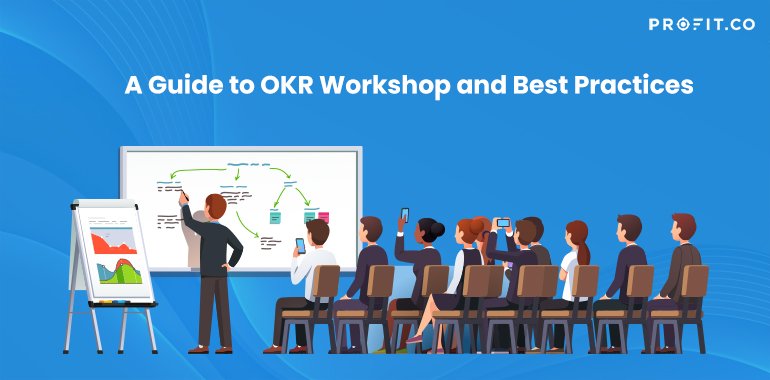
An OKR Workshop is an interactive, collaborative space where teams can create and implement Objectives and Key Results (OKRs). It can also serve as a platform to review past objectives and understand the reasons for success or failure.
These workshops should be for all stakeholders, productive and progressive sessions.
Such a workshop provides a platform for team members to discuss business objectives. It helps the team align business objectives with individual goals while setting measurable targets.
When hosting an OKR Workshop, it is essential to ensure clear timelines and expectations. Each participant should actively participate to ensure everyone understands how to achieve the objectives.
You should also provide your team with resources such as templates or tools to simplify setting effective OKRs.
A learning organization involves a deliberate effort to incorporate knowledge into the execution framework, and an OKR workshop is an essential exercise in the learning curve of an organization.
During the OKR setting workshop, your team members should discuss topics such as:
- Company strategy
- Goal-setting best practices
- Feedback collection methods
- Evaluation criteria for success measurement tools
At the end of every session, you should review all submitted materials and give feedback on areas that need improvement or clarification. It’s the best way to ensure that all the team members clearly understand the key results they need to achieve to attain the desired outcomes.
Reviewing the materials also enables you to gauge whether your team members are comfortable applying the Objectives and Key Results in future projects or assignments. If there is a gap or lack of strategy implementation, try arranging special training or another specified workshop to equip your team with the necessary skill set to implement OKRs successfully across their departments.
To learn more about how OKR software can optimize your organization’s performance!
Why should you conduct an OKR Workshop?
Focus
These workshops will bring everyone together and increase focus on what matters and increases productivity through employee engagement.
Measure
The workshop gives you an insight into how best to measure your goals and apply them to your key results.
Achieve
workshops create an atmosphere that improves employee engagement by sharing of challenges faced and how people can overcome them
How to conduct an OKR workshop?
Planning
During the OKR planning workshop, it is crucial to consider the size of the team, your goals, and available resources.
You can start by listing potential objectives and organizing them as your team debates on which one to prioritize and why.
Teams should be encouraged to analyze their existing OKRs and introspect on reasons for success and failure.
Agenda for the workshop
You should also map the workshop plan. It should include interactive activities such as brainstorming sessions or small group discussions. For instance, encourage your team to suggest as many metrics as possible within 10 minutes.
Such activities allow team members to explore the different aspects of goal-setting. For the OKR workshop to succeed, all participants should be active, and there should be clear and transparent communication. You can choose three metrics and convert them into key results by allowing the team members to set specific, measurable targets.
The workshop should be about appreciating all ideas, the ability to think big, and the spirit of being creative. Encourage teams to have an open conversation to get inspired by the ideas they share. Let your team discuss the metrics you can use to track the progress toward the selected objectives.
Once everyone agrees with the OKRs, you can share the details with the rest of the company or stakeholders. Remember to track the progress throughout the workshop to determine how successful your team was in attaining the desired outcomes.
Best Practices
Choose an Appropriate Location
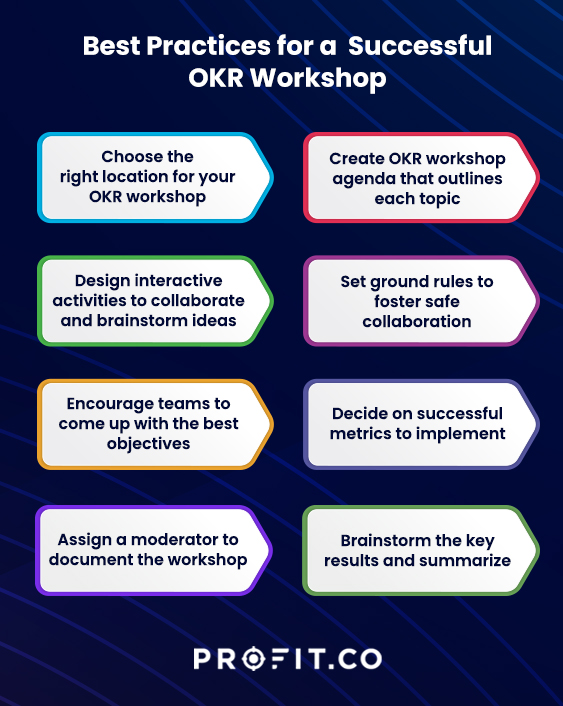
It’s crucial to choose the right location for your OKR workshop. First, make sure that the room accommodates all participants. It should have a comfortable, distraction-free environment to encourage productive conversations.
You should also provide the materials or equipment to optimize the session, like
- Projectors
- Flip charts
- Whiteboards
Prepare Accordingly
A successful OKR workshop requires adequate preparation. You can prepare for the workshop by
- Reviewing the relevant documents and data related to the objectives you intend to set
- Deciding how to measure success metrics using innovative platforms such as Profit.co
- Creating an OKR workshop agenda that outlines each topic you will discuss
- Designing interactive activities for team members to collaborate and brainstorm ideas
- Assigning roles such as moderator and scribe
Have some ground rules before beginning formal conversations to foster a safe collaboration space.
Brainstorm Key Results
Once everyone voices their ideas, the teams can start brainstorming key results that align with every objective.
During this process, the facilitators must be keen on the time constraints to keep things moving at a manageable pace. After choosing 2-3 measurable metrics for each objective, the next step should be developing actionable plans to achieve these goals.
The facilitator should review everything the team discusses and summarize the final decisions on OKRs.
FAQs
- What are the common challenges for setting OKRs?
Some of the common challenges that you can face while setting OKRs are:
- Failing to understand the overarching goal
- Challenges in aligning individual objectives with business objectives
- Confusion over how to measure success
- Difficulty in creating measurable metrics that accurately reflect each objective’s goals
- What happens if you fail to achieve an objective?
If your team fails to achieve an objective, take a step back and evaluate why they failed. You can discuss the roadblocks they faced during the process and identify the areas that need improvement. Your team should also re-evaluate the targets and come up with more achievable key results.
- What is the role of managers in OKR workshops?
Managers in OKR workshops should provide guidance. They should encourage active participation and collaboration while giving the necessary feedback.
Conclusion
Ultimately, an OKR Workshop is essential to any team’s strategy to achieve the overall goals and objectives. When implemented correctly, it allows you to measure successes more accurately to improve business performance. An OKR software can improve your OKR program’s success. With robust and innovative tools such as Profit.co, you can successfully conduct an OKR workshop and maintain a competitive edge with the OKR framework.