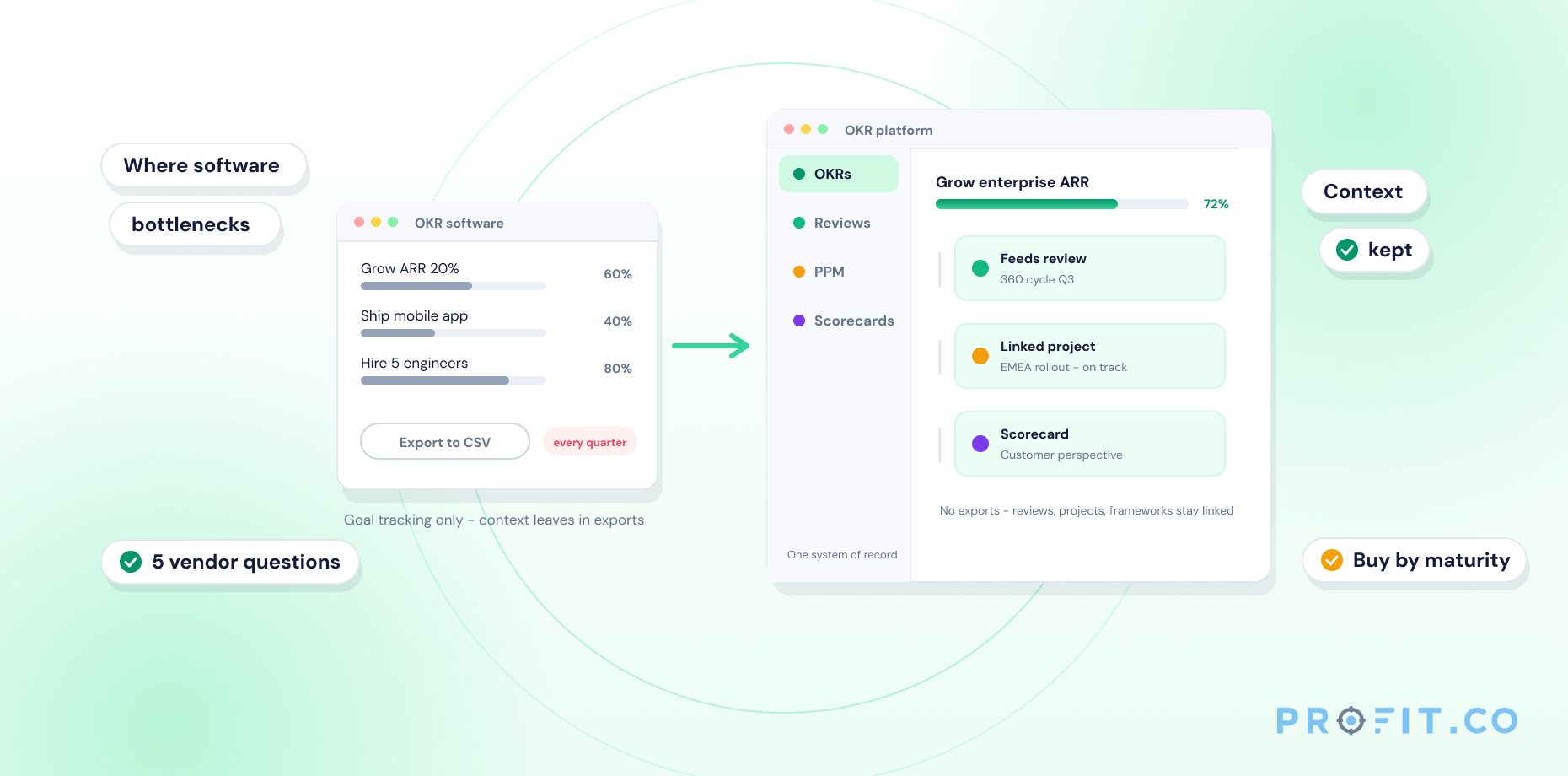
We stopped pushing for more check-ins and started making each one count.
In this guide
- Why Is OKR Adoption Low Even When the Setup Is Right?
- What Causes Low OKR Check-in Rates?
- How Do You Connect OKRs to Performance Management?
- How Do You Credit People Who Contribute to OKRs They Don’t Own?
- What Results Can You Expect From Connecting OKRs and Performance?
- What Should You Do If OKR Adoption Is Stuck?
- Frequently Asked Questions
I’ll be honest: when I first saw that 32% adoption number, my plan was more training and more reminders. That’s the standard playbook. This is the story of why we didn’t follow it, and what worked instead.
Why Is OKR Adoption Low Even When the Setup Is Right?
OKR adoption is often low because employees don’t see what’s in it for them. A clean goal structure doesn’t guarantee participation.
That was exactly the situation with this customer, a large shipping and logistics enterprise operating across several markets in Asia. They had more than 1,000 users on Profit.co. Company priorities cascaded neatly into departmental and individual OKRs. On paper, everything was in place.
In practice, adoption was around 32%, and check-in discipline hovered near 60%. Leadership couldn’t get a reliable read on progress. And quietly, we knew that if engagement didn’t improve, the renewal was at risk.
What Causes Low OKR Check-in Rates?
The most common hidden cause is that OKRs and performance reviews run as separate processes. When goal progress doesn’t feed into how people are evaluated, check-ins feel like admin work.
We found this by changing the question. Instead of asking “how do we get people to log in?”, we asked, “why would anyone bother?” Then we sat down with business leaders and HR.
The answer came quickly. This organization ran two processes side by side:
- OKRs tracked what employees were expected to achieve.
- Performance reviews judged how well they contributed.
The two barely touched. An employee could skip every check-in and see no difference at review time. No amount of training fixes that. People needed a reason the check-in mattered.
How Do You Connect OKRs to Performance Management?
You connect them by making goal progress an input to performance reviews, built around the review process HR already runs, not a new one. Here’s how we did it:
- Bring HR in early. They own the review process, so they had to co-own the fix.
- Map the existing review workflow. We documented their evaluation criteria and review cycle before configuring anything.
- Configure performance management around it. We set up Profit.co’s Performance Management System (PMS) to match how they already evaluated people.
- Show employees the full journey. Set goals, execute, check in, demonstrate progress, and see it reflected in performance.
- Support the change. Demos, training and ongoing enablement kept managers and employees on board.
We were careful to position the Performance Management System as a bridge, not another module to learn. The message to employees was simple: your check-ins are now part of your performance story.
See What Connecting OKRs to Reviews Can Do
How Do You Credit People Who Contribute to OKRs They Don’t Own?
Link each OKR to everyone who actually worked on it, not only the person it’s assigned to. Otherwise, real contributions stay invisible at review time.
This was the turning point of the project. Once employees knew check-ins would count, a new question kept coming up in training sessions:
“What happens if I contributed to an OKR but it wasn’t assigned to me?”
It was a fair question. Plenty of people had done real work on departmental OKRs without being named on them. In their own OKR view, that work simply didn’t exist. Why would they trust a review process that couldn’t see it?
We worked with the customer to associate those OKRs with every contributor. That small fix changed the tone of the whole rollout. We stopped pushing for more check-ins and started making each one count.
What Results Can You Expect From Connecting OKRs and Performance?
In this case, OKR adoption nearly doubled, and the customer renewed and expanded.
| Metric | Before | After |
|---|---|---|
| OKR adoption | 32% | 63% |
| Check-in discipline | ~60% | 79% |
| Overall engagement | 64% | 75% |
The numbers only tell part of it. More people took part in the execution cycle, so managers could finally see progress, gaps and dependencies across departments. Leadership got a clearer cross-team view.
The customer renewed with Profit.co and expanded to the Performance Management System. OKRs stopped being a strategy exercise sitting off to the side. They became part of how the organization manages performance and accountability.
Most of the credit belongs to their HR team, who were willing to reshape reviews around the work people were already doing.
What Should You Do If OKR Adoption Is Stuck?
Start with the business process behind the metric, not the metric itself. Before you schedule another training or reminder campaign, work through these questions:
- What do employees get from checking in? If the honest answer is “nothing they can see”, that’s your real problem.
- Does goal progress feed into performance reviews? If not, check-ins will always feel optional.
- Who owns the process you need to connect to? Usually it’s HR. Bring them in early.
- Whose work is invisible today? Look for people contributing to OKRs they aren’t assigned to.
- What would managers and leaders see if participation went up? Make that visibility part of the pitch.
Not every adoption problem needs a performance management module. But almost every lasting fix starts with understanding how the platform fits into the way the business already works.
If your adoption numbers look like this customer’s did, we’d love to help you find the process behind them.
Is OKR Engagement Stalling on Your Team?
Frequently Asked Questions
Most often, they can’t see any benefit. If check-ins don’t show up in performance conversations, or their contributions aren’t credited, employees treat check-ins as admin work and skip them.
Check-in discipline measures how consistently people update progress on their OKRs on schedule. It’s a better signal of real engagement than logins alone.
It depends on how you tie them. Many OKR practitioners warn against linking OKR scores directly to pay, because people start setting safe goals. What worked here was different: OKRs made contributions visible in reviews, without turning scores into a grading system.
For this customer, discovery and setup with HR ran through most of 2025, and PMS went live in late September 2025. The improvements were measured in the months after go-live.
Sometimes, but not always. In our experience, it’s often a process problem: the platform isn’t yet connected to something people care about, such as their performance reviews.