7 min read ·

8 Email Marketing KPIs to Improve Emails Effectiveness

Bastin Gerald Bastin Gerald ·

Email marketing is a highly effective channel to grow your business. On average, In fact, for every dollar spent on a marketing email, you stand to gain $36 from it. To achieve this incredible ROI, keep track of your key performance indicators or KPIs for email marketing.

This guide explores the essential email marketing KPIs and how they can boost your digital marketing campaigns.

Key Takeaways

  • Email marketing KPIs give you the most accurate view of your outbound emails.
  • Define clear marketing goals first before measuring your performance metrics.
  • Use the email marketing KPIs to make data-driven improvements to your emails.

What are KPIs for Email Marketing?

KPIs are metrics that measure different aspects of your email marketing performance. Before you dive into email KPIs, understand your specific goals for running an email campaign in the first place.

Some email marketing goals include:

  • Give your audience new information
  • Attract new customers to your business
  • Engage your audience with your band
  • Nurture your customer journey
  • Improve conversion rates and bottom line

stevejobs

It’s really hard to design products by focus groups. A lot of times, people don’t know what they want until you show it to them.

Steve Jobs

Importance of Email Marketing KPIs

The main reason why you need KPIs for email marketing is to optimize your email strategy. KPIs help you understand market trends and customer behavior. Email marketing KPIs also give insights into the strengths and challenges in your campaign, so you can test and improve each outbound email to increase engagement.

How to Measure Email Marketing KPIs

The easiest way to track your email marketing KPIs is to integrate email marketing software. This software offers email metrics, automation options, and templates to design each outbound email.

Today’s best email marketing software includes;
  • Salesforce Pardot
  • Hubspot
  • Mailchimp
  • GetResponse, and
  • Zoho Campaigns.

How to Improve Your Email Marketing Using Email KPIs

Let’s look at some examples of email KPIs and how you can use them to improve your email campaign success.

  • A high open rate may signal that your recipients express interest in your content.
  • However, a low clickthrough rate means that even if your recipients open your emails, they’re not engaging with your call to action.
  • An unsubscribe rate indicates your emails are missing the mark. Recipients opt out of emails if they are too frequent or have little or no relevant content.
This data helps you reassess your email marketing campaign, conduct A/B tests, and implement changes to improve your ROI. Get started tracking your important EMail KPIs by signing up with Profit.co today. 8email-marketing

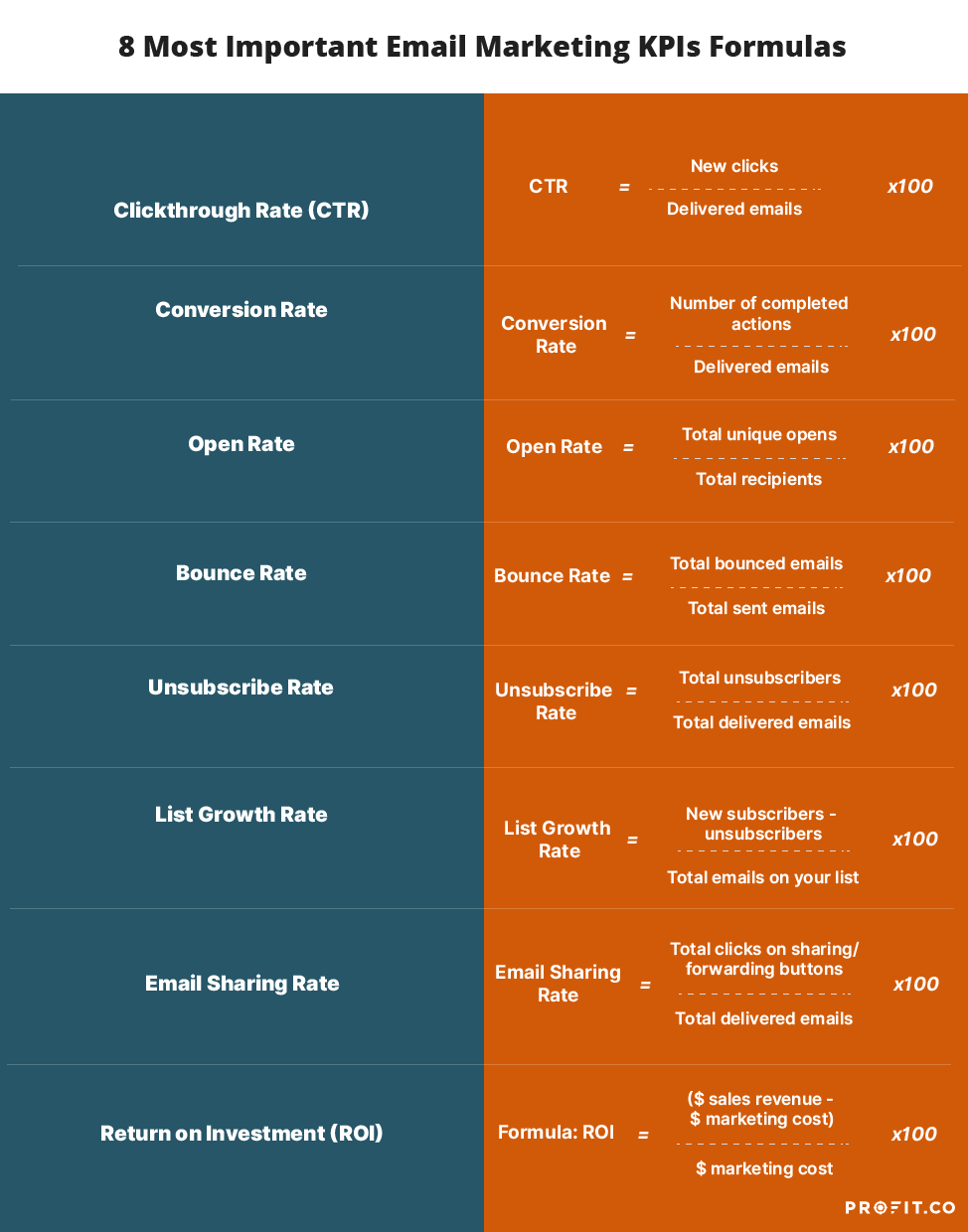
8 Most Important Email Marketing KPIs

All email marketing software has a dashboard packed with analytics, but eight key metrics directly contribute to your overall marketing goals. These are

Clickthrough Rate (CTR)

CTR
=
New clicksDelivered emails
x 100
The CTR is the percentage of recipients who clicked on your CTA or other links in your email. It’s the best KPI to track A/B tests, aiming to get more clicks for your campaign. The average CTR for emails is 2.91%, but it can be higher depending on your industry.

Conversion Rate(CTR)

Conversion Rate
=
Number of completed actionsDelivered emails
x 100
Conversion rate is the percentage of recipients who followed through with your CTA, such as sharing their contact details, buying a discount product, or any other desired action. The conversion rate is directly related to your email marketing goals. For example, if you aim to get your audience to download your ebook, your conversion rate indicates how many recipients actually got a copy. The average conversion rate for email campaigns is about 15%, but anything above 10% passes for a successful conversion rate.

Open Rate

Open Rate
=
Total unique opensTotal recipients
x 100
The Open rate is the percentage of email recipients who open your email. The formula is a good metric for understanding your recipients’ behavior. If they open your email but take no action, consider redesigning your email newsletter to encourage them to click on your CTA.

Bounce Rate

Bounce Rate
=
Total bounced emails Total sent emails
x 100
Bounce rate is the percentage of undelivered emails. Note that a soft bounce is a temporary issue, such as the recipient’s full inbox or a delay in the server. Your email will ultimately reach the intended destination once you clean out these issues. A hard bounce results from an invalid or closed email address, so your message will never get delivered. The acceptable bounce rate for your email campaign is 2% or less. Anything higher may alert your ISP and identify you as a spammer.

Unsubscribe Rate

Unsubscribe Rate
=
Total unsubscribers Total delivered emails
x 100
The unsubscribe rate is the percentage of your email recipients who opt out of your email list. While this is a valuable metric to understand your campaign’s performance, it offers only one perspective. For example, recipients may simply ignore your emails instead of taking steps to unsubscribe. Consider your CTR and open rate alongside your unsubscribe rate for a more accurate insight. That said, the ideal unsubscribe rate is 0.2% or less.

List Growth Rate

List Growth Rate
=
(New subscribers – unsubscribers) Total emails on your list
x 100
This percentage of new email subscribers and unsubscribers determines how fast your contact list grows. Track this email KPI if you want to expand your reach and audience or build a reputation as a thought leader in your industry. An email list decays by about 22.5% annually, so you should aim for a list growth rate to recover this decay.

Email Sharing Rate

Email Sharing Rate
=
Total clicks on sharing/forwarding buttons Total delivered emails
x 100
The email sharing rate is the percentage of email recipients who share your content through social pages or a dedicated forwarding button in your newsletter. It is easy to overlook email sharing when assessing KPIs for email marketing. It offers insights into your content value. The more value it adds, the more your recipients will share it and grow your reach.

Return on Investment (ROI)

ROI is the total revenue generated from your email campaign. Your ROI considers your types of leads and potential and actual revenue directly linked to your marketing budget.
ROI
=
($ sales revenue – $ marketing cost) $ marketing cost
x 100
The ideal email marketing ROI is a ratio of 5:1, which is $5 in sales revenue for every $1 of marketing spend. Anything under 2:1 is not profitable since it means you’re simply breaking even between your marketing costs and returns.

Conclusion

These are the top 8 email marketing KPIs for every marketer, regardless of your industry. Use this data to identify the potential improvements for your email marketing campaigns. Accurate KPIs for email marketing give you tangible results for your marketing investment and achievable lead generation strategies for your business. To learn more about how Profit.co can help your marketing team, schedule a free demo with our OKR experts today!

Ready to start your OKR Journey for FREE?

Get Started Now!

Frequently asked questions

Use a reputable email marketing software or CRM for data analytics.

Pay the most attention to your clickthrough rate (CTR), return on investment (ROI), and conversion rate for all your email campaigns.

Use the metrics to understand audience trends, improve your email content, and gather feedback from your recipients through email surveys.

Related Articles

10-Qualities-that-Differentiate-Leaders-1
OKR Management
6 min read · April 28, 2023

10 Qualities that Differentiate Leaders and Managers

Both managers and leaders are essential members of every team and are very important for all team-building activities. Managers are…

Bastin Gerald Bastin Gerald
The-Importance-of-Month
BLOG
6 min read · March 31, 2023

The Importance of Month on Month (MOM) Growth

Introduction Metrics are essential tools for measuring, tracking, and analyzing data related to a business or organization. Metrics help to…

Bastin Gerald Bastin Gerald
importance-of-tracking-monthly-recurring-revenue
BLOG
11 min read · March 24, 2023

The Importance of Tracking Monthly Recurring Revenue

IntroductionMonthly Recurring Revenue (MRR)is among the top 5 SaaS Metrics businesses use to track their revenue streams and forecast future…

Bastin Gerald Bastin Gerald
Customer-Retention-Rate
BLOG
12 min read · March 24, 2023

Customer Retention Rate: Definition, Formula and Benefits

In any organization, customer loyalty is essential for sustainability and growth. Loyal customers and employees become your brand ambassadors by…

Bastin Gerald Bastin Gerald
10-great_okr_examples for product mng
OKR Examples
12 min read · March 10, 2023

10 Great OKR Examples For Product Management

As a Product Management team, have you ever felt that building a product with the best features needs an ever-learning…

Bastin Gerald Bastin Gerald
get-the-most-out-of-okrs
OKR Management
7 min read · March 10, 2023

Get the Most Out of OKRs With Better Governance

Setting achievable, practical, and compelling goals requires time and effort. You may have sound objectives and key results (OKRs), but…

Bastin Gerald Bastin Gerald