Most organisations set OKRs every quarter. Most organisations fail to execute them. Here are the six real reasons and exactly what to do about each one.
- 90% of organisations fail to execute their strategy, first documented by Kaplan and Norton in The Balanced Scorecard, and consistently cited across strategy execution research since.
- The failure is almost never in the goal-writing. It is in what happens after, or doesn’t.
- The six real causes: strategy not cascaded, check-ins collapse, tools miss execution, key results measure tasks not outcomes, leadership misalignment, and OKRs disconnected from performance reviews.
- Each failure has a specific fix. Companies that apply them see 75–90% improvements in OKR completion and review efficiency.
- The right OKR software solves the structural problems. The right implementation solves the cultural ones.
- Strategy never reaches the teams doing the work
- Check-in discipline collapses after the first two weeks
- The tool shows green while the work underneath sits stalled
- Key results measure tasks, not outcomes
- Leadership is not aligned before the rollout begins
- OKRs are disconnected from performance reviews and projects
- How to run an OKR program that actually sticks
There is a pattern that shows up in almost every organisation that tries OKRs and gives up on them. It is not that the goals were bad. It is not that the framework doesn’t work. It is that the program was set up in a way that made failure almost guaranteed, and nobody realised it until the quarter was already lost.
According to Kaplan and Norton’s research in The Balanced Scorecard, cited by Harvard Business School and the Balanced Scorecard Institute, approximately 90% of organisations fail to execute their strategy successfully. OKRs are supposed to be the fix for this. But when OKRs themselves fail, teams often blame the framework and walk away from the tool that could have changed their execution entirely.
This post covers the six real reasons OKR programs fail in 2026, not the surface-level reasons, but the structural ones that show up regardless of company size, industry, or how experienced your leadership team is. And for each one, the specific fix.
1 Strategy gets set at the top and never reaches the teams doing the work
Leadership sets the company objectives in January. By February, every team is executing against a slightly different version of those priorities, filtered through their manager’s interpretation, their department’s habits, and the urgent requests that fill the week. By the end of Q1, the strategy exists on paper and nowhere else.
This is the most common OKR failure mode, and it is also the most invisible. Leaders look at the company objectives and assume teams are working toward them. Teams look at their own objectives and assume they connect to the company direction. Neither side has visibility into the gap between them.
The technical term for this is cascade failure. Company objectives should flow down into department objectives, which flow into team objectives, which flow into individual key results. When that cascade breaks, even at one level, every team below the break is executing on their own version of what the company wants.
Make the alignment tree visible to everyone, not just leadership. Every person in the organisation should be able to see how their key result connects to a team objective, which connects to a company objective. When that line of sight exists, teams self-correct. When it doesn’t, they drift with good intentions.
Profit.co’s OKR Alignments view shows the full cascade from company to individual in a single view, with dependency links between teams flagged automatically. A blocker at team level surfaces at company level in real time, not at the end of the quarter. See how Profit.co’s alignment view connects strategy to every team →
2 Check-in discipline collapses after the first two weeks
OKR programs almost always start with strong participation. But according to the OKR Benchmark Report 2026, teams that skip a consistent weekly check-in rhythm are 3x more likely to abandon OKRs altogether. By the end of the quarter, goals that looked active in week one are effectively invisible.
This failure is not about discipline or culture. It is about systems. When check-ins rely entirely on people remembering to do them against a calendar already full of actual work, they become the first thing to drop. Nobody plans to stop checking in. It just happens, one week at a time.
The consequences are significant. When check-ins stop, leaders lose visibility. At-risk goals are not flagged until it is too late to course-correct. The quarter ends with surprises: goals that looked fine because nobody updated them, suddenly missed.
Automate the follow-up. Not a generic calendar reminder; a targeted, intelligent prompt that goes to the specific person who has not updated, for the specific key result that is behind pace. The check-in habit should not depend on willpower. It should be supported by a system that fills the gap when willpower runs out.
Profit.co’s OKR Progress Agent monitors every key result in real time and sends targeted follow-up prompts to owners whose updates are overdue, before a missed check-in becomes a missed quarter. It also generates automated weekly digests for leaders so visibility doesn’t require anyone to manually pull a status report.
3 The OKR tool shows the goal as on track while the work under it sits stalled
A key result shows 65% progress. Three projects feeding it are stalled. Two task dependencies are unresolved. The OKR tool shows green. The leader sees green. The quarter ends with a red result that nobody saw coming.
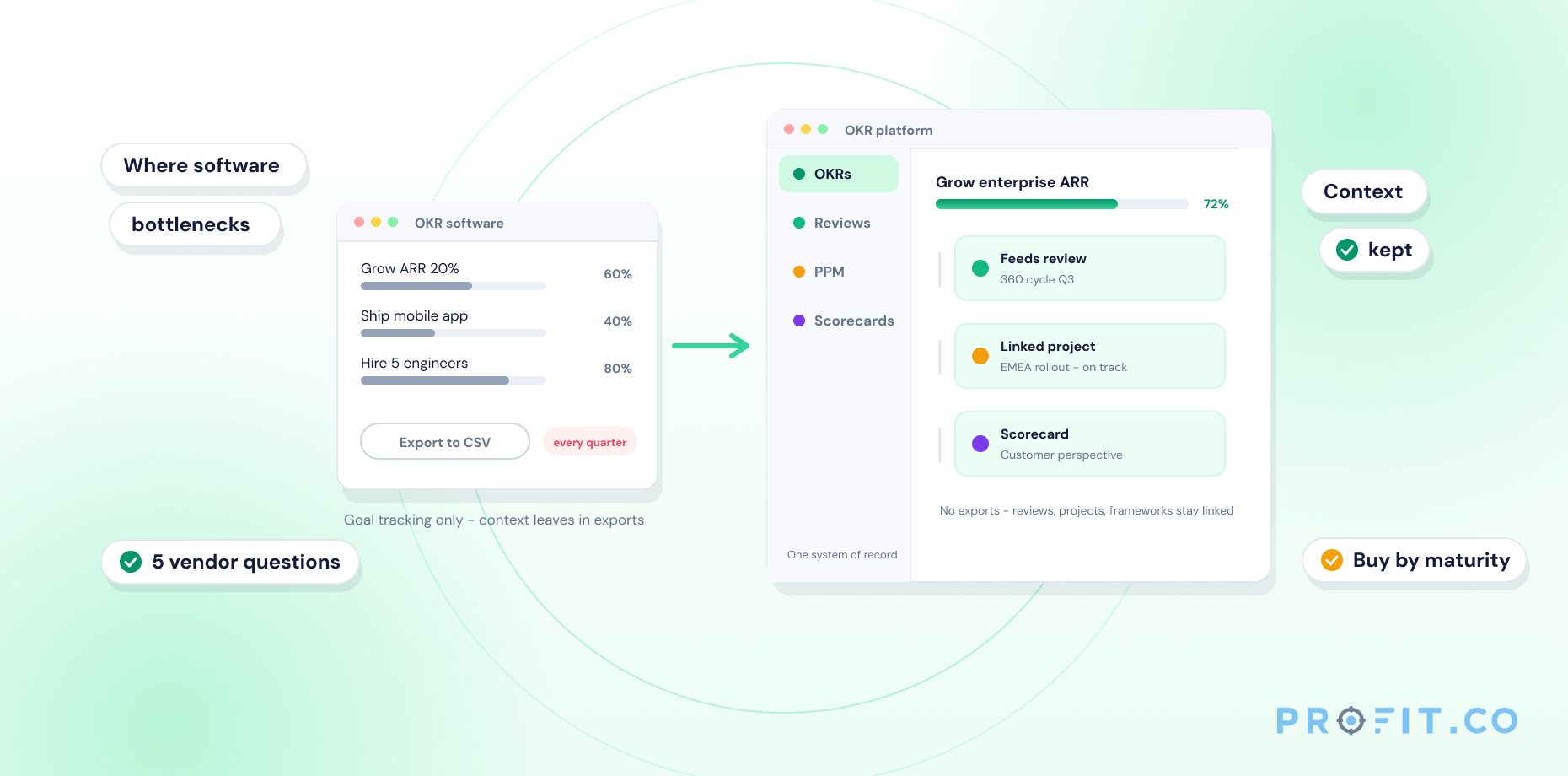
This is the fundamental limitation of most OKR software. It tracks the goal. It does not track the execution underneath the goal. The two live in separate systems: the OKR in one tool, the projects in another, the tasks in a third. Progress rolls up manually, which means it rolls up when someone remembers to update it, and it reflects what people think is happening rather than what the system knows is happening.
In this environment, OKRs become a reporting layer on top of the work, not a connected view of the work itself. Leaders make decisions based on the reporting layer. The reporting layer is wrong. The decisions are wrong.
Connect the OKR directly to the project and task layer. A project milestone completing should move the key result automatically. A stalled dependency should surface as an at-risk key result in real time, without a human manually connecting the dots.
Profit.co links every key result to the projects and tasks that move it. When a Jira ticket closes, the connected key result updates automatically. When a project milestone slips, the key result it feeds shows as at-risk before the quarter slips with it.
4 Key results measure what the team did, not what changed as a result
“Launch the new onboarding flow” is a task. “Increase 30-day activation rate from 42% to 65%” is a key result. Most teams write the first one and call the OKR done when the launch happens, regardless of whether activation improved. The goal was never measuring the right thing.
This is the most technically common OKR mistake, and it is the one that makes entire programs feel useless. When key results measure output, what the team produced, rather than outcome, what changed in the business because of it, OKRs become a sophisticated to-do list. Teams tick boxes. Nothing measurably improves. Leadership asks why they are investing in OKRs at all.
The shift from output-based to outcome-based key results is the single highest-leverage change most organisations can make. It forces a different question before the quarter starts: not “what will we build?” but “what will be different when we are done?”
Common examples of the output/outcome confusion:
- Output (wrong): “Complete the customer satisfaction survey rollout” Outcome (right): “Increase customer satisfaction score from 6.8 to 8.2 by end of Q3”
- Output (wrong): “Hire 3 engineers” Outcome (right): “Reduce average feature delivery cycle from 6 weeks to 4 weeks”
- Output (wrong): “Launch partner programme” Outcome (right): “Generate 15 qualified leads from partner channel in Q4”
Before accepting any key result, ask: “If this key result is marked complete, could the underlying business outcome still not have happened?” If yes, it is measuring output, not outcome. Rewrite it. For scale, use an AI quality scoring system that checks every key result before the quarter opens.
Profit.co’s OKR Quality Agent scores every key result against measurability, clarity, and outcome-orientation before the cycle begins. Vague or task-based key results are flagged with specific suggestions for rewriting, so the quality problem is caught before it becomes a quarter-long misdirection. See how the OKR Quality Agent scores every key result before the quarter starts →
5 Leadership is not aligned before the rollout reaches the teams
When the CEO is prioritising market expansion, the CFO is prioritising cost efficiency, and the COO is prioritising operational scale, every team below them inherits that conflict. Their OKRs pull in three directions. Cross-functional work stalls because nobody agrees on the priority. OKRs surface the misalignment. They do not create it.
This failure is unique because OKRs often get blamed for the symptom they expose rather than the problem they reveal. When teams see that their OKRs conflict with another team’s OKRs, the instinct is to question the framework. The real issue is that leadership has not aligned on priorities before asking teams to cascade them.
The OKR program should start with a leadership alignment session, not a goal-setting exercise, but a genuine prioritisation conversation. What are the three things that matter most this quarter? What are we willing to delay or deprioritise to focus there? Without that conversation, the OKR program inherits the organisation’s existing strategic ambiguity and makes it visible at every level.
Run a two-hour leadership alignment session before setting a single OKR. The output of that session is not a set of objectives; it is a prioritised list of what the company is and is not doing this quarter. The OKRs come after the alignment, not before it.
Profit.co’s Strategy Roadmap module connects top-level strategic themes to quarterly OKRs, so the cascade starts from an agreed strategic direction, not from each leader’s individual priorities. When leadership sets the roadmap, team OKRs cascade from a shared foundation instead of competing ones.
6 OKRs live in a separate tool from performance reviews and project delivery
When a person’s quarterly performance review has no connection to their OKR progress, OKRs feel like overhead. When projects don’t link to key results, delivery and strategy run in parallel, producing work without producing outcomes. When OKRs sit in a standalone tool that nobody checks because it isn’t where the real work happens, the program dies quietly.
This is the systemic failure that makes individual contributors stop caring about OKRs. If doing your OKRs well has no effect on your performance rating, and failing your OKRs has no effect on it either, then OKRs are administrative work with no personal relevance. The rational response is to do the minimum required to appear compliant, which is exactly what most people do.
The same logic applies at the project level. When projects and OKRs are in different systems, the connection between “what we are building” and “what we are trying to achieve” is never made explicit. Teams deliver projects that are disconnected from strategy and wonder why the strategy isn’t moving.
Connect OKR progress to performance reviews. Connect projects to the key results they serve. When OKR performance flows automatically into an individual’s review, and when project milestones move key results automatically, OKRs stop being a separate system and become the connective tissue between strategy, work, and people.
Profit.co is the only OKR platform that connects goal-setting, performance reviews, and project portfolios in one product. Each person’s OKR progress flows into their review template when enabled. Each project links to the objectives it serves. When the project delivers, the OKR moves. See how Profit.co connects OKRs, performance reviews, and project portfolios in one platform →
The 6 OKR failure points and what fixes them
Here is a summary of each failure and its fix, for teams doing a diagnostic on an existing OKR program or planning a new rollout:
| Failure | Root cause | Fix |
|---|---|---|
| Strategy not reaching teams | Cascade breaks between levels | Visible alignment tree, top to individual |
| Check-ins collapse after week two | System relies on willpower | Automated AI follow-up per owner |
| Goal shows green, execution is red | OKR tool not connected to project layer | Link key results to tasks and milestones |
| Key results measure tasks not outcomes | No quality gate before quarter opens | AI quality scoring on every KR |
| Leadership pulling in different directions | No alignment session before rollout | Strategy roadmap set before OKRs cascade |
| OKRs feel irrelevant to individuals | No link to performance reviews or projects | One platform connecting all three |
How to run an OKR program that actually sticks
Most OKR programs fail for the six structural reasons above. The good news is that each one has a direct fix, and the fixes compound. A team that solves all six does not just avoid failure; it builds an execution system that improves every quarter.
Here is the sequence that successful OKR implementations follow:
Align leadership before writing a single OKR
Run a two-hour prioritisation session with the leadership team. The output is not a set of OKRs; it is an agreed list of the three things that matter most this quarter. Every team’s OKRs cascade from that list, not from individual department priorities.
Use AI to write and score OKRs before the quarter opens
Rewriting vague OKRs mid-quarter is expensive and demoralising. Use an AI quality scoring tool to flag task-based or unmeasurable key results before the cycle starts. One quality gate at the beginning saves six weeks of misdirected work.
Automate check-in follow-up from week one
Do not rely on calendar reminders or manager nudges to maintain check-in discipline. Set up automated follow-up prompts from the first week of the cycle. The habit builds faster when the system does the chasing, not the person.
Connect every key result to the projects and tasks that move it
Each key result should have at least one linked project or task that drives progress automatically. When a Jira ticket closes, the key result should move. When a project slips, the key result should flag. If your OKR tool cannot do this, progress is always manual and always wrong.
Link OKR outcomes to performance reviews
When OKR performance flows into an individual’s review, OKRs stop feeling like overhead. Make it explicit at the start of the cycle: these are the goals you will be reviewed against. That single change is often enough to move check-in rates and completion rates significantly.
Review every quarter and improve the process, not just the goals
At the end of each quarter, ask two questions alongside goal scoring: What made check-in discipline hard this cycle? What slowed progress that was not captured in the key results? The OKR process should improve every quarter, not just the goal content.
Profit.co’s OKR Management platform is built to solve each of these six failure points, from AI-assisted authoring and quality scoring to automated check-in tracking and performance review integration.
Profit.co’s OKR Management platform is built to solve each of these six failure points directly
How Profit.co OKR Management solves each of these problems
Strategy not reaching teams. Profit.co’s OKR Alignments view shows the full cascade from company objective to individual key result in a single live view. Every person can see how their work connects to the company direction, and blocked goals surface at leadership level automatically before the quarter slips.
Check-ins collapsing after week two. Profit.co’s AI Progress Agent monitors every key result in real time and sends targeted follow-up prompts to each goal owner automatically. Check-in discipline stops relying on willpower and becomes a system that runs without manual chasing.
Goal status showing green while work sits stalled. Every key result in Profit.co connects directly to the projects and tasks that drive it. When a Jira ticket closes, the linked key result updates automatically. When a project slips, the key result shows as at-risk in the OKR Cockpit Dashboard before the quarter is lost.
Key results measuring tasks instead of outcomes. Before any OKR cycle opens, Profit.co’s Quality Agent scores every key result against measurability, clarity, and outcome-orientation. Task-based or vague key results are flagged with specific rewrite suggestions before they reach the team, not eight weeks in when it is too late.
Leadership pulling in different directions before rollout. Profit.co’s Strategy Roadmaps module lets leadership set and agree on the top strategic priorities before any team writes a single OKR. Every department’s goals cascade from that shared direction rather than from each leader’s individual interpretation, resolving conflict at the top before it reaches the teams.
OKRs feeling irrelevant to individuals. Profit.co is the only OKR platform that connects goal-setting, performance reviews, and project portfolios in one product. Each person’s OKR progress flows directly into their performance review when the cycle closes. When OKRs affect performance ratings, individuals stop treating them as overhead and start owning them as personal commitments.
You can see how each of these works inside the platform on the Profit.co OKR Management page.
See Profit.co OKR Management in Action
Frequently Asked Questions
Most OKR programs fail not because of bad goal-setting, but because of execution gaps: strategy is not cascaded to teams, check-in discipline collapses after week two, key results measure tasks instead of outcomes, and OKRs live in a tool that is disconnected from performance reviews and project delivery. The framework is sound. The implementation breaks.
Most OKR programs show failure signals within the first quarter. The OKR Benchmark Report 2026, based on 200+ organisations, found that teams who skip a consistent weekly check-in rhythm are 3x more likely to abandon OKRs altogether. Strategy misalignment between leadership and teams becomes visible within 6 to 8 weeks. A program that looks functional in week one can be effectively stalled by week six, even if the OKRs are still technically open.
Writing key results that measure activity instead of outcomes. “Launch the new product feature” is a task. “Increase feature adoption to 40% within 60 days of launch” is a key result. Most teams write the first and call it an OKR. When the launch happens, the key result is marked complete regardless of whether the outcome improved. The program produces activity, not results.
Fix it by addressing the structural cause, not the symptom. Align leadership before rolling out to teams. Connect OKRs to the projects and tasks under them. Automate check-in reminders so discipline doesn’t rely on willpower. Rewrite key results to measure outcomes not tasks. Link OKR progress to performance reviews so OKRs feel relevant to individuals, not just to leadership. Each fix addresses one structural failure. Apply all six and the program becomes self-sustaining.
Approximately 10% of organisations successfully execute their strategy, based on Kaplan and Norton’s research in The Balanced Scorecard, which found that 90% of organisations fail to execute their strategy successfully. OKRs improve those odds significantly when implemented correctly, but only when the structural problems above are resolved. Organisations that connect OKRs to performance reviews and project delivery show significantly higher completion and participation rates.
Profit.co’s OKR Management platform addresses each failure point directly: the AI Progress Agent automates check-in follow-up so participation doesn’t drop off; the alignment view cascades strategy from company to individual; project and task linkage connects execution to key results automatically; performance review integration makes OKRs relevant to individuals; and the Quality Agent catches vague or task-based key results before the quarter opens. It is the only OKR platform that connects goal-setting, performance reviews, and project portfolios in one product.