Continuous performance management is an ongoing cycle of goal-setting, feedback, and progress check-ins that replaces a single annual review. Most companies still run yearly reviews while teams execute in fast, iterative cycles, creating a gap between what gets measured and what happens week to week. Quarterly OKR cycles close that gap as governance checkpoints for continuous feedback.
In this guide
- What Is Continuous Performance Management?
- How Does Continuous Performance Management Differ From Annual Reviews?
- Why Do Most Continuous Feedback Programs Fail to Change Behavior?
- How Do OKRs Bridge Stage-Gate Governance and Agile Execution?
- How Does Continuous Performance Management Software Connect Feedback to Real Work?
- What Does a Hybrid Stage-Gate and Agile Model Look Like in Practice?
- Frequently asked questions
A performance review that happens once a year cannot describe work that changes every two weeks. That mismatch, not a lack of effort from managers, is the actual reason most performance management programs feel disconnected from how teams operate.
What Is Continuous Performance Management?
Continuous performance management is a system where goals, feedback, and progress reviews happen on a recurring short cycle, typically weekly or biweekly, instead of once or twice a year. Instead of one retrospective conversation in December, managers and employees revisit goals as work happens, adjusting direction before a project drifts off course rather than explaining the drift afterward.
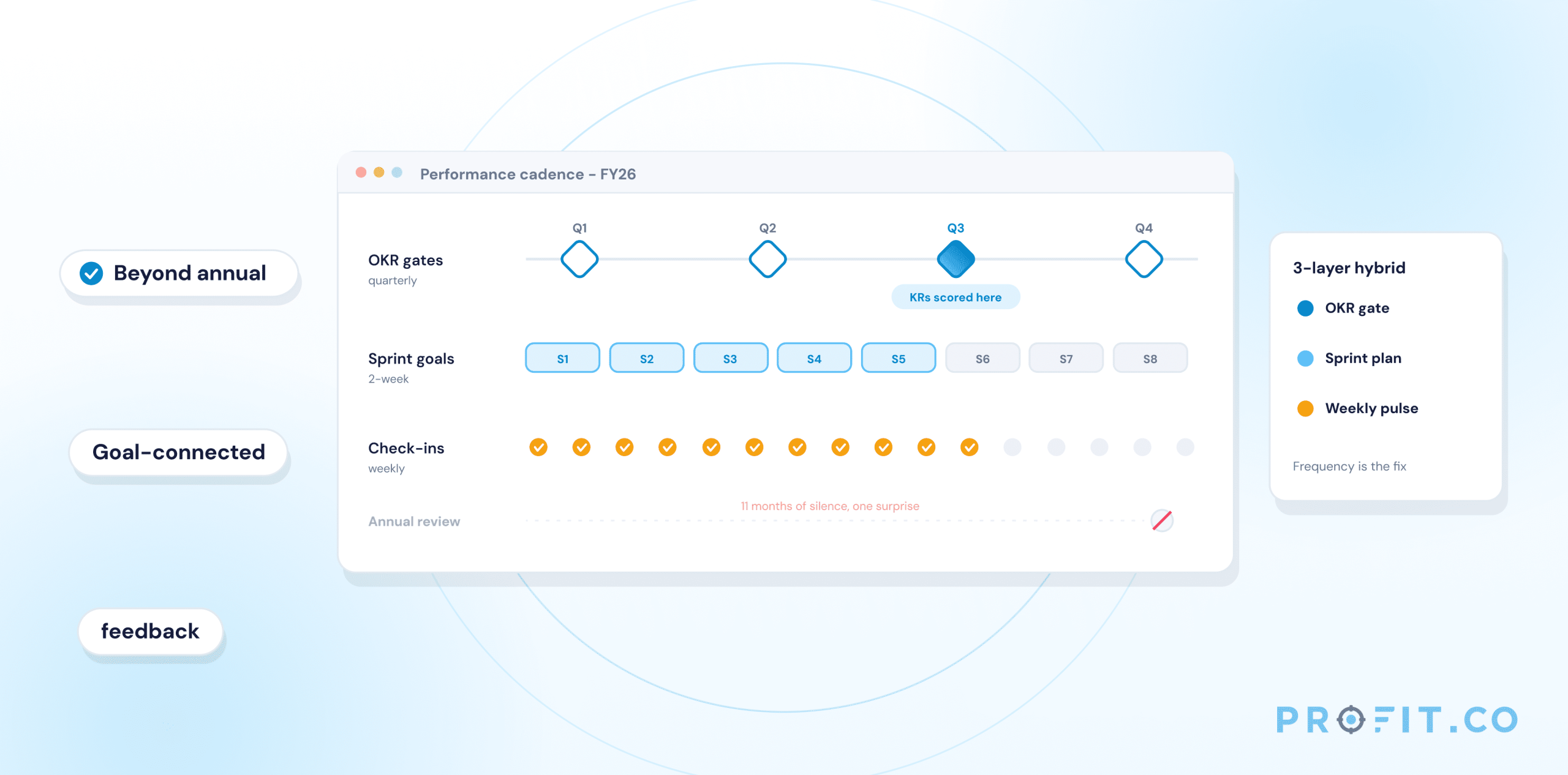
The shift sounds small. It isn’t. An annual review measures a year of work through one conversation, which means 51 weeks of context gets compressed into a single data point. A continuous model spreads that same context across 26 or more checkpoints, so the data reflects what actually happened instead of what people remember happening.
Most employees don’t find their annual review motivating, and that is not a feedback problem. It is a frequency problem: feedback delivered once a year arrives too late to change behavior on the work it was meant to improve.
How Does Continuous Performance Management Differ From Annual Reviews?
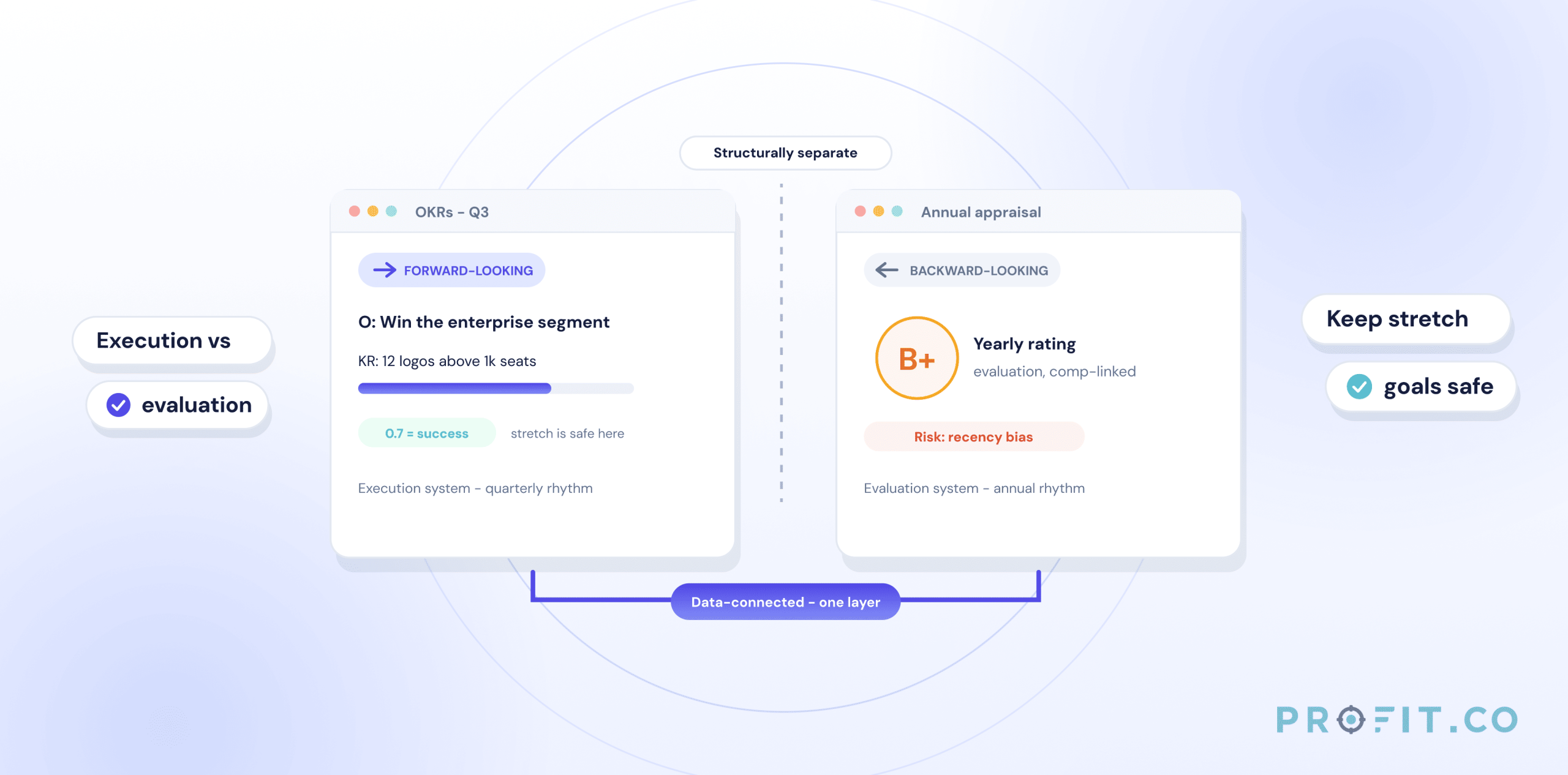
The two models differ in cadence, in what gets measured, and in who the data serves. An annual review is built for HR compliance and compensation decisions. A continuous model is built for the manager and the employee, in the middle of active work, deciding what to do next.
| Annual Review Model | Continuous Performance Management |
|---|---|
| Feedback delivered once or twice a year | Feedback delivered weekly or biweekly, tied to active work |
| Goals set in January, revisited in December | Goals reviewed every check-in cycle and adjusted mid-quarter |
| Designed for compensation and compliance | Designed for course correction and daily decision-making |
| Manager recalls performance from memory | Performance data is logged continuously across the quarter |
| One retrospective conversation per cycle | Many small, low-stakes conversations across the cycle |
Most HR leaders already know annual reviews are not working. The model is not broken because managers are bad at giving feedback. It is broken because the cadence is too slow for the speed at which work changes.
Connect Quarterly OKR Gates to Weekly Continuous Feedback
Why Do Most Continuous Feedback Programs Fail to Change Behavior?
Most companies believe that adding more check-ins automatically produces continuous performance management. It doesn’t. A weekly check-in that asks “how’s everything going?” with no connection to a goal is just a more frequent version of the same disconnected review: it adds meetings without adding direction.
This breaks at scale because feedback and goals live in separate systems. The manager gives feedback in a one-on-one document. The goal sits in a spreadsheet or a separate OKR tool. The project status lives in a third system entirely. By the time someone tries to connect “did this feedback change the outcome,” the trail is already cold. Feedback without a goal attached is just opinion; it has nowhere to land.
The second failure point is governance. Continuous feedback without any structured checkpoint turns into noise: constant input with no clear gate for deciding whether a goal is on track, at risk, or should be cut. Teams end up with more conversations and the same blind spots, because nothing forces a structured go/no-go decision at any point in the cycle.
How Do OKRs Bridge Stage-Gate Governance and Agile Execution?
This is where most continuous performance management advice stops short. It tells teams to give feedback more often without explaining what should anchor that feedback. The anchor is the OKR cycle itself, and it works because it borrows structure from two methodologies that usually get treated as opposites.
Stage-gate governance works by setting a checkpoint: a project only advances past a gate if it meets defined criteria. Agile delivery works by breaking execution into short, adaptable units called sprints that can change direction without waiting for a yearly plan to update. Most organizations pick one model and inherit its weakness: stage-gate is too rigid for fast-changing work, and agile alone has no governance layer to confirm the work is still pointed at the right outcome.
A quarterly OKR cycle solves both problems at once. The key result is the gate criteria: a specific, measurable bar that has to be hit before the quarter closes. The sprint goal is the execution unit underneath it: the adaptable, short-cycle work that moves toward that bar. A sprint goal with no key result behind it is just busy work with a deadline. A key result with no sprint goal underneath it is just a number nobody is accountable for moving. The OKR cycle is what forces the two to share a definition of progress.
The Architecture Advantage
One Data Layer for OKRs, Performance Reviews, and Project Portfolio Management
Connected OKR, performance review, and project portfolio management modules running on the same data layer let a key result set at the start of a quarter function as the gate, while the tasks and sprint goals underneath it update that same key result in real time. Continuous feedback during weekly check-ins references the same number leadership reviews at the quarterly gate: one system, one number, two governance speeds.
How Does Continuous Performance Management Software Connect Feedback to Real Work?
Software earns its place in this model only if it removes the disconnect described above: feedback in one place, goals in another, project status in a third. Continuous performance management software should do three specific things: log feedback against a specific goal at the moment it’s given, surface progress on that goal automatically from the work being done against it, and present both to the manager and employee at the same check-in, not in separate tools.
Without that connection, “continuous” just means “more frequent.” With it, every check-in becomes a small course correction grounded in current data rather than a recap of what someone remembers from two weeks ago. A dashboard that looks clean but pulls from three disconnected systems isn’t measuring performance, it’s measuring whichever system happened to sync last. The fix isn’t a better chart. It’s one source of truth feedback can actually write to.
What Does a Hybrid Stage-Gate and Agile Model Look Like in Practice?
In practice, a hybrid model runs on three layers. The top layer is the quarterly OKR, the gate. The middle layer is the project or sprint plan underneath it, broken into two-week increments that can shift without renegotiating the entire quarter. The bottom layer is the weekly check-in, where feedback gets attached directly to the key result or task it affects, not filed separately.
This is the practical answer to a question operations and strategy leaders ask constantly: how do you keep agile teams moving fast without losing the governance a board or leadership team needs to trust the numbers? The answer isn’t choosing agile or stage-gate. It’s using the OKR quarter as the gate and the sprint as the unit of work inside it. Read more on how this connects in how OKRs bridge strategy and project execution.
For teams trying to decide which governance model fits their structure, it helps to study both ends of the spectrum directly: see how agile and waterfall project management compare on planning rigidity and change tolerance, and how a stage-gate project management framework defines go/no-go checkpoints. Teams already running sprints can pair that structure with agile goal management practices that keep sprint goals tied to the quarterly key result instead of drifting from it.
Get Started
Frequently Asked Questions
Continuous performance management replaces the annual review with recurring weekly or biweekly cycles of goal-setting and feedback tied to active work.
Annual reviews compress a year of work into one conversation for compensation decisions. Continuous performance management spreads feedback across many cycles to guide real-time decisions.
Quarterly OKRs set the gate criteria for a cycle, while weekly check-ins and sprint goals provide the continuous feedback that tracks progress toward that gate.
Most companies keep a lightweight annual summary for compensation but move day-to-day performance decisions to continuous, goal-linked check-ins instead.
Continuous feedback fails when it isn’t attached to a specific goal: frequent conversations without a tracked outcome produce noise, not improvement.