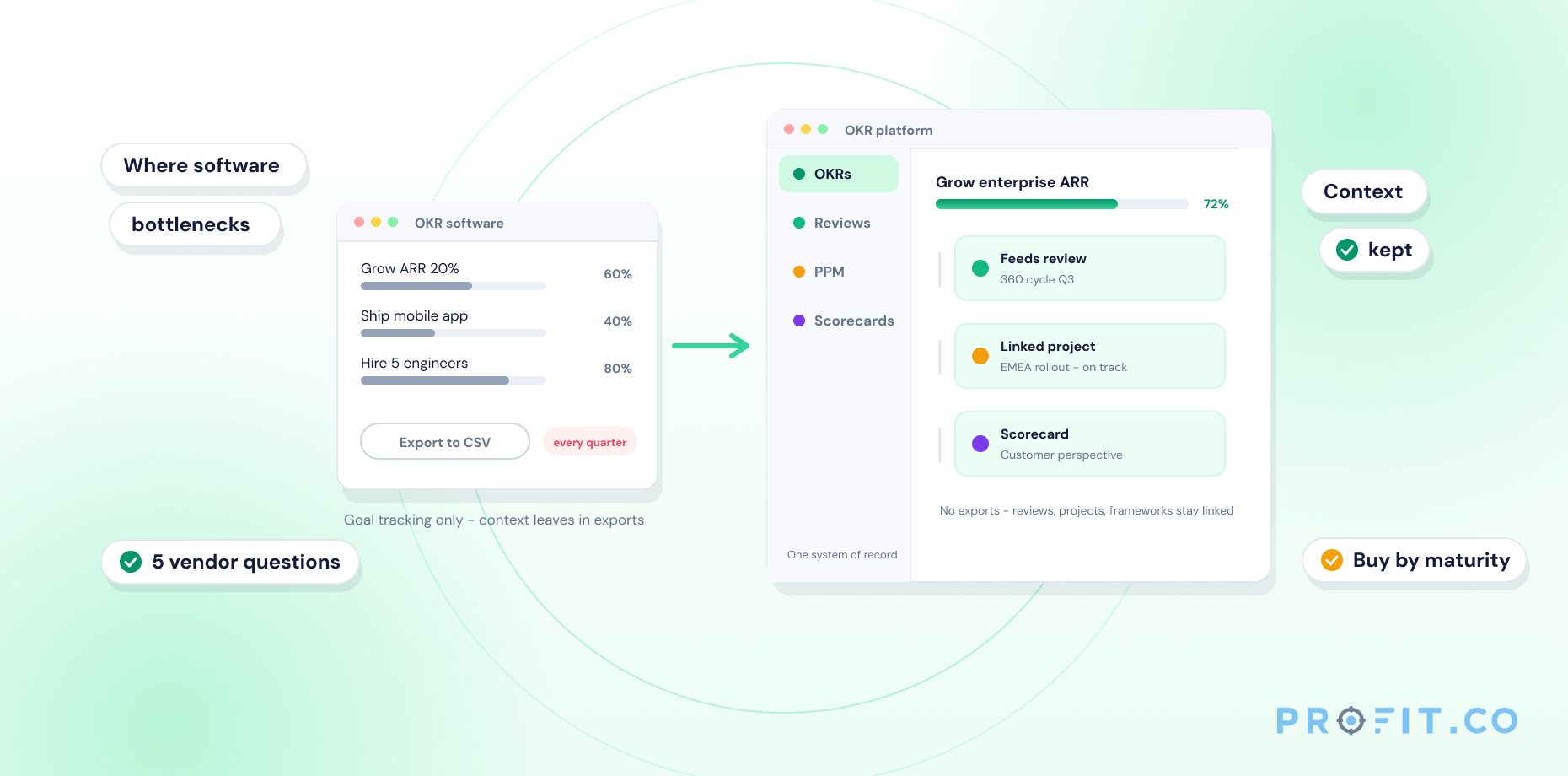
An OKR platform works in five steps: set Objectives and Key Results, align and cascade goals across every org level, track progress through weekly check-ins and automated integrations, review OKR health on live dashboards, and close out each cycle with structured scoring and reflection. The platform then resets, preserving context and carrying priorities forward automatically.
In this guide
- How Does an OKR Platform Work?
- Step 1: Set Objectives & Key Results
- Step 2: Align & Cascade Across Levels
- Step 3: Track Progress via Check-ins & Scoring
- Step 4: Review on Dashboards & Reports
- Step 5: Close Out & Learn
- Frequently Asked Questions
This guide walks through each of the five steps in detail, explaining what happens at each stage, what a capable OKR platform does to support it, and where most organizations run into problems when a step is skipped or done poorly.
How Does an OKR Platform Work?
- Set Objectives and Key Results at company, team, and individual levels, with AI-assisted authoring, quality scoring, and approval workflows.
- Align and cascade goals top-down and bottom-up so every team’s priorities connect to company strategy.
- Track progress through structured weekly check-ins, automated scoring, and real-time data integrations from connected tools.
- Review OKR health on live dashboards, including heatmaps, status breakdowns, and check-in discipline, and generate reports in one click.
- Close out the quarter: score results, answer reflection questions, carry priorities forward, and feed OKR scores into performance reviews.
An OKR platform turns the OKR framework, Objectives and measurable Key Results, into an operational cycle that repeats every quarter. The platform manages the entire lifecycle: goal creation, team alignment, weekly progress tracking, real-time dashboards, and end-of-cycle review. Before diving into the five steps, it helps to understand what an OKR platform is and how it differs from a simple goal-tracking spreadsheet.
Each step in the OKR cycle has specific inputs, activities, and outputs, and each depends on the previous one being done well. When any step is skipped or treated as optional, the effects compound: goals lose alignment in Step 2, progress stops being updated in Step 3, and the close-out in Step 5 becomes a superficial exercise instead of a genuine learning moment.
Step 1: Set Objectives & Key Results
Every OKR cycle begins with goal creation. The platform provides a structured interface where leaders write Objectives, the ambitious, qualitative goals that define what the organization wants to achieve, and attach Key Results: the specific, measurable outcomes that will confirm whether each objective is being reached.
In a well-configured OKR platform, this stage includes four capabilities:
- AI-assisted OKR authoring: Enter a strategy prompt and the platform generates a complete set of Objectives and Key Results, scored and ready for review. In Profit.co, the OKR Authoring Agent produces draft OKRs in seconds from a plain-language strategy input.
- Quality scoring: The platform evaluates every OKR for clarity, measurability, and strategic alignment before the quarter starts, flagging vague goals so they can be fixed before becoming a problem at week eight. Profit.co’s Quality Agent runs this check automatically.
- Approval workflows: OKRs route through a configurable review process before going live, ensuring alignment with senior leadership before work begins. Profit.co supports parallel approval flows and custom approval thresholds.
- Key result type selection: Teams set numeric, percentage, currency, or milestone Key Results to match exactly what they are tracking. Milestone key results also support flexible ad-hoc check-ins, so progress can be logged as it happens rather than waiting for the next scheduled date.
The output of Step 1 is a complete set of approved OKRs, one set for each team and individual who will contribute to the cycle. These become the foundation for everything that follows.
OKR Authoring Agent: Turns a strategy prompt into a full set of draft Objectives and Key Results in seconds.
Quality Agent: Scores every OKR for clarity and measurability before the quarter begins.
Approval Workflows: Parallel flow and custom thresholds, all approvers can review simultaneously with configurable sign-off requirements.
OKR Templates Library: Pre-built templates by industry and function accelerate first-cycle setup for new teams.
Step 2: Align & Cascade Across Levels
Once OKRs are created and approved, the platform builds the alignment layer, the visible connection between every Objective and the higher-level goal it is designed to advance. This is what separates an OKR platform from a simple goal tracker.
Profit.co supports two alignment directions:
- Top-down alignment (cascading): Company or department OKRs flow downward. Executives assign their Key Results as Objectives to department heads, who in turn assign their Key Results to teams or individuals. Every level’s goals connect back to the company objective above them, creating a chain of accountability from CEO to individual contributor.
- Bottom-up alignment (rolling up): Individual contributors or teams can align their own self-defined OKRs upward to a higher-level goal. When a contributor makes progress on their own Objective, that progress automatically flows up to the parent Key Result it is aligned to. This fosters ownership and ensures ground-level insight reaches strategy, not just the other way around.
The alignment view in Profit.co shows the full tree, from company to department to team to individual, making it immediately visible when a team’s goals are disconnected from company strategy, or when two teams have conflicting priorities. The OKR Platform Buyer’s Guide covers alignment feature evaluation in detail, including what to look for when cascading across complex enterprise org structures.
Key principle: Cascading is not about duplicating the same OKR at every level. It is about translating strategy into language that is actionable at each level. A company objective to “increase revenue by 30%” becomes a marketing team objective to “grow qualified pipeline,” which becomes an individual SDR key result to “book 20 qualified demos per month.”
Step 3: Track Progress via Check-ins & Scoring
Progress tracking is where most OKR programs succeed or fail. The platform needs to make it easy, ideally automatic, for teams to update their Key Result progress throughout the quarter. When updates are manual and time-consuming, they stop happening. When they stop, the OKR system goes dark, and the cycle ends in surprises.
Profit.co supports progress tracking through two mechanisms:
Structured Check-ins
Profit.co recommends weekly check-ins as the standard cadence. At each check-in, contributors update the current progress value, record a confidence score (0 to 1 scale indicating how likely they are to hit the key result), and log notes on any blockers or obstacles. Platforms can also configure bi-weekly or monthly check-in frequencies, with grace periods to accommodate real-world scheduling. Weekly check-ins in OKR follow PPP methodology (Progress, Plans, Problems) or the ProProPro format (Progress, Promises, Problems), giving every check-in a consistent structure managers can quickly scan.
Profit.co also generates check-in discipline reports, tracking which teams and individuals are updating consistently (on-time), which are late, and which have missed check-ins entirely. Managers use these reports to identify teams that are going dark before it shows up in the actual progress numbers.
Automated Progress Updates
For Key Results driven by data from connected systems, Profit.co pulls updates automatically when a task is completed, a data source changes, or a sub-key result is updated. This is supported for three scenarios: Key Result progress roll-up from sub-key results; Task Tracked Key Results (where completing a task automatically logs progress); and Key Results integrated with external applications. Browse Profit.co’s full integrations directory, 100+ native connectors with bi-directional sync, including Jira, Salesforce, HubSpot, Tableau, Power BI, Google Sheets, Asana, Looker, and more.
When an integrated Key Result receives an automatic update, the progress is logged to the next scheduled check-in date, keeping the check-in history clean and accurate without requiring manual data entry.
Weekly check-in reminders: Automated notifications via Action Center and email prompt contributors to update progress on schedule.
Flexible check-ins for milestone key results: Ad-hoc check-ins can be added anytime between scheduled dates, progress captured as it happens (Feb 2026 release).
Check-in grace periods: Configurable grace windows (e.g. 4 to 6 days for weekly, up to 15 days for bi-weekly) prevent accidental missed check-in flags.
Check-in discipline reports: Cockpit dashboards track on-time, late, and missed check-ins across every team, managers see who is updating and who is not.
Automated progress from integrations: Task completion, sub-key result roll-up, and integration sync all auto-update the relevant Key Result without manual entry.
Step 4: Review on Dashboards & Reports
Throughout the quarter, and especially at mid-cycle and end-of-cycle reviews, leaders need a consolidated view of OKR health across the entire organization, without chasing individual status reports.
Profit.co provides this through the OKR Cockpit: a configurable dashboard that aggregates progress from every team, department, and individual into a single live view. As of the February 2026 release, the Cockpit now shows which Key Results are aligned or unaligned based on hierarchical connections, so leaders can instantly identify alignment gaps across departments.
What the Cockpit shows in Step 4:
- Overall OKR score: A single aggregate number representing progress across all active goals in the current cycle.
- Status breakdown: Goals segmented by On Track, At Risk, Behind, and Completed, with projection status indicators now visible in List View, Canvas View, and Alignment View (previously only in List View).
- Check-in discipline: Which teams are updating consistently (Execute phase view in Cockpit) and which have gone quiet.
- Aligned vs. unaligned data: Key Results grouped by whether they are connected to a higher-level objective, so alignment gaps surface at a glance.
- Heatmaps: Color-coded progress views by department, team, or objective cluster.
Beyond dashboards, Profit.co generates reports in seconds from live OKR data, including PDF exports, PowerPoint slides via OKR Present Mode for board meetings, and one-click email summaries for leadership. No manual deck rebuilding required before any review.
The most common failure at Step 4: Leaders wait until end of quarter to look at dashboard data. The Cockpit is designed to be opened weekly, not monthly. Teams that review OKR health weekly at Step 4 have more time to intervene at Step 3 before the quarter closes.
Step 5: Close Out & Learn
At the end of each OKR cycle, the platform guides teams through a structured close-out process. This is the stage most organizations treat as optional, and it is the primary reason why OKR programs plateau after a few cycles rather than improving with each iteration.
Profit.co’s Reflect/Reset module handles Step 5 with three options for each Key Result:
- Complete & Close: The key result is completed and closed for the current quarter, it does not carry forward into the next cycle.
- Modify & Continue: The key metric value is adjusted and the Key Result is pushed into the next period with its history intact.
- Do Not Carry Forward: For incomplete Key Results where the team decides not to continue, the reset flow includes an explicit “do not carry forward” option, added in July 2025 to give teams better control.
The reflection process in Profit.co uses a configurable Question Builder, where administrators set a standard set of reflection questions that teams answer for each closed OKR. Teams score their Objectives (typically on a 0 to 1 scale, where 0.7 is a strong outcome for aspirational goals) and log what drove or hindered results, what they would do differently, and what they are carrying into the next quarter.
For organizations with performance management enabled, end-of-cycle OKR scores flow directly into each person’s performance review in the same platform, replacing subjective manager recall with a documented, evidence-based record of what was achieved.
How Profit.co Connects Step 5 to the Next Cycle
Profit.co’s OKR Management module preserves all close-out data, including reflection answers, scores, and carry-forward decisions, in an audit log that is accessible in every subsequent cycle. This means the institutional knowledge from each quarter does not evaporate when a team reorgs or a manager moves on. The next cycle starts with context, not a blank slate.
Reflect/Reset module: Configurable reflection questions, complete/close or modify/continue options, and “do not carry forward” for incomplete key results.
OKR Scoring: Custom or standard 0.0 to 1.0 grading with fulfillment score visualization, the score slider shows an instant indicator when weights are unbalanced.
OKR Audit Log: Every change to an objective is timestamped and recorded, full history preserved across cycles.
Performance Review Linkage: When the performance module is enabled, OKR cycle scores flow directly into performance reviews, no manual export between systems.
Goal Auto-Inheritance: If a new cycle opens before team members have created goals, enabling the “Inherit Manager’s Goals” toggle automatically assigns the manager’s goals to direct subordinates (Feb 2026 release).
The cycle then restarts at Step 1, better calibrated than the previous quarter. Teams that complete Step 5 properly enter each new cycle with sharper OKRs, more realistic targets, and a shared record of what to improve. For methodology guides, templates, and OKR education resources, Profit.co’s OKR University is the most comprehensive resource available online.
Ready to see all five steps in action?
See how Profit.co manages every stage of the OKR cycle, from goal creation to performance review, in one platform.
Frequently Asked Questions
An OKR platform works in five steps: teams set Objectives and Key Results at every organizational level, align and cascade goals to connect team priorities to company strategy, track progress through weekly check-ins and automated integrations, review OKR health on live dashboards, and close out each cycle with structured scoring and reflection. The platform preserves context across cycles so each quarter starts informed by the last.
Profit.co recommends weekly check-ins as the standard cadence. Weekly updates keep goal data current, surface blockers early, and create the consistent rhythm that makes OKRs feel integrated into day-to-day work rather than a separate quarterly exercise. Platforms can also configure bi-weekly or monthly check-in frequencies, with grace periods for flexibility. Check-in discipline reports show managers which teams are updating on time and which have gone quiet.
OKR cascading is the process of translating company-level Objectives into aligned goals for departments, teams, and individual contributors. A platform manages this through top-down alignment: executives assign their Key Results as Objectives to the next level down, and bottom-up alignment: contributors align their own OKRs upward to a higher-level goal, with their progress automatically rolling up. The alignment tree makes every connection visible and flags orphaned OKRs that are not linked to any company objective.
Yes. Profit.co supports automated check-ins for three scenarios: Key Result progress roll-up from sub-key results, Task Tracked Key Results (where completing a task logs progress automatically), and Key Results integrated with external tools like Jira, Salesforce, HubSpot, Tableau, and 100+ others. When an integration or task triggers a progress update, it is logged to the next scheduled check-in date, keeping the check-in history accurate without manual data entry.
At the end of a quarter, Profit.co’s Reflect/Reset module guides teams through structured close-out: scoring each Objective on a 0.0 to 1.0 scale, answering configurable reflection questions about what drove or hindered results, and choosing whether to complete and close each Key Result, modify it and continue, or explicitly not carry it forward. OKR scores can flow directly into performance reviews when the performance management module is enabled.
Profit.co is the only OKR platform that combines OKR management, performance reviews, project portfolio management, and employee recognition in one product. Most standalone OKR tools handle Steps 1 through 4 only. When the quarter ends, context must be manually transferred to wherever performance and project data lives. Profit.co connects all five steps of the OKR cycle in one system, so nothing is lost between stages and every close-out in Step 5 feeds directly into the performance conversation that follows.