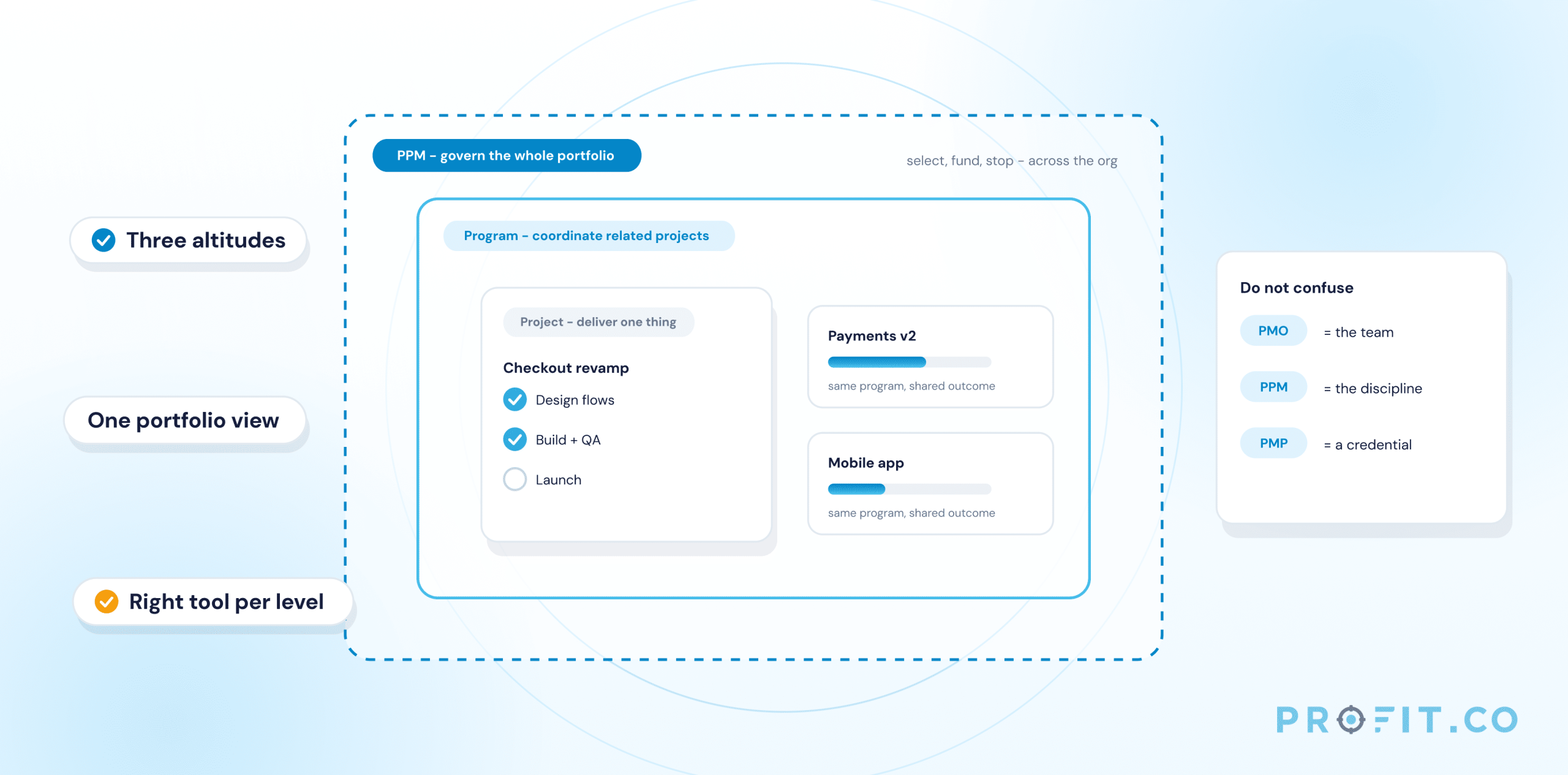
PPM (Project Portfolio Management) selects and prioritizes multiple projects to deliver strategic outcomes. Project management executes a single project. Program management coordinates related projects toward a shared objective. All three are distinct disciplines operating at different altitudes, and conflating them produces governance structures that nobody actually uses.
In this guide
- What Is the Difference Between PPM, Project Management, and Program Management?
- Why Do Most Companies Confuse These Three?
- How Does PPM Differ from a PMO?
- What Is the Difference Between PPM and PMP Certification?
- How Do OKRs Bridge Stage-Gate PPM Governance and Agile Project Delivery?
- When Does a Company Need PPM Instead of Project Management?
- Frequently asked questions
What Is the Difference Between PPM, Project Management, and Program Management?
The three terms share a word, “project,” and that’s where most of the confusion starts. They describe fundamentally different scopes of responsibility, not variations of the same job.
Project management focuses on delivering a single, defined piece of work within scope, schedule, and budget. A project manager owns the plan, the risks, and the delivery of one outcome. Success is concrete: delivered or not, on time or not.
Program management coordinates a group of related projects that share dependencies, resources, or a common strategic objective. A program manager doesn’t manage each project directly; they manage the interdependencies between projects and the collective outcome those projects must produce together.
Project Portfolio Management (PPM) operates at the highest level. It answers the question every leadership team should be asking: “Of everything we could do, what should we do, in what order, with the resources we have?” PPM selects, funds, balances, and governs the full collection of projects and programs an organization runs at any point in time.
The table below separates project management, program management, and PPM across six dimensions: scope, core question, success metric, owner, time horizon, and organizational altitude.
| Dimension | Project Management | Program Management | PPM |
|---|---|---|---|
| Scope | Single project | Group of related projects | All projects across the org |
| Core question | “Can we deliver this on time?” | “Do these projects fit together?” | “Should we even do these?” |
| Success metric | On-time, on-budget | Shared objective achieved | Strategic outcomes delivered |
| Owner | Project Manager | Program Manager | PMO / Portfolio Director / COO |
| Time horizon | Weeks to months | Months to years | Annual + rolling quarterly |
| Altitude | Ground level | Terrain view | Map view |
Project managers work on the ground. Program managers see the terrain. Portfolio managers look at the map, and decide which routes are worth taking.
Why Do Most Companies Confuse These Three, and What Breaks When They Do?
Most organizations believe they’re doing PPM because they track active projects in a spreadsheet, have a PMO, and hold regular status meetings. They’re not. They’re doing project management at scale, a fundamentally different discipline with a different set of failure modes.
The first failure is prioritization. When every project gets approved because a senior stakeholder requested it, the portfolio fills with work that doesn’t connect to strategy. The root cause is almost always the same: projects were selected because of who asked for them, not because they move a measurable strategic outcome.
The second failure is resource allocation. Without a portfolio view, the same engineers, designers, and analysts get assigned across five competing projects simultaneously. Each project manager fights for their share. Nobody sees the conflict until someone misses a deadline, by which point three other timelines have already slipped.
The third failure is the one nobody catches. Projects are delivered on time and on budget, but strategy doesn’t move. Speed without direction is faster failure. A company that executes the wrong projects efficiently is still going in the wrong direction.
PPM doesn’t fix execution speed. It fixes strategic coherence. The question isn’t “are our projects delivered?”, it’s “are our projects delivering the right outcomes?”
How Does PPM Differ from a PMO?
A PMO (Project Management Office) is a team or function. PPM is a discipline. They’re related but not the same, and organizations that conflate them end up with governance structures that report on projects without actually governing them.
A PMO sets project standards: templates, methodologies, reporting formats, governance gates. It may also provide project managers, run internal training, and maintain the organization’s project management maturity. A PMO is infrastructure.
PPM is the discipline of selecting, funding, and balancing the right mix of projects across strategic priorities. A PMO often uses project portfolio management software to execute this discipline, but a PMO’s existence doesn’t guarantee the discipline is actually happening.
Many PMOs are operationally focused: they track project status, escalate issues, and produce dashboards. That’s necessary work, but it’s not PPM. PPM requires the PMO to have real authority, or at least influence, over project selection and investment decisions. Without that authority, the PMO manages the portfolio it’s given rather than shaping it.
“Most dashboards fail structurally, not visually. A PMO with perfect status reporting but no selection criteria isn’t doing portfolio management; it’s doing sophisticated documentation.”
What Is the Difference Between PPM and PMP Certification?
PMP (Project Management Professional) is an individual certification. PPM is an organizational practice. Confusing them leads to the wrong hiring decisions and software purchases, and neither solves the right problem.
A PMP-certified project manager has demonstrated competence in managing a single project through its lifecycle: initiation, planning, execution, monitoring, and closure. The PMP is issued by PMI and recognized globally as the benchmark credential for individual project practitioners.
PPM is what an organization needs when it runs twenty PMP-certified project managers simultaneously and realizes nobody is deciding which projects those managers should be working on. Individual competence doesn’t automatically produce portfolio coherence.
The relevant portfolio-level credential is PMI’s PfMP (Portfolio Management Professional), a less common but strategically more relevant qualification for leaders building PPM at scale. Individual certification builds better project managers. PPM discipline builds better project decisions, and organizations that invest in both outperform those that treat them as the same thing.
Align Your Portfolio to Strategy, From Day One
How Do OKRs Bridge Stage-Gate PPM Governance and Agile Project Delivery?
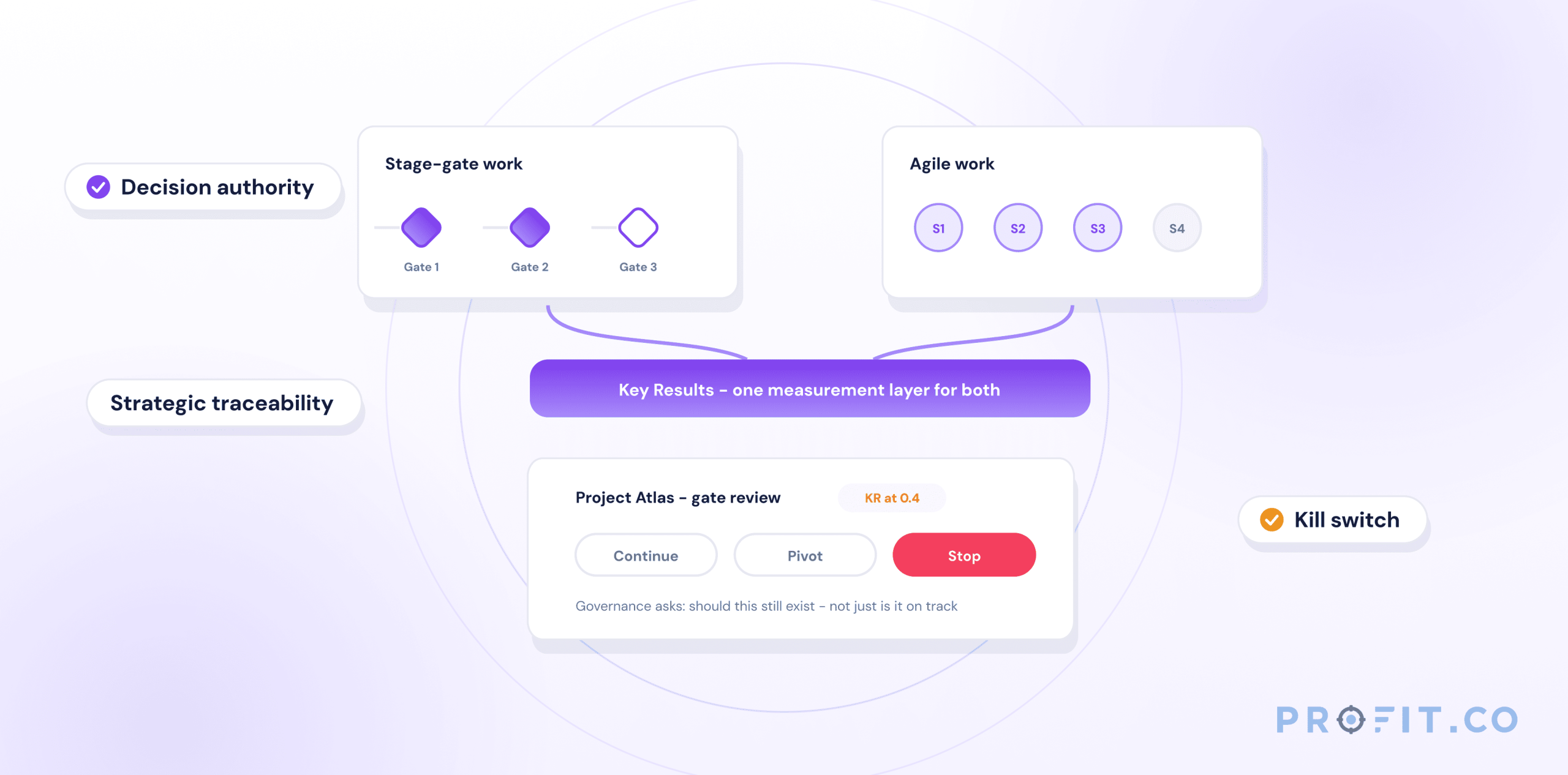
The deepest tension in PPM is between governance and speed. Stage-gate project governance creates the strategic coherence PPM promises, projects pass formal approval checkpoints before moving forward. Agile delivery models create the execution speed modern teams need, short sprints, continuous adaptation, fast feedback.
Most organizations treat these as opposing forces. They’re not. They’re different cadences serving different purposes, and OKRs are the mechanism that connects them.
Quarterly OKRs set the gate criteria
Instead of stage-gate reviews anchored only to project milestones, gate reviews align to the quarterly OKR cadence. A project passes the gate when it demonstrates clear alignment to at least one active Key Result, removing the subjectivity that makes traditional gates political.
Sprint goals are the execution units
Within the quarter, teams run two-week sprints. Each sprint goal connects to a Key Result. Agile and waterfall delivery models can both coexist under this structure; the governance overhead is absorbed at the quarterly level, not the sprint level.
The portfolio view shows OKR alignment, not just project status
Every project in the portfolio maps to at least one Key Result. Projects with no Key Result alignment become candidates for deprioritization at the quarterly review, based on data, not politics.
The Architecture Advantage
OKR Management Connected Directly to the PPM Layer
A connected OKR management platform links directly to the PPM layer, so the same system that tracks Key Results also tracks the projects designed to move them. AI-powered authoring builds project plans aligned to active Key Results. AI-powered status monitoring flags delivery drift before it becomes a missed quarter.
For teams building toward this model, agile goal management principles show how sprint-level execution connects to portfolio-level outcomes, translating the OKR-PPM bridge from theory into a working quarterly rhythm.
When Does a Company Need PPM Instead of Project Management?
Not every organization needs PPM. A 20-person startup running two concurrent projects can manage both with a shared task board and weekly standups. The trigger for PPM isn’t company size; it’s the point where complexity and strategic misalignment start costing more than the governance infrastructure would.
1. Resource conflicts are decided by whoever shouts loudest
When the same senior engineers are listed on six projects and project managers are competing for their time, the problem isn’t scheduling; it’s selection. PPM fixes this at the source by defining capacity constraints before projects are approved, not after they start.
2. Nobody can explain why these projects were chosen
If the selection criteria are implicit, or the real answer is “someone senior wanted it,” the portfolio is politics, not strategy. PPM introduces explicit criteria: strategic alignment, expected ROI, risk profile, and resource feasibility. Projects that can’t clear those criteria get deprioritized before they consume budget.
3. Projects are delivered but strategy doesn’t move
This is the hardest signal to act on because it looks like a strategy problem, not a project problem. But it’s both. When projects don’t connect to measurable strategic outcomes, delivery becomes activity, not progress. PPM forces that connection at the approval stage, not the retrospective.
The signal isn’t complexity; it’s cost. When political prioritization, resource conflicts, and misaligned delivery are consuming more leadership time than a governance framework would, the threshold for PPM has been crossed.
Key Differences: PPM, Program, and Project Management
- Project management executes one project. Program management coordinates related projects. PPM selects and governs the full collection of both, connecting every project to a strategic outcome.
- A PMO is a team. PPM is a discipline. Having a PMO does not mean PPM is happening, unless the PMO has authority over project selection, not just project reporting.
- PMP is an individual credential for project practitioners. PPM is an organizational discipline for managing multiple projects aligned to strategy. More certified project managers don’t fix a portfolio selection problem.
- OKRs bridge stage-gate governance and agile delivery: quarterly Key Results set the selection and gate criteria, sprint goals run the execution units. The hybrid model works when both cadences are designed to connect.
- PPM becomes necessary when resource conflicts are chronic, project selection is political, or delivered projects consistently fail to move strategy. Speed without direction is faster failure.
Connect Portfolio Decisions to Live OKRs
Frequently Asked Questions
PPM selects and prioritizes a collection of projects to deliver strategic outcomes. Project management executes a single project within scope, time, and budget. Program management coordinates interdependent projects toward a shared objective. Each operates at a different organizational altitude.
A PMO is a team that sets project standards and governance. PPM is the discipline of selecting and managing a portfolio of projects. A PMO often runs PPM processes, but its existence does not guarantee the discipline is happening.
PMP is an individual credential for project practitioners, issued by PMI. PPM is an organizational discipline for managing multiple projects aligned to strategy. One is a certification for a person; the other is a practice for a company.
A company needs PPM when it runs more than ten simultaneous projects, when resource conflicts become chronic, or when delivered projects consistently fail to move strategic metrics. Small teams running one or two projects can operate with project management alone.
OKRs define the strategic outcomes a portfolio must deliver. PPM selects and funds the projects that move those Key Results forward. When OKRs serve as gate criteria for project approval, every project in the portfolio has a measurable strategic justification.