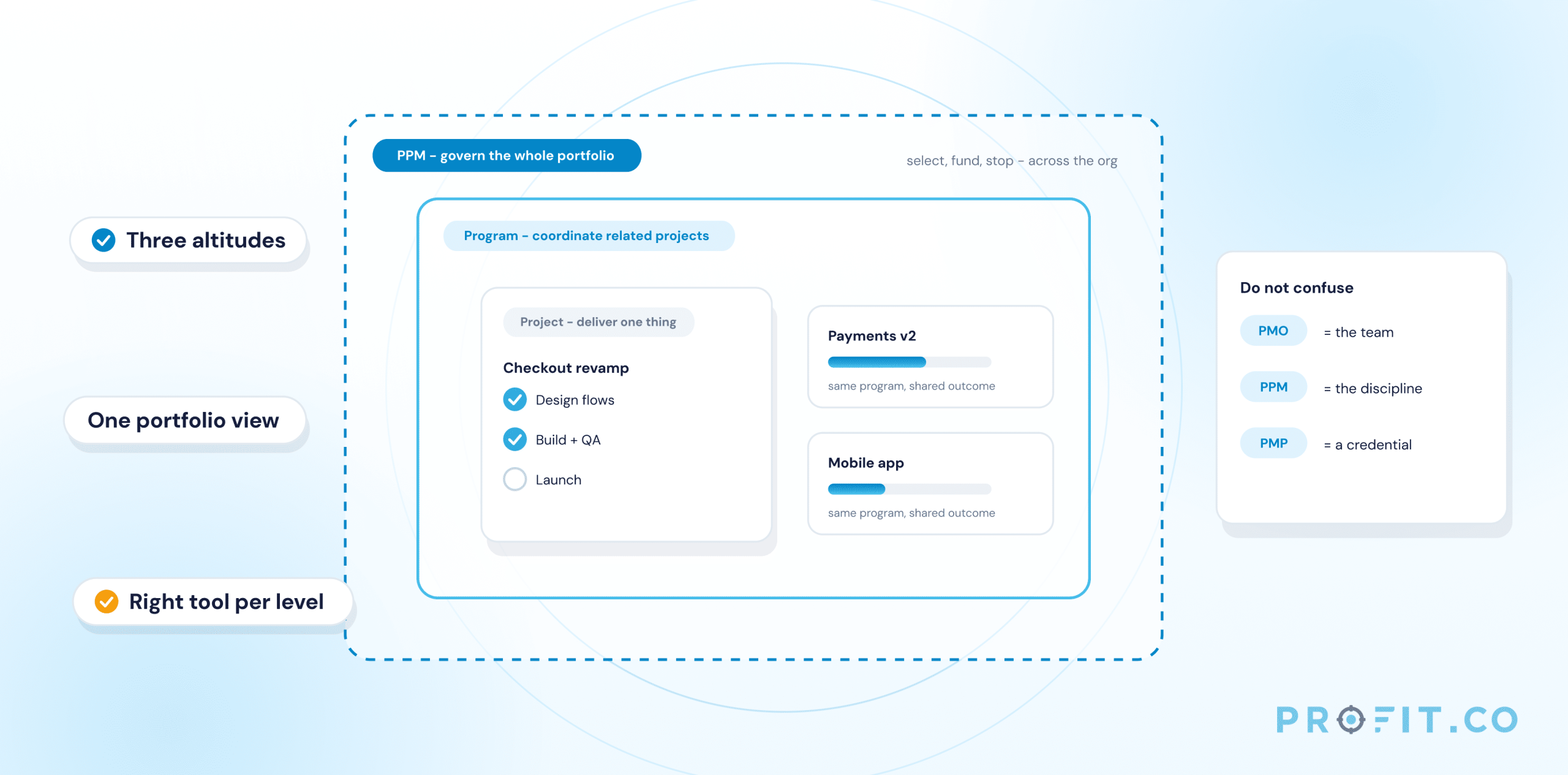
The PPM lifecycle is the structured sequence of phases, intake, prioritization, planning, execution, and review, that determines how an organization selects, funds, and delivers its project portfolio. A complete PPM cycle connects every approved project to a strategic objective. Most organizations run a PPM schedule. Far fewer run one that actually delivers on strategy.
In this guide
- What Is the PPM Lifecycle?
- Why Do Most PPM Cycles Break Down Before They Deliver?
- Stage-Gate vs. Agile Sprints: Which PPM Schedule Model Should You Use?
- How Do OKRs Turn Stage-Gate Criteria Into Agile Execution Goals?
- What Does a Complete PPM Schedule Look Like Quarter by Quarter?
- What Three Changes Stop a PPM Cycle From Drifting?
- Frequently asked questions
What Is the PPM Lifecycle?
The project portfolio management (PPM) lifecycle is not a project tracker. It is the operating system for how strategic investment moves through an organization, from idea to prioritization, to funded execution, to measurable business outcome. A project management tool answers “how do we deliver this project?” The PPM lifecycle answers the harder question: “which projects should we be running in the first place?”
A complete PPM cycle runs through five phases:
Pipeline Intake
New project requests enter a structured queue with defined criteria: strategic fit, estimated return on investment, resource requirements, and risk level. Without a defined intake process, projects enter the portfolio through informal channels, and informal channels favor advocacy over alignment.
Prioritization
A scoring model ranks intake requests against strategic objectives. High-scoring projects move forward; low-scoring ones are deferred or declined. The scoring criteria, not the loudest project sponsor, determines what gets resourced.
Planning and Resourcing
Approved projects receive scope, timeline, budget, and team. Dependencies are mapped. The PPM schedule is set, either as a stage-gate roadmap for capital-intensive work or a sprint-based delivery plan for software and digital initiatives.
Execution and Monitoring
Work begins. Progress is tracked against plan. Blockers are escalated. Portfolio health is reviewed on a defined cadence, not just when something goes visibly wrong.
Review and Reset
At the end of each cycle, typically quarterly, the portfolio is assessed. Projects are closed, reprioritized, or extended based on strategic relevance and actual performance data. This phase is where most PPM programs quietly fail: by converting a decision forum into a status meeting.
Most organizations run phases one through four with reasonable consistency. Phase five is where the cycle earns its existence. Portfolio review is not a bookkeeping exercise; it is the only moment in the PPM schedule when leadership can reverse a bad intake decision before another quarter of resources is spent on it. That is the phase most PPM programs abbreviate. That is exactly the one they cannot afford to skip.
Why Do Most PPM Cycles Break Down Before They Deliver?
Most PPM failures are not execution failures. They are intake failures.
Projects get approved for the wrong reasons. A senior leader champions something late in the budget cycle. A vendor relationship tilts a decision. Teams rush requests through before year-end to protect headcount. By the time the PPM schedule is set, the portfolio already contains projects that were never aligned to strategy; they were simply funded.
Two structural failures accelerate this:
No objective scoring at intake
When projects are prioritized without a clear link to strategic objectives, the portfolio reflects internal politics, not strategy. Teams spend entire quarters executing work the board would not recognize as strategic if presented to them directly.
Status reporting replaces decision-making
A PPM cycle that produces red/amber/green dashboards without triggering real resource reallocation decisions is theatre, not governance. The portfolio review becomes a reporting exercise. No project ever gets cancelled in a status meeting, and no strategic gap ever gets closed in one either.
Most portfolio failures trace back to intake, not execution. The wrong project gets approved, the PPM schedule gets set around it, and teams execute it competently, delivering something that was never strategically justified in the first place.
“A PPM schedule that isn’t connected to strategy is just a more expensive way to stay busy.”
The fix is not a better dashboard. It is a PPM lifecycle where each phase is structurally tied to a strategic objective, and where the review cycle produces real resource decisions, not summaries. The stage-gate process is one governance model that enforces exactly this discipline at each project phase transition.
Stage-Gate vs. Agile Sprints: Which PPM Schedule Model Should You Use?
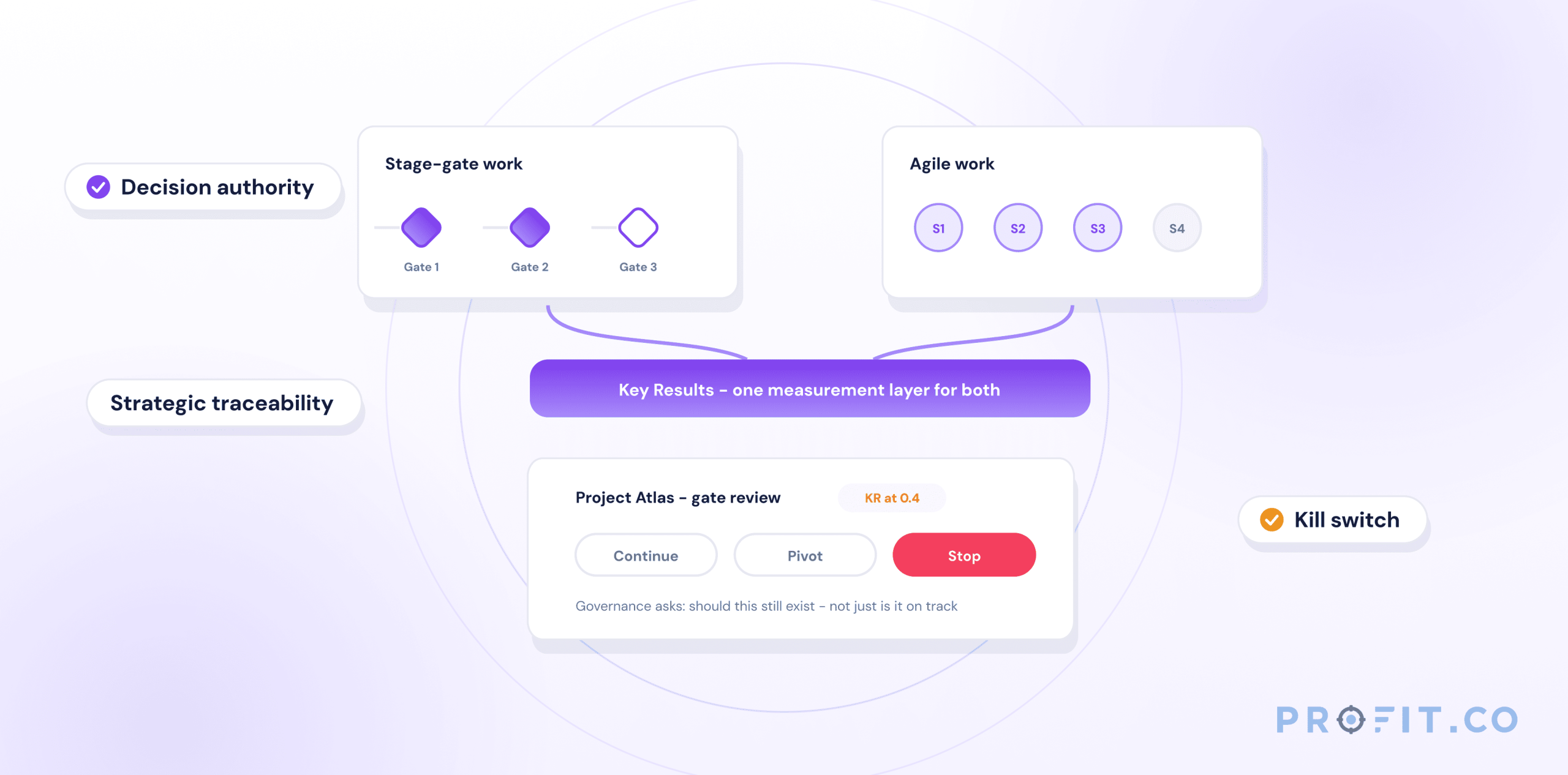
The stage-gate versus agile debate is usually framed as a methodology choice. It is not. They operate at different altitudes, and most mature PPM programs need both running simultaneously.
Stage-gate governs the portfolio. It answers: should this project remain funded? Does it still align to strategy? Has it cleared the criteria to proceed to the next phase?
Agile sprints govern delivery. They answer: what does the team build in the next two weeks? What is the minimum viable increment? What is blocking progress right now?
The table below compares stage-gate and agile PPM across five dimensions: planning horizon, change management, risk handling, best-fit work type, and critical weakness.
| Dimension | Stage-Gate | Agile Sprints |
|---|---|---|
| Planning horizon | Upfront, milestone-based | Rolling, sprint-by-sprint |
| Change management | Formal change request at each gate | Built into each sprint retrospective |
| Risk handling | Gates filter risk before investment | Risk surfaces iteratively, early in delivery |
| Best for | Capital-intensive, regulatory, hardware | Software, digital, fast-shifting priorities |
| Critical weakness | Slows response when strategy shifts mid-cycle | No portfolio-level governance or strategic view |
The failure mode of stage-gate alone: governance becomes bureaucracy. Projects that should pivot get locked into waterfall contracts. The market moves on before the project ships. The failure mode of agile alone: delivery teams move fast but in different directions. Resources are allocated by urgency, not strategy. No one asks whether this sprint backlog connects to the quarterly objectives.
For a deeper breakdown at the project delivery level, see this guide on agile vs. waterfall in project management. The hybrid model resolves the governance-delivery tension, but only when both sides share a common language for what success looks like this quarter. That language is OKRs.
Connect Your PPM Cycle to Live OKRs, Starting this Quarter
How Do OKRs Turn Stage-Gate Criteria Into Agile Execution Goals?
This is the structural gap most PPM frameworks miss.
Stage-gate governance answers: “Should we continue?” Agile delivery answers: “What should we build next?” Neither framework, on its own, asks: “Are we building the right thing to hit our strategic objective this quarter?” OKRs answer that question, and they do so at exactly the right cadence.
A quarterly OKR cycle maps directly onto a standard PPM review cycle. Key results become the gate criteria: a project passes its stage gate when the relevant key result is met or demonstrably on track. Sprint goals become the execution units; each two-week sprint delivers the increment that advances the key result. The operational model looks like this:
Expand into the enterprise customer segment by end of Q3
Launch enterprise SSO and audit logging for 10 pilot customers
Project passes Phase 2 when SSO is in production and security audit is complete
Deliver SSO provider integration; complete initial penetration test
Implement audit logging; complete compliance review with legal
Each sprint goal moves a key result forward. Each key result is a gate criterion. The portfolio stays connected to strategy, not by policy document, but by structure. The gate cannot be passed by a project that hasn’t delivered its key result. The sprint cannot be called successful if it did not advance the strategic objective.
“OKRs are not a goal-setting exercise. They are the bridge between what the board approved and what the team shipped.”
Most organizations treat OKRs as planning artifacts, reviewed at quarter-start, revisited at quarter-end, ignored in between. In a connected PPM cycle, OKRs are the live mechanism that tells a portfolio leader whether execution is moving strategy forward, not just whether projects are on schedule. That distinction is the difference between a portfolio review that produces decisions and one that produces slides.
A connected OKR + PPM + task management platform links portfolio projects, quarterly key results, and individual sprint tasks in one view. A project manager sees how today’s sprint connects to the company’s Q3 strategy without switching systems. A portfolio leader sees which projects are advancing key results and which are consuming resources without delivering strategic progress.
For teams running agile goal management at the team level, this connection closes the gap between sprint velocity and strategic impact, the measurement that most agile transformations never solve.
What Does a Complete PPM Schedule Look Like Quarter by Quarter?
A PPM schedule structured around quarterly OKR cycles runs in three phases within a 13-week window. Each phase has a specific job, and skipping any of them is how portfolios drift.
Weeks 1–2 · Portfolio Review and Intake
- →Review previous quarter OKR scores by project
- →Close or deprioritize projects that missed key results by more than 40%
- →Score and rank new intake requests against the refreshed strategy
- →Assign or reallocate resources to approved projects
Weeks 3–11 · Execution
- →Teams run 2-week sprints with goals tied directly to quarterly key results
- →OKR progress updates flow in automatically from the tools teams already use, so portfolio health reflects reality, not manual status submissions
- →Portfolio health is reviewed every 3 weeks, not just at month-end
- →Blockers and resource gaps are escalated before they become delivery failures
Weeks 12–13 · Review and Reset
- →OKR scores are finalized for each project in the portfolio
- →Portfolio retrospective: which projects delivered strategic value? Which didn’t?
- →Learnings feed directly into the next cycle’s intake scoring criteria
This structure shrinks the strategy-execution feedback loop. Instead of discovering at year-end that the portfolio drifted from strategy, the quarterly review cycle surfaces misalignment while there is still time to act. The review phase is not the last step of the cycle; it is the first step of the next one.
Strategy that cannot be connected to funded, executing projects is just a document. The quarterly PPM cycle is the mechanism that keeps strategy alive past the planning meeting, when it is structured correctly.
What Three Changes Stop a PPM Cycle From Drifting?
Portfolio programs do not drift all at once. They drift incrementally, one informal approval, one skipped review, one status meeting that never produces a decision. Three operational changes close the gap before it opens.
Score projects at intake using strategic criteria, not advocacy
Every project request should be scored against four to five weighted criteria: strategic alignment, estimated return, resource availability, risk level, and dependency complexity. A scoring model removes politics from prioritization. The loudest sponsor no longer determines what gets resourced.
Replace status updates with decision checkpoints
Portfolio review meetings should answer one question: should any project be cancelled, reprioritized, or resource-shifted based on current strategic priorities? If that question is not being asked and answered, it is a status update. Real governance produces decisions, not summaries.
Connect the PPM schedule to the OKR cycle
Set portfolio review dates to coincide with OKR quarter-ends. Use key result scores as gate criteria. Require every project in the portfolio to have at least one associated company-level key result. If a project cannot be connected to a strategic objective, it does not belong in the portfolio. The OKR management platform becomes the single source of truth for whether the portfolio is moving strategy forward, not just moving.
“Speed without strategic direction is faster failure. The PPM cycle is only as valuable as the strategy it is executing.”
Keep Your Portfolio Connected to Strategy, Every Quarter
Frequently Asked Questions
The PPM lifecycle is the structured sequence, intake, prioritization, planning, execution, and review, that governs how an organization selects, funds, and delivers its project portfolio. Each phase connects project work to a strategic objective, turning portfolio management into a strategy execution system.
The five phases are pipeline intake, prioritization, planning and resourcing, execution and monitoring, and review and reset. Most PPM programs fail at the final phase by converting portfolio reassessment into a status update meeting instead of a real reallocation decision.
Stage-gate governs portfolio funding decisions, whether a project should continue at each milestone. Agile governs delivery, what teams build each sprint. Most mature PPM programs use both: stage-gate for governance at the portfolio level, agile sprints for execution at the team level.
OKRs connect to the PPM lifecycle by turning quarterly key results into stage-gate criteria and sprint goals into execution units. This maps the OKR cycle directly onto the PPM review cycle, keeping every project structurally aligned to strategy throughout execution.
A PPM schedule is the time-bound plan governing when portfolio phases occur, intake windows, stage gates, sprint cadences, and review cycles. Aligned to the OKR cycle, it creates a repeatable governance rhythm keeping every project connected to a live strategic objective.