Most organizations run OKRs. Very few have built the system that makes OKRs run strategy.
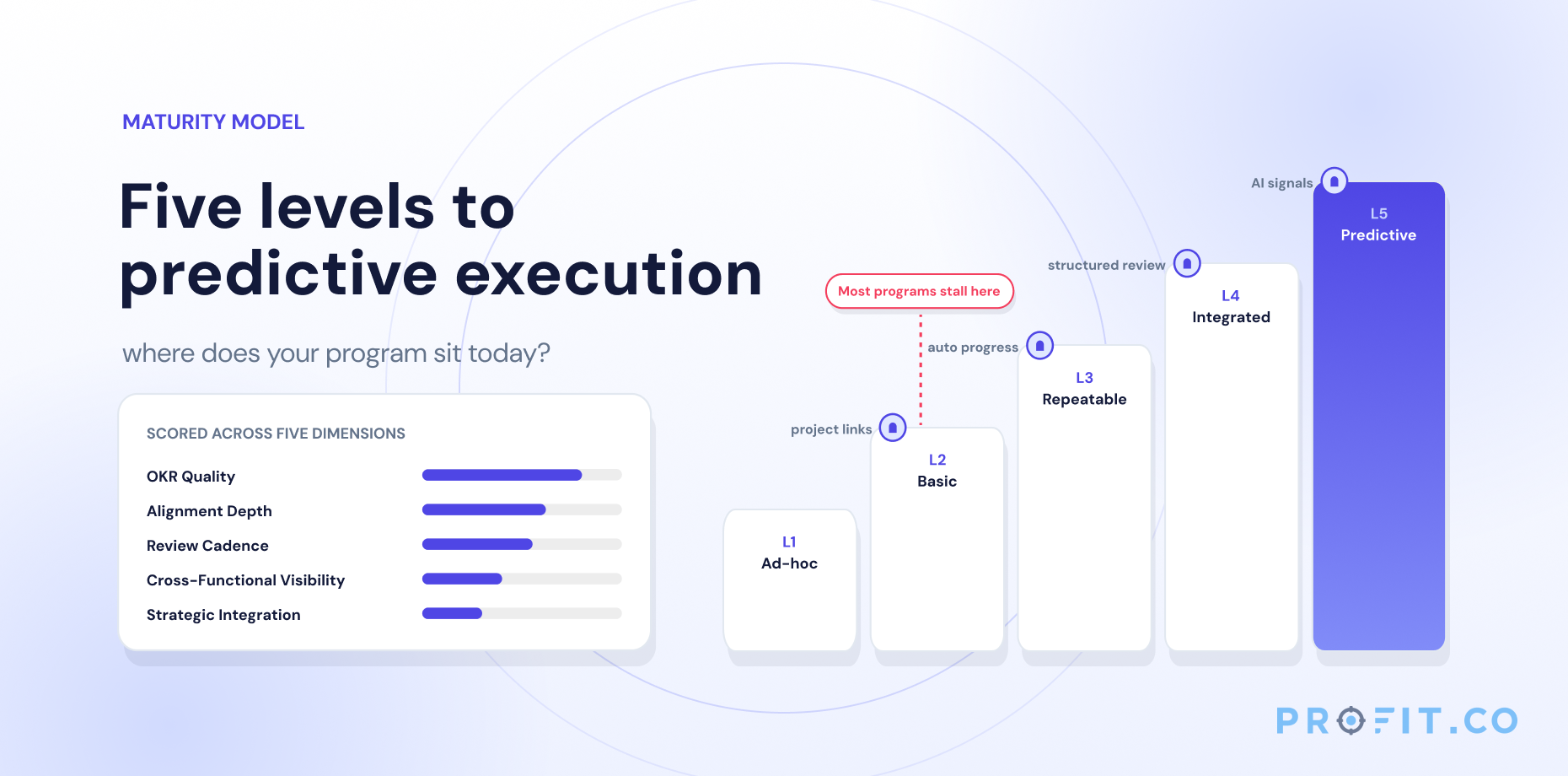
A strategy execution maturity model is a five-level framework that diagnoses how effectively an organization sets, aligns, and executes its strategic goals. The five levels run from Ad-hoc, where goals are annual, vague, and untracked, to Predictive, where AI agents improve OKR quality each cycle, progress updates flow automatically, and leading indicators are monitored in real time. Each level transition requires a specific structural change, not more effort or better intent: moving from Level 2 to Level 3 requires building a weekly check-in habit backed by automated nudges; moving from Level 3 to Level 4 requires connecting OKRs directly to project portfolio decisions. Most organizations enter a formal OKR program at Levels 1 to 2; reaching Level 3 takes deliberate process design; Levels 4 to 5 require integrated tooling where OKRs, portfolios, and performance data share a single data model.
Table of Contents
In this article
- What a Strategy Execution Maturity Model Actually Measures
- The Five Dimensions of Execution Maturity
- The Five Maturity Levels: Signals, Breakdowns and Next Steps
- Why Most Programs Never Advance Past Level 2
- How to Move Between Maturity Levels: The Four Transitions
- How Execution Model Choice Affects Maturity Progress
- Worked Examples: What Each Maturity Level Looks Like in Practice
- Common Mistakes That Stall Maturity Progression
- Best Practices for Advancing Maturity One Stage at a Time
- FAQ
Key Takeaways
- Maturity is about the system, not the goals. A well-formed OKR in a broken system produces the same result as a vague one: quarterly activity that doesn’t change decisions.
- Only 16% of knowledge workers say their company effectively sets and communicates goals. The gap is structural, not motivational.
- Most programs stall at Level 2. The unlock is not more OKR training, it’s building a weekly check-in habit backed by automated progress collection.
- The hardest transition is Level 3 to Level 4. It requires connecting OKRs to project portfolio decisions so goal data actually changes what gets resourced.
- Levels 4 and 5 require integrated tooling. OKRs, project portfolios, and performance data must share one data model, separate tools will not get you there.
- Level 1 to Level 3 typically takes 2 to 4 quarters with consistent process changes. Reaching Level 4 requires integrated tooling.
1. What a Strategy Execution Maturity Model Actually Measures
The term is often mistaken for a goal-quality rubric, a checklist for writing better OKRs. It is something fundamentally different. A strategy execution maturity model measures the system behind your goals: whether the process that produced last quarter’s OKRs is repeatable, aligned, and improving. Most organizations confuse OKR tracking with OKR maturity. Tracking tells you where a key result stands today. Maturity tells you whether your OKR program will still be running and improving three quarters from now.
An OKR that doesn’t change a decision isn’t a goal, it’s a report. That line from Profit.co’s maturity assessment framework captures the central diagnostic question: are your OKRs connected to anything that moves? If portfolio investment decisions, project prioritizations, and performance conversations run independently of OKR status, your program has reached a ceiling regardless of how well-written the objectives are.
Profit.co’s OKR Maturity Model frames the assessment across four steps: Assess your program against five measurable maturity indicators. Benchmark against real-program stage signals. Prioritize the single highest-value structural gap blocking your next level. Advance by applying one structural improvement per quarter and tracking the change.
2. The Five Dimensions of Execution Maturity
Profit.co’s OKR maturity assessment framework scores execution maturity across five dimensions. These are not independent, they interact and compound. A program with strong OKR Quality but no Strategic Integration will plateau at Level 3. A program with excellent Strategic Integration but poor Review Cadence will lose momentum mid-quarter. Diagnose all five before investing in any single fix.
| Dimension | What It Measures | Low-Maturity Signal | High-Maturity Signal |
|---|---|---|---|
| OKR Quality | Are key results measurable outcomes or tasks with a deadline? | Key results are task lists with due dates | Every KR has a start value, target value, and owner |
| Alignment Depth | Do team OKRs connect to company-level goals in a traceable cascade? | Team OKRs written independently with no parent link | Every team OKR shows the company objective it advances |
| Review Cadence | Are check-ins weekly, with monthly course-correction reviews? | Quarterly check-ins only, OKR is invisible mid-cycle | Weekly async check-ins; monthly steering conversations |
| Cross-Functional Visibility | Can other teams see your OKRs and do they influence project decisions? | Siloed OKRs, each team looks aligned in isolation | Dependencies mapped; project priorities shift on OKR signals |
| Strategic Integration | Are OKRs connected to project portfolios, budgets, and performance reviews? | OKRs run as a parallel system, reported on but not acted on | OKRs drive portfolio funding, gate approvals, and review scores |
Of the five, Strategic Integration is the single dimension that separates a Level 3 program from a Level 4 program. Without it, OKRs operate as a parallel system, reported on but not acted on. With it, a red-status key result triggers a resource reallocation, not just a slide update.
3. The Five Maturity Levels: Signals, Breakdowns and Next Steps
The following table is drawn directly from Profit.co’s OKR Maturity Model and the OKR Programme Health Check. Use the “What Breaks Here” column as the primary diagnostic, it names the failure mode specific to each level, not what is missing from an ideal state.
| Level | Name | Key Signals | What Breaks Here | Next Structural Step |
|---|---|---|---|---|
| 1 | Ad-hoc | No consistent OKR format. Goals are annual, vague, or absent. No formal review process. | Every cycle restarts from scratch. No institutional learning. | Set a quarterly OKR cadence with a consistent format. |
| 2 | Basic | Quarterly OKRs written. Mixed quality, some key results are tasks. Check-ins happen quarterly only. | OKRs exist but don’t change decisions. Check-ins are reporting, not steering. | Connect OKRs to department strategy. Move to weekly check-ins. |
| 3 | Repeatable | Cascaded OKRs. Measurable key results. Weekly check-ins with monthly course-correction reviews. | OKRs are well-formed but float free, no link to projects or budget. | Link OKR scores to project prioritization decisions. |
| 4 | Integrated | AI-assisted authoring. Quality scoring before the quarter starts. Automated progress via integrations. | Leading indicators still absent. Quality corrected retroactively, not prospectively. | Connect OKRs to performance data and portfolio management. |
| 5 | Predictive | AI agents improve OKR quality from each prior cycle. Real-time progress. Leading indicators tracked continuously. | Program is fully embedded, sustain it and extend to every business unit. | Sustain the model and scale it across all business units. |
Most organizations entering a formal OKR program start at Levels 1 to 2. Reaching Level 3 requires deliberate process design. Levels 4 to 5 require integrated tooling where OKRs, project portfolios, and execution share a single data model. Profit.co’s platform is built to operate across all five levels, with its Quality Agent scoring OKR quality before each quarter launches, OKR Authoring Agent cascade alignment closing the translation gap between strategy and team goals, and automated progress collection via 100+ integrations removing the manual check-in burden that stalls most programs at Level 2.
4. Why Most Programs Never Advance Past Level 2
The common belief is that OKR programs plateau because teams don’t understand the methodology. Teams understand OKRs well enough to write them. What they haven’t built is the infrastructure for OKRs to change decisions. The maturity gap isn’t knowledge. It’s infrastructure.
Here is what breaks in practice. A team writes a well-formed OKR. The quarter starts. Check-ins happen sporadically. By week six, the OKR is effectively invisible, no one updated it, no project priority shifted because of it, no conversation was triggered by a red-status flag. The quarter-end review becomes a retrospective on what happened rather than a steering mechanism for what comes next. This is the Level 2 plateau.
Three structural gaps cause this almost universally:
- No integration between OKRs and project management. Project decisions happen independently of strategic priorities, so work executes at full speed in the wrong direction.
- No automated progress collection. Check-ins depend on manual updates that teams deprioritize the moment execution pressure rises, exactly when the data matters most.
- No structured OKR review process. Quarter-end conversations lack the data to produce actionable next steps, so the same mistakes repeat across cycles.
The fix is architectural. Profit.co’s visible signs of a healthy and mature OKR program covers the PEEL cycle (Plan, Execute, Engage, Learn), four areas ordered by where most programs underinvest. Most companies pay close attention to planning, slightly less to execution, and almost none to engaging and learning. Maturity advancement requires inverting that pattern.
See your exact maturity level in 30 minutes
5. How to Move Between Maturity Levels: The Four Transitions
Each maturity transition has a specific unlock condition, a structural change that makes the next level accessible. Training alone doesn’t advance maturity. A better tracking spreadsheet doesn’t either. Each stage transition requires removing one specific systemic friction point.
| Transition | Unlock Condition | The Structural Change Required |
|---|---|---|
| 1 → 2 | Write OKRs consistently | Standardize the format. Run a quarterly kickoff where every team submits OKRs before the quarter begins. One habit that moves most organizations from Stage 1 to Stage 2 within two cycles. |
| 2 → 3 | Build the weekly check-in habit | Move from quarterly to weekly check-ins. Automated progress nudges remove the manual burden of chasing updates so the habit forms without friction. This changes the OKR from a planning artifact to a management tool. |
| 3 → 4 | Connect OKRs to project portfolios | Map every active project to a key result. Portfolio reviews use OKR status to prioritize investment. Without this connection, even a healthy Stage 3 program hits a ceiling: OKRs are well-formed and tracked but they don’t change what gets resourced. |
| 4 → 5 | Automate progress and AI-assist authoring | Integrate data sources so progress updates flow automatically. Use AI-assisted authoring so OKR quality is scored and corrected before the quarter starts, not diagnosed after it ends. |
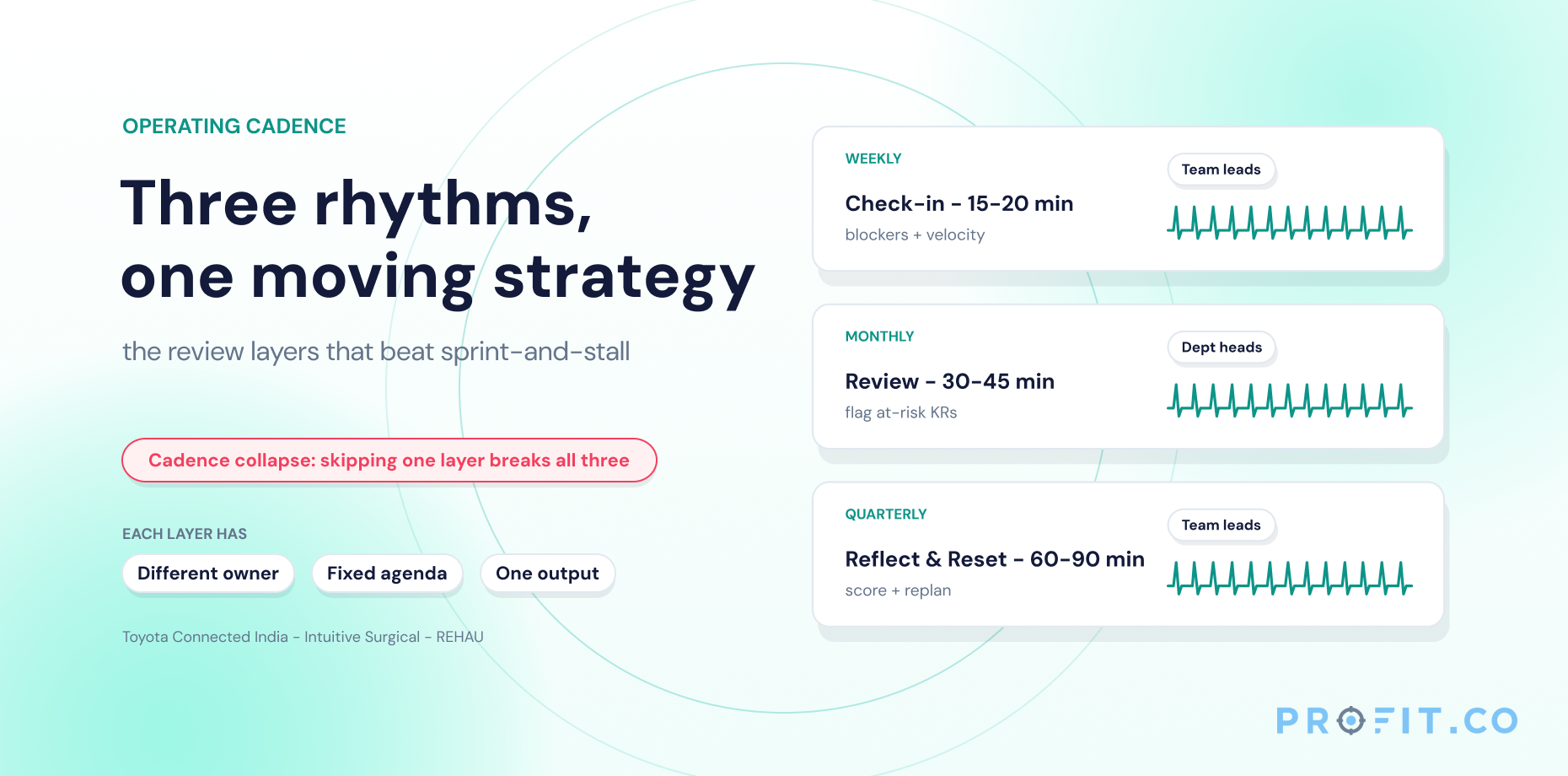
The Quarterly Reflect/Reset session is the mechanism that drives all four transitions. High-maturity programs include one explicit question in that session: “Which structural gap are we closing next quarter?” This is the highest-leverage OKR review practice for organizations stuck at Level 2 or 3. OKR University’s guides on OKR review frameworks and check-in templates cover how to structure all three cadences, weekly, monthly, and quarterly, for each maturity stage.
Level 1 to Level 3 typically takes 2 to 4 quarters with consistent process changes. Reaching Level 4 requires integrated tooling, not just process discipline, where OKR management connects to project portfolio management and performance reviews in one platform. Separate tools will not get an organization to Level 4, no matter how disciplined the process.
6. How Execution Model Choice Affects Maturity Progress
A common error in maturity planning: focusing on process improvement while leaving the underlying execution model undefined. Profit.co supports four execution models, Objectives-Led, Metric-Led, Initiative-Led, and Open, each defining a different way to connect objectives, KPIs, and initiatives. Choosing the wrong model, or running without a defined model, creates a structural blocker that process discipline alone cannot remove.
Objectives-Led
Strategic objectives serve as the anchor. KPIs and initiatives both attach independently, so multiple measures and projects report to the same goal. Most appropriate for organizations using OKRs as their primary strategy execution framework. This model maps most naturally to the five-level maturity progression.
Metric-Led
Set the objective, then define KPIs that measure progress toward it. Initiatives exist only under KPIs, so every project has a clear number it must move. Closest to a Balanced Scorecard structure. Organizations running BSC alongside OKRs, using Profit.co’s Balanced Scorecard module, typically operate in Metric-Led or Objectives-Led depending on the perspective.
Initiative-Led
Initiatives attach directly to objectives as the primary commitment. KPIs sit underneath each initiative to validate that the work produced the results promised. Suited to organizations where project delivery is the dominant execution rhythm, closer to Hoshin Kanri and stage-gate governance structures.
The maturity implication
Whichever model is chosen, the maturity ceiling is the same: Level 3 without project linkage, Level 4 with it. The model defines the architecture; the five-level maturity framework defines how completely that architecture is built and used. Profit.co allows switching execution models from Settings without losing historical data, critical for organizations whose maturity advancement requires a structural model change. The building an agile organization guide maps the five OKR agility levels directly onto this model, showing how task-level work connects upward through team OKRs, department objectives, company strategy, and three-year roadmap at full maturity.
7. Worked Examples: What Each Maturity Level Looks Like in Practice
Level 1: Strategic planning exists; execution is annual and invisible
Leadership holds an annual strategy offsite. Goals are defined. A deck is shared. Within eight weeks, teams return to the work they were already doing. No one checks in against the annual goals until the year-end review, at which point the discussion is retrospective rather than corrective. The goals may have been well-written, this is a process failure, not a goal-quality failure.
Level 2: OKRs written quarterly; treated as compliance, not management
Teams submit OKRs before each quarter. Progress is updated once at quarter end. The quarterly review is a scorecard reading, not a steering session. Leadership can report participation rates. They cannot tell you which OKR status changed a project priority in the past ninety days, because none did.
Level 3: Weekly check-ins; OKRs are a management tool
Teams update key results weekly. Monthly reviews identify at-risk key results early enough to course-correct. Cascading is consistent, every team OKR shows the company objective it advances. When Suganya R., Senior HR at Toyota Connected India, reported that employee participation in goal setting rose from 60% to 80% and review cycles ran 40% faster, the mechanism was this: a faster cadence makes real-time visibility actionable rather than merely available. That is the defining characteristic of Level 3. Read more in Profit.co’s strategy execution examples.
Level 4: OKRs drive portfolio and performance decisions
Every funded project maps to a key result. Portfolio reviews use OKR status to prioritize investment, projects advancing strategic outcomes get resources; those that don’t get deprioritized or paused. The strategic portfolio management platform connects OKR progress to portfolio health dashboards and value realization tracking past project close. Mark Hudoba, Executive VP at REHAU Building Solutions, described accomplishing nearly 90% of the high-level objectives set at the start of the year, describing those objectives as direct lead indicators of business success. That phrase, direct lead indicators, is the language of a Level 4 organization.
Level 5: AI improves the next cycle from the current one
At Level 5, the Quality Agent scores OKR quality before the quarter begins. The OKR Authoring Agent turns strategy into cascade-aligned team goals automatically. Prior-cycle data informs how goals are set in the next cycle. The AI Agents platform delivers this across all modules, from authoring to progress to portfolio status, so the platform closes the loop between learning and planning rather than leaving it to individual memory and judgment.
8. Common Mistakes That Stall Maturity Progression
- Investing in Level 4 tools while operating at Level 2 processes. Technology cannot repair alignment problems caused by unclear strategy or poor organizational design. The sequence matters: process first, tooling second, a point Profit.co’s research into why most enterprise OKR programs fail in year two documents at length.
- Treating maturity advancement as a training project. Teams understand OKRs well enough to write them. The structural gaps that stall programs are infrastructure problems, not knowledge problems.
- Measuring completion rate rather than decision impact. If every OKR in the portfolio scores 1.0, the planning process failed, not execution. Targets that are all achieved were not ambitious enough. A high-maturity program produces OKRs that teams do not fully complete because the targets were genuinely stretching.
- Skipping Review Cadence on the way to Strategic Integration. Organizations often attempt to connect OKRs to portfolio decisions (Level 3 to 4 transition) before they have built a working weekly check-in habit (Level 2 to 3 transition). The portfolio integration has nothing useful to draw from if OKR data is updated quarterly.
- Running multiple execution models simultaneously without a primary. When engineering uses one structure and sales uses another, cross-functional visibility collapses. Choose one model and apply it consistently before attempting the Level 3 to 4 connection.
- Measuring maturity by framework adoption, not decision change. The real indicator is behavioral: did goal data change a resource decision this quarter? Until the answer is yes with specific examples, maturity is nominal regardless of how many teams have submitted OKRs.
9. Best Practices for Advancing Maturity One Stage at a Time
- Run a maturity assessment before each annual planning cycle, not after. Use the OKR maturity assessment framework to score all five dimensions and identify the single highest-value structural gap.
- Identify one structural unlock per quarter, not five. Maturity advances one stage at a time, with one structural change driving each transition. Organizations that attempt multiple transitions simultaneously typically succeed at none.
- Use the Quarterly Reflect/Reset session to explicitly close the maturity loop. End every quarterly review with: “Which structural gap are we closing next quarter?” Write the answer as a key result for the next cycle.
- Choose and standardize your execution model before Level 3. Cross-functional visibility, the fourth maturity dimension, cannot be achieved while teams define their own goal architecture independently.
- Automate progress before trying to interpret it. Profit.co integrates with 100+ tools including Jira, Salesforce, and HubSpot. Progress data fed automatically into OKR tracking is far more reliable than manually updated figures and is the prerequisite for the Level 4 portfolio connection.
- Use Quality Agent scoring as a pre-quarter gate, not a post-quarter audit. Catching vague key results before the quarter begins prevents the problem from compounding. Diagnosing them after the quarter ends changes nothing for the cycle just completed.
- Track maturity signals publicly within the organization. Publishing the weekly check-in rate, the number of OKRs with project links, and the number of resource decisions driven by OKR status makes the maturity journey visible and creates organizational pressure to advance.
- Review your strategy execution approach in the context of the broader platform. Profit.co’s strategy roadmaps keep the long-term vision tied to quarterly OKRs, ensuring that maturity advancement happens in the direction of the right strategy, not just a well-executed one.
Turn your OKR program into a strategy execution system
Frequently Asked Questions
A strategy execution maturity model is a five-level diagnostic framework that measures how effectively an organization sets, aligns, and acts on its strategic goals. It assesses OKR quality, alignment depth, review cadence, cross-functional visibility, and strategic integration, and identifies the specific structural change required to advance from one level to the next.
Level 1 (Ad-hoc): goals are annual, vague, or absent with no review process. Level 2 (Basic): quarterly OKRs written but treated as compliance, not management. Level 3 (Repeatable): cascaded OKRs with weekly check-ins and monthly course-correction reviews. Level 4 (Integrated): OKRs connected to project portfolios, performance reviews, and budget cycles with AI-assisted authoring. Level 5 (Predictive): AI agents improve OKR quality each cycle and leading indicators are tracked in real time.
Three structural gaps cause the Level 2 plateau: no integration between OKRs and project management, no automated progress collection, and no structured OKR review process. These are infrastructure problems, not knowledge or motivation problems. Advancing requires removing those structural gaps one at a time, starting with the weekly check-in habit backed by automated progress nudges.
Moving from Level 1 to Level 3 typically takes 2 to 4 quarters with consistent process changes. The critical unlock is building a weekly check-in habit that is automated rather than manual, so it survives execution pressure. Reaching Level 4 requires integrated tooling where OKRs connect to project portfolios and performance data in a single platform, that structural requirement cannot be met by process discipline alone.
OKR maturity is one dimension of strategy execution maturity. A program can have high OKR quality, well-written, measurable, cascaded, and still operate at Level 2 if those OKRs are not connected to project prioritization, budget decisions, or performance conversations. Strategy execution maturity is the broader system: OKR quality plus the infrastructure that makes OKR data actionable across portfolio, performance, and funding decisions.
At Level 4, AI-assisted authoring scores OKR quality before the quarter begins, preventing the planning failure that produces vague key results. Automated progress collection via integrations removes the manual check-in dependency. At Level 5, AI agents use prior-cycle data to improve how goals are set in the next cycle, closing the loop between learning and planning. Profit.co’s Quality Agent and OKR Authoring Agent are purpose-built for these transitions.
At Level 3, OKRs are well-formed and tracked but float free, they do not change what gets funded or resourced. Strategic integration means every project maps to a key result and portfolio reviews use OKR status to prioritize investment. Projects advancing strategic outcomes get resources; those that don’t get deprioritized. Without this connection, even a healthy Level 3 program hits a ceiling where OKRs are reported on but not acted on.