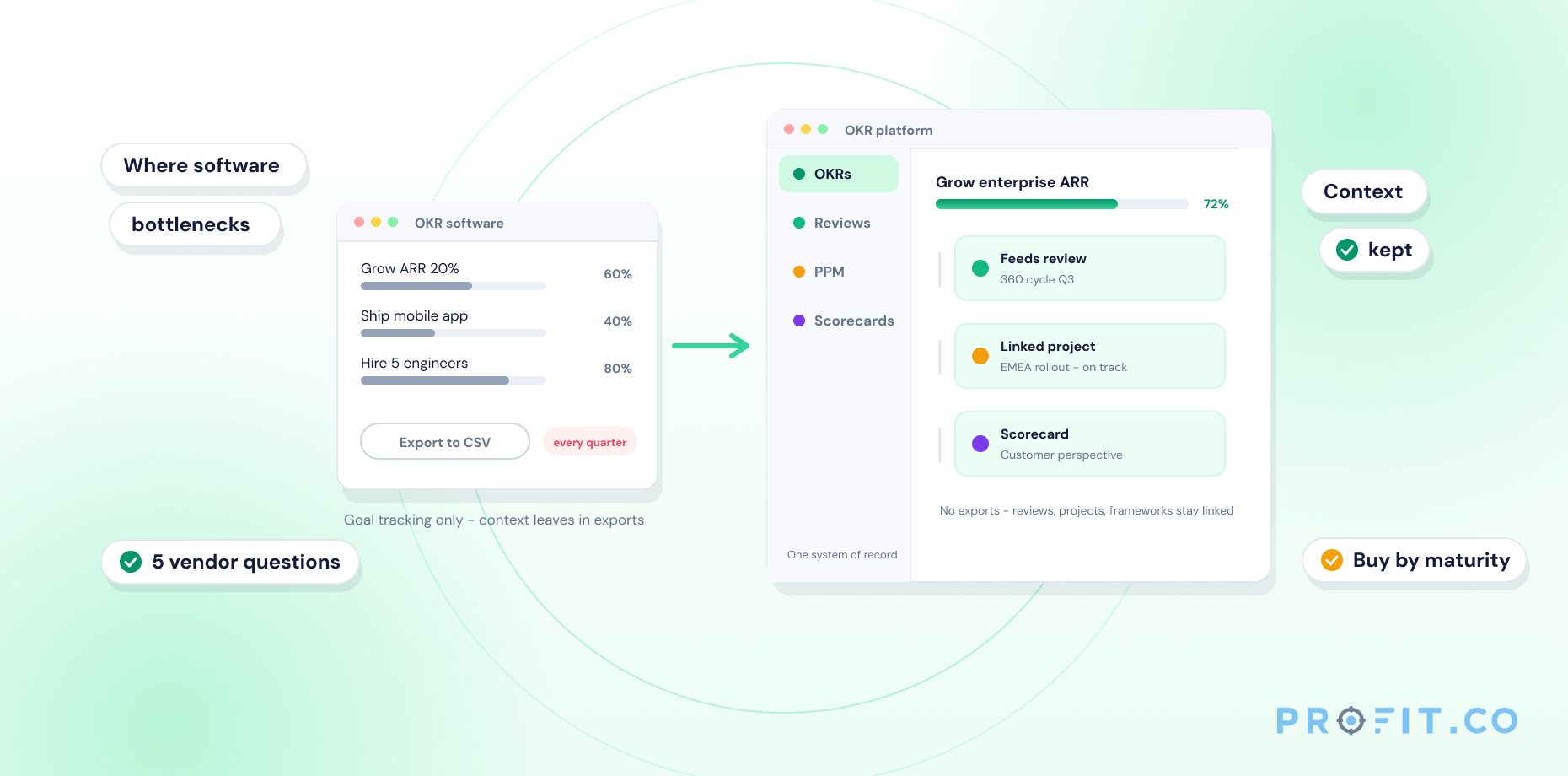
An OKR platform is a purpose-built software system that centralizes the OKR goal-setting process across an entire organization. It connects company-level objectives to team and individual key results, automates progress tracking, and surfaces alignment gaps before they become execution failures.
In this guide
- What Is an OKR Platform?
- OKR Platform vs. Spreadsheets & Manual Tracking
- Core Components of an OKR Platform
- Who Uses an OKR Platform
- Why Companies Adopt an OKR Platform
- Frequently Asked Questions
An OKR platform is a dedicated software system that helps organizations set, align, and track Objectives and Key Results across every level of the business. It replaces manual spreadsheets and disconnected tools with a single structured environment for goal-setting, progress tracking, real-time check-ins, and cross-functional alignment, all in one place.
This guide defines what an OKR platform is, explains how it differs from manual tracking methods, breaks down its core components, and identifies the types of teams and organizations that benefit most from using one.
What Is an OKR Platform?
OKR stands for Objectives and Key Results, a goal-setting framework popularized by Intel and Google that asks teams to define ambitious goals (Objectives) and the specific, measurable outcomes that signal progress toward them (Key Results).
An OKR platform is the software infrastructure that makes this framework operational at scale. Without a platform, OKRs typically live in spreadsheets, slide decks, or email threads: updated infrequently, visible to only a few people, and disconnected from the day-to-day work that is supposed to be driving them forward.
A purpose-built OKR platform solves this by centralizing the entire goal cycle, from objective creation and approval, through structured weekly check-ins and automated progress scoring, to end-of-quarter reviews, in a single system every level of the organization can access and act on.
The most capable OKR platforms connect OKR data to performance reviews, project portfolios, and AI-powered insights, turning goals into a live operating system. For a step-by-step breakdown, see how an OKR platform works.
OKR Platform vs. Spreadsheets & Manual Tracking
Many organizations begin their OKR journey with spreadsheets or shared documents. This works for a few teams over a short period, but the limitations surface quickly as adoption grows.
| Dimension | Spreadsheets / Manual Tracking | OKR Platform |
|---|---|---|
| Visibility | Siloed: each team manages its own sheet | Company-wide: all OKRs visible in one system, including Canvas and Alignment views |
| Alignment | Manual: requires cross-referencing multiple documents | Automatic: objectives link from company level to individual level with dependency tracking |
| Progress updates | Manual entry, often outdated by the time anyone reads it | Automated from connected tools (Jira, Salesforce, Google Sheets, and 100+ others) |
| Check-ins | Informal or skipped entirely | Structured weekly and ad-hoc check-ins, tracked across every team with confidence scoring |
| Reporting | Built manually from scratch each quarter | Generated automatically from live data: PDF, PowerPoint, or email in seconds |
| Alignment gaps | Invisible: discovered only at end of quarter | At-risk OKRs flagged in real time via projection status in List View, Canvas View, and Alignment View |
| Scalability | Breaks down beyond two or three teams | Scales from 10 to 10,000+ users with role-based access and department-level controls |
| Integration | Isolated from the tools teams use for actual work | 100+ native integrations with bi-directional sync: Jira, Salesforce, Slack, Teams, and more |
The bottom line: Spreadsheets capture what you planned. An OKR platform shows what is actually happening, and flags when execution is drifting from strategy while there is still time to correct it.
Core Components of an OKR Platform
Not all OKR platforms are built the same. But every serious OKR system must include the following six capabilities. If any is missing, teams will paper over the gap with manual workarounds, defeating the purpose of adopting a platform.
1. Goal-Setting
The foundation of any OKR platform is a structured goal-creation interface. Teams should be able to draft Objectives, attach measurable Key Results, and choose the right measurement type: numeric, percentage, currency, or milestone. Strong platforms include AI-assisted OKR authoring that generates quality-scored drafts from a strategy prompt, and approval workflows that route new OKRs through a review process before the quarter begins. For OKR examples by department and industry, Profit.co’s OKR University library is the best starting point.
2. Alignment and Cascading
Alignment is what separates an OKR platform from a simple task tracker. Every objective should link upward to a company-level priority and downward to the team or individual responsible for moving it. Platforms should also support bottom-up alignment, where contributors propose goals that cascade upward, giving teams a voice in how strategy is shaped, not just delivered. The OKR Platform Buyer’s Guide covers alignment feature evaluation in depth, including what to look for when cascading across enterprise org structures.
3. Progress Tracking
Progress tracking is the engine that keeps OKRs live between check-ins. A platform should allow teams to update key result progress manually or pull data automatically from connected business tools, so that a Jira ticket completed, a Salesforce deal closed, or a BI metric updated reflects immediately in the relevant OKR. Platforms should also display projection status indicators directly in List View, Canvas View, and Alignment View, so at-risk OKRs are visible wherever teams work.
4. Dashboards and Reporting
Leadership needs a real-time view of OKR health without chasing status reports. A capable OKR platform provides configurable dashboards, including heatmaps, status charts, progress summaries, and aligned vs. unaligned OKR breakdowns, that update automatically from live goal data. One-click exports to PDF, PowerPoint, or email allow leaders to walk into any meeting with current numbers, not a manually assembled deck from the night before.
5. Check-ins
Regular check-ins are the heartbeat of an OKR cycle. Platforms should make it easy for contributors to log weekly updates, including a progress score, a confidence level, and notes on blockers. When check-ins happen consistently, managers can identify at-risk goals early and intervene before a small lag becomes an end-of-quarter shortfall. Platforms should also support flexible ad-hoc check-ins for milestone key results, so teams can log progress as it happens rather than waiting for the next scheduled date.
6. Integrations
An OKR platform that sits apart from the tools teams already use will eventually be abandoned. Native integrations with project management tools (Jira, Asana, Planview), CRM systems (Salesforce, HubSpot), communication platforms (Slack, Microsoft Teams), HRIS systems (Workday, SAP SuccessFactors, BambooHR), and data tools (Tableau, Power BI, Looker) ensure that OKR progress updates happen where work already happens, reducing friction and increasing adoption. Browse the full integrations directory for all 100+ native connectors.
Who Uses an OKR Platform
OKR platforms are built for organizations where strategy needs to be visible, alignment is a recurring challenge, and execution needs to be tracked beyond individual team silos. The roles that rely most on an OKR platform are:
- CEOs and executive teams: to set company-level objectives and track progress without waiting for quarterly business reviews, using live dashboards that present current OKR data directly into board meetings
- Chief Strategy Officers and operations leaders: to manage cross-functional goal alignment and identify execution risks before they compound
- HR and People leaders (CHROs): to connect individual performance reviews to OKR results and run performance conversations grounded in what was actually accomplished
- PMO directors: to link project delivery to the objectives those projects are supposed to advance, and govern OKRs with the same rigor applied to project portfolios
- Department heads and team leads: to cascade company strategy into team-level goals and track weekly execution against them
- Individual contributors: to understand exactly how their daily work connects to team and company priorities
OKR platforms serve organizations across manufacturing, financial services, healthcare, technology, government, and retail, from scaling startups to Fortune 500 enterprises. The common requirement is structured goal-setting, visible alignment, and disciplined follow-through at every level.
Why Companies Adopt an OKR Platform
The strategic case for an OKR platform comes down to one persistent problem: the gap between strategy and execution. Most organizations do not fail because the strategy is wrong: they fail because the strategy never makes it from the leadership team’s planning session into the daily decisions made by managers and contributors.
An OKR platform closes this gap by giving every person in the organization a direct line of sight between their work and the company’s priorities. This produces four outcomes that manual tracking cannot reliably deliver:
Alignment at scale: Strategy decisions made at the top become visible commitments at every level, without requiring leaders to manually communicate priorities to each team.
Faster course correction: When goals are tracked in real time and check-ins happen weekly, at-risk objectives surface in days, not weeks, before they become end-of-quarter surprises.
Improved accountability: Every OKR has a named owner, a measurable target, and a visible status, making it clear where execution is lagging and what is driving the gap.
Better performance conversations: When OKR progress is documented throughout the quarter, performance reviews stop being based on recollections and start being based on evidence.
Organizations that implement OKR platforms effectively report significant improvements across goal achievement rates, cross-team collaboration, and the speed at which strategic priorities translate into action. Verified Profit.co customer results include: achieving nearly 90% of annual high-level objectives (REHAU Americas); saving over $300,000 in operational costs in one year (United Technical Support Services); reducing time spent in OKR review sessions by 75% and executive PPT preparation by 84% (Intuitive Surgical); and increasing employee goal participation from 60% to 80% while making review cycles 40% faster (Toyota Connected India).
How Profit.co Delivers on All Five Components
Its OKR Management module is the only OKR tool that connects goals, performance reviews, and project portfolios in one platform, eliminating the fragmentation that causes most OKR programs to stall when data needs to inform decisions outside the goal-tracking tool.
AI OKR Authoring + Quality Scoring: The Athena AI Suite drafts complete, scored OKRs from a strategy prompt in seconds; the Quality Agent evaluates every OKR for clarity, measurability, and strategic alignment before the quarter begins.
Alignment and Cascading: Full alignment tree from company objectives to individual key results, with cross-team dependency tracking and bottom-up alignment support.
Projection Status in List, Canvas, and Alignment Views: At-risk OKRs are now visible via colored indicators in Canvas View and Alignment View, previously only visible in List View, so teams see execution risks wherever they work (Feb 2026 release).
Live Cockpit Dashboards: Configurable heatmaps, aligned vs. unaligned OKR data, and one-click export to PDF or PowerPoint for board and executive reporting.
Flexible Check-ins: Structured weekly check-in workflows with scoring and blocker logging.
100+ Integrations: Native bi-directional sync with Jira, Salesforce, Slack, Microsoft Teams, HubSpot, Tableau, Power BI, Workday, SAP SuccessFactors, and more.
Performance + Project Linkage: OKR results feed directly into performance reviews and link to project portfolios in the same platform, with no manual export required.
Teams typically run their first OKR cycle within 30 days, with dedicated customer success support and 24/7 live assistance on every plan. A free trial is available with no credit card required. For methodology guides, templates, and examples, Profit.co’s OKR University is the most comprehensive OKR education resource available online.
Ready to see an OKR platform in action?
Frequently Asked Questions
An OKR platform is a dedicated software system that helps organizations set, align, and track Objectives and Key Results across every level of the business. It replaces manual spreadsheets with a structured environment for goal-setting, progress tracking, weekly check-ins, and cross-functional alignment, giving every employee a clear line of sight from their daily work to the company’s strategic priorities.
The terms are often used interchangeably, but they describe different scopes. OKR software typically refers to a tool focused on goal-setting and tracking within the OKR framework. An OKR platform is broader: it integrates OKR management with performance reviews, project management, and strategy execution frameworks (such as Balanced Scorecard and Hoshin Kanri) in a unified system. Not every OKR software product qualifies as a platform.
Every serious OKR platform must include six components: goal-setting (with AI authoring, quality scoring, and approval workflows), alignment and cascading (linking objectives from company to individual level, with bottom-up support), progress tracking (manual check-ins plus automated integrations), dashboards and reporting (live views with heatmaps, projection status, and one-click exports), check-ins (structured weekly and flexible ad-hoc updates), and integrations (native connections to the tools teams already use).
OKR platforms serve CEOs, strategy leaders, CHROs, PMO directors, department heads, and individual contributors across manufacturing, financial services, healthcare, technology, government, and retail. Any company with more than two or three teams running simultaneous goals will benefit from a dedicated OKR platform over manual tracking. Profit.co serves organizations from scaling startups to Fortune 500 enterprises.
Implementation timelines vary by platform and organization size. With Profit.co, teams typically run their first OKR cycle within 30 days, supported by dedicated onboarding, OKR cadence configuration, integration setup, and guided training for managers and contributors. A dedicated customer success team and 24/7 live support are included on every plan.
Yes. Profit.co offers a permanently free plan with no meaningful caps: unlimited goals, unlimited users, weekly check-ins, alignment views, and mobile access, as well as a 30-day free trial with no credit card required. Small businesses benefit from the same alignment and accountability features as enterprises, often more immediately, since early-stage teams have fewer formal systems in place.