Organizations face the challenge of how to accurately assess and rank performance and implement an effective system for employee performance appraisals. The Bell Curve was applied in performance appraisals as a way of distinguishing elite performers from average performers, and further segregating below-par employees from the overall average.
What is the bell curve?
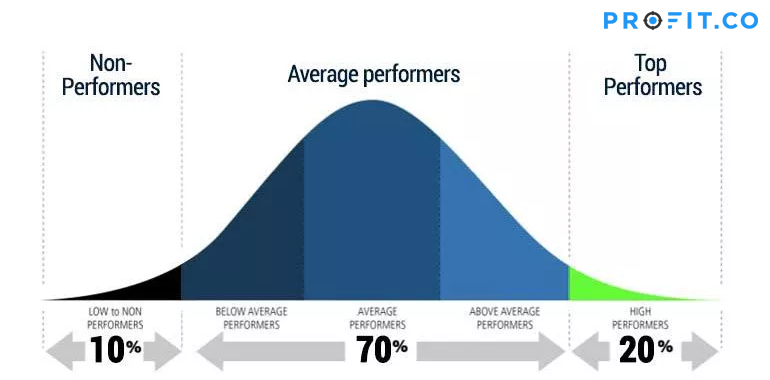
The Bell Curve represents what statisticians call a “normal distribution.” A normal distribution is a sample with a large average in the middle and an equal number of above and below average like the curve below.
This model assumes that there is an equal number of people who perform above and below average, and that there will be a very small number of people with very low performance and very high performance.

How Bell Curve Appraisal Works in Practice: Ratings, Distribution and Example
Quick answer: In bell curve performance appraisal, employees are distributed into rating categories according to a predetermined percentage split. The most common is GE’s original 20-70-10 model: 20% top performers, 70% middle performers, and 10% bottom performers. Managers must rank their teams to fit these percentages regardless of how their team actually performed.
The Three Bell Curve Distribution Models
| Model | Top performers | Middle performers | Bottom performers | Originally used by |
|---|---|---|---|---|
| GE 20-70-10 | 20%, highest rewards | 70%, core of the organisation | 10%, exit or improve | GE under Jack Welch (1980s-2016) |
| 10-80-10 | 10%, stars, highest bonuses | 80%, solid contributors | 10%, PIPs | Many Indian IT firms and traditional manufacturing companies |
| 5-point distribution | 5% exceptional plus 15% exceeds expectations | 60% meets expectations | 15% needs improvement plus 5% unsatisfactory | Larger enterprises needing finer calibration |
Bell Curve Appraisal Example: A Team of 10
| Employee | Actual performance | Bell curve rating (GE 20-70-10) | Problem created |
|---|---|---|---|
| A | Exceeded targets consistently | Top performer (20% tier) | Fair, correctly rated |
| B | Exceeded targets on most projects | Top performer (20% tier) | Fair, correctly rated |
| C | Met all targets; led a major initiative | Middle performer (70% tier) | Initiative not recognised; forced to average |
| D | Met all targets; strong peer reviews | Middle performer (70% tier) | Correct but demoralising for a high contributor |
| E | Met all targets across all projects | Middle performer (70% tier) | Correct; no differentiation from D despite different output quality |
| F | Met most targets | Middle performer (70% tier) | Correct |
| G | Met most targets | Middle performer (70% tier) | Correct |
| H | Met most targets; new to role | Middle performer (70% tier) | Correct; onboarding period absorbed into average tier fairly |
| I | Slightly below average quarter; strong prior year record | Middle performer (70% tier) | Moved from bottom to middle (R2 fix): one quarter of underperformance does not define the year |
| J | Missed one key target; new to role | Bottom performer (10% tier) | Placed on PIP despite meeting most targets; curve requires exactly one bottom performer in a team of 10 |
With 10 employees, the 20-70-10 model requires exactly 1 person in the bottom tier. Employee J is placed on a performance improvement plan despite meeting most of their targets, because the curve demands a bottom performer regardless of actual results. This is the defining structural flaw: the curve imposes a shape onto performance data rather than measuring it.
Profit.co’s Performance Review module replaces forced distribution with continuous, goal-aligned reviews. Rather than ranking employees against each other, it evaluates each person against their own agreed objectives. Managers see individual progress, not a forced curve. See how Profit.co replaces forced ranking →
The Bell curve and Performance management
The Bell Curve approach was traditionally utilized within performance management system. But now with the corporate world constantly evolving, many organizations are evaluating whether bell curves are a relevant approach for performance management.
Following are some reasons why bell curves may not be the right approach for present times:
- Teamwork doesn’t count
Performance appraisal systems must also evolve and adapt to the changing workplace dynamics so that organizations can be successful in the competitive corporate world - Inaccurate and Unfair Assessments
- Forced Rankings are very demoralizing for employees
A 360 feedback appraisal system instead of the bell curve method can effectively rank an employee’s performance based on individual work, not against the work of their peers. - Setting up losers & winners, Employees Hate Them
- It is too rigid an approach
Teamwork doesn’t count
Bell curve ranking system does not work with collaborative teams. A regular workday is not defined by a 9-to-5 regime; even more so since the pandemic. Business practices are constantly evolving given the times we live in, and with that, performance management processes need to evolve too to remain effective.
In organizations where work is more team led, the bell curve performance ranking system will not work. For example, an employee might score higher on the curve than a co-worker on the team. This gives the employee an unfair superiority over his/her co-workers, and the co-workers will begin to fall under average company rating standards. Performance appraisals should therefore be conducted on an individual’s expectations inclusively, not on the group distribution scale that bell curves require.
The bell curve system is inefficient given the workplace dynamics in the current corporate economy. With the rapid development of modern technology and the rise in millennials in the workforce, company protocols must also evolve. Performance appraisal systems must also evolve and adapt to the changing workplace dynamics so that organizations can be successful in the competitive corporate world.
Inaccurate and Unfair Assessments based on bell curve
When teams exceed performance expectations, it is not possible to measure performance accurately on the bell curve. Performance management software can further enhance this process by providing tools for comprehensive evaluations and tracking progress over time.
Inaccurate assessment of employee performance can then lead to higher probationary periods or increased turnover rates. The use of the bell curve can be so off the mark, that more resources and money might get spent on recruiting and training new employees instead of working with members of the team individually to refine performance.
The unfortunate result of utilizing a bell curve ranking system is expensive employee replacement and excessive training.
Forced Rankings: Bell Curves are very demoralizing for employees
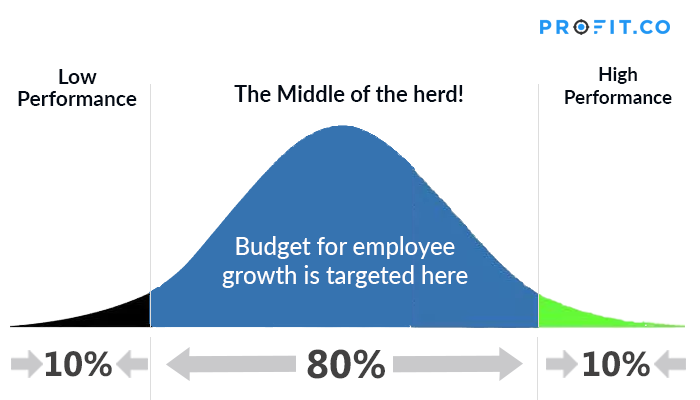
The bell curve method runs the risk of diminishing the top performer’s value while inflating the value of middle performers. The bell curve provides a forced ranking of employees that distinguishes stellar performance from performance that is average or below par. This affects employee morale as the bell curve forces groups top and low performers regardless of their actual performance. Employees who fall in the middle of the curve make up 80% of the team population, forcing the organization to allocate budget to focus on mid-value employees.
The bell curve’s ranking system can lead to an increase in salaries, without really being able to assess an employee’s qualifications and overall performance. Salary scaling also has negative consequences for employee morale and can misallocate budgets. This method is no longer effective in ranking individual employee performance in modern group environments.
A 360 feedback appraisal system instead of the bell curve method can effectively rank an employee’s performance based on individual work, not against the work of their peers.
Setting up Losers & Winners: Employees Hate Them
Forced rankings diminish the value of the top performers, inflates middle performers, and ignores the efforts of the under performers. Josh Bersin, the president and founder of Bersin & Associates, a leading industry research and advisory firm in enterprise learning and talent management, explained the basic faults of the system and the damages to employee morale in three concise and poignant phrases:
- Grading on a Bell Curve rations high performers, regardless of those who perform well. These are (typically) the top 10% of the workforce.
- Forced rankings set a “losers” group at the bottom of the employee food chain. These are (typically) the bottom 10% of your team.
- Then there’s everyone else, the middle of the herd. Because they make up 80% of the employees you just scaled, that’s where your budget for employee growth goes.
Forced rating of employee performance causes more problems than provides beneficial resolutions. It discourages collaboration and decreases productivity.
It is too rigid an approach
The bell curve model in performance management is too rigid an approach for assessing employee performance. Sometimes managers need to put employees in specific gradients just for the sake of bell curve requirements. Managers can only have a limited number of employees in the top performers’ category. As a result, employees who might have done exceptionally well throughout the year might be forced to be categorized in the average performers’ category to meet some valid bell curve requirements. This can be quite a dampener to their morale. This happens more often when the teams are small, and can lead to employee dissatisfaction, and could even cause a great employee to seek recognition at a different company.
Bell Curve Alternatives: Better Approaches for Modern Performance Appraisal
Quick answer: The best alternatives to bell curve appraisal are: OKR-based performance reviews (evaluating employees against their own agreed objectives), continuous feedback systems (regular check-ins replacing the annual ranking), 360-degree feedback (multi-source assessment of contribution and behaviour), calibrated ratings without forced distribution (managers align across teams without a percentage quota), and contribution-based assessment.
| Alternative | How it works | Key advantage over bell curve | Adopted by |
|---|---|---|---|
| OKR-based reviews | Employees set measurable objectives each period; performance is reviewed against their personal commitments, not peers | Each person is evaluated on what they committed to, not where they fall on a forced curve | Google, Intel, LinkedIn, Profit.co |
| Continuous feedback | Regular 1-on-1 check-ins, project-level feedback and real-time coaching replace the annual rating event | Problems surface and are addressed in-year rather than appearing in an annual retrospective score | Adobe (2012), Microsoft (2013), GE (2016) |
| 360-degree feedback | Peers, direct reports, managers and sometimes customers all contribute assessments of an employee’s work and behaviour | Captures collaboration and influence that a single manager’s rating misses entirely | Deloitte, Accenture, most large professional services firms |
| Calibrated ratings (no forced distribution) | Managers still rate employees on a scale but do so in a cross-functional calibration session without percentage quotas | Retains the differentiation benefit without creating artificial losers or damaging morale | Netflix and most modern tech companies |
| Contribution-based assessment | Reviews evaluate specific contributions, projects and behaviours against pre-agreed standards rather than relative ranking | Directly addresses the teamwork problem: collaborative behaviours are rewarded rather than penalised | Increasingly common in knowledge-work organisations |
Profit.co’s Performance Management module supports OKR-aligned reviews, continuous check-ins and 360-degree feedback, the three alternatives most widely adopted by organisations moving away from forced distribution. Reviews connect directly to the OKRs employees committed to, so every performance conversation starts from agreed goals. See how Profit.co replaces forced ranking →
The verdict?
Bell curves are irrelevant at best. The bell curve performance appraisal is so passé. Now, there are more effective, well researched performance appraisal systems that can better assess performance, boost employee confidence, promote collaboration, and encourage team efforts, rather than make individuals compete with each other.
If an employee is not performing well, instead of ousting them, there are now ways to actually understand the root cause of the issue and be able to put a plan in place that will give them the necessary tools to better their skills and help them improve their performance. This will benefit the employee, the team and organization in the long run. Bell curve simply misses the point.