In the corporate world, the continuity of performance and leadership among employees is paramount. The expertise and internal understanding gained over time are priceless, and employees who grow within the organization typically align closely with its culture and goals. Almost all employers (94%) said that having a succession plan positively impacts their employees’ engagement levels. So companies nowadays believe that investing in their growth fortifies the company’s future and enhances employee loyalty and efficiency. This is where a Succession Development Plan plays a crucial role. It’s a strategic approach designed to safeguard a company against the unpredictability of losing key personnel due to retirement, resignation, or other unforeseen circumstances. Succession planning maintains operational consistency, protecting against interruptions due to unexpected changes. It acts as a means to retain employees by clearly outlining their career advancement opportunities. Additionally, it showcases the stability of the organization, which boosts investor trust and strengthens the company’s culture.
“You can’t connect the dots looking forward; you can only connect them looking backwards.”

Understanding Succession Development Plan
Succession and Development play a pivotal role in facilitating the advancement and growth of individuals within an organization. Through the Succession and Development framework, organizations can create tailored programs for their workforce, including Individual Development Plans, Performance Improvement Plans, and Potential Assessments. This approach provides a structured pathway for employee progression, fostering professional development and enhancing organizational contributions. Understanding the history of your company, much like appreciating world history, enables leaders to glean valuable lessons from previous missteps and successes. This historical insight, combined with a clear understanding of the company’s present state and future direction, provides leaders with the necessary tools to craft a comprehensive guide. Such a guide is crucial for employees undergoing various transitions: it supports those departing, integrates new members joining the team, and assists top performers in navigating their ascent up the corporate hierarchy. This holistic approach ensures that the company’s past, present, and future journey informs and shapes its strategic planning and workforce development.To experience how Profit.co can transform your Succession Development Planning process!
The Evolution of Succession Planning
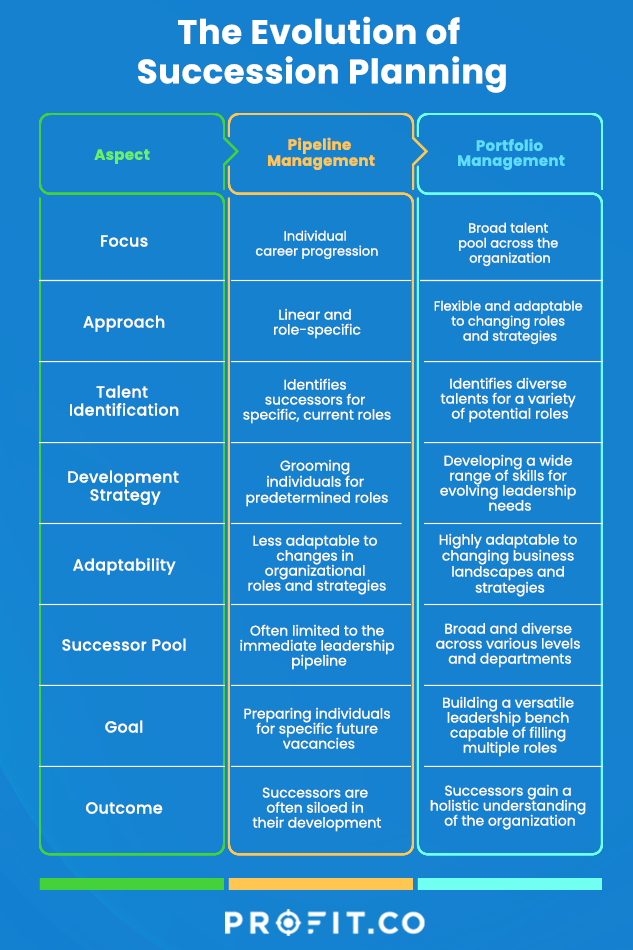
Executive leaders are often tasked with planning succession for their teams and participating in organization-wide efforts. According to Gartner’s research on succession planning, Traditionally, organizations have used a pipeline management approach, focusing on current leadership roles and grooming successors within each unit until ready for transition. However, as roles evolve faster, this method’s effectiveness diminishes, especially when scaled up, often leading to process-focused rather than strategic planning. To address these challenges, organizations are shifting towards a portfolio management strategy. This involves prioritizing critical roles aligned with future strategy, broadly identifying successors across the organization, and diversifying successor options for various potential scenarios. This strategy allows for more focused planning on key roles, enhancing the overall capacity of the leadership bench to adapt as roles change. Here are the major differences between pipeline management and portfolio management.Effective Strategies for Succession Planning
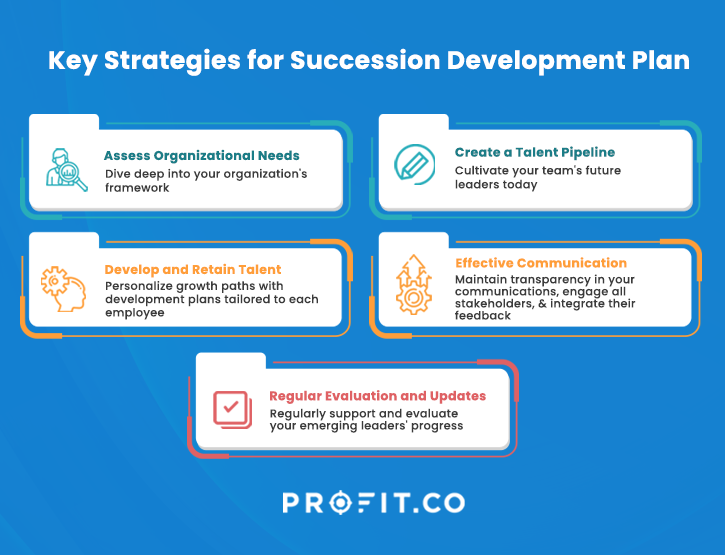
The goal of succession planning is to create a culture of ongoing learning and preparedness in an organization, not just to fill vacant positions. It involves finding and developing internal talent for key roles to maintain business operations, avoid hiring risks, and motivate employees with clear career opportunities. In the present scenario, potential leaders must be selected based on their performance, skills, and alignment with the company’s vision. However, according to research, it is said that only half of companies (50%) have written down the skills required for the next CEO (Stanford, 2010). The companies should make sure that the C-suite leaders receive customized development plans, which include training, mentoring, and challenging assignments to prepare them and their employees for future roles, with their progress monitored on the platform. Continuous feedback is an essential part of this plan, using tools for regular communication, evaluation, and 360 feedback to keep potential successors involved and aware of their strengths and weaknesses. The plan’s effectiveness is evaluated by how ready potential leaders are for new roles, how well they perform in those roles, and how they contribute to business continuity and growth. Moreover, developing future leaders in line with the company’s culture, values, ethics, and mission is vital, ensuring that the leadership development process is closely linked with the organization’s identity.Assess the current and future needs of the organization
Identify the critical and vulnerable positions that are essential for the success of the business and the skills and competencies required for those roles. Use data and analytics to support your decisions and get buy-in from senior leaders.Create a talent pipeline
Evaluate the current performance and potential of your employees, and nominate successors from the qualified positions. Use various methods, such as assessments, feedback, interviews, and simulations, to measure their readiness and suitability for the target roles.Develop and retain your talent
Provide your successors with individualized development plans that address their strengths and areas for improvement. Offer them opportunities to gain experience and exposure to different aspects of the business, such as mentoring, coaching, job rotation, shadowing, and training.Communicate your succession plans effectively
Establish who needs to know what and when, and tailor your communication accordingly. Be transparent and timely with your communication, and avoid creating unrealistic expectations or confusion. Engage your successors and stakeholders in the process, and solicit their feedback and input.Evaluate and update your succession plans regularly
Monitor the progress and performance of your successors, and provide them with ongoing support and feedback. Review and revise your succession plans as needed, based on the changing needs of the organization and the availability of talent. Celebrate the achievements and milestones of your succession planning efforts. Simon Sinek insightfully notes that “If you hire people just because they can do a job, they’ll work for your money. But if you hire people who believe what you believe, they’ll work for you with blood, sweat, and tears.” This principle aligns with the understanding that while every employee seeks a livelihood, there’s a profound distinction between those who are merely present for financial reasons and those deeply connected with their organization’s mission. Such alignment not only inspires exceptional commitment but is also crucial in succession planning. Recognizing future staffing needs and identifying individuals with the requisite skills and potential for future roles is essential. Utilizing tools like the Professional & Organizational Development’s Succession Planning Toolkit, and engaging HR professionals in this process, can effectively guide in nurturing and preparing employees who are not just competent but also passionately aligned with the organizational ethos.Succession Development Plan in Profit.co
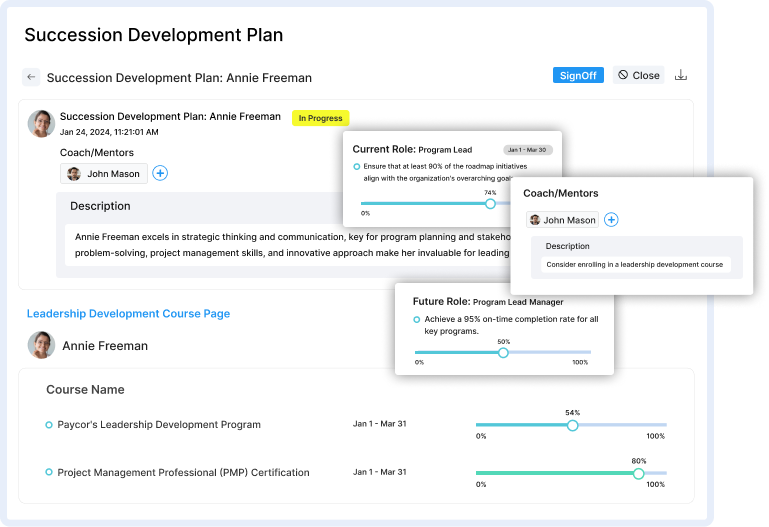
Profit.co’s Succession and Development module stands out as a comprehensive and versatile tool designed to streamline and enhance employee development within organizations. This feature serves as a unified interface that enables users to create and customize a variety of developmental frameworks efficiently. It allows for the design of tailored layouts specifically for Individual Development Plans (IDP), Performance Improvement Plans (PIP), Succession Development Plans (SDP), and Potential Assessments.