
TL;DR
In 2026, the best enterprise OKR software is about scalability, deep integrations, adoption support, and change management. Eight top platforms stand out:Top Enterprise OKR Platforms:
- Profit.co – AI-powered All-in-one OKRs + performance + projects with strong support.
- WorkBoard (Quantive) – Analytics + AI coaching.
- Lattice – People-centric performance + OKRs.
- Betterworks – Enterprise alignment + feedback automation.
- Perdoo – OKRs + KPI tracking + strategy maps.
- Mooncamp – Flexible, modern interface, MS Teams integration.
- Peoplebox – AI-powered alignment & talent management.
- Asana – Project management + OKRs.
Choosing the Right One:
Focus on adoption, integration quality, support, and scalability rather than feature lists. Run pilots with real work, and score vendors on usability, integrations, reporting, support, and pricing. The best OKR tool is the one your teams actually use and that fits your organization’s strategy execution needs.
Choosing enterprise OKR software seems straightforward at first. Find a platform that can handle a growing team, integrate with existing tools, and help execute strategic goals. Simple enough, right?
Not quite.
The reality is far more complex. With over 130 OKR software providers listed on G2 and Gartner, the market is crowded, and the differences between platforms aren’t always obvious. Choosing enterprise OKR software isn’t just about features and pricing; it’s about understanding what an organization actually needs to execute strategy at scale.
This comprehensive comparison examines the leading enterprise OKR platforms, analyzing data from G2, Gartner Peer Insights, and real-world implementations to reveal what actually matters when making a decision that could impact an entire organization.
The Enterprise OKR Software Landscape in 2026
The OKR software market has exploded. Gartner’s analysis reveals only four vendors consistently recognized in its Hype Cycle reports over multiple years, despite more than 130 companies competing in this space. This tells us something important: not all OKR platforms are built to handle enterprise-level complexity.What makes enterprise OKR software different? Three critical factors separate enterprise platforms from smaller solutions:
- First, scalability isn’t just about user count. It’s about supporting multiple OKR levels across complex organizational structures, managing thousands of interconnected objectives, and maintaining performance as companies grow from 250 to 25,000 employees.
- Second, integration depth matters more than integration quantity. Having 80+ integrations sounds impressive until the reality sets in that only 15 of them actually sync the data teams use daily. Enterprise teams need deep, bidirectional integrations with their HRIS, project management tools, and communication platforms.
- Third, adoption support becomes critical. Rolling out OKRs to thousands of employees across different departments, time zones, and work styles requires more than just software. It demands coaching, training resources, and dedicated customer success support.
The Top Enterprise OKR Platforms: What Sets Them Apart
Based on G2 rankings, Gartner Peer Insights reviews, and real-world implementations, here are the platforms that consistently rise to the top for enterprise organizations:Profit.co – The All-in-One Enterprise Performance Solution
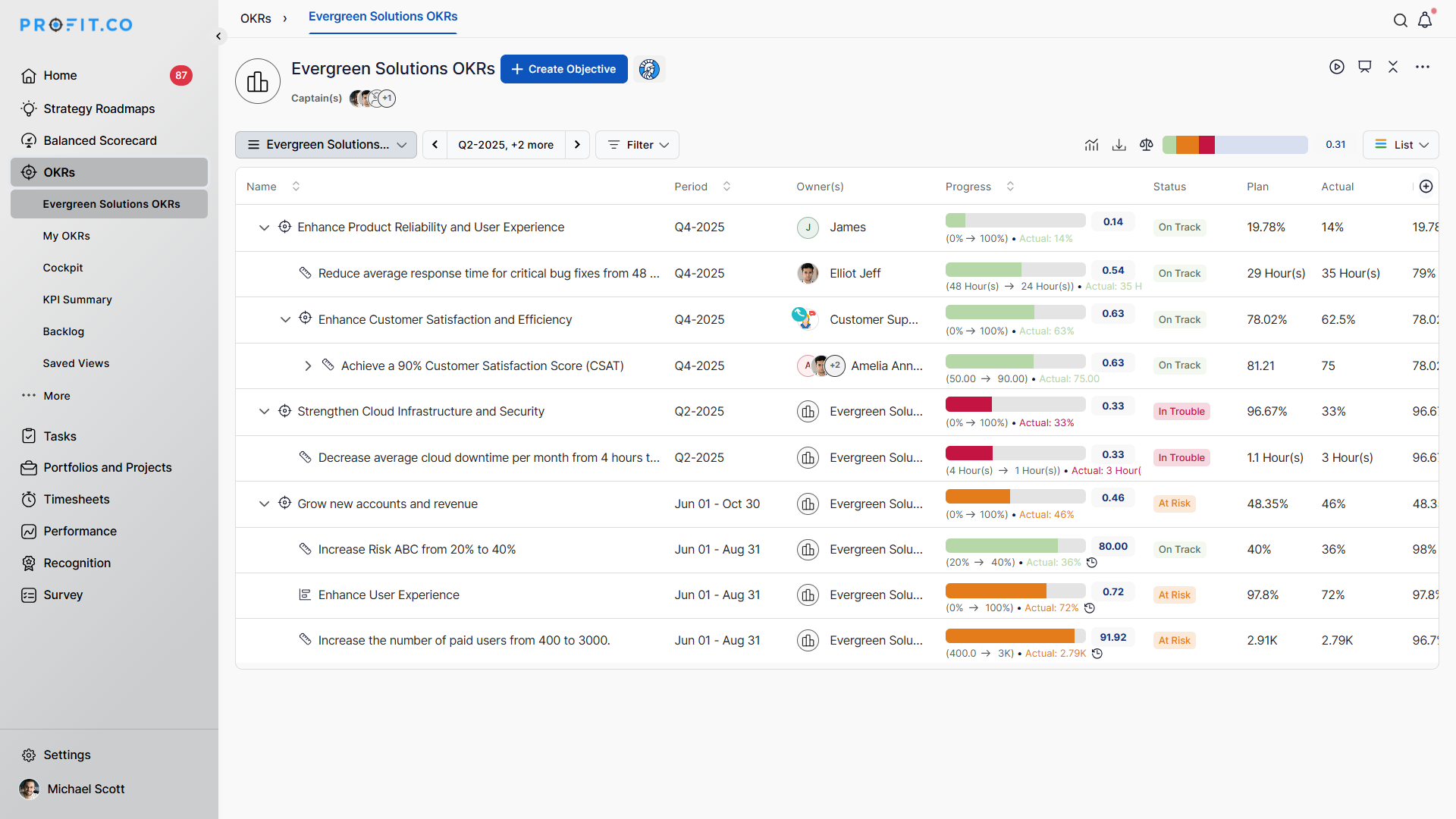
Profit.co has been recognized as a G2 Leader and featured in Gartner’s Hype Cycles. The platform stands out by integrating AI-powered OKR software with performance management, project portfolio management, and employee engagement in a single unified system.For enterprise teams, this integration eliminates the tool sprawl that often undermines strategy execution. Instead of jumping between separate systems for goal setting, performance reviews, and project tracking, everything is in one AI-enhanced ecosystem.
The platform offers over 80 integrations and provides 24/7 live support, which becomes invaluable during enterprise implementations. Their coaching and consulting team helps organizations navigate the challenges of rolling out OKRs across multiple business units with different maturity levels.
Best for: Organizations looking for an end-to-end strategy execution platform that combines OKRs with performance management and project tracking.
Ready to try?
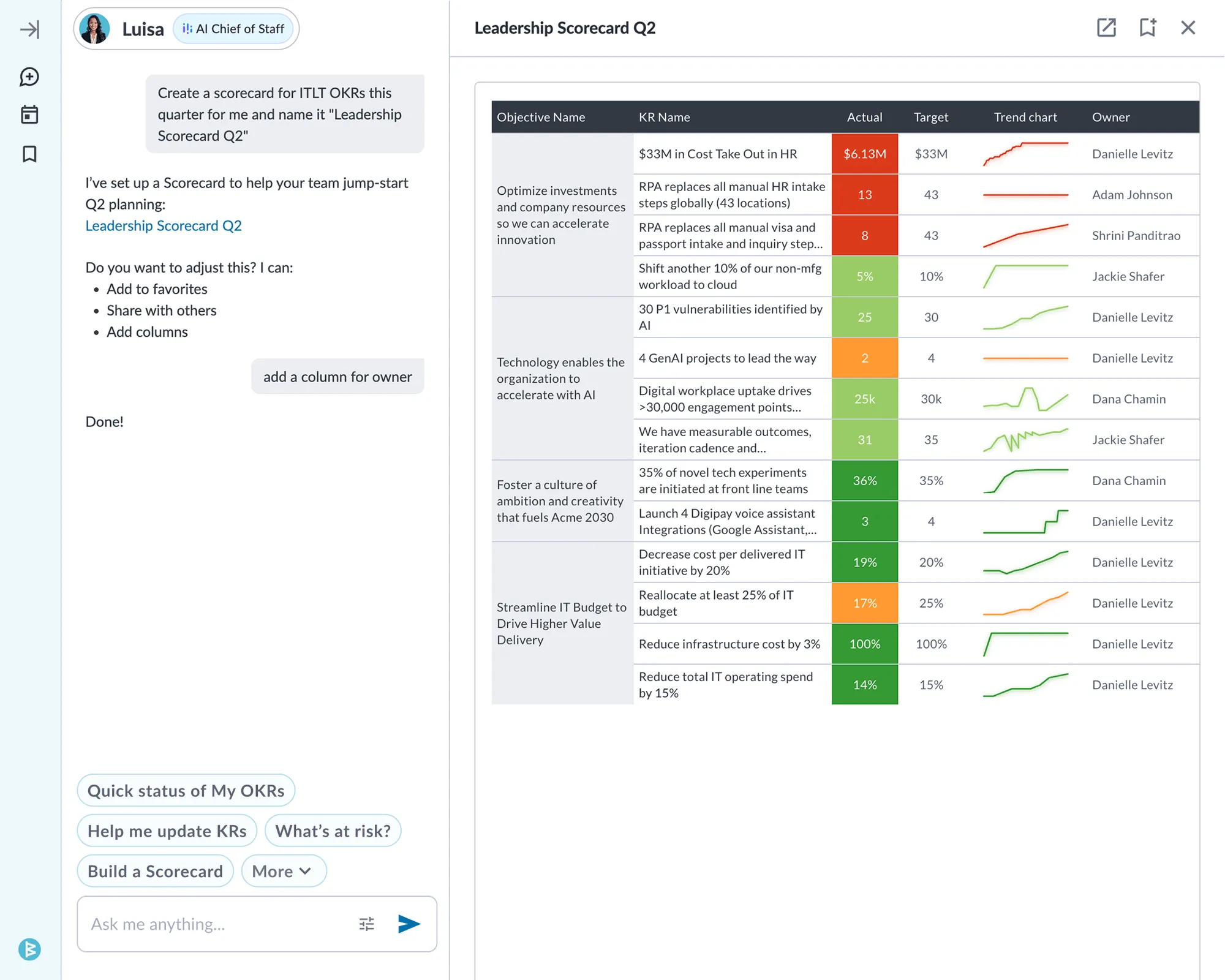
WorkBoard (including Quantive) – Advanced Analytics and Coaching
WorkBoard acquired Quantive to strengthen its position in the enterprise market, creating a powerful combination of advanced OKR analytics paired with AI-powered strategy coaching.What makes WorkBoard stand out is how it helps executives understand not just where goals stand, but why. The platform’s analytics capabilities allow organizations to benchmark their OKR processes against similar companies, identify bottlenecks in goal execution, and get predictive insights about which objectives are at risk.
Their AI coaching feature provides contextual guidance for writing better OKRs, solving a major pain point: teams writing objectives that sound good but aren’t actually measurable or achievable. The platform excels at providing the strategic context needed for enterprise-level alignment.
Best for: Large enterprises that need sophisticated analytics and want data-driven insights into their strategy execution process.
Lattice – The People-First Performance Platform
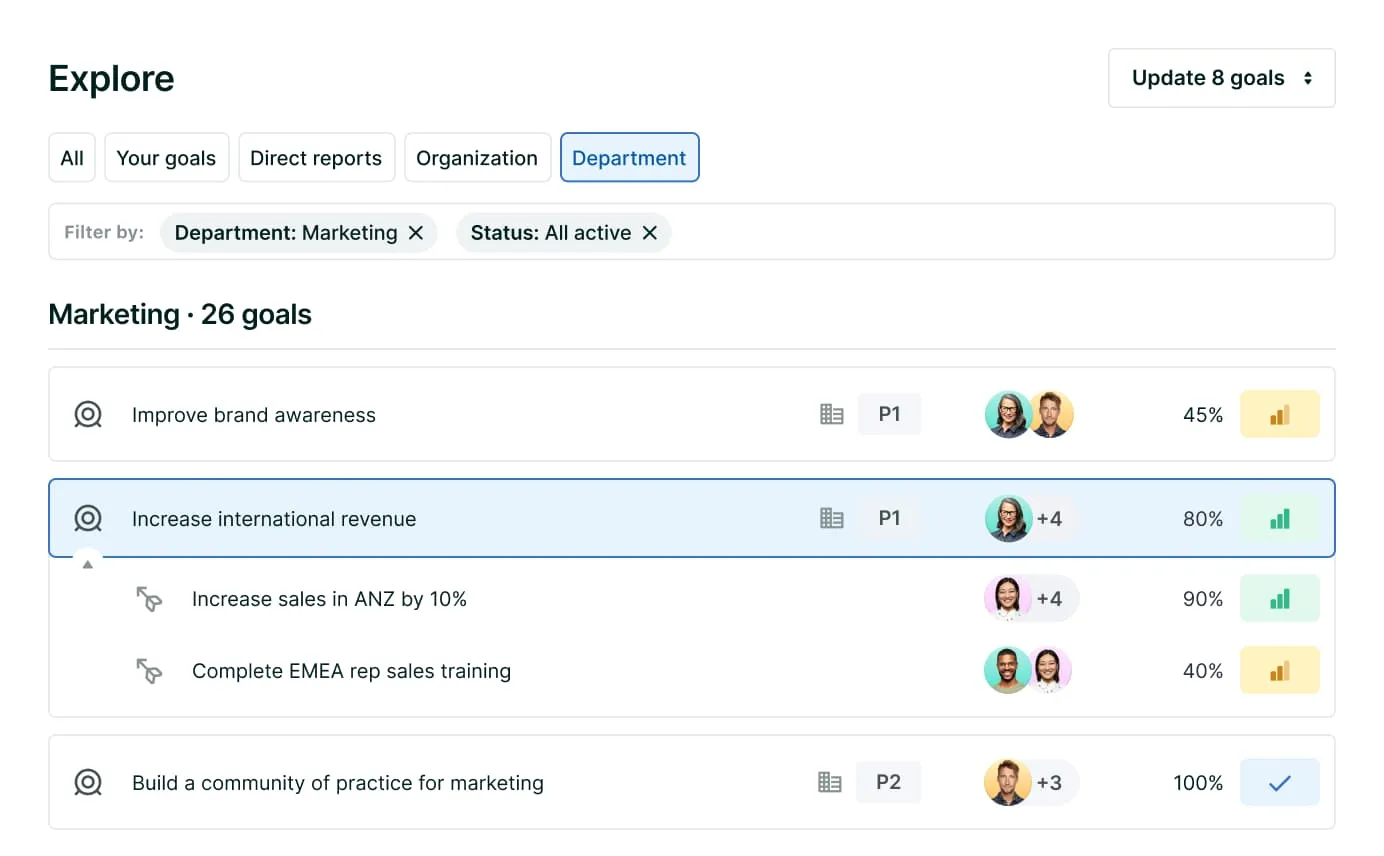
Lattice approaches OKRs from a different angle. Rather than being purely a goal-tracking tool, it’s a comprehensive people management platform that integrates OKRs with performance reviews, engagement surveys, and career development.With a G2 rating of 4.7/5 and recognition as a leader in multiple categories, Lattice excels at connecting individual performance with organizational objectives. The platform’s strength lies in creating a continuous feedback culture where OKRs aren’t just quarterly checkboxes but ongoing conversations.
For enterprise HR teams focused on building a strong performance management system, Lattice offers the depth needed to support everything from 360-degree reviews to succession planning. The AI-powered features help with manager enablement and provide insights across the full employee lifecycle.
Best for: HR-led organizations seeking to deeply integrate OKRs into their broader people management strategy.
Betterworks – Enterprise-Grade Performance Management
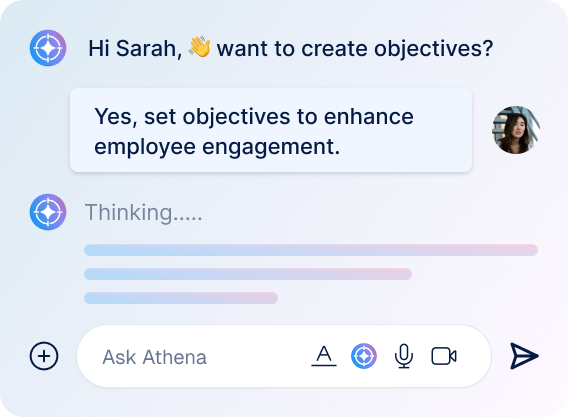
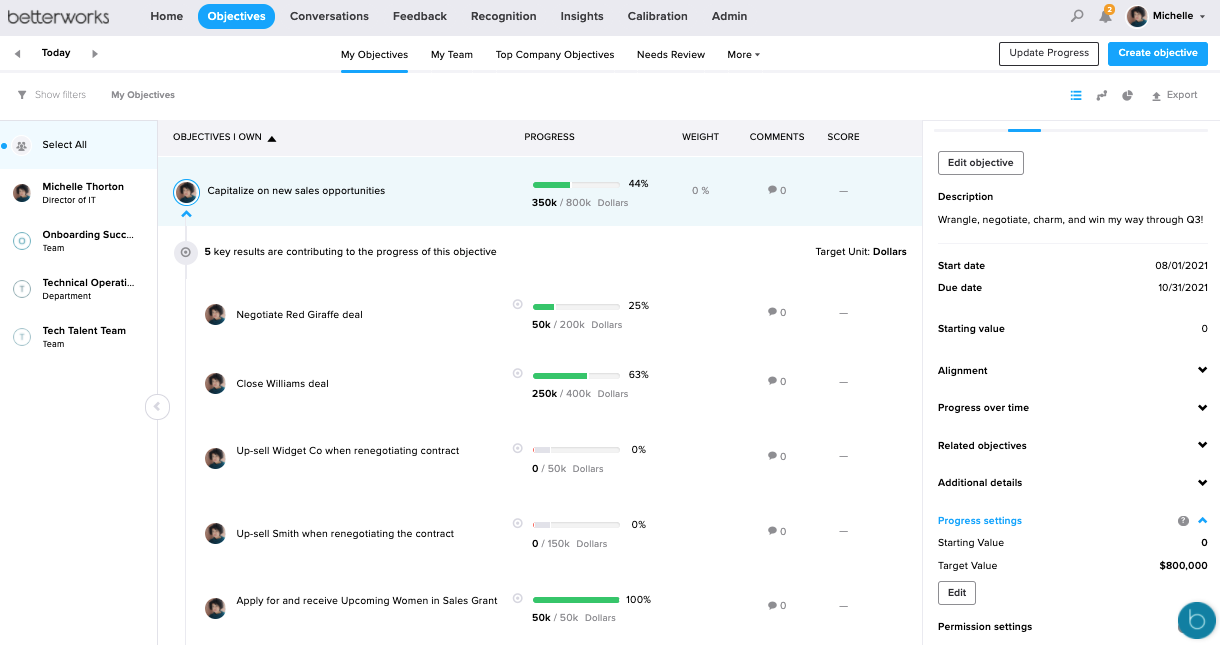
Betterworks has built a reputation for scaling OKRs across large, complex organizations. The platform supports transparent communication, goal alignment, and frequent progress assessments with features specifically designed for enterprise needs.The platform’s focus on the employee experience makes it easy for individual contributors to understand how their work connects to company strategy, driving engagement and accountability at scale. Betterworks also offers GenAI-powered conversations that help teams set better goals, provide more meaningful feedback, and have more productive performance discussions.
This automation becomes increasingly valuable as organizations grow.
Best for: Enterprises prioritizing employee alignment and looking for robust performance management integrated with OKRs.
Perdoo – Strategy Execution with KPI Integration
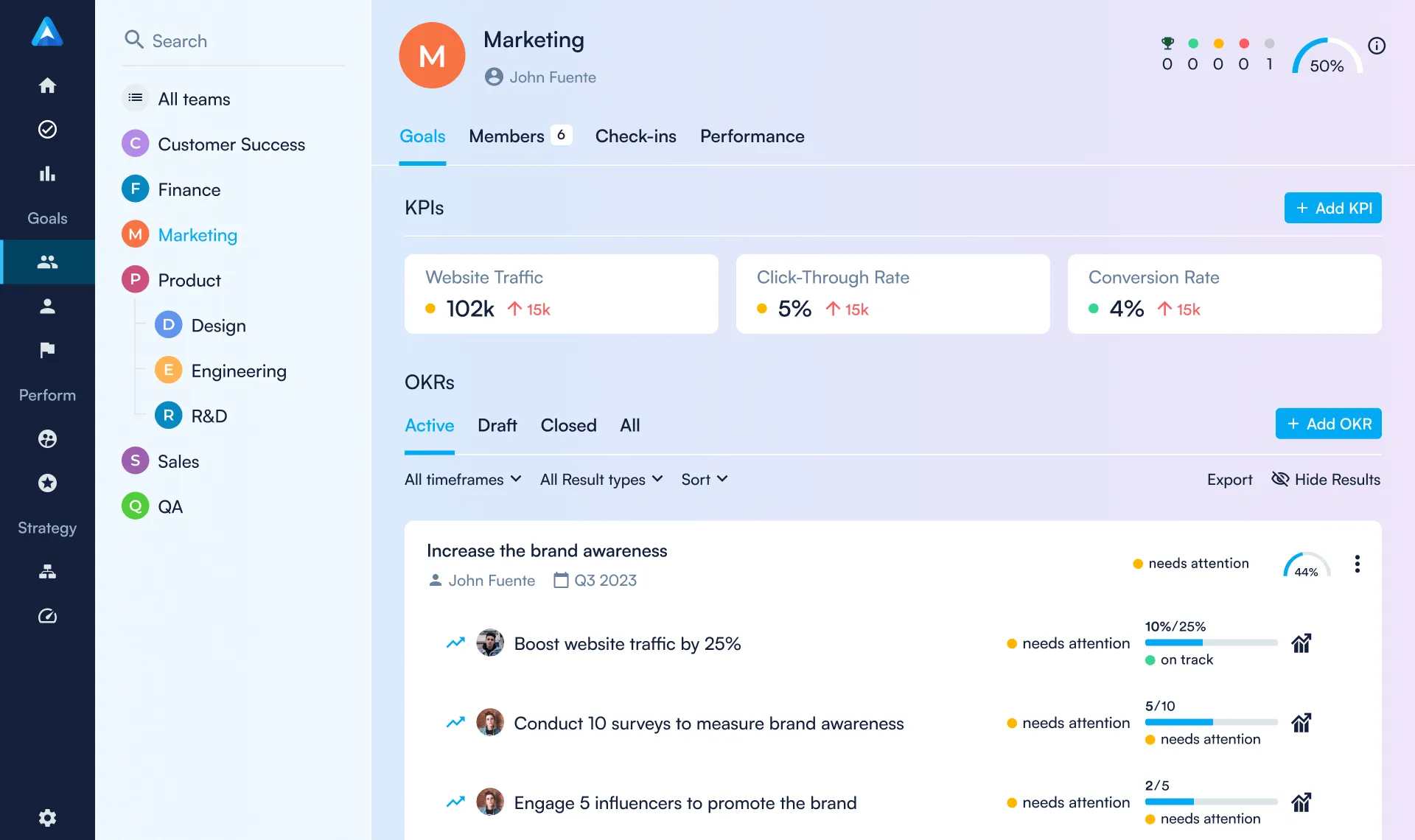
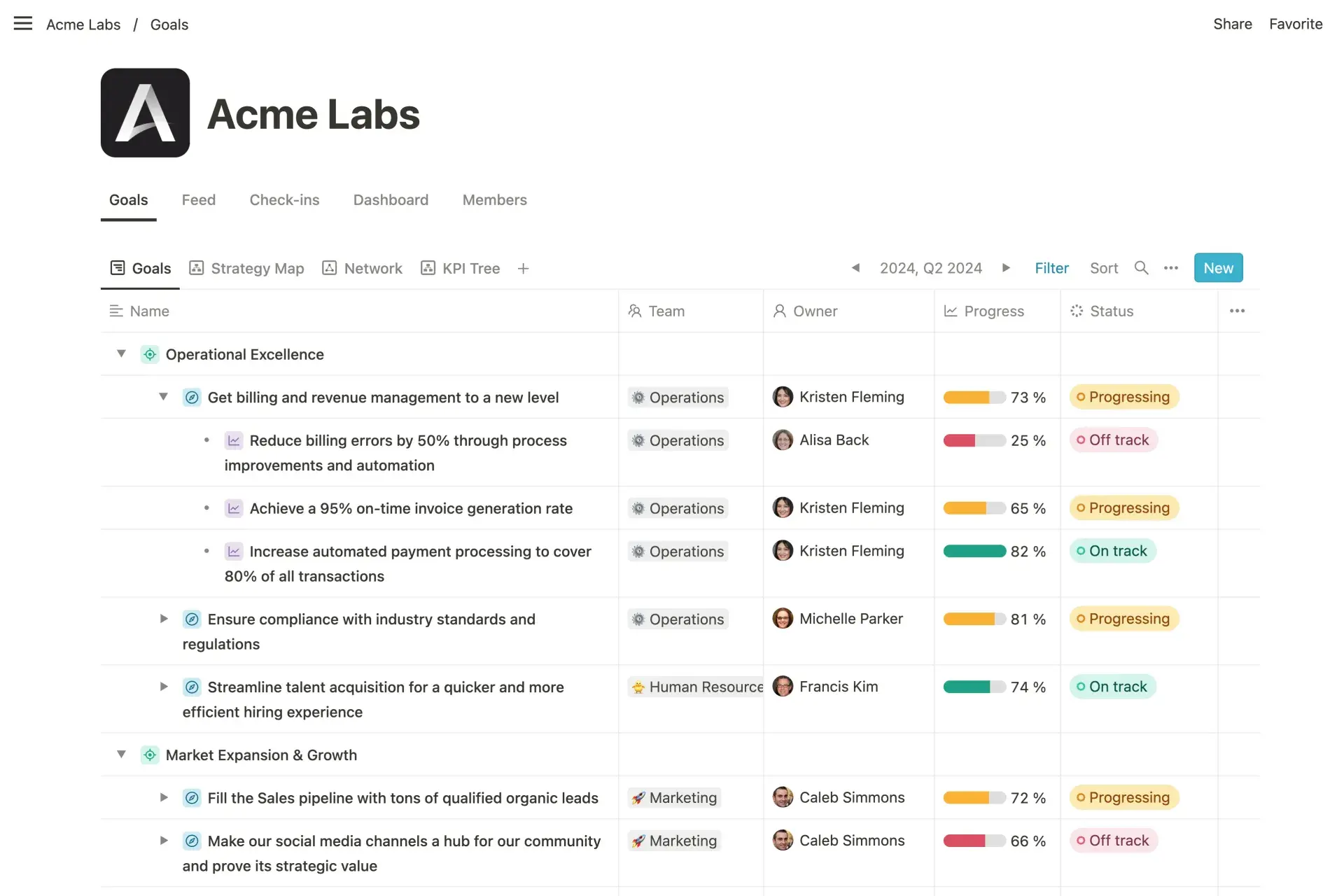
Perdoo for strategy execution takes a unique approach, combining OKRs and KPIs on a single platform. The software is designed specifically to translate strategy from slide decks into executable goals.The platform’s Strategy Map feature addresses a critical problem: 95% of employees don’t know or understand their company’s strategy. Perdoo makes strategy visible and actionable, helping teams stay focused on what matters most.
What sets Perdoo apart is how it treats KPIs as equally important to OKRs. Organizations can align KPIs with strategy, track them alongside OKRs, and build insightful connections – like creating an OKR to improve a specific KPI. The platform also includes robust 1:1 capabilities, performance reviews, and weekly check-ins.
Best for: Organizations that want to combine OKR and KPI tracking with strong strategy visualization capabilities.
Mooncamp – Flexible Enterprise OKR Platform
Mooncamp is recognized as a flexible OKR software on the market, suited for mid-market and enterprise organizations. The platform is customizable and intuitive.Customer reviews on G2 highlight the flexibility of the tool, especially the Microsoft Teams integration. Despite extensive features, Mooncamp maintains a modern and uncluttered interface.
The platform enables full transparency and alignment across teams.
Best for: Mid-market and enterprises that need maximum customization and modern UX with deep Microsoft Teams integration.
Peoplebox – AI-Powered Alignment and Talent Management
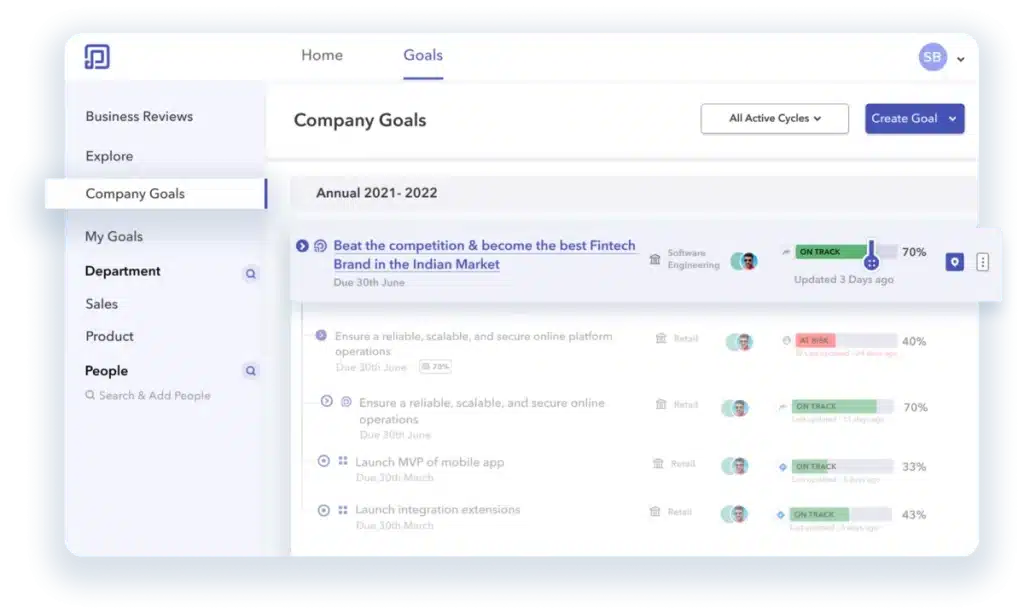
Peoplebox merges goal-setting with talent management, making OKRs integral to everyone’s workflow. The platform comes with automated goal updates, real-time feedback, and integrated one-on-one meetings, ensuring continuous alignment and performance discussions.The platform’s powerful analytics extract in-depth insights into team alignment, helping identify potential roadblocks before they become major issues. Organizations can spot problems like understaffed teams failing to keep up with deadlines and make better decisions to address them.
Peoplebox integrates seamlessly with popular tools like Slack and Microsoft Teams, allowing teams to incorporate it into their existing tech stack without friction. The platform excels at making OKRs feel like a natural part of daily work rather than an additional burden.
Best for: Organizations seeking AI-powered insights and tight integration between goal tracking and talent management.
Asana – Project Management with OKR Capabilities
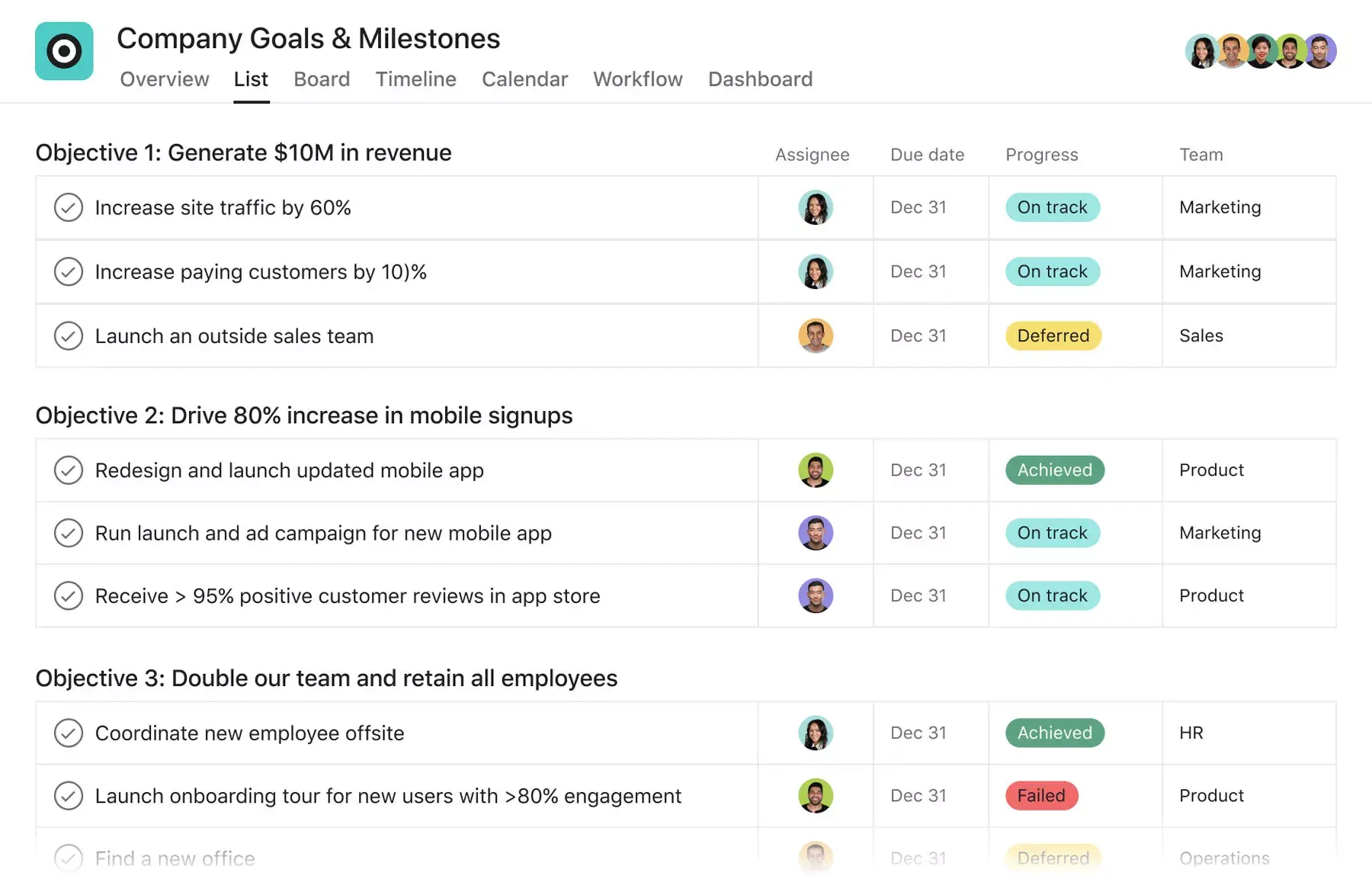
While primarily known as a project management platform, Asana offers robust OKR and goal-tracking capabilities that appeal to enterprises already using Asana for work management.Asana allows organizations to monitor team OKR progress in real-time through portfolios. The platform excels at connecting top-down OKR and goal setting with detailed tactical execution, making it easy to see how daily tasks ladder up to strategic objectives.
The platform’s strength is its ability to keep everything in one place, from major objectives to detailed tactical layouts. However, organizations should note that Asana is primarily task-oriented, which might dilute focus on higher-level strategic goals compared to dedicated OKR platforms.
Best for: Organizations already invested in Asana for project management who want to add OKR tracking without introducing another tool.
What the Data Reveals About Enterprise Needs
After analyzing hundreds of reviews on Gartner Peer Insights and G2, several patterns emerged about what enterprise buyers actually value:- Functionality Over Features: Enterprise teams don’t just want a long feature list. They want detailed reporting that tracks current and historical OKR performance, the ability to customize workflows to match their processes, and support for complex organizational structures with multiple OKR levels.
- Integration Quality: The number one complaint from enterprise users isn’t about missing features. It’s about integrations that don’t work as promised. Successful implementations happen when OKR software connects seamlessly with existing HRIS systems, project management tools, and communication platforms through true bidirectional sync.
- Support and Training: For enterprises, implementation support isn’t optional. Organizations need dedicated consultants to help with setup, comprehensive training resources for different user groups, and ongoing coaching to ensure OKR adoption sticks.
- Scalability Without Complexity: The best enterprise platforms grow with organizations without adding complexity. They support teams from 250 to 25,000+ users while maintaining performance and usability.
The Hidden Costs of Enterprise OKR Software
Pricing isn’t straightforward in the enterprise OKR market. Here’s what the total cost of ownership actually includes:Software Licensing: Most enterprise platforms use per-user pricing that ranges from $4 to $15 per user per month, with volume discounts for larger organizations. Some vendors offer custom enterprise pricing that bundles additional features and support.
Implementation Services: Organizations should budget for dedicated consulting support during rollout. This typically costs 15-30% of first-year license fees but dramatically increases adoption success rates.
Training and Enablement: Planning for both initial training and ongoing enablement is essential. The best vendors include this in their enterprise packages, but some charge separately.
Integration Development: If custom integrations beyond what’s offered out-of-the-box are needed, organizations should factor in development costs or expect to pay for premium integration support.
Opportunity Cost: The highest hidden cost? Choosing software that teams won’t adopt. A failed OKR implementation doesn’t just waste the software investment—it can set back strategic execution by months.
How to Actually Choose the Right Platform
After evaluating dozens of platforms across hundreds of implementations, here’s a framework that leads to the right decision:Start with your “why” before evaluating tools. The primary use case matters most. Is the goal better goal visibility? Improved performance management? Cross-functional alignment? The answer should eliminate 80% of options immediately.
Test with real work, not demo scenarios. Most vendors offer 14-30 day trials. These should be used to run an actual OKR cycle with a pilot team. Two weeks of real use reveals more than six vendor demos ever could.
Prioritize adoption over features. The most powerful platform is worthless if teams won’t use it. Look for intuitive interfaces, workflow automation, and integration with tools teams already use daily.
Evaluate the vendor, not just the software. In the enterprise world, the relationship with the vendor matters as much as the technology. Key questions include: Do they have enterprise customer success teams? Can they provide implementation support? Do they have a track record with organizations of similar size?
Create a scorecard before starting. A simple evaluation matrix with weighted criteria prevents getting swayed by flashy demos or aggressive sales tactics. Consider: usability (25%), integration quality (20%), reporting capabilities (20%), support offerings (20%), and pricing (15%).
The Reality of Enterprise OKR Implementation
Here’s what no vendor wants to tell you: software alone doesn’t make OKRs successful.The organizations that succeed with enterprise OKR platforms share three characteristics.
- First, they have executive sponsorship that goes beyond budget approval. Leaders actively participate in setting and reviewing OKRs, which signals to the entire organization that this matters.
- Second, they invest in change management. Rolling out OKR software is a change management challenge first and a technology challenge second. The best platforms make this easier, but they don’t eliminate the need for thoughtful communication, training, and iteration.
- Third, they start to focus and expand gradually. Every enterprise that tried to implement OKRs across the entire organization on day one struggled. The ones that succeeded began with 1-3 pilot teams, learned from their experience, and then scaled.
Making Your Decision
Choosing enterprise OKR software is one of those decisions that’s both simpler and more complex than it appears. The technology is largely table stakes—most leading platforms can handle the core OKR mechanics. What differs is how well they fit an organization’s specific context, culture, and strategic execution needs.The market has matured significantly. Platforms such as Profit.co, WorkBoard, Lattice, Betterworks, Perdoo, Mooncamp, Peoplebox, and Asana have proven capable of supporting enterprise-scale implementations.
The decision shouldn’t be based on which platform has the most features or the slickest demo. It should be based on which one will actually get adopted by teams, integrate with existing workflows, and provide the support needed to make OKRs a lasting part of how the organization executes strategy.
The right platform doesn’t make OKRs easy, but it makes them possible at scale. In an enterprise environment where alignment and execution often break down, that difference matters more than any single feature ever could.
Looking to implement OKRs at your organization? Profit.co offers a comprehensive enterprise solution with 24/7 support and proven success with Fortune 500 companies
There isn’t one universal “best.” Platforms like Profit.co, WorkBoard, Lattice, and Betterworks lead the enterprise segment depending on use case.
Yes. Bidirectional integration with HRIS and performance systems is critical for enterprise alignment.
Tools offer goal-tracking integrations, and dedicated OKR platforms provide deeper alignment, analytics, and strategy visibility.
Related Articles
-
OKR Software with Mobile App: Track Your Goals Anywhere
TL;DR OKR software with a mobile app keeps your team aligned and productive wherever they are. Profit.co's mobile app allows... Read more
-
Top OKR Tools That Integrate Seamlessly with Microsoft 365
TL;DR If your company runs on Microsoft 365, your OKR tool should too. The best platforms integrate deeply with Teams,... Read more
-
The 6 Biggest Goal Management Challenges During M&A And How to Solve Them
TL;DR M&A integrations create unique goal management challenges that don't exist in normal operations: cultural conflicts, system incompatibility, talent loss,... Read more
-
6 Adaptations Required to Implement OKRs in Government
TL;DR The Objectives and Key Results (OKR) framework helps organizations align strategy, measure outcomes, and improve execution. However, government agencies... Read more