

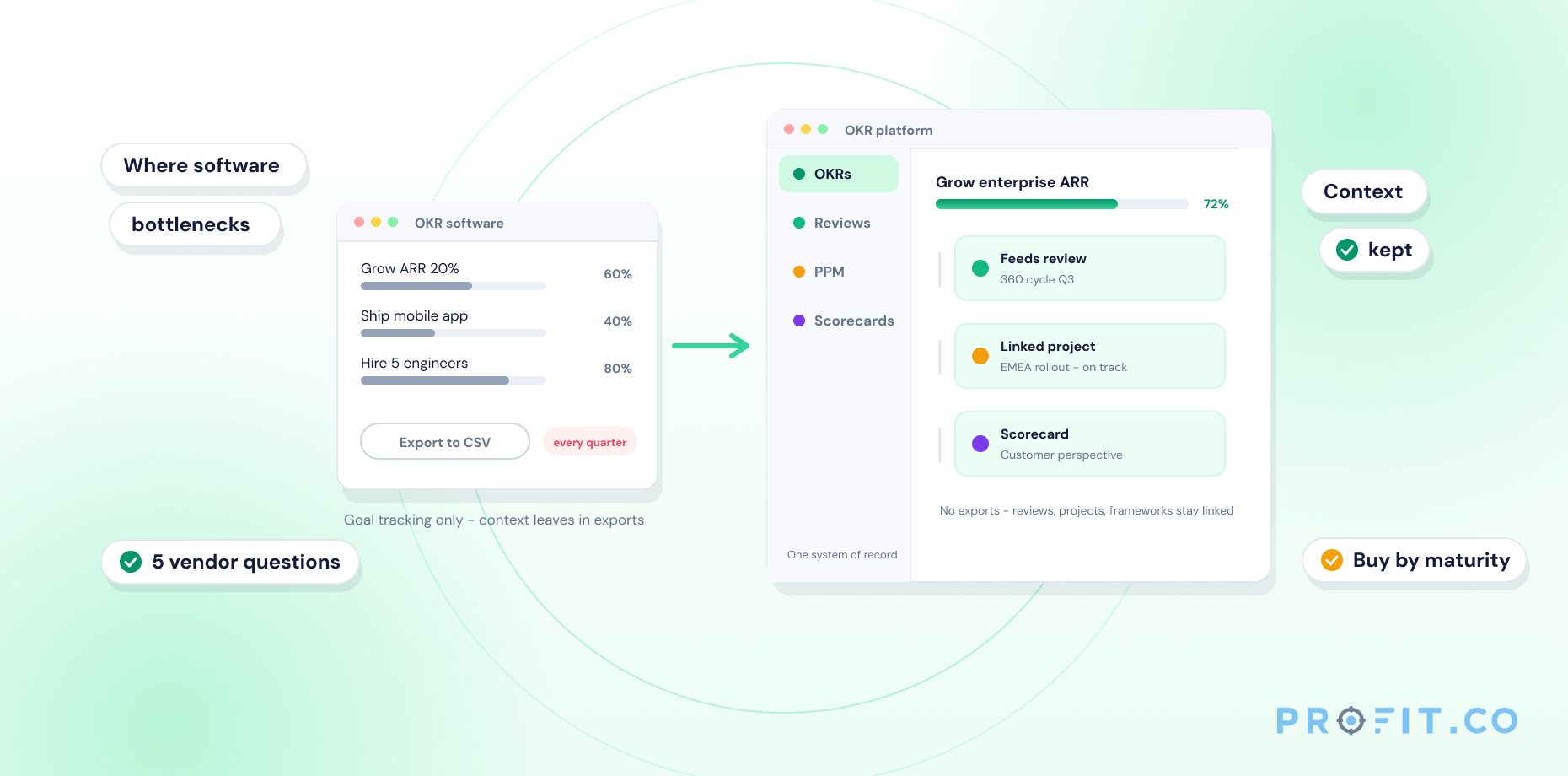
OKR software handles goal-setting and progress tracking within the OKR framework. An OKR platform does all of that, and connects goals to performance reviews, project portfolios, and strategy execution frameworks in a single integrated environment. The difference is scope: OKR software answers “Are we on track?”; an OKR platform answers “Why, and what do we do next?”
In this guide
- OKR Platform vs. OKR Software: The Short Answer
- What “OKR Software” Usually Means
- What an “OKR Platform” Adds
- Side-by-Side Comparison
- 5 Questions to Ask Before You Choose
- Which One Does Your Team Need?
- Frequently Asked Questions
OKR software and an OKR platform are not the same category. OKR software is a focused tool for setting and tracking Objectives and Key Results. An OKR platform extends that scope, connecting OKRs to performance reviews, project portfolios, and strategy frameworks in a single unified system. The difference is depth: software tracks goals; a platform executes strategy.
OKR Platform vs. OKR Software: The Short Answer
The two terms appear interchangeably in most vendor marketing, including on some of the most widely read OKR guides on the internet. The terminology problem is real: a tool calling itself a “platform” may be a basic goal tracker with a premium price, while a tool marketed as “software” may include performance management, project portfolios, and AI capabilities that make it a genuine platform by any functional measure.
The distinction that matters is not the label. It is what the tool connects to.
The clear line: OKR software solves the goal-tracking problem. An OKR platform solves the strategy-execution problem. Every OKR platform is OKR software. Not every OKR software qualifies as a platform.
Understanding where a tool sits in this spectrum determines whether it will scale with your organization, or create a new set of integration problems when OKR data needs to inform decisions outside the goal-tracking tool itself. For a full definition, see what an OKR platform is and how it differs structurally from simpler goal-tracking tools.
The Platform vs. Software Spectrum
It helps to think of OKR tools not as two binary categories but as a spectrum. At one end sits lightweight, single-purpose OKR trackers tools designed to do one thing (track OKRs) and do it simply. At the other end sit unified strategy execution platforms that connect goals to people management, project delivery, and long-term strategic frameworks. Most tools marketed as “OKR software” or “OKR platforms” sit somewhere on this spectrum and the marketing language alone will not tell you where.
Four questions reveal where a tool actually sits:
- When a quarter closes, do OKR scores automatically flow into performance reviews or does someone export a spreadsheet?
- When a project slips in the project management tool, does the connected OKR flag as at risk or does leadership only find out at the end-of-quarter review?
- Can the organization run OKRs alongside a Balanced Scorecard or Hoshin Kanri framework in the same system or are those managed in a separate tool?
- When a new employee joins, do they see how their individual goals connect to company strategy or do they receive a link to a separate goal-tracking spreadsheet?
If the answer to any of these is “separate tool” or “manual export,” the organization is using OKR software not a platform regardless of what the vendor calls it.
Why This Distinction Has Become More Urgent in 2026
Three years ago, the platform vs. software distinction mattered primarily for large enterprises. Today it matters for any organization above 50 people. The reason is tool proliferation. The average mid-market company now runs separate systems for OKRs, performance management, project management, and employee engagement each with its own data model, its own update cycle, and its own user interface. The coordination cost of stitching these systems together manually has grown large enough to offset the benefits of each individual tool.
At the same time, AI-powered strategy execution has raised the bar for what a single platform can deliver. A unified platform with AI built in can now draft OKRs, score their quality, auto-update progress from integrated tools, flag at-risk goals, summarize performance for review cycles, and generate project status reports all without switching tabs. That capability is not available when the data lives in four separate tools that do not share a data model.
What “OKR Software” Usually Means
OKR software, in its most common form, is a dedicated tool for creating and tracking Objectives and Key Results. It does the core job of the OKR framework well: it replaces spreadsheets, structures the goal-setting process, and provides a central location for teams to log updates and see progress against targets.
Most OKR software products share a common feature set:
- Objective and Key Result creation with flexible target types: numeric, percentage, currency, or milestone
- Alignment views that link goals from company level to team and individual level
- Check-in workflows for regular progress updates, with confidence scoring and blocker notes
- Basic dashboards showing progress status, overall score, and at-risk goals
- Integrations with a selection of external tools for automated data sync
This is genuinely valuable, especially for organizations new to OKRs or small teams running a single goal cycle. The problems surface when the organization matures and OKR data needs to inform decisions outside the goal-tracking tool: performance reviews, project delivery, strategic planning, and executive reporting.
When OKR Software Becomes a Bottleneck
Standalone OKR software creates predictable friction at three specific points in the organizational calendar:
At the end of each quarter: When a cycle closes, performance managers need OKR results to inform review scores. With standalone software, this requires a manual data pull someone exports OKR scores, maps them to each employee in the HR system, and enters the data by hand. The process typically takes HR teams two to four hours per department per cycle. Over a year, the hidden administrative cost of this export-and-reconcile loop adds up to a meaningful drain on HR bandwidth time that a unified platform eliminates entirely.
When projects slip mid-quarter: In most organizations, OKRs and project management live in different systems. A product team’s project falls behind in Jira. The product lead knows. The product OKR which depends on that project completing is still showing as “On Track” in the OKR tool because no one has manually updated it. Leadership sees the OKR as green until the quarterly review reveals the miss. A unified platform with project linkage surfaces this the moment the project slips, giving leaders time to intervene while the quarter is still recoverable.
At the start of each new cycle: When a new OKR cycle opens, HR and strategy teams need to set goals that connect meaningfully to the company’s annual priorities. With standalone software, this involves pulling together context from multiple systems last cycle’s OKR results from the OKR tool, performance data from the HR system, project outcomes from the project management tool and manually synthesizing them into the next quarter’s goal-setting session. A unified platform with institutional memory built in presents this context automatically.
At end-of-quarter, someone manually copies OKR scores into the performance review system.
Project managers update their tools, but OKR progress only changes when contributors remember to log a check-in.
Executives ask for OKR health updates before board meetings, and someone spends hours assembling data from multiple dashboards.
When a team member leaves, their OKR history lives only in the OKR tool not connected to their performance record.
New hires cannot see how their goals connect to company strategy without navigating three separate systems.
At that point, standalone OKR software becomes an island. Leaders extract data manually, HR teams work in a separate performance management system, and project managers have no formal connection between the projects they are delivering and the objectives those projects are supposed to advance. The tool that solved the goal-tracking problem has created a new integration problem that grows with every quarter.
The OKR Platform Buyer’s Guide walks through the full evaluation checklist for distinguishing platform-level tools from standalone software, including what questions to ask vendors about integration depth and data flow between modules.
What an “OKR Platform” Adds
An OKR platform starts with everything OKR software does, and extends it across three adjacent disciplines that turn strategy execution into a continuous, connected process rather than a quarterly goal-tracking exercise. The key word is connected not just integrated via API, but sharing a live data model so that an update in one module automatically surfaces in every other module that depends on it.
1. Performance Management Integration
An OKR platform connects OKR results to performance reviews in the same system. When a quarter closes, each person’s scored OKRs feed directly into their performance evaluation, replacing subjective manager recall with documented, evidence-based outcomes. This is not simply a convenience it fundamentally changes the quality of performance conversations.
When performance data and OKR data live in separate systems, managers conduct reviews based on what they remember about the past 90 days. Memory is selective and subject to recency bias the project from week two of the quarter is often forgotten by the time the review form opens in week thirteen. When the same platform holds both the OKR scores and the performance form, managers enter the review with a complete, objective record of what was accomplished, what was missed, and what blockers were logged throughout the cycle.
Profit.co includes performance reviews, 360-degree feedback, calibration, succession planning, development plans, pulse surveys, and employee recognition all connected to OKR progress so every review is grounded in real execution outcomes. OKR completion rates and key result progress populate review forms automatically, with no CSV export and no manual reconciliation. When an employee’s OKRs show consistent over-performance, that signal flows automatically into their talent matrix score. When blockers are logged repeatedly in check-ins, those patterns surface during calibration giving HR and leadership data they would otherwise have to reconstruct from memory.
This connection also changes the employee experience. Contributors who know their OKR progress will be referenced in their performance review are more motivated to keep check-ins current and to document blockers accurately. The performance system becomes a natural downstream use of the OKR system not a separate exercise that requires a separate effort.
2. Project and Portfolio Linkage
An OKR platform connects the projects a team is delivering to the objectives those projects are supposed to advance. This closes a visibility gap that plagues most organizations running OKRs and project management in separate tools: the gap between what is planned (OKRs) and what is actually being built (projects).
Consider a common scenario. A product team sets an OKR to improve customer onboarding completion rates by 40%. To deliver this, they are running three projects in parallel: a UI redesign, an email onboarding sequence, and an in-app tutorial. Each project has its own timeline, dependencies, and risks. In a standalone OKR environment, the product OKR shows “On Track” until a project team member manually updates the check-in. If the UI redesign slips by three weeks because of a dependency on the design team, the OKR continues to show “On Track” until the product lead remembers to log an update which may be too late for leadership to intervene.
In a platform with project linkage, the UI redesign delay triggers an automatic at-risk flag on the connected OKR. Leadership sees the risk in the Cockpit dashboard before the week is out not in the quarterly review three months later. The timeline is recoverable. Context is preserved. The strategic decision about whether to reprioritize resources can be made while it still matters.
Profit.co’s Project Portfolio Management module is built directly into the platform alongside OKRs and performance management. Leaders can see which projects are contributing to which OKRs, track budget and resource allocation against strategic objectives, and identify which portfolio investments are delivering business outcomes versus which are consuming capacity without strategic return. This portfolio-to-OKR visibility is the capability most frequently cited by enterprise customers as the primary reason they chose a platform over standalone software.
Beyond project portfolio management, Profit.co also includes Strategic Portfolio Management connecting corporate strategy through annualized OKRs to portfolio, program, and project execution. This prevents the strategic drift that occurs in organizations where long-term strategic themes are planned in one system and quarterly OKRs are set in another, with no formal mechanism to verify that the quarterly work actually advances the multi-year plan.
3. Strategy Execution Frameworks
An OKR platform supports multiple strategy frameworks alongside OKRs in the same operating environment. This capability is more important than it might initially appear, because most enterprise organizations do not run on a single strategic framework they run on several simultaneously, at different levels of the organization.
A global manufacturing company might govern its ten-year strategic plan using a Balanced Scorecard across four perspectives: financial, customer, internal processes, and learning and growth. At the business unit level, it might use OKRs for quarterly execution. At the plant level, it might use Hoshin Kanri a framework focused on breakthrough annual priorities and the X-matrix for policy deployment. With standalone OKR software, these three frameworks live in separate systems. Cross-framework visibility understanding how a plant-level Hoshin priority connects to a business unit OKR and ultimately to a corporate Balanced Scorecard initiative requires manual reconciliation across three tools.
In a unified platform, all three frameworks share the same data model. Progress on a Hoshin breakthrough objective flows upward into the relevant OKR, which flows upward into the Balanced Scorecard perspective it belongs to. An executive can see the full strategic picture in a single dashboard without any data being manually transferred between systems.
Profit.co supports OKRs, Balanced Scorecard, Hoshin Kanri, and Strategy Roadmaps natively in the same platform, with configurable connections between frameworks. Organizations can choose to run all four simultaneously, run two in parallel during a transition, or start with OKRs and layer in additional frameworks as governance needs evolve. To see how all of these components operate in sequence, see how an OKR platform works across the full five-step cycle.
Side-by-Side Comparison
Use this table to evaluate tools you are currently considering against the platform vs. software distinction. The four rows required by any serious evaluation scope, modules, primary use case, and typical buyer appear first, followed by the operational dimensions that reveal how the distinction plays out in day-to-day use.
| Dimension | OKR Software | OKR Platform |
|---|---|---|
| Scope | Goal-setting and tracking within the OKR framework | OKRs connected to performance, projects, and strategy across the entire business |
| Modules | OKR creation, check-ins, dashboards, and basic integrations | OKR management + Performance reviews + Project portfolio + Employee recognition + Strategy roadmaps |
| Primary use case | Running structured OKR cycles for a team or department | Connecting company strategy to execution across every level and function |
| Typical buyer | Team leads or department heads starting their first OKR program | CHROs, CSOs, CEOs, and PMO directors managing organization-wide strategy execution |
| Performance linkage | None, or manual export to a separate HR system | OKR scores flow directly into performance reviews in the same system |
| Project management | Not included requires a separate tool and manual data bridging | Projects link to objectives in the same platform; project slippage surfaces as OKR risk automatically |
| Strategy frameworks | OKRs only | OKRs, Balanced Scorecard, Hoshin Kanri, Strategy Roadmaps in the same environment |
| AI capability | Limited or absent some tools offer basic goal-writing suggestions | AI Agents across the full cycle: OKR authoring, quality scoring, progress updates, project summaries, review drafts |
| Scalability | Effective for smaller teams; integration complexity grows with org size and tool stack | Built to scale from small teams to global enterprises with 10,000+ users and complex governance requirements |
| Total cost of ownership | Lower tool cost, but hidden cost of manual reconciliation between systems grows each quarter | Higher platform cost, but eliminates the coordination overhead of running multiple disconnected tools |
5 Questions to Ask Before You Choose
The right tool is not the one with the longest feature list it is the one that eliminates the most friction in the workflows your organization actually runs. These five questions will clarify which category you need and expose where any tool you are evaluating falls short:
How does OKR progress populate a performance review form?
If the vendor answers with “we have an integration” or “you can export the data,” that is two systems, not one. Look for a vendor that describes automatic data flow within a single product where checking off an OKR score in one module immediately surfaces in the review template in another module without any user action.
What happens to an OKR when the project that drives it slips?
In a platform, the OKR automatically flags as at risk when the connected project falls behind no manual update required. In standalone software, the OKR stays green until a contributor manually logs a check-in. Ask the vendor to demonstrate this scenario live in the product.
Can you run OKRs and a Balanced Scorecard simultaneously in the same system?
If your organization uses multiple strategy frameworks or anticipates needing to confirm whether the tool supports this natively or requires a workaround. A true platform holds multiple frameworks with formal connections between them. Standalone OKR software typically does not.
How does the AI work, and where does it sit in the workflow?
AI features in standalone OKR software typically offer goal-writing suggestions at the point of OKR creation and stop there. A platform with AI built in applies it across the full cycle: drafting OKRs, scoring quality before the quarter begins, auto-updating progress from integrated tools, summarizing project status, and drafting performance review language from actual outcomes. Ask to see the AI in action across multiple stages of the cycle, not just at the goal-writing step.
What does the total cost of ownership look like at 200 users?
Request a fully-loaded TCO comparison that includes: the platform cost, the cost of any tools the platform replaces (HR system, project management tool, engagement survey tool), and an estimate of the coordinator time currently spent manually reconciling data between those systems. For most organizations above 100 people, the platform TCO is lower than the fragmented-stack TCO when all costs are included not just the subscription price.
Which One Does Your Team Need?
The right answer depends on where your organization is in its OKR maturity and what you expect OKR data to inform beyond goal tracking.
Your organization is running OKRs for the first time and needs a low-friction starting point where the primary goal is building check-in habits not connecting to downstream systems.
Goal-setting and weekly check-ins are the only use cases you need right now, and you can confidently say that performance reviews, project delivery visibility, and strategic planning will remain in separate systems for the foreseeable future.
Your team has fewer than 50 people, performance reviews are managed entirely separately, and the coordination cost of manual reconciliation between systems is still manageable.
Budget is a primary constraint and you plan to add integrations as needs evolve but understand you will likely face a migration when your OKR program matures.
You need OKR data to connect directly to performance reviews without a manual export, a separate HR system login, or an administrator spending time building the bridge each quarter.
Project delivery needs to be formally linked to the objectives those projects serve so that leadership knows when a project slip threatens a strategic outcome, not three months later.
You are running or planning to run more than one strategy framework simultaneously OKRs at the team level, Balanced Scorecard at the executive level, or Hoshin Kanri at the operational level.
Leadership requires a single source of truth for strategy execution: one dashboard that shows goal progress, project health, and performance signals not three separate logins delivering three partial pictures.
You are scaling past 100 people and the coordination cost of a fragmented tool stack is already visible in the time HR and strategy teams spend manually reconciling data between systems each quarter.
You want AI to work across the full OKR cycle not just at goal creation and need it to operate on a unified data model rather than a disconnected collection of point tools.
The inflection point for most organizations is the moment when OKR data needs to live in more than one conversation: the goal-setting meeting, the performance review, the project status call, and the board update. OKR software handles one of those conversations well. An OKR platform handles all of them from the same system, without context being lost between stages.
The Hidden Cost of Running a Fragmented Stack
Many organizations underestimate the real cost of using separate tools for OKRs, performance, and projects because the cost does not show up on any single invoice. It shows up in hours. When an HR Business Partner spends four hours each quarter pulling OKR exports and manually entering scores into performance review templates, that is 16 hours per year per HRBP spent on data reconciliation instead of people strategy. When a strategy operations manager rebuilds an executive dashboard before every board meeting by pulling data from three tools, that is a recurring cost that compounds as the organization grows.
A unified platform eliminates these reconciliation costs entirely. The automation benefit is not captured in the per-seat price comparison it only appears when you add the coordination hours back into the cost model. Organizations that do this calculation consistently find the platform TCO is lower than the fragmented-stack TCO once 100 or more people are actively using the goal system.
Why Profit.co Is the Platform, Not Just Software
Profit.co is the only OKR tool that connects goals, performance reviews, and project portfolios in one product. Its OKR Management module is not a standalone goal tracker it is the strategy layer of a unified execution platform that also includes performance management, project portfolio management, employee recognition, and AI-powered workflows across every module.
OKRs + Performance: End-of-quarter OKR scores flow directly into performance reviews no manual export or separate HRIS required. 360-degree feedback, calibration, succession planning, and development plans all connect to real OKR outcomes. Performance conversations are grounded in what was actually accomplished, not what a manager remembers.
OKRs + Projects: Projects link to the objectives they serve. When a project slips, the connected OKR is flagged at risk automatically before the end-of-quarter review. Strategic Portfolio Management connects corporate strategy through annualized OKRs to portfolio and project execution, preventing strategic drift between long-term planning and quarterly delivery.
OKRs + Strategy: Run OKRs alongside Balanced Scorecard, Hoshin Kanri, or Strategy Roadmaps in one environment, with no system switching. Cross-framework visibility shows how quarterly OKRs connect to long-term strategic themes in the same dashboard, updated in real time.
OKRs + AI (Athena): AI Agents handle OKR authoring, quality scoring, progress updates, project summaries, and performance review drafts across every module reducing admin across the full execution cycle. The AI operates on a unified data model, so its outputs draw on OKR history, project data, and performance signals simultaneously.
100+ Integrations: Bi-directional sync with Jira, Salesforce, Slack, Microsoft Teams, HubSpot, Tableau, Power BI, Workday, SAP SuccessFactors, and more. Progress in connected tools updates OKRs automatically no manual check-in required for integration-tracked key results.
Profit.co is rated 4.7/5 on G2, trusted by 1,500+ organizations worldwide, and holds SOC 2 (SSAE18), ISO 27001, HIPAA, and GDPR certifications. A 30-day free trial with no credit card required makes it accessible from the earliest stage of OKR adoption. View plans and pricing to find the right tier for your organization’s size and use case.
See why 1,500+ organizations chose the platform, not just the software.
Frequently Asked Questions
OKR software focuses on goal-setting and tracking within the OKR framework it replaces spreadsheets, provides alignment views, and supports weekly check-ins. An OKR platform does all of that, and connects OKRs to performance reviews, project portfolio management, and strategy execution frameworks in a single integrated data model. The practical difference is what happens at the end of a quarter: with OKR software, performance managers manually export OKR scores and reconcile them into a separate HR system. With an OKR platform, that data flows automatically. Every OKR platform is OKR software, but not every OKR software qualifies as a platform.
Yes, but the transition carries a real cost that is often underestimated. Moving from a standalone OKR tool to a platform requires migrating historical goal data (so leadership can see multi-cycle trends in the new system), reconfiguring integrations, and retraining teams on a broader feature set. Organizations that anticipate needing platform-level capabilities performance linkage, project visibility, multi-framework support within 12 to 18 months are typically better served by starting on a platform from day one. The migration cost of switching later, plus the coordination cost of manually reconciling systems in the meantime, usually exceeds the cost of starting on the right platform earlier. Profit.co’s free trial lets teams evaluate the full platform before committing, and paid plans scale from small teams to global enterprises without requiring a tool switch as the organization grows.
Profit.co is an OKR platform. It combines OKR management, performance reviews, project portfolio management, and employee recognition in one product which is what functionally distinguishes a platform from standalone OKR software. Unlike standalone OKR tools that require a manual data export for performance reviews and a separate project management tool for delivery tracking, Profit.co connects all three in a shared data model. When an OKR cycle closes, scores flow directly into performance review forms. When a project slips, the connected OKR flags at risk automatically. No manual reconciliation, no separate tool login, no data loss between stages.
Organizations that need an OKR platform typically have at least one of these requirements: performance reviews that must draw from OKR data without a manual export step; project delivery that needs formal linkage to the strategic objectives it serves; more than one strategy framework running simultaneously at different organizational levels; a team above 100 people where the coordination cost of manually reconciling data between separate OKR, HR, and project tools is already visible; or an executive team that needs a single source of truth for strategy execution without aggregating data across multiple systems before every board meeting. In practice, most organizations above 50 people will reach at least one of these thresholds within 18 months of starting their OKR program.
Platform pricing is typically higher than standalone tool pricing on a per-seat basis but the total cost of ownership comparison is more nuanced. When you include the cost of all the tools a platform replaces (standalone OKR tool, separate performance management system, project management software, engagement survey tool), plus the coordinator hours spent manually reconciling data between those systems each quarter, the fragmented-stack TCO usually exceeds the platform TCO once an organization reaches 100 or more users. The hidden cost of reconciliation HR time spent exporting OKR scores, strategy ops time rebuilding executive dashboards is the cost that most point-tool cost comparisons omit. Profit.co publishes pricing transparently and offers a 30-day free trial so organizations can evaluate the full platform before committing.
For many organizations, yes. A purpose-built OKR platform that includes performance reviews, 360-degree feedback, calibration, succession planning, and development plans in the same system as OKR management can replace a standalone performance management tool and deliver better review quality in the process, because OKR completion data feeds directly into review forms rather than being manually reconstructed from memory. The key question to ask any vendor is how OKR progress actually populates a review form. If the answer requires a CSV export, a webhook configuration, or an administrator building a data bridge, that is two systems sharing data not one integrated platform. If the answer is “it happens automatically within the same product,” you are looking at a genuine platform.


