Areas of improvement are specific professional skills or behaviours that an employee or manager should develop to perform more effectively in their current role. They differ from weaknesses – a weakness is a gap; an area of improvement is a gap with a development plan attached. The most useful areas of improvement are role-specific, measurable, and tied to a concrete outcome the employee is working toward in the next 90 days.
In this guide
- What Are Areas of Improvement at Work?
- What Are the Most Common Areas of Improvement for Employees?
- What Are Areas of Improvement for Managers?
- How Do You Write Areas of Improvement in a Performance Review?
- How Do You Turn Areas of Improvement Into Tracked Goals?
- Frequently Asked Questions
Every performance review cycle produces the same awkward moment: the manager needs to name development areas, the employee braces for criticism, and both leave the conversation with a vague sense of direction and no concrete plan. This guide replaces that dynamic with specific, role-appropriate areas of improvement examples – and a framework for turning them into trackable development goals.
What Are Areas of Improvement at Work?
An area of improvement identifies a specific skill, behaviour, or habit that, if developed, would improve an employee’s effectiveness in their role. The key word is specific. “Communication” is not an area of improvement. “Giving structured written updates to stakeholders before the weekly leadership meeting” is.
| Vague (avoid) | Specific (use this) |
|---|---|
| “Communication skills” | “Deliver structured async updates to stakeholders by Thursday each week” |
| “Time management” | “Complete project deliverables 2 days before the stated deadline consistently” |
| “Leadership presence” | “Run the weekly team standup with a written agenda sent 24 hours in advance” |
| “Technical skills” | “Complete Python data analysis certification by Q3” |
| “Conflict resolution” | “Address interpersonal friction with direct conversations within 48 hours of issue” |
| “Taking initiative” | “Propose one process improvement to the team lead per quarter with a written brief” |
An area of improvement that cannot be measured by the end of the quarter is not a development goal – it is a performance critique with nowhere to go.
What Are the Most Common Areas of Improvement for Employees?
These are the 7 most universally applicable areas across functions and seniority levels, each with a specific development target. For a broader set of examples by role, Profit.co’s performance review comments and phrases library covers 100+ formulations managers can adapt directly.
Proactive Communication
The development gap: waiting to be asked for updates rather than surfacing them.
The improvement target: send a written project status update to all stakeholders every Friday by 4pm, including current status, next steps, and any blockers, without being prompted.
Prioritisation Under Pressure
The development gap: treating every task as equal urgency.
The improvement target: use a written priority list at the start of each week – top 3 outcomes that must be achieved, regardless of what comes in. Share the list with the direct manager every Monday.
Receiving and Acting on Feedback
The development gap: acknowledging feedback verbally but not changing behaviour.
The improvement target: within 48 hours of receiving feedback, document one specific action change and share it with the feedback giver. Review whether the change has been sustained in the next one-on-one.
Cross-Functional Collaboration
The development gap: working in isolation from adjacent teams.
The improvement target: schedule one working session per month with a counterpart in a different function to align on shared dependencies before they become blockers.
Written Communication Clarity
The development gap: verbal fluency that does not carry into written communication, leading to misread messages and follow-up questions.
The improvement target: before sending any email or team message with a required action, include a one-sentence summary at the top: “Action needed by [person] by [date]: [what].”
Ownership of Errors
The development gap: minimising mistakes or attributing them to external factors.
The improvement target: when an error is identified, produce a one-paragraph post-mortem within 24 hours naming the root cause and one process change that prevents recurrence.
Data-Driven Decision Making
The development gap: relying on instinct rather than data when making recommendations to leadership.
The improvement target: include one supporting data point (internal metric, customer feedback, or benchmark) in every recommendation presented to leadership.
What Are Areas of Improvement for Managers?
Manager development areas differ from individual contributor areas in one key dimension: they affect team performance, not just personal performance. A manager who does not give clear feedback does not just limit their own growth – they limit the growth of everyone who reports to them.
Delegation Without Micromanagement
The development gap: holding on to tasks that should be owned by direct reports because it is faster to do them yourself.
The improvement target: identify 3 recurring tasks currently owned by the manager that could be delegated in Q2; transfer ownership with a written brief and check-in cadence, then step back.
Giving Specific, Timely Feedback
The development gap: saving feedback for the quarterly review rather than sharing it at the point of the event.
The improvement target: give written or verbal feedback within 48 hours of any notable performance event – positive or developmental. Document it in the performance management system at the time.
One-on-One Quality
The development gap: using one-on-ones for status updates rather than coaching and development conversations.
The improvement target: reserve the first 10 minutes of every one-on-one for the direct report’s agenda; use a standing template that includes: what is going well, what is blocking progress, and one development topic.
Building Psychological Safety
The development gap: a team dynamic where people do not raise problems until they escalate.
The improvement target: in the next team retrospective, explicitly invite the team to name one process that is not working – then act on it publicly and attribute the fix to the person who raised it. Managers who track team sentiment through Profit.co’s employee engagement platform surface these signals continuously – not just at retrospectives.
Strategic Thinking and Upward Influence
The development gap: strong operational execution but limited visibility into how the team’s work connects to company strategy.
The improvement target: in every quarterly planning meeting, present the team’s OKRs with explicit links to company-level objectives – not just a list of projects. Profit.co’s pulse surveys also give managers a real-time read on whether the team understands that connection – a signal most managers only discover at attrition.
Cross-Functional Stakeholder Management
The development gap: under-investing in relationships with stakeholders outside the immediate team, which causes surprises in project reviews and delayed decisions.
The improvement target: conduct one structured (20-minute) stakeholder check-in per month with the top 3 cross-functional partners – with a written summary of alignment gaps shared with the team after each one.
PERFORMANCE MANAGEMENT + DEVELOPMENT TRACKING
The best managers treat areas of improvement as infrastructure, not therapy
The development conversation is not about what someone did wrong – it is about closing the gap between current performance and the performance the role requires at the next level.
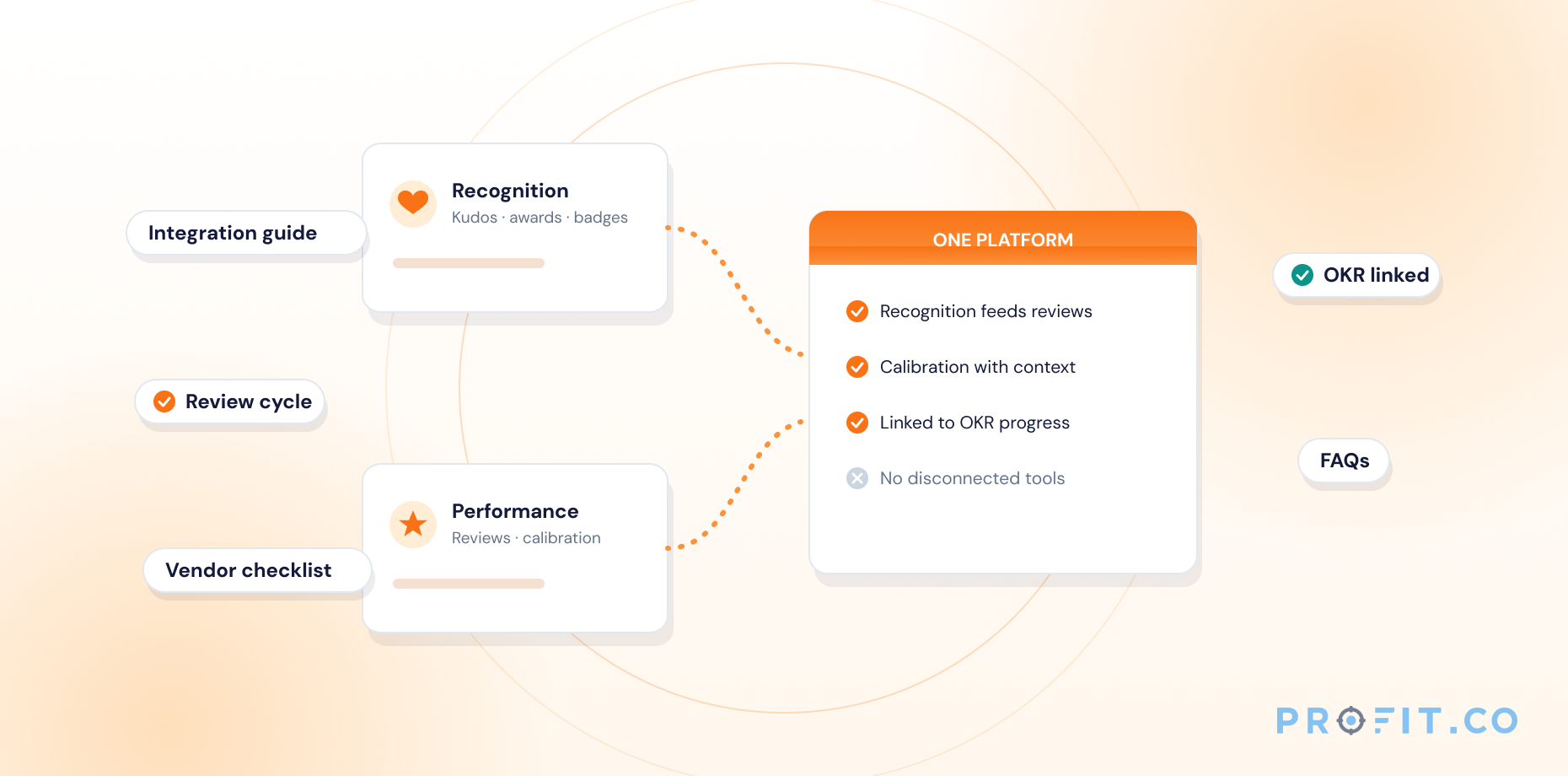
Organisations that run this conversation inside a continuous performance management system – tracking development goals week over week rather than letting them sit until the annual review – close improvement gaps within a single quarter. Profit.co’s performance management platform connects development goals to OKR progress, so managers can see whether a direct report’s improvement areas are translating into better outcomes – not just better intentions.
From Development Conversations to Tracked Progress
How Do You Write Areas of Improvement in a Performance Review?
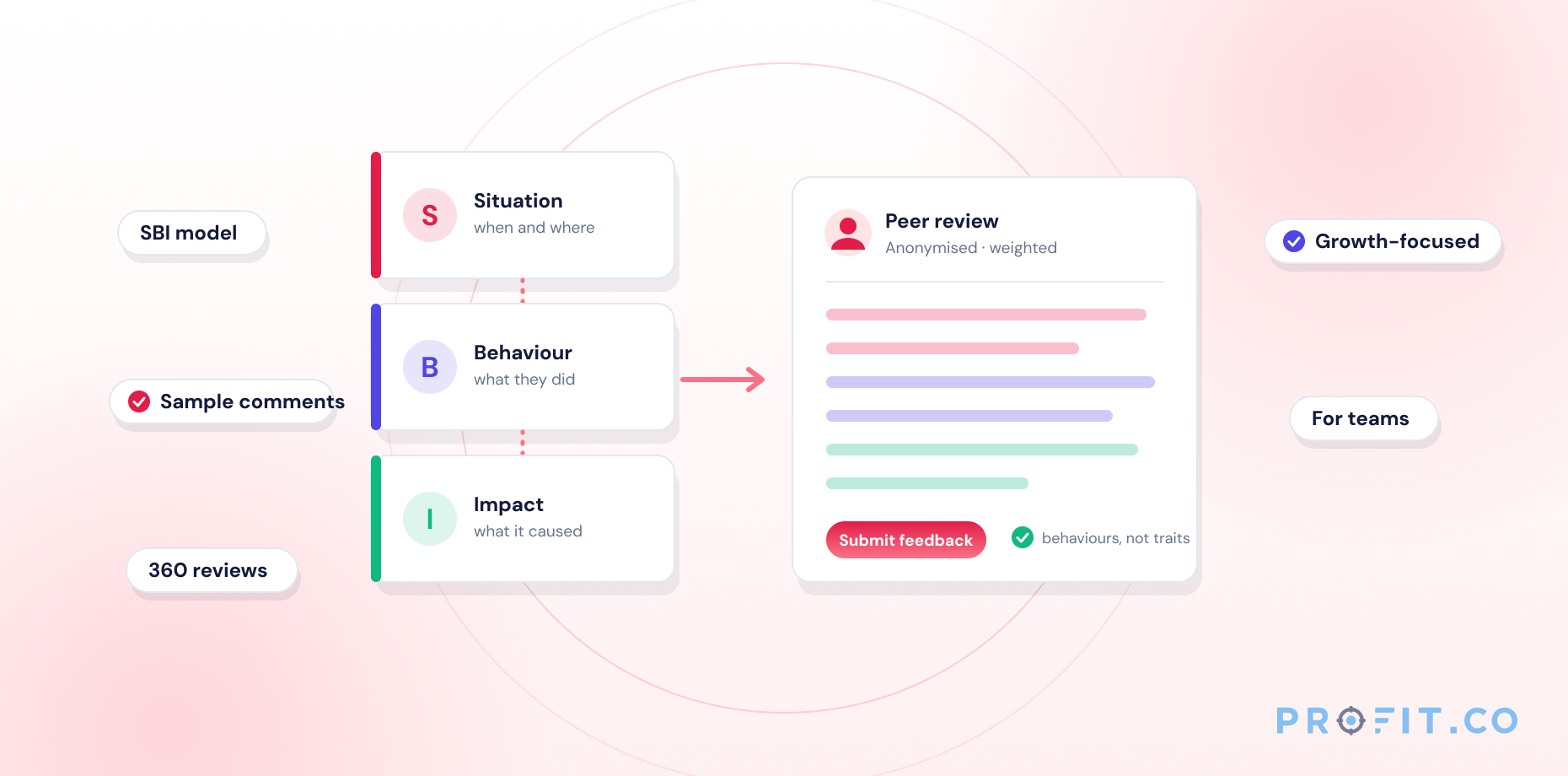
Performance review software makes this easier – but the language itself must follow three rules: it is specific, it is forward-looking, and it names a success condition.
Name the specific behaviour, not the category
Wrong: “Alex needs to improve communication.”
Right: “Alex’s written project updates often arrive after the deadline has passed and omit the ‘blockers’ section that enables leadership to act. The development goal for Q3 is to deliver structured written updates by Thursday 4pm each week, consistently including current status, risks, and required decisions.”
Frame it as a development goal, not a criticism
Wrong: “Jordan lacks strategic thinking.”
Right: “Jordan’s project recommendations would benefit from a stronger connection to the business metrics they are designed to move. In Q3, Jordan will present every new project proposal with an explicit link to one company-level OKR and a projected impact on one measurable KPI.”
Set a measurable end condition
Wrong: “Emma should work on taking more ownership.”
Right: “By the end of Q3, Emma will have owned two initiatives from brief to delivery without requiring manager escalation. The success condition: both projects delivered on time, within scope, each with a post-completion retrospective document.”
How Do You Turn Areas of Improvement Into Tracked Goals?
A development area that a review names has a short half-life if it never moves from the review document into a tracked goal. The most common outcome is that both manager and employee return to their day jobs, and the same development area resurfaces six months later with no progress to show.
The fix is to convert the area of improvement into a SMART goal or individual OKR within one week of the review conversation, assign it an owner (the employee), a check-in cadence (monthly, minimum), and a visible home in the performance management or OKR management platform.
Profit.co’s performance management platform connects individual development goals to OKR tracking – so an area of improvement that a January review names becomes a weekly-visible goal by February, with automated check-in reminders. The Goals Progress Agent tracks individual goal progress in real time, surfacing development gaps before the quarter ends rather than at the next annual review.
Make Development Conversations Drive Real Change
Frequently Asked Questions
The most frequently cited areas of improvement at work include proactive communication, prioritisation, receiving feedback constructively, cross-functional collaboration, written clarity, ownership of errors, and data-driven decision making. The most useful areas of improvement are role-specific and include a measurable development target, not just a label.
Name one or two specific, role-relevant behaviours rather than broad categories. Follow the structure: “I want to improve [specific behaviour] – currently [current state], and by [date] I aim to [specific target]. I plan to do this by [specific action].” Avoid naming areas of improvement that are core requirements of the role or that sound like major weaknesses without a development plan.
Strong areas of improvement for managers include delegation clarity (transferring ownership of tasks with a brief and check-in cadence), giving timely feedback (within 48 hours of a performance event), improving one-on-one quality from status updates to coaching conversations, building psychological safety in team retrospectives, connecting the team’s work to company strategy in planning conversations, and managing cross-functional stakeholder relationships proactively.
A weakness is a performance gap. An area of improvement is a performance gap with a structured development plan attached. Every area of improvement should name: the specific behaviour to develop, the current baseline, the target state, the deadline, and the method of tracking. A weakness without these elements stays a weakness.
Convert each area of improvement into a SMART individual goal within one week of the review conversation. Assign it a monthly check-in cadence and log it in the performance management system – not in the review document. See OKR examples for HR teams for goal structures that fit development areas directly, or use Profit.co’s Goals Progress Agent to surface real-time progress without manual check-in chasing.