Performance review phrases are structured sentences managers use to give specific, behavior-focused feedback during appraisals – covering achievements, communication, teamwork, leadership, and growth areas. Use these 100+ examples as a starting point; personalize each one with a specific example from the employee’s actual work.
In this guide
- What Are Performance Review Phrases and How Should You Use Them?
- Using Generic Performance Review Comments: An Example
- What Are Performance Review Phrases for Job Knowledge?
- What Are Performance Review Phrases for Adaptability?
- What Are Phrases for Accuracy and Attention to Detail?
- Employee Performance Review Phrases for Specific Areas of Performance
- Setting Your Performance Review Up for Success
- What Performance Review Phrases and Comments Should You Avoid?
- When and How Should You Deliver Performance Feedback?
- What Performance Review Phrases Signal Bias – and What Should You Use Instead?
- Top Performance Review Phrases for Managers
- How Do Performance Review Phrases Fit Into a Wider Feedback System?
- Frequently Asked Questions
100 Performance Review Phrases and Comments for 2026 – Download PDF Here
As a manager, it’s important never to be lost for words during a performance review. Reviews can be a daunting task for everyone involved. Employees might feel like their behaviour and personality are being put on trial. Meanwhile, managers might struggle to give performance feedback that addresses the areas in need of improvement while also balancing coming across as constructive and positive.
Overall, common performance review phrases might seem like a cookie-cutter approach to performance conversations. However, knowing what to say and how best to phrase your feedback can make a significant difference in how your employees react in the moment and in their future performance.
What Are Performance Review Phrases and How Should You Use Them?
In order to conduct an impactful performance review, managers need to strive to make feedback individualized. Therefore, it might seem counterintuitive to use the performance review comments examples during this process.
That’s why it’s important to understand that these phrases and comments are a great source of inspiration, but they shouldn’t replace comments that are specific to an employee. A generic performance review conversation peppered with appraisal phrases can leave your employees feeling like you don’t care enough to put in the time and effort into their development, which can be just as harmful to their performance as saying the wrong thing or being too negative in your review.
With that being said, there is a time and a place for generic feedback comments, particularly if you’re working with processes that can be measured numerically or with a simple yes or no. The important part here is to ensure that even in these cases, you can quantify these phrases with individualized comments if you need to.
Using Generic Performance Review Comments: An Example
So, as an example, when you’re talking about attendance, a generic performance review comment might be: “Jane has used more than her allotted sick days in this review period.”
While this is a simple yes/no question, it doesn’t say much about the reason for Jane’s absence. After all, every manager knows there’s a stark difference between an employee that has to go to the hospital regularly and no-call-no-shows.
That’s why, during feedback, you should make a note underneath this comment documenting the reasons why Jane needed those sick days, and whether it’s something that needs to be addressed in this performance review period.
What Are Performance Review Phrases for Job Knowledge?
Job knowledge measures whether an employee understands the technical, procedural, and industry-specific requirements of their role – not just whether they finish tasks on time. A gap here often hides behind otherwise solid productivity numbers, which is why it needs its own line in the review rather than a mention buried inside “technical skills.”
| # | Positive Phrase | Constructive Phrase |
|---|---|---|
| 1 | Demonstrates a strong command of [tool/process] and applies it correctly without oversight | Requires repeated guidance on [process], suggesting the underlying concept isn’t fully understood |
| 2 | Understands how [role-specific system] connects to the wider workflow, not just their own step in it | Treats [process] as a checklist rather than understanding why each step exists |
| 3 | Keeps up with changes in [industry/regulation] and adjusts their work accordingly | Continues using outdated methods for [task] after the process changed |
| 4 | Can explain the reasoning behind [decision/process] to newer team members | Struggles to explain why they completed [task] a certain way when asked |
| 5 | Applies specialized knowledge of [domain] to catch issues before they become problems | Missed [specific error] that a stronger grasp of [domain] would have flagged early |
What Are Performance Review Phrases for Adaptability?
Adaptability shows up in how an employee responds when priorities shift, not in how they perform when everything goes to plan. Reviews that skip this category tend to reward employees who look calm because nothing has tested them yet.
| # | Positive Phrase | Constructive Phrase |
|---|---|---|
| 1 | Adjusted quickly when [project] priorities changed mid-quarter, with no drop in output | Becomes visibly frustrated when plans change, which slows the team down during transitions |
| 2 | Took on [unfamiliar responsibility] without being asked, when the team was short-staffed | Resists taking on tasks outside their original job description, even temporarily |
| 3 | Adapted their approach to [process] after feedback, rather than defending the original method | Continues using the same approach to [task] despite feedback that it isn’t working |
| 4 | Handled the transition to [new tool/system] smoothly and helped others do the same | Struggled to adjust to [new tool/system], falling behind while teammates adapted |
| 5 | Stayed productive through [organizational change], keeping the team steady | Needs significant reassurance and repeated direction whenever circumstances change |
What Are Phrases for Accuracy and Attention to Detail?
| # | Positive Phrase | Constructive Phrase |
|---|---|---|
| 1 | Consistently catches errors in [document/process] before it reaches [stakeholder] | Small errors in [deliverable] have reached clients/leadership more than once this period |
| 2 | Double-checks [type of work] against [requirement/spec] before submitting | Submits work without verifying it against [requirement], leading to avoidable rework |
| 3 | Maintains accuracy even when working under tight deadlines on [task] | Accuracy drops noticeably when deadlines tighten on [task] |
| 4 | Flagged an inconsistency in [data/report] that others had missed | Has repeated the same type of data-entry error in [task] across multiple cycles |
| 5 | Follows [checklist/process] precisely, reducing the need for a second reviewer | Skips steps in [checklist/process], requiring a second reviewer as a safety net |
Deliver Structured, Bias-Free Performance Reviews
Employee Performance Review Phrases for Specific Areas of Performance
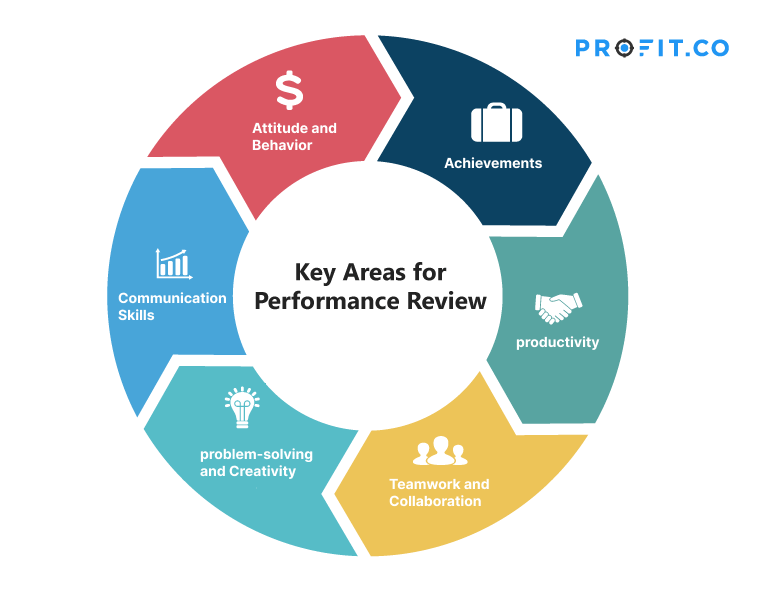
To make things easier for you, this article has grouped phrases and comments based on the specific areas they are relevant to. While every good performance management review should have a standard format that follows key areas, every employee performance review conversation should cover the following key areas:
- Achievements
- Productivity
- Teamwork and Collaboration
- Problem-solving and Creativity
- Communication Skills
- Attitude and Behavior
Achievements
Recognizing an employee’s achievements is a proven way to help reduce employee turnover, particularly within the first six months of employment. Not only that, but 69% of employees say they’d work harder if they felt that they were more appreciated at work, meaning recognizing your employees’ achievements can help your team become more profitable and productive. Furthermore, this practice of acknowledgment has been shown to build morale and create a sense of belonging among team members, creating a more cohesive and motivated group.
| # | Positive Phrase | Constructive Phrase |
|---|---|---|
| 1 | Saved the company $x through [specific task] | Missed quota by x% |
| 2 | Spearheaded [project] which resulted in [result] | Missed previously set target of [target] because of [reason] |
| 3 | Used own initiative and suggested [project] which aims to [goal] | Needs further training in [process] because of [reason] |
| 4 | Improved process x by y% | Did not complete [task] because of [reason] |
| 5 | Exceeded monthly quota by x% | Reduced quality of work output because of [reason] |
Productivity
According to Gallup, 85% of employees are either not engaged or actively disengaged at work, which results in an estimated $7 trillion loss of productivity each year. However, recognizing an employee’s work through regular performance reviews or feedback can lead to employees being 4.6 times more likely to perform at their peak.
| # | Positive Phrase | Constructive Phrase |
|---|---|---|
| 1 | Consistently turns work in ahead of schedule | Did not hand in [task] on time due to [reason] |
| 2 | Has contributed to the success of the department by [example] | Has made little progress with [goal] since the last performance review |
| 3 | Demonstrated strong time management skills by always delivering on time [example] | Will often sacrifice handing in work by deadline to help coworkers |
| 4 | Significantly improved on [goal] since the last performance review | Has shown reluctance to work towards [goal]/[task] |
| 5 | Demonstrated excellent task flexibility by [example] | Continuously asks for longer deadlines |
Teamwork and Collaboration
75% of employers rate teamwork as being extremely important in the workplace, particularly as research shows that strong workplace communities have the power to reduce employee turnover and improve internal communication. Personalized feedback on team members’ skills helps employees understand their unique role in the team’s success, strengthening team dynamics and overall workplace harmony.
| # | Positive Phrase | Constructive Phrase |
|---|---|---|
| 1 | Displayed a strong drive to collaborate during [task] | Other team members have felt alienated during [project] because of [behavior] |
| 2 | Encourages every member of the team to share their ideas in meetings | Has a tendency to avoid delegating tasks during projects |
| 3 | Is willing to share their expertise with colleagues to improve their performance | Is quiet and reluctant to share ideas and knowledge during team meetings |
| 4 | Demonstrated the ability to delegate tasks fairly during [project] | Is often reluctant to provide constructive feedback to other colleagues, even when asked |
| 5 | Shared ideas on how to improve the inclusiveness of our workplace culture | Has shown an inability to take on constructive criticism by [behavior] |
Problem-Solving and Creativity
Research indicates creativity is the top marker for future success; however, only 35% of employees say they can be creative multiple times throughout the year. Since 75% of employees think their creative potential is wasted at work, your performance reviews need to highlight your employees’ creative skills and celebrate where their creativity has helped solve business problems. Acknowledging the creative efforts of team members in performance reviews can inspire a culture of creativity and collaboration, building a more dynamic and forward-thinking workplace.
| # | Positive Phrase | Constructive Phrase |
|---|---|---|
| 1 | Our clients value [employee]’s creative approach to problem-solving | Is generally quiet in team meetings and rarely suggests new ideas |
| 2 | Suggested [project] at a team meeting, which has achieved [goal] | Appears hesitant to make creative decisions during projects |
| 3 | Seeks creative solutions like [example], which resulted in [result] | Does not take creative risks with their work |
| 4 | Regularly suggests new projects and ideas in team meetings | Demonstrated a hesitancy to engage creatively with [project] |
| 5 | Shows curiosity over processes elsewhere in the business and suggests new initiatives like [example] | Is often too “by-the-book” when dealing with customers, leading to [result] |
Communication Skills
In a study by Fierce Inc., a lack of communication and miscommunication was attributed to increased levels of stress, project failure, poor company morale, lost sales, and missed performance goals. Regular feedback on communication skills during performance appraisals can significantly improve how team members interact, collaborate, and resolve conflicts.
| # | Positive Phrase | Constructive Phrase |
|---|---|---|
| 1 | Clearly communicates their thoughts in team meetings | Can become defensive when given constructive criticism or difficult feedback |
| 2 | Demonstrates the ability to concisely communicate complex and difficult issues | Uses unprofessional language or discusses unprofessional topics with colleagues |
| 3 | Demonstrated active and focused listening and debating skills during [project] | Written communication from [employee] is often unclear |
| 4 | Delivers constructive feedback without alienating others | Rarely asks questions from colleagues and managers, leading to [result] |
| 5 | Has great written communication skills, as evidenced by [example] | Is uncomfortable in one-on-one meeting situations |
Attitude and Behavior
A negative employee is more likely to be disengaged at work and is at a higher risk of quitting than someone with a more positive attitude. However, given that employees with bad attitudes can also drag the morale of the team down, you need to give employees feedback about how their attitude and behavior is affecting their work, colleagues, and even career development in your organization.
| # | Positive Phrase | Constructive Phrase |
|---|---|---|
| 1 | Demonstrates the ability to motivate and inspire their colleagues by [example] | Has strained relationships with other employees through [specific behavior] |
| 2 | Is always happy to help their colleagues, even when things are tough for them | Does not get involved with the company culture |
| 3 | Supported [employee] with [task]/through [project] and willingly shared their expertise | Has been caught gossiping about other employees, which has resulted in [result] |
| 4 | Is extremely honest and trustworthy, as demonstrated when [example] | Regularly ignores the company’s dress code |
| 5 | Clients like to work with [employee] because they always strive to do the right thing | Regularly refuses to take on more challenging tasks |
Leadership
While the phrase “employees don’t quit their jobs, they quit their managers” is nearly a cliche, it’s also true – 79% of employees report leaving their job because of a lack of appreciation. Not every employee will be reviewed on their leadership skills, however if you’re looking to promote someone to a supervisory or management position, these skills should be discussed during performance reviews.
| # | Positive Phrase | Constructive Phrase |
|---|---|---|
| 1 | Sets a positive example for other employees by [example] | Struggles to work with differing personalities, as evidenced when [example] |
| 2 | While spearheading [project], took responsibility for the team’s mistakes | Does not show appreciation for other team members’ work during feedback sessions |
| 3 | Is well-respected by their colleagues for [example] | Tends to avoid responsibility for the actions of others, as evidenced by [example] |
| 4 | Regularly gives colleagues constructive feedback and shows appreciation for their work | Doesn’t provide the support team members need to succeed |
| 5 | Demonstrated the ability to remain calm under pressure when [example] | Demonstrates a tendency to micromanage when in charge of projects, such as when [example] |
Improvement and Goal-Setting
According to a psychological study from 1990, goal-setting has the potential to motivate employees towards a higher level of performance, as well as increase overall levels of effort at work. Encouraging team members to actively participate in goal-setting during performance appraisals can create a sense of ownership and commitment towards team objectives.
| # | Positive Phrase | Constructive Phrase |
|---|---|---|
| 1 | Demonstrates a consistent drive to achieve the goals set during performance review meetings | Refuses to engage with training events, even when relevant to their role |
| 2 | Has a positive attitude towards improving performance and is motivated to succeed | Missed the deadline for [goal] because [reason] |
| 3 | Keeps themselves accountable to their goals by [behavior] | Sets goals that do not challenge their current level of performance |
| 4 | Has fulfilled every goal that has been set in performance review meetings | Demonstrates an inability to push past their comfort zone, such as when [example] |
| 5 | Regularly seeks development opportunities throughout the company | Pursues personal goals on company time and at the expense of professional goals |
Organizational Skills
It’s estimated that office workers lose an average of 40% of their workday due to disorganization, which is why performance management reviews should address organizational skills if managers want to improve an employee’s productivity. While some organizational strategies will have to come from a managerial level, such as organizational apps or better internal processes, employees should also be encouraged to improve their own organizational skills.
| # | Positive Phrase | Constructive Phrase |
|---|---|---|
| 1 | Effectively prioritizes their workload by [example] | Struggles to handle their current workload |
| 2 | Always meets production benchmarks and deadlines | Is inflexible and becomes panicked when work deadlines are changed |
| 3 | Always maintains an organized work environment | Regularly misses production benchmarks and deadlines due to a lack of planning |
| 4 | Helps other team members use organizational software to stay on top of tasks | Can be easily distracted from the task at hand, as evidenced by [example] |
| 5 | Is flexible with their task plans to accommodate shifting priorities | Regularly postpones difficult tasks in favor of easier ones |
Technical Skills
Many organizations rely on their employees having a physical competency with certain types of machinery or software. Employees legally have to be trained and/or qualified to operate certain forms of machinery, and some optional qualifications and training provided for software and other practices can improve performance.
| # | Positive Phrase | Constructive Phrase |
|---|---|---|
| 1 | Regularly seeks out training opportunities when they arise | Refuses to attend technical seminars in their field |
| 2 | Sought to organize their mandatory training with their manager ahead of its expiry | Struggles to apply themselves to mandatory training |
| 3 | Pursues additional qualifications to improve performance | Failed [qualification] and must wait to be retested |
| 4 | Achieved [qualification], which is outside of their responsibilities | Does not stay up to date with the latest technological advancements in their field |
| 5 | Pursued [qualification] so they could [result] | Struggles to learn new forms of technology, such as [example] |
PERFORMANCE REVIEWS + GOAL DATA
Performance review phrases are not a writing problem – they are a data problem
Reviews default to vague labels like “great team player” or “needs to improve communication” not because managers lack vocabulary, but because a manager writing from memory at the end of a quarter reaches for the most recent impression instead of the full quarter’s evidence.
The phrases in this guide work best inside a review process where goal progress is already visible before the manager writes a word – which is what Profit.co’s performance review module does: it pulls OKR completion data, check-in frequency, and peer feedback directly into the review form, so the manager’s job is to interpret the evidence in front of them, not reconstruct it from memory.
Setting Your Performance Review Up for Success
With all of this in mind, it is important to note that knowing the best performance conversation phrases and comments aren’t automatically going to have the intended effect on your employees. However, noted social psychologist Robert Cialdini coined the phrase “Pre-suasion” to describe a phenomenon where you can set your employee up for the tone of their performance review by using certain words, phrases, and expressions that associate with how you want them to conceptualize the rest of the meeting.
For example, if you’re conducting a performance review where you want to emphasize your employee’s performance in a certain area of work, then you would start the meeting by using phrases like “successful”, “admirable”, “impressive”, or “achievement”.
This can be particularly useful in a situation where an employee has performed well in certain areas, but you need to discuss where they can improve in others. The “no sandwich” technique – in which you present a negative surrounded by two positives – can work brilliantly with this method, as it will help you to highlight their strengths and make them feel more confident that they can improve on their weaknesses.
What Performance Review Phrases and Comments Should You Avoid?
When you’re using these phrases and performance review examples, you can’t assume that they will be 100% effective simply because they’re recommended during feedback. Understanding what comments you need to avoid is equally important for an effective performance review.
Cliche Phrases
Just as you don’t want to see candidates including “good team player” and “a clear communicator” on their resume, using cliche phrases during your performance review tells your employee that you don’t care enough about their development to spend more than a few minutes preparing. You should avoid using cliche phrases wherever possible because they don’t say anything about an employee’s performance. If you don’t know why David is a good team player, then you can’t expect David to know either. That’s why cliche phrases should be avoided in favor of more specific comments like “David is a great influence on his team and helps to keep everyone motivated.”
Passive Voice
When you use the active voice during feedback, you’re centering the person. With the passive voice, you’re making the sentence about the action – not the person who performed it.
Active Voice: “Lea saved the company $200,000 by identifying inefficiencies in the payroll system”
Passive Voice: “$200,000 was saved by Lea identifying inefficiencies in the payroll system”
By ensuring that you use the active voice during feedback, you’re conveying that you recognize the importance of your employee to a specific action, and you’re giving them direct credit for it.
Comparisons
No-one likes being compared to someone else. While you might think that comparing your employee to a model team member might be helpful, the results can harm productivity, morale, confidence, and mental health. Comparing employees to their colleagues also breeds unhealthy competition in the workplace. You must focus only on the employee whose performance you’re reviewing, and not mention the performance of their colleagues.
Avoid Absolutes (“Always” / “Never”)
Absolute language turns a specific incident into a permanent character trait, and it’s almost never literally true – the employee can usually think of one counterexample, which is all it takes to make them stop listening to the rest of the feedback.
Before: “You’re always late to meetings.”
After: “You were late to four of the last six team meetings – what’s getting in the way?”
Avoid Personality-Based Language
Describing who someone is (“difficult,” “abrasive,” “a pessimist”) gives the employee nothing to act on. Describing what they did gives them something to change.
Before: “You have a negative attitude.”
After: “In the last two planning meetings, you raised concerns about the roadmap without offering an alternative – next time, pair the concern with a suggestion.”
Don’t Use the Feedback Sandwich
Burying constructive feedback between two compliments teaches employees to brace for bad news the moment you say something nice. It also means the manager often softens the actual issue into vagueness just to fit the “sandwich” structure.
Before: “Great job this quarter! One thing to work on is your reporting accuracy. But overall, you’re doing great!”
After: “Your reporting accuracy dropped this quarter – here’s specifically where, and here’s what I’d like to see next quarter. Separately, your client communication has been strong all year.”
Avoid Raising Issues Older Than Six Months
Bringing up something from two quarters ago – that nobody flagged at the time – tells the employee the manager was either not paying attention or saving feedback up. If it mattered, it should have been raised close to when it happened.
Avoid Coded or Biased Terms
Certain phrases correlate strongly with biased reviews, particularly against women, people of color, and older or younger employees. See the full table in the What Performance Review Phrases Signal Bias? section below.
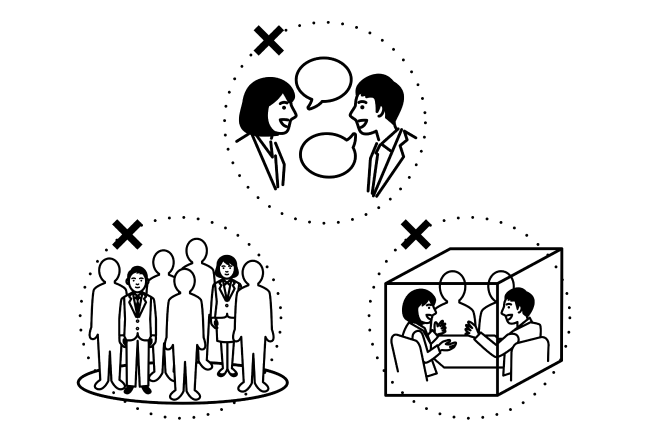
PHRASES AND COMMENTS TO AVOID – SUMMARY
- Steer Clear of Cliches
- Don’t Use Passive Voice
- Avoid Comparisons
- Avoid Absolutes
- Avoid Personality-Based Language
- Don’t Use the Feedback Sandwich
- Avoid Coded or Biased Terms
When and How Should You Deliver Performance Feedback?
Knowing what to say matters less if you get the timing wrong. Two rules cover most of the damage:
Don’t deliver serious feedback over email, and don’t save it up
Anything that affects someone’s standing, pay, or role should happen face-to-face – over video if you’re remote – and close to when it happened, not months later in one batch. Written feedback strips out tone; batched feedback turns a conversation into an ambush. Address issues incrementally rather than warehousing them for the annual review.
Don’t give feedback while you’re frustrated
If an incident just happened and you’re still reacting to it, wait 24 hours. Feedback delivered in the heat of the moment tends to focus on how the manager feels rather than what the employee should change.
What Performance Review Phrases Signal Bias – and What Should You Use Instead?
Certain phrases correlate strongly with biased performance reviews, particularly against women, people of color, and older or younger employees. None of them describe a specific, observable behavior – which is exactly why they’re worth removing.
| Biased / Coded Phrase | Why It’s Problematic | Better Alternative |
|---|---|---|
| “Too emotional” | Vague, frequently applied disproportionately to women, and describes a reaction rather than the behavior itself | “In the meeting on [date], you raised your voice when [specific situation] – let’s talk about what triggered that” |
| “Aggressive” | Often used to describe assertiveness in some employees and confidence in others, depending on gender or background | “You interrupted [colleague] three times in [meeting] – let’s talk about turn-taking in group discussions” |
| “Lacks initiative” | Doesn’t specify what action was expected or by when | “You didn’t flag the [budget/timeline] issue in [project] until it had already caused delays” |
| “Not a culture fit” | Unfalsifiable and frequently a proxy for “different from the existing team” | Name the specific behavior: “You’ve skipped the last three team stand-ups without notice” |
| “Always late” | An absolute that’s rarely literally true and invites defensiveness rather than a fix | “You were late to [X] of the last [Y] deadlines – let’s figure out what’s causing that” |
| “Hard to work with” | Describes the reviewer’s discomfort, not the employee’s behavior | “Two teammates mentioned they felt talked over in [project] planning – can we look at that together?” |
| “Very outspoken” | Frequently applied to women and junior employees for behavior praised as “confident” in others | Describe the specific instance and its actual effect: “In [meeting], your pushback on [X] delayed the decision by a week” |
| “Abrasive” | Vague personality label with well-documented gender bias in performance-review research | “Your feedback to [colleague] on [date] came across as dismissive – here’s what I’d suggest instead” |
Every one of these phrases describes how the reviewer felt. None of them describe what the employee actually did.
Top Performance Review Phrases for Managers
Now that you know what the best practices are for performance reviews and key things to avoid, the following examples will help you to better understand how to conduct an effective performance conversation during an employee evaluation. If you want to grab the following examples and save them for later use, you can download our effective phrases for performance appraisals PDF here.
The Future of Performance Reviews
Sustainability and Social Responsibility
As businesses continue to address global environmental and social challenges, integrating Sustainability and Social Responsibility into performance reviews becomes essential. Organizations prioritizing these areas must evaluate how employees contribute to sustainability goals through eco-friendly initiatives, reducing waste, or community involvement.
Key questions for evaluating employee contributions to sustainability include:
- How have you contributed to the organization’s sustainability goals this year?
- Can you explain how you’ve reduced waste or promoted resource conservation?
- What steps have you taken to engage with the community or participate in CSR programs?
- How do you incorporate sustainability considerations into decision-making within your role?
- What ideas do you have for improving our sustainability efforts?
Diversity, Equity, and Inclusion (DEI)
Incorporating diversity, equity, and inclusion (DEI) into performance reviews is crucial for building a respectful and inclusive environment. DEI in performance reviews allows managers to evaluate individual performance and how employees contribute to a culture of inclusion, equality, and respect for all.
Key questions to evaluate DEI contributions include:
- How have you contributed to creating an inclusive workplace for your team?
- Can you share an example of how you’ve worked to challenge biases or support underrepresented groups?
- How have you helped others feel included and valued within your team?
- What steps have you taken to promote equality of opportunity for all employees?
- How do you actively learn about and contribute to DEI initiatives in the organization?
Performance Review Phrases for High Achievers
High performers might, at first, seem like the easiest performance management review you’ll conduct. However, there’s a fine line between praising their work and reinforcing negative behaviors like arrogance, competitiveness, or burnout. It can also be difficult to know what to say when a high-achieving employee doesn’t seem to have any weaknesses.
Positive Phrases
- Understands how costs impact project decisions and seeks to save the company money
- Finds the root cause of an issue and seeks to solve it
- Is well-respected by their colleagues for their passion and dedication
- Willingly shares their knowledge with less experienced team members, and helps them navigate the organization
- Happy to help less experienced team members when they’re struggling
Constructive Phrases
- Shortcuts some processes and standard operating procedures to save time
- Sometimes prioritizes completing tasks over quality control
- Has a “know-it-all” attitude which has caused strained relationships
- Becomes visibly upset or standoffish if their ideas are not used in projects
- Holds too many meetings without purpose or direction
Performance Reviews with Profit.co
Profit.co’s performance management software allows HR administrators and managers to conduct customizable, detailed, and efficient performance reviews.
Standard reviews – also called conversation and feedback reviews – allow HR administrators to customize a collection of open-ended questions answered by both managers and reviewed employees. This not only gives employees ample opportunity to voice their opinion on their performance and perspective, but also allows managers to review their answers and dedicate time and attention towards crafting feedback responses. This written component usually precedes a one-on-one meeting – when managers have the opportunity to read employee thoughts early, they can prepare their comments in advance and have a more productive conversation with the employee.
KEY TAKEAWAYS
- Precise, behavior-focused phrasing improves engagement and reduces confusion – vague labels do the opposite.
- Avoid absolutes (“always,” “never”), cliches, and personality-based language; describe the specific action instead.
- Pair every constructive phrase with a concrete example and a clear next step, not just a label.
- Use these phrases as a starting point – always personalize with the employee’s actual work.
How Do Performance Review Phrases Fit Into a Wider Feedback System?
A well-phrased comment doesn’t fix a broken review cycle on its own. It works best inside a system where feedback is continuous, tied to actual goals, and followed up on – not delivered once a year and forgotten.
If you’re building that system out, two resources go one level deeper than phrasing: for full, ready-to-use comments rather than fill-in-the-blank templates, see the 50 employee evaluation comments guide. For connecting review scores to actual goal progress automatically, see Profit.co’s performance review module.
The annual review guide, self-review examples, and SMART goals framework are worth a look too – search “performance review” or “SMART goals” on the Profit.co blog when you’re ready to go deeper on those.
Track the Goals Behind Every Review Phrase
Frequently Asked Questions
Performance review phrases are crucial for providing constructive feedback to employees during performance evaluations. They help managers communicate areas of strength, areas needing improvement, and set goals for future development. Effective feedback increases motivation and enhances overall performance – but only when phrases are specific, behavior-focused, and tied to actual examples from the employee’s work.
Managers can ensure that performance feedback is impactful and individualized by tailoring comments to each employee’s specific strengths, weaknesses, and goals. This involves avoiding generic phrases and cliches, understanding the employee’s unique contributions and challenges, and providing actionable feedback that promotes growth and development. Use the phrases in this guide as a starting point – always personalize with a specific example from the employee’s actual work.
Common mistakes to avoid during performance reviews include using cliche phrases, making unfair comparisons between employees, using passive voice, using absolutes like “always” or “never,” relying on personality-based language (“difficult,” “abrasive”), using the feedback sandwich structure, and raising issues from more than six months ago. Additionally, managers should avoid coded or biased terms that describe how the reviewer felt rather than what the employee actually did.
Positive reinforcement during performance reviews can be effectively used to motivate employees, build morale, and reinforce desired behaviors. Recognizing specific, observable contributions – not just general praise – is what makes recognition stick. Phrases like “you saved the company $x through [specific task]” or “you covered two colleagues’ escalations during peak season and first-response time held under four hours” are far more effective than “great job.”
This guide covers 100+ phrases across ten competency areas: job knowledge, adaptability, accuracy, achievements, productivity, teamwork, problem-solving, communication, attitude, leadership, improvement, organizational skills, and technical skills. Each area includes both positive phrases and constructive phrases. For full, ready-to-use comments rather than fill-in-the-blank templates, see the 50 employee evaluation comments guide on the Profit.co blog.
100 Performance Review Phrases and Comments – Download PDF Here