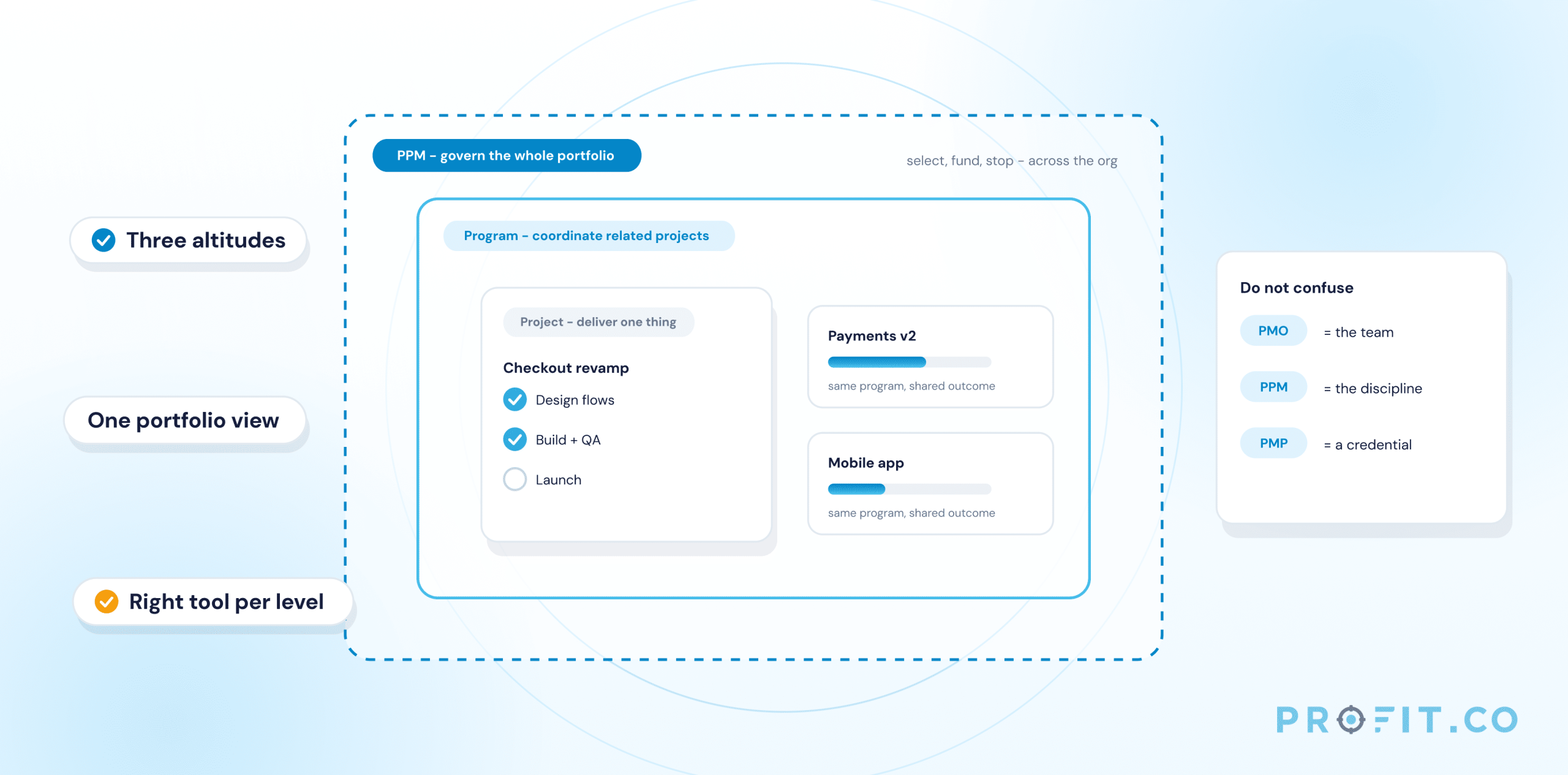
Strategic Portfolio Management (SPM) and Project Portfolio Management (PPM) govern different organizational layers. PPM controls how projects are executed: scope, schedule, and resources. SPM controls which initiatives deserve investment. At scale, organizations need both, connected by a shared execution framework that translates strategic intent into measurable delivery.
In this guide
- What Is the Difference Between SPM and PPM?
- Why Most Organizations Think They Have SPM but Actually Don’t
- How Does Stage-Gate Governance Interact with Agile Delivery?
- How Do OKRs Bridge SPM Strategy and PPM Execution?
- Which Framework Does Your Organization Actually Need Right Now?
- Frequently asked questions
What Is the Difference Between SPM and PPM?
The sharpest separation: PPM asks “are we building projects right?” SPM asks “are we building the right projects?” Both questions matter, but organizations routinely treat them as the same question, and the cost of that confusion is a portfolio full of well-executed projects that were the wrong bets from the start.
Project Portfolio Management (PPM) is the operational discipline of managing a collection of projects as a coordinated whole. A PMO running project portfolio management tracks delivery status, resource utilization, budget burn, milestone completions, and risk signals across every active project. The governance model is typically stage-gate: projects advance through defined phases with approval checkpoints at each boundary. PPM is execution-layer governance.
Strategic Portfolio Management (SPM) operates one layer above. It governs which projects and programs deserve investment in the first place, and whether the active portfolio mix actually aligns with the company’s strategic priorities. Strategic portfolio management is a C-suite and strategy function: it answers the composition question, not the execution question. Portfolio investment reviews, strategic scoring, and initiative prioritization are SPM activities. Milestone tracking and resource scheduling are PPM activities.
The table below separates PPM and SPM across six dimensions: primary question, time horizon, governance model, key output, primary stakeholders, and success metric.
| Dimension | PPM: Project Portfolio Management | SPM: Strategic Portfolio Management |
|---|---|---|
| Primary Question | Are we executing projects correctly? | Are we investing in the right projects? |
| Time Horizon | Project lifecycle: weeks to months | Annual to multi-year strategic cycles |
| Governance Model | Stage-gate phases, milestone reviews | Portfolio investment reviews, strategic scoring |
| Key Output | Delivery confidence, on-time / on-budget rate | Strategic alignment score, portfolio ROI |
| Primary Stakeholders | PMO leads, project managers, department heads | C-suite, strategy directors, board |
| Success Metric | On-time, on-scope, on-budget delivery rate | OKR attainment rate, strategic outcome realization |
The distinction is not just structural. It is an accountability issue. PPM is owned by the PMO. SPM requires the strategy function to own portfolio composition decisions. Organizations that blur this accountability produce a PMO trying to make strategic investment calls it was never resourced or positioned to make.
Why Most Organizations Think They Have SPM but Actually Don’t
The common belief: a mature PMO with a prioritization matrix, a resource capacity model, and a portfolio dashboard has strategic alignment covered. Project scoring models, health dashboards, quarterly portfolio reviews. Surely that constitutes SPM?
It doesn’t. What most PMOs call strategic alignment is retroactive justification. Projects get selected based on which department lobbied hardest in the annual planning cycle, which commitments carry over from last year, and which resources happen to be available. The portfolio is built bottom-up from requests, then mapped to strategic pillars after the fact. That is PPM with a strategy narrative attached to it, not SPM.
True SPM begins with measurable strategic outcomes, the goals the organization must achieve this year and over the next three, and works backward to ask: which projects, if delivered, would move those outcomes? Any project that cannot trace a direct line to a strategic goal is a candidate for deferral or cancellation, regardless of how operationally sound its execution plan is.
“Executing the wrong projects efficiently is not a delivery win. It is a capital loss that arrived on time. Speed without strategic direction is faster misallocation.”
How Does Stage-Gate Governance Interact with Agile Delivery?
This is where the SPM vs PPM question becomes structurally critical, and where most hybrid organizations break down without recognizing it.
Stage-gate project management was designed for predictable, sequential work: define the scope, fund the phases, approve at each gate before proceeding. It works when requirements are stable and the cost of mid-course change is high: infrastructure rollouts, regulated product launches, capital construction programs.
Agile delivery was designed for the opposite condition: iterative, adaptive work where the goal is learning fast and adjusting direction based on evidence. Two-week sprints do not map to six-month phase gates. The delivery cadence and the governance cadence operate on different clocks.
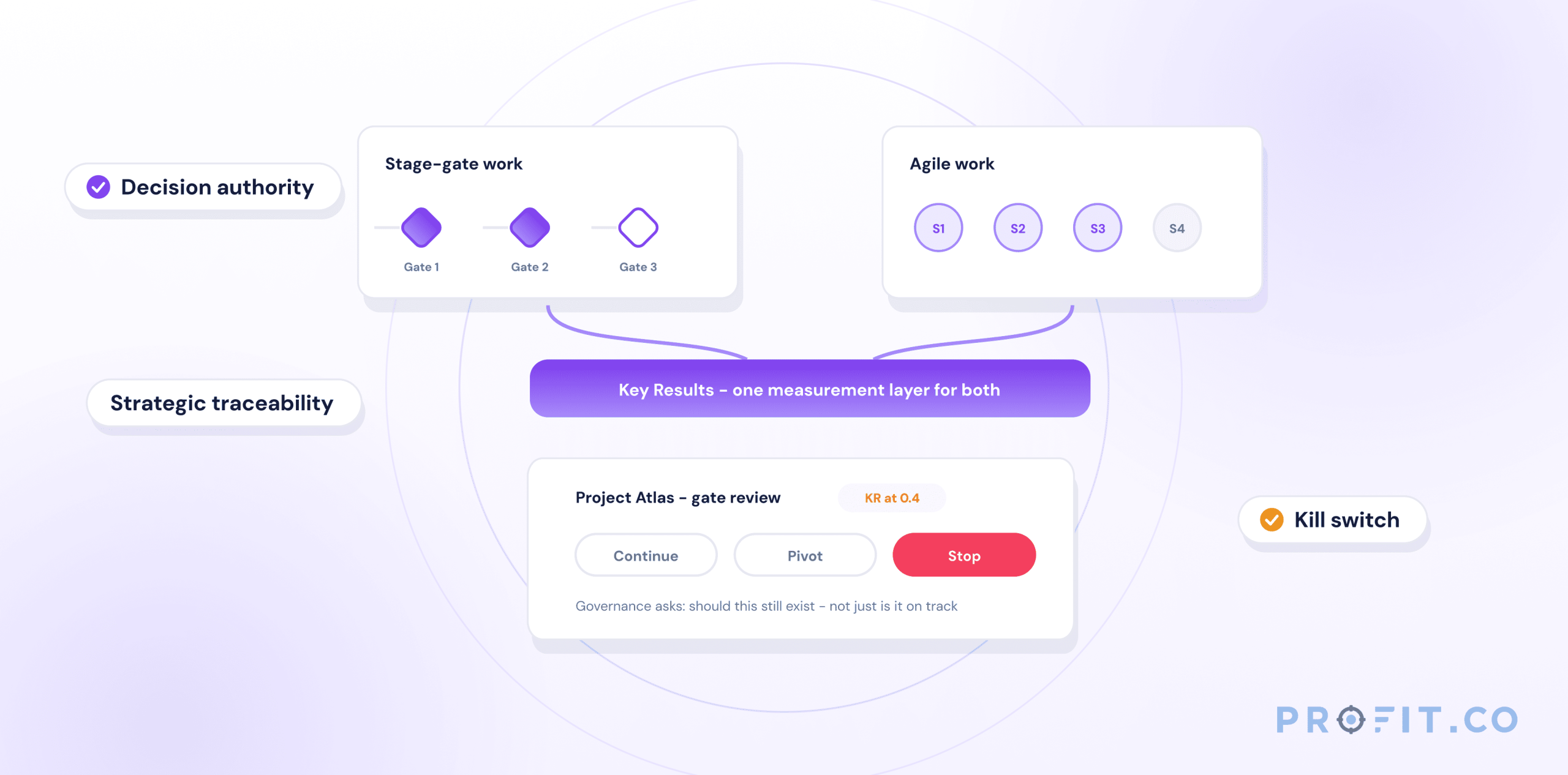
The failure most hybrid organizations experience: they adopt agile for delivery teams while retaining stage-gate governance at the portfolio level, and never build a translation layer between the two. Portfolio managers approve gates based on phase milestones that no longer reflect how the team works. Delivery teams produce sprint outcomes that portfolio-level governance cannot interpret or evaluate.
The result is governance theater. Gates pass based on PowerPoint summaries of sprint work, not actual strategic progress. The portfolio looks healthy on paper while strategic outcomes drift. This is the structural gap that neither PPM tooling nor SPM frameworks alone can close.
Connect Strategy to Execution, not just Execution to itself
How Do OKRs Bridge SPM Strategy and PPM Execution?
OKRs solve the structural problem that neither PPM nor SPM solves independently: they create a shared unit of measurement that works at every organizational layer simultaneously, from C-suite portfolio decisions to individual sprint goals.
At the SPM layer, the organization sets quarterly Objectives with measurable Key Results that define the strategic outcomes the portfolio must advance. A Key Result such as “increase enterprise customer retention to 91% by end of Q3” becomes the gate criterion for the next portfolio review: not “did Phase 2 complete?” but “did Phase 2 actually move retention?” Gate decisions shift from milestone compliance to outcome accountability.
At the PPM layer, those same Key Results cascade into team-level OKRs and sprint goals. Each sprint connects explicitly to a Key Result. Delivery teams are no longer pushing features into a roadmap backlog. They are advancing specific, measurable outcomes that SPM-level stakeholders can evaluate directly in a portfolio review without needing a separate translation layer.
The quarterly OKR cadence aligns naturally with stage-gate cycles. A 90-day Key Result maps directly to a project phase review. Stage gates stop being compliance checkpoints and become strategic decision moments: is this project still advancing the outcomes it was funded to move? If not, the gate closes, regardless of how technically on-track the milestone is.
For the full framework on building this structure, the OKR University covers cascading OKRs from C-suite portfolio strategy down into team-level sprint execution, with templates for hybrid delivery environments.
“Quarterly key results are the gate criteria. Sprint goals are the execution units. When those two things speak the same language, SPM and PPM stop being separate systems.”
The Architecture Advantage
OKR Management, SPM, and PPM Connected in One Workspace
A native platform that connects OKR management, strategic portfolio management, and project portfolio execution in a single workspace gives portfolio review meetings a unified view of OKR attainment alongside stage-gate status, without manual consolidation across delivery tools and strategy trackers. AI-powered OKR quality tools improve goal clarity before a single sprint begins, so what gets executed is worth executing.
Most standalone PPM platforms force organizations to connect these layers through integrations and manual reporting. That translation gap is where strategic misalignment compounds quietly, quarter by quarter, until delivery confidence and strategic outcomes diverge beyond what a re-planning cycle can correct.
Which Framework Does Your Organization Actually Need Right Now?
The answer depends on where your strategy execution is breaking down. Run this diagnostic against your current state:
You need stronger PPM if:
- →Projects regularly run over budget or miss delivery milestones
- →The PMO lacks visibility into cross-project resource conflicts
- →Stage-gate reviews rely on manual status reports, not live progress data
- →Delivery teams run in agile sprints but governance still runs on waterfall cadences
You need stronger SPM if:
- →Projects complete on time but strategic outcomes are still missed
- →Portfolio composition is driven by department requests, not strategic priorities
- →Leadership cannot connect active projects to quarterly strategic goals
- →No mechanism exists to pause or cancel projects that lose strategic relevance mid-year
Most organizations above 300 employees will recognize symptoms in both columns, and that is the expected pattern. PPM execution gaps and SPM alignment gaps co-exist and reinforce each other. Fixing one without the other produces temporary improvement that erodes within two quarters.
For organizations running hybrid delivery models, where some teams operate in agile sprints while others follow stage-gate sequences, the highest-value investment is building the translation layer between governance cycles and delivery cadences. Agile goal management frameworks that use OKRs as the shared execution language across governance layers give every layer of the organization a common vocabulary for progress, risk, and strategic relevance.
The organizations that execute strategy reliably are not the ones that picked the right framework. They are the ones that built the connective tissue between their governance model and their delivery model, and made that connection visible to every layer of the organization, on a shared cadence.
Key Takeaways: SPM vs PPM
- 01PPM governs execution quality. SPM governs investment decisions. Conflating the two means optimizing the wrong layer of the organization.
- 02Most organizations have PPM. Very few have true SPM: the discipline of building portfolios top-down from strategic outcomes, not bottom-up from departmental requests.
- 03Stage-gate and agile are not competing delivery models. They break when there is no translation layer between governance cycles and sprint cadences.
- 04OKRs are that translation layer. Quarterly Key Results serve as gate criteria. Sprint goals serve as execution units. Both speak the same measurable language.
- 05A platform that natively connects OKRs, PPM, and SPM removes the manual reporting burden that obscures misalignment until it is too late to correct in-quarter.
Connect Your Strategy Portfolio to Project Execution
Frequently Asked Questions
PPM governs how projects are executed, covering scope, schedule, and resources. SPM governs which projects should exist, with investment decisions aligned to strategy. PPM answers “are we building it right?” SPM answers “are we building the right things?”
Most organizations above 500 employees need both. PPM manages delivery execution. SPM governs strategic investment decisions. Without both, teams execute projects efficiently that should never have been approved in the first place.
OKR quarterly key results serve as gate criteria in stage-gate governance, and sprint goals serve as the execution units inside each phase. OKRs translate strategic intent from SPM into measurable delivery targets that PPM teams track.
Stage-gate is a project governance model that divides execution into phases separated by decision checkpoints called gates. Each gate evaluates progress before approving the next phase, reducing investment risk on poorly performing projects.
Profit.co natively combines OKR management, PPM, and SPM in one platform. OKRs serve as the bridge between strategic portfolio investment decisions and agile project execution, with quarterly key results as gate criteria and sprint goals as delivery units.