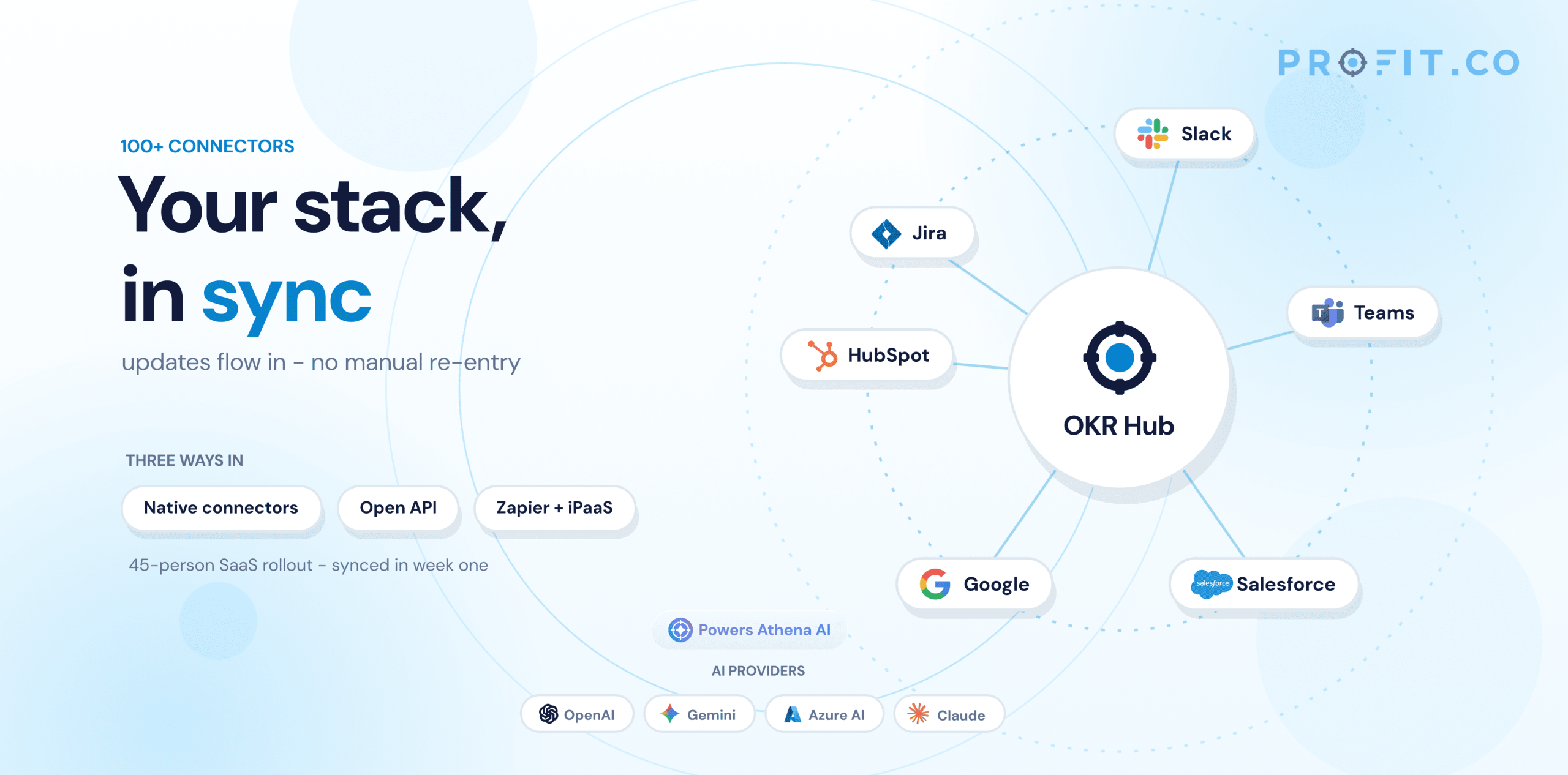
Profit.co is the better fit for organizations that want OKRs, execution, and performance reviews in one self-serve platform with a free tier to start. Betterworks still makes sense for large enterprises that specifically need its fairness/calibration tooling and 25+ language support.
In this guide
- Where Profit.co Wins
- Where Betterworks Makes Sense
- Full Capability Comparison
- Other Alternatives Worth a Look
- Frequently Asked Questions
Where Profit.co Wins
-
1
A free plan to actually start on
Betterworks does publish list prices (–9/user/month for its core plans), but there’s no free tier; Profit.co lets teams run a real OKR cycle at no cost before committing to anything.
-
2
Execution built in, not bolted on
Profit.co links OKRs to daily tasks directly, while Betterworks’ cascading tools focus on hierarchy and calibration rather than day-to-day task tracking.
-
3
Faster time to value
Profit.co doesn’t require the heavier setup and change management Betterworks’ own users report, so teams can get a full OKR cycle running without a lengthy implementation phase.
Where Betterworks Still Makes Sense
Betterworks’ performance calibration tools, fairness controls, manager-view normalization, and 25+ language support, are genuinely stronger than what Profit.co offers at that layer. Its Conversations module for structured manager-employee dialogue is well-regarded at enterprise scale, and its change-management resources make adoption in large, complex hierarchies more structured than a self-serve rollout allows. If your primary need is rigorous, enterprise-scale performance calibration deeply embedded in an OKR workflow, and your organization runs above 500 employees, Betterworks is worth a serious evaluation alongside Profit.co.
See How Profit.co Connects OKRs, Performance, and Projects in One Platform
Full Capability Comparison
Here’s how the two platforms compare across every module, so you can judge the tradeoffs yourself. The first five cover OKR and KPI ground where Betterworks competes directly; the rest cover the platform scope beyond it.
Create, weight, grade, and align objectives and key results.
| Capability |  |
 |
|---|---|---|
| An AI agent drafts and scores objectives before the cycle | ||
| Weight key results so the objective score reflects priorities | ||
| Measure key results by percent, milestone, increase, decrease, project, or task | ||
| Configure objective types, cycles, and approval flows | ||
| Start from 100+ prebuilt OKR templates | ||
| Set owners and due dates for every key result | ||
| Align and cascade objectives across every level |
Tie every key result to a real metric, pulled from a 400+ KPI library.
| Capability | |
|
|---|---|---|
| Back key results with KPIs from a 400+ library | ||
| Attach a measurable target and threshold to each key result | ||
| Pull metric values automatically from connected tools | ||
| Track leading and lagging measures behind an objective | ||
| Surface off-track key results on KPI heat maps | ||
| Roll metric updates into the objective score automatically | ||
| Report on OKR and KPI performance together |
Connect objectives to a Balanced Scorecard and the strategy roadmaps that guide the company.
| Capability | |
|
|---|---|---|
| Cascade objectives from company strategy to individuals | ||
| Roll objectives up into a Balanced Scorecard | ||
| Link OKRs to strategic initiatives and themes | ||
| Align OKRs to mission and vision statements | ||
| Run strategy reviews against live OKR progress | ||
| Visualize alignment on a strategy map |
Link objectives to the projects, tasks, and check-ins that deliver them.
| Capability | |
|
|---|---|---|
| Link OKRs to live projects and initiatives | ||
| Break objectives into tasks with owners and due dates | ||
| See project and task progress roll up to the objective | ||
| Track delivery cost and schedule against the objective | ||
| Run regular OKR check-ins with progress updates | ||
| Connect OKRs to portfolios and programs | ||
| Sync OKR progress with Jira and project tools |
See objective progress live, then share it as reports or board presentations.
| Capability | |
|
|---|---|---|
| Build custom OKR dashboards by team or level | ||
| See real-time objective and key-result progress | ||
| Generate OKR reports for leadership reviews | ||
| Build presentations from OKR data, with PowerPoint export | ||
| View company-wide alignment in one place | ||
| Drill from a company objective down to any key result |
View full Comparison
Track strategy across financial, customer, process, and learning perspectives.
| Capability | |
|
|---|---|---|
| Map objectives across four BSC perspectives | ||
| Build strategy maps linking each perspective | ||
| Run Hoshin Kanri policy deployment | ||
| Plan strategic initiatives per perspective | ||
| Weight perspectives and objectives | ||
| Track scorecard health on dashboards | ||
| Cascade the scorecard across the organization |
Run reviews, 360 feedback, and one-on-ones tied to the goals people own.
| Capability | |
|
|---|---|---|
| Run structured performance review cycles | ||
| Collect 360-degree feedback from peers and managers | ||
| Hold one-on-ones with shared agendas and notes | ||
| Tie appraisals to real objective and KPI results | ||
| Track competencies and development plans | ||
| Run self-assessments and manager reviews | ||
| Use custom review templates |
Track morale with pulse surveys, eNPS, and peer recognition.
| Capability | |
|
|---|---|---|
| Run pulse surveys on a regular cadence | ||
| Track eNPS and sentiment trends | ||
| Recognize good work with peer recognition | ||
| Act on results with follow-up plans | ||
| Run anonymous surveys | ||
| Connect engagement to goals and performance |
Plan and run projects, portfolios, and resources with cost and schedule tracking.
| Capability | |
|
|---|---|---|
| Plan and prioritize projects and portfolios | ||
| Manage tasks with owners, due dates, and dependencies | ||
| Track cost and schedule with Earned Value Management | ||
| Plan team capacity with resource management | ||
| Lay out schedules and milestones on a Gantt timeline | ||
| Track planned versus actual spend per project | ||
| Connect projects to objectives and KPIs |
Share updates, comments, and recognition from the same view of the work.
| Capability | |
|
|---|---|---|
| Share progress through check-ins and updates | ||
| Comment and mention teammates in context | ||
| Recognize peers with kudos | ||
| Work from shared dashboards | ||
| Get notified in Slack and Microsoft Teams | ||
| See goals, KPIs, and projects in one view |
SOC 2 and GDPR certified, with single sign-on and 100+ integrations.
| Capability | |
|
|---|---|---|
| SOC 2 Type II certified | ||
| ISO 27001 certified | ||
| GDPR compliant | ||
| HIPAA compliant | ||
| 99.9% uptime | ||
| 100+ integrations | ||
| Single sign-on and role-based access |
Get 24/7 support, guided onboarding, and OKR coaching from real people.
| Capability | |
|
|---|---|---|
| 24/7 live support | ||
| Guided onboarding | ||
| Dedicated customer success | ||
| Help center and documentation | ||
| OKR coaching from experts | ||
| OKR certification program |
A Few More Alternatives Worth a Look
Betterworks isn’t the only enterprise-grade option worth a look. Here’s how the rest of the field covered in our full OKR software guide stacks up, in the same order we rank them there.
Best for enterprise teams wanting deep OKR analytics with European data hosting for GDPR compliance. Its coaching program and analytics suite are genuinely strong for organizations building out a formal OKR practice. It is for smaller deployments, but most mid-to-large rollouts are quoted individually, with no free plan to test first. The tradeoff: no native mobile app and no published AI features, which several of its own reviewers point out as gaps.
See the Workpath Alternative →Best for organizations building a people-first, feedback-driven culture that want OKRs bundled with engagement surveys and career development. Its Goals & OKRs module can be purchased , separate from other modules; a ,000 minimum annual agreement applies either way. There’s no free plan and no self-serve trial, only a guided product tour. Its AI is concentrated in engagement-survey insights rather than OKR authoring itself.
See the Lattice Alternative for OKRs →Best for organizations that want a lightweight weekly check-in habit as the foundation of continuous performance management. OKR functionality specifically requires its Perform plan ; its cheaper Engage tier doesn’t include OKRs at all. There’s no permanent free plan, and its own positioning frames OKRs as secondary to its check-in and engagement core. Its AI is centered on summarizing conversations rather than authoring goals.
See the 15Five Alternative for OKRs →Best for organizations that want goals tied directly to learning paths, competencies, and career progression decisions. Pricing is modular and available only through direct sales, no published rate card, though it does offer a genuine 14-day free trial with no credit card required. Its own materials note that OKR tracking specifically is less specialized than dedicated tools, since it’s one part of a broader development suite.
See the Leapsome Alternative for OKRs →Best for small teams (5 or fewer) that want a genuinely free way to visualize how OKRs and KPIs connect to strategy. Its free plan is real, not a crippled trial, and its Strategy Map is a standout visual alignment tool. Paid plans require a 10-seat minimum, so a 6-person team outgrowing free pays for 10 seats regardless of headcount. Its cascade structure is also fairly rigid for cross-functional teams.
See the Perdoo Alternative →Best for small or remote teams brand new to OKRs that want the simplest possible weekly habit. Its PPP (Plans, Progress, Problems) check-in framework and included unlimited OKR coaching make it fast to adopt with minimal training. The tradeoff: it’s intentionally light on advanced analytics and has no published AI-assisted authoring features, by its own admission.
See the Weekdone Alternative →Best for lean, budget-conscious startups that want AI to handle the first draft of their OKRs. Its AI-generated goals and action plans, plus AI-powered retrospectives, make for a genuinely fast setup. Its own positioning acknowledges lighter feature depth than platforms built for enterprise scale, so growing teams may outgrow it.
See the Tability Alternative →Best for organizations deeply standardized on Microsoft Teams that want OKR updates without leaving it, its native Teams integration is the deepest in this category. As of this writing it has no AI-assisted features at all, a choice the company frames as deliberate sequencing rather than an oversight. Its integration catalog outside Microsoft 365 is also comparatively narrow.
See the Mooncamp Alternative →Best for teams that want AI-driven goal alignment tied closely to performance reviews and 1:1s. Its OKR Platform tier runs around /user/month, with no permanent free plan, only a free trial. Its own reviewers note a smaller market presence and integration ecosystem than more established OKR platforms, which is worth weighing against its genuinely useful AI-alignment features.
See the Peoplebox Alternative →Best for large enterprises that want automated business-review deck generation and AI-driven risk detection layered on top of OKRs. There’s no pricing page at all, every quote requires a demo, and no free trial. That’s a real barrier for teams wanting to self-serve evaluate the platform before a sales conversation, though its automation is genuinely strong for enterprise leadership reporting.
See the WorkBoard Alternative →Enterprise cascading and unified execution solve different problems. The question isn’t which platform is bigger; it’s which one fits how your team actually works.
If OKRs connected to daily execution are what you’re after, see how Profit.co runs the full goal cycle in a quick product tour.
When OKRs need to connect to daily execution and not just the org chart, the platform built around that connection wins.
Ready to See Profit.co in Action Against Betterworks?
Frequently Asked Questions
Betterworks is a strong fit for large enterprises that need OKR cascading tied to performance calibration and broad language support. Its own site notes it adds the most value above 500 employees, and there’s no free tier for smaller teams to test it with.
Profit.co is the strongest alternative for teams that want OKRs connected to execution and performance reviews in a self-serve platform with a free plan. Lattice is worth a look if people-first engagement is the priority instead of cascading hierarchy.
Profit.co has a free plan and published paid tiers. Betterworks also publishes list pricing (–9/user/month for its core plans, Enterprise on custom quote), but has no free plan, and its published rate is currently running a limited-time promotional discount tied to a 3-year contract, so confirm current terms directly.
Yes, its Goal Assist AI helps with goal writing and feedback. Profit.co’s AI covers goal writing plus alignment suggestions and automated progress reporting.