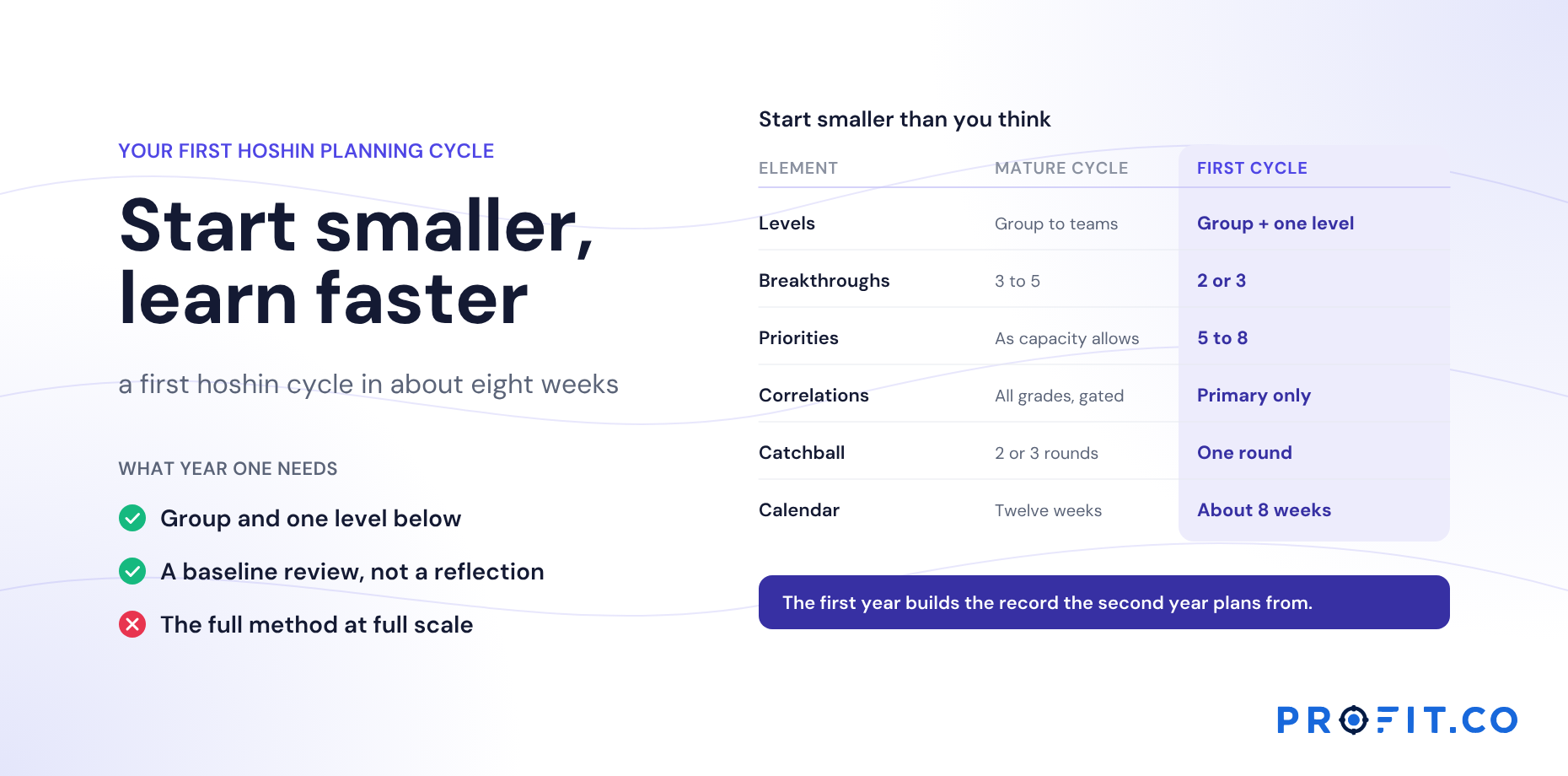













Catchball is where hoshin planning calendars slip. Not because the negotiation is hard, but because it’s unstructured: sequential, undated and invisible. Two or three dated rounds, run in parallel, keep it inside four weeks.
In this guide
Key Takeaways
- →Two rounds settle most objectives. A third is for the few where the gap is real and specific.
- →Dated rounds. The calendar does not wait for the slowest responder.
- →Parallel, not sequential. Every objective is in catchball at once.
- →Visible status is the rule email cannot meet, and the one that decides the calendar.
- →Bring the function a commitment depends on into round 2. That adds a participant, not a round.
- →Count the targets that changed. If none did, the levels below were informed, not consulted.
Why catchball runs long
The offsite ends with a draft matrix and a sense of momentum. Then the draft goes out for catchball, and the momentum disappears. Some objective owners send proposals the next day; others wait until after a holiday. Responses come back at different times, in different formats, to different people. Nobody can say, at any point, how much of the plan is agreed.
Four weeks becomes eight. The matrix locks after the year has started.
The fix is structure. This article covers running the rounds during planning. Keeping the record of each negotiation, so its reasoning survives, is covered in Catchball in software: turning negotiation into a record.
Round by round
| Round | Proposer sends | Receiver responds with | Typical length |
|---|---|---|---|
| Round 1 | Objective, proposed target and the reasoning behind it | What they can commit to, what they would need, and the assumptions involved | Eight to ten working days |
| Round 2 | Revised proposal addressing the response | Agreement, or a remaining specific disagreement | Five to seven working days |
| Round 3, if needed | Final proposal on open items only | Agreement or escalation | Three to five working days |
Rounds close on fixed dates. Late responses roll into the next round.
Most objectives settle in two rounds. A third is for the few where the gap is real and specific. Anything still open after round three goes to the executive team for a decision; a fourth round rarely changes the outcome and always costs a week.
Three rules that keep it on time
- Dated rounds. Each round opens and closes on a date set at the offsite. The calendar doesn’t wait for the slowest responder.
- Parallel, not sequential. Every objective is in catchball at once. Nothing waits for another objective to settle first.
- Visible status. The planning lead can see at any moment which negotiations are open, agreed or escalated.
The third rule is the one email can’t meet. When catchball lives in inboxes, the planning lead has to ask everyone where things stand, which takes most of a week and is out of date by the time it’s collated.
Horizontal catchball
Catchball is usually described as vertical: between a level and the level below. Many targets also depend on another function. A services target depends on sales selling contracts; an emissions target depends on procurement converting suppliers. If those dependencies aren’t negotiated, the receiving level commits to a target it doesn’t control.
During round 1, ask each receiver to name any other function its commitment depends on. Bring that function into round 2 for that objective. It adds a participant, not a round.
Is it real catchball?
One simple measure tells you whether catchball happened or was an announcement with a comment period: how many targets changed between the offsite draft and the locked plan?
If no target changed in catchball, the receiving levels weren’t negotiating. They were being informed.
Some change is healthy. It means the people closest to the work tested the plan and the plan improved. Very large changes across most objectives suggest the offsite draft was set without enough input from result owners, which is a planning room problem to fix next cycle.
A worked example: status at the end of round two
| Status | Objectives | What happens next |
|---|---|---|
| Agreed | 6 of 10 | Recorded on each objective; no further rounds |
| Open, specific gap | 3 | Round 3, limited to the open point |
| Escalated | 1 | Executive decision at the 4 December session |
Illustrative, for ten group objectives.
The three open items each have a named gap: a dependency on legal approval, a disagreement about phasing, and a site that needs one more engineer to commit. The escalated item is the North America services target, where the region and the division disagree about the market itself; another round won’t resolve that, so the executive team decides.
Of the ten objectives, four ended with a target different from the offsite draft. That’s a healthy result. The levels below tested the plan and changed it where they had better information.
What the rounds need from the software
Read the third rule again, because it is the one with a product requirement inside it. “The planning lead can see at any moment which negotiations are open, agreed or escalated” is not a discipline problem. It is a reporting problem, and a mailbox cannot answer it.
That is why the calendar slips rather than the negotiation failing. Each individual exchange is fine. What is missing is the view across thirty of them, and without it nobody notices a stalled thread until the round has already closed.
| What a round needs | What the tool has to do | How to test it in a demo |
|---|---|---|
| A dated round | A close date on the thread, not just a reminder | Open a negotiation and set a round close date |
| Parallel threads | Every objective negotiating at once, independently | Show me ten negotiations running side by side |
| Visible status | One view: open, agreed, stuck, escalated | Show me which threads are stuck right now |
| A real close | “Closed” means every participant agreed, not that a date passed | Try to close a session with one participant unapproved |
| Own-number-only | A participant can counter their own number, not everyone else’s | Try to change someone else’s target in a session |
| Horizontal participants | A second function added to one objective’s thread | Add procurement to the emissions negotiation |
| The reasoning kept | Why a target moved, attached to the target | Agree a revision and show me where the reason lives |
Row 4 is the check most easily faked, and the one a March review depends on.
Row 4 deserves pressing. A thread where the deadline passed and the conversation stopped looks identical, in a document, to one where every participant agreed. Only one of those holds up when the target is disputed in a review. Row 7 is what next October’s reflection will read, and it is the reason to keep catchball in a system rather than a mailbox at all.
What an eight-week catchball costs
Price the overrun rather than the tool. Catchball that takes eight weeks instead of four pushes lock past the December break, which means January runs on last year’s matrix or on nothing. The first monthly review of the year then has no plan to run from, and the cost compounds through the quarter. That is the real expense, and it does not appear on any invoice.
Against it, the published license models differ mainly in how many people they admit. OnStrategy lists $200 per month for unlimited users. i-nexus publishes a free Starter tier for up to five users and $28 per user per month at its Standard tier. Catchball is the stage where that matters most: it runs across every objective owner, the level below, and in a cascade the sites as well. A model that charges per seat prices exactly the people whose agreement the round is waiting on.
Profit.co publishes two plans, Essentials and Enterprise, and quotes against modules and scale rather than a public seat rate. Hoshin Kanri sits in Essentials with OKRs and Goals, Balanced Scorecard and Strategy Roadmap, so the people agreeing a target in November are already in the system running their quarters, rather than being added for four weeks and removed again. What drives the cost of hoshin kanri software covers the rest of what to total, and the seven pass/fail tests the questions to ask.
The 30-day free trial covers a full round one and round two, which is the span where the three rules either hold or do not.
Catchball rounds in Profit.co
Catchball in Profit.co runs as a session: a thread, a change table showing every proposed change, and agreement required from every participant before targets commit. Each participant can counter only their own number, and a balance constraint on approval keeps cascaded targets adding up.
That maps directly onto the rounds above. The change table is each round’s record. Own-number-only stops a round turning into a debate about everyone else’s targets. Agreement from every participant is what “closed” means, and the planning lead can see which sessions are open, agreed or stuck without chasing inboxes. More on the planning software page.
Horizontal catchball works the same way: adding procurement to one objective’s session brings that function into the negotiation without opening a round for everyone else. And because the session holds the reasoning, the question this article ends on, how many targets actually changed, is a report rather than an argument.
Free Product Demo
Run this year’s catchball where you can see it
A 30-minute walkthrough, tailored to your team.
Book a free demo
What happens in the call
How your teams set goals, track progress and review results.
Strategy, performance, projects and engagement on one platform, with AI.
A practical path to align teams, execute faster and drive results.
Questions this article answers
Usually two, with a third only for the few objectives where a specific disagreement remains. After that, escalate for a decision.
About four weeks: eight to ten working days for round one, five to seven for round two, and three to five for any third round.
Count how many targets changed between the offsite draft and the locked plan. If none did, the levels below were informed rather than consulted.
Negotiating with another function a commitment depends on, such as sales or procurement, rather than only with the level below. Bring them into round 2 for that objective.
Because nobody can see the whole picture. The planning lead has to ask every participant where things stand, which takes most of a week and is out of date once collated.
Run every objective in parallel with a dated close, show which threads are open, agreed or stuck, require agreement from every participant before a target commits, and keep the reasoning behind each change.