












Writing an A3 for every red cell wastes effort and buries the important ones. Never writing one leaves persistent gaps to a monthly cycle of one-line countermeasures. A few simple triggers make the call consistent.
In this guide
Key Takeaways
- →An A3 for every red cell buries the investigations that matter among routine ones.
- →Never writing one leaves real gaps to a monthly cycle of one-line countermeasures.
- →Four triggers: two red months, a failed countermeasure, unexplained outcome lag, a threatened annual objective.
- →Agree the triggers at the start of the year so the call isn’t renegotiated monthly.
- →An A3 is for a gap you don’t yet understand. If you understand it, act instead.
- →One gap, one A3, timeboxed to two weeks so findings reach the next review.
Two failure modes
Some organizations write an A3 for every red cell. A3s become a reporting chore, quality drops, and the investigations that matter are lost among the routine ones. Others almost never write them. Persistent gaps get a new one-line countermeasure each month and the cause is never found.
The A3 is a deliberate investment of the owner’s time. It should be triggered by conditions that justify that investment.
Triggers for an A3
- Two consecutive red months. The gap isn’t timing.
- A failed countermeasure. The expected effect didn’t happen, so the cause was misunderstood.
- Outcome lag with an unclear cause, or diagnosed as a broken mechanism.
- A threat to an annual objective, even after one month, if the gap is large.
Any one trigger is enough. Agree them at the start of the year and apply them in the monthly review, so the decision isn’t renegotiated each time.
The second trigger depends on a record of what each countermeasure was expected to do; see Countermeasure Sheets in Hoshin Kanri: Tracking Actions on Off-Track Objectives. The third is diagnosed in Outcome lag: when priorities are green and KPIs don’t move.
When not to write one
- Known timing. An order slipped a month and is confirmed for next month. A comment is enough.
- Known external cause. A currency swing or a regional market shock is a target question for catchball, not a problem to solve with an A3.
- A plan row that was wrong. If the phasing didn’t match the path, fix the phasing.
An A3 is for a gap you don’t yet understand. If you understand it, you need a countermeasure or a conversation, not an investigation.
The third case is more common than it looks, and avoidable at planning time; see Phasing Monthly Plan Values in Hoshin Kanri So the Bowler Tells the Truth.
Scoping and writing
| Question | Guidance |
|---|---|
| Who writes it? | The owner of the red row, with help from someone experienced in A3s |
| How long? | Timebox to two weeks so findings reach the next review |
| How wide? | One gap, one A3. Don’t bundle related reds |
| Who reviews it? | The owner’s manager, before the next monthly review |
How to write each section is covered in How to Write a Hoshin Kanri A3, Section by Section.
A worked example: five red rows, one review
Here are five hypothetical red rows, each with a decision at one review:
| Row | Situation | Decision |
|---|---|---|
| Price realization | First red month; large deal discounted | Countermeasure only |
| Site B on-time delivery | Second red month | A3 |
| Services share | Retraining countermeasure failed | A3 |
| Regional order intake | Competitor price cut; territory comparison confirms | Catchball on target, no A3 |
| Scope 3 share | Red because plan was linear and conversions land in Q3 | Re-phase plan; no A3 |
Illustrative.
Two A3s from five red rows. Each will get proper attention.
What the wrong threshold costs
Both failure modes have a price, and they are not the same price. Writing five A3s from the five rows above costs roughly ten weeks of owner time, most of it spent documenting things already understood, and it teaches everyone that an A3 is paperwork. Writing none costs a quarter on the services row, where retraining had already failed and the real cause was never looked for.
The triggers exist to spend that time where it changes something. In the example, two rows get an investigation and three get a cheaper, correct response: a comment, a catchball conversation and a corrected plan row. Getting that split right is worth more than any individual A3.
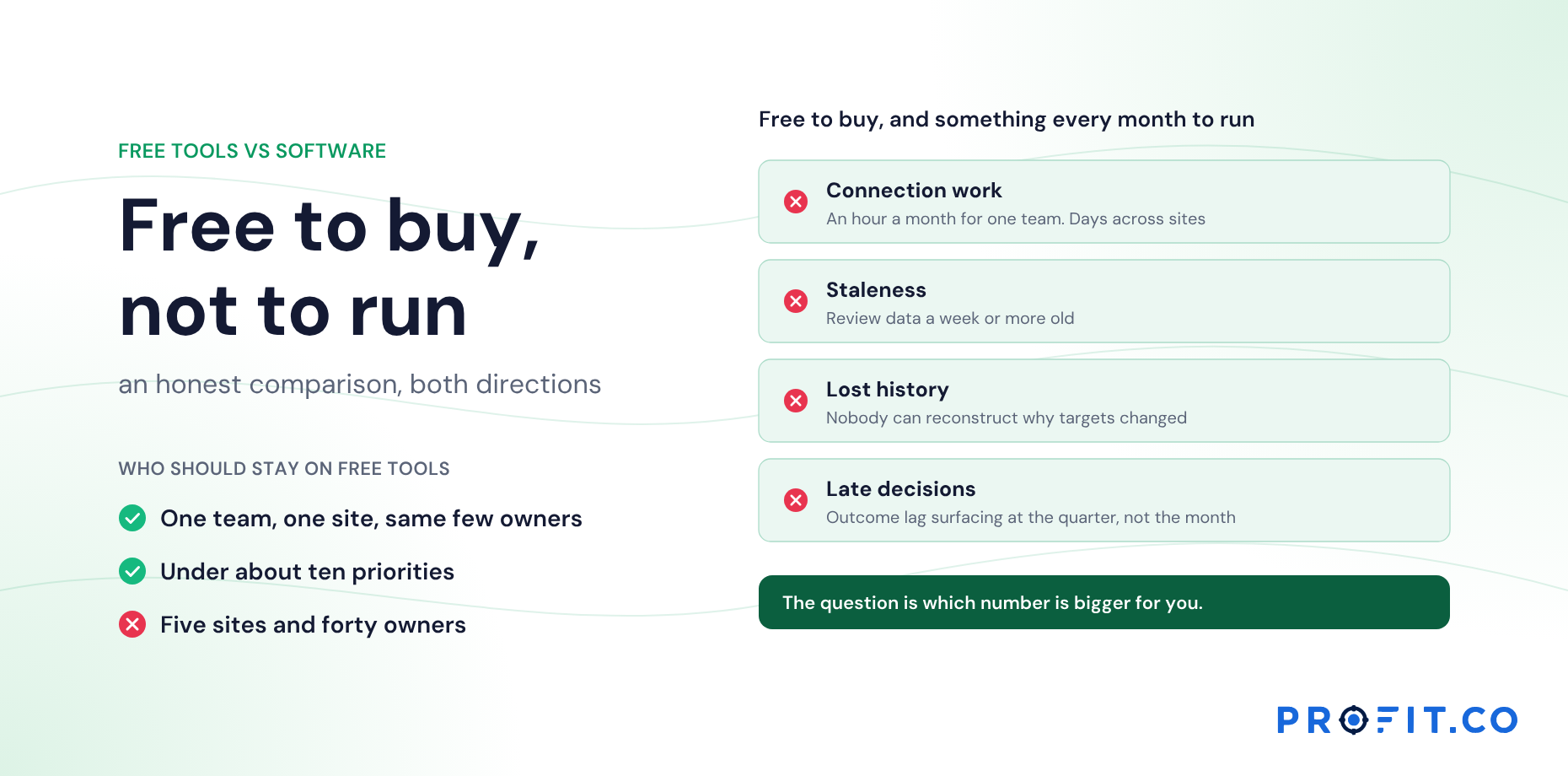
Among published alternatives for holding the history these triggers depend on, OnStrategy lists $200 per month for unlimited users. i-nexus publishes a free Starter tier for up to five users and $28 per user per month at its Standard tier. The first two triggers are historical claims: red twice running, and a countermeasure whose expected effect didn’t arrive. Neither can be applied consistently from a rebuilt monthly pack.
Profit.co publishes two plans, Essentials and Enterprise, quoting against modules and scale rather than a public seat rate. Hoshin Kanri sits in Essentials alongside OKRs and Goals, Balanced Scorecard and Strategy Roadmap. What drives the cost of hoshin kanri software lists the rest to total, and the 30-day free trial covers one review at which the triggers can be applied for real.
When to open an A3 in Profit.co
In Profit.co, a countermeasure A3 opens from where the trigger shows up: an exception-queue item, an initiative’s delivery-problem escalation, or a red or amber bowler cell. Opening it fills the evidence blocks, the anchor’s facts, the bowler row and gap and the correlation’s details, with an as-of date, so the owner starts from data rather than a blank form.
Templates set the starting shape; your organization chooses which template applies by default. The A3 header shows how many A3s are open at that level and warns, without blocking, when the count passes a threshold, which is the “an A3 is a deliberate investment” principle above, enforced gently. More on the Hoshin Kanri software page.
Free Product Demo
Find the rows that need an A3
A 30-minute walkthrough, tailored to your team.
Book a free demo
What happens in the call
How your teams set goals, track progress and review results.
Strategy, performance, projects and engagement on one platform, with AI.
A practical path to align teams, execute faster and drive results.
Questions this article answers
When a row has been red for two consecutive months, a countermeasure has failed, outcome lag has an unclear cause, or a large gap threatens an annual objective.
No. One-off timing issues need a comment, external causes need a target conversation, and wrong phasing needs a corrected plan row.
Timebox it to about two weeks, so findings reach the next monthly review.
The owner of the red row, with help from someone experienced in A3s. The owner’s manager reviews it before the next monthly review.
No. One gap, one A3. Bundling related reds produces an investigation that is too broad to reach a testable cause.
At the start of the year, so they are applied in the monthly review rather than renegotiated each time a row turns red.