












In this guide
Key Takeaways
- →Four rhythms, four questions: check-ins record, monthly asks whether each bet is working, quarterly decides whether to change the bets, annual asks whether the breakthroughs are right.
- →Check-ins are not a meeting. They are the input every meeting depends on, and they have to arrive before it.
- →The monthly review runs on exceptions only. Rows on plan, or with a countermeasure already in place, are not discussed.
- →If December’s matrix is identical to January’s, the quarterly reviews did not happen, whatever the calendar says.
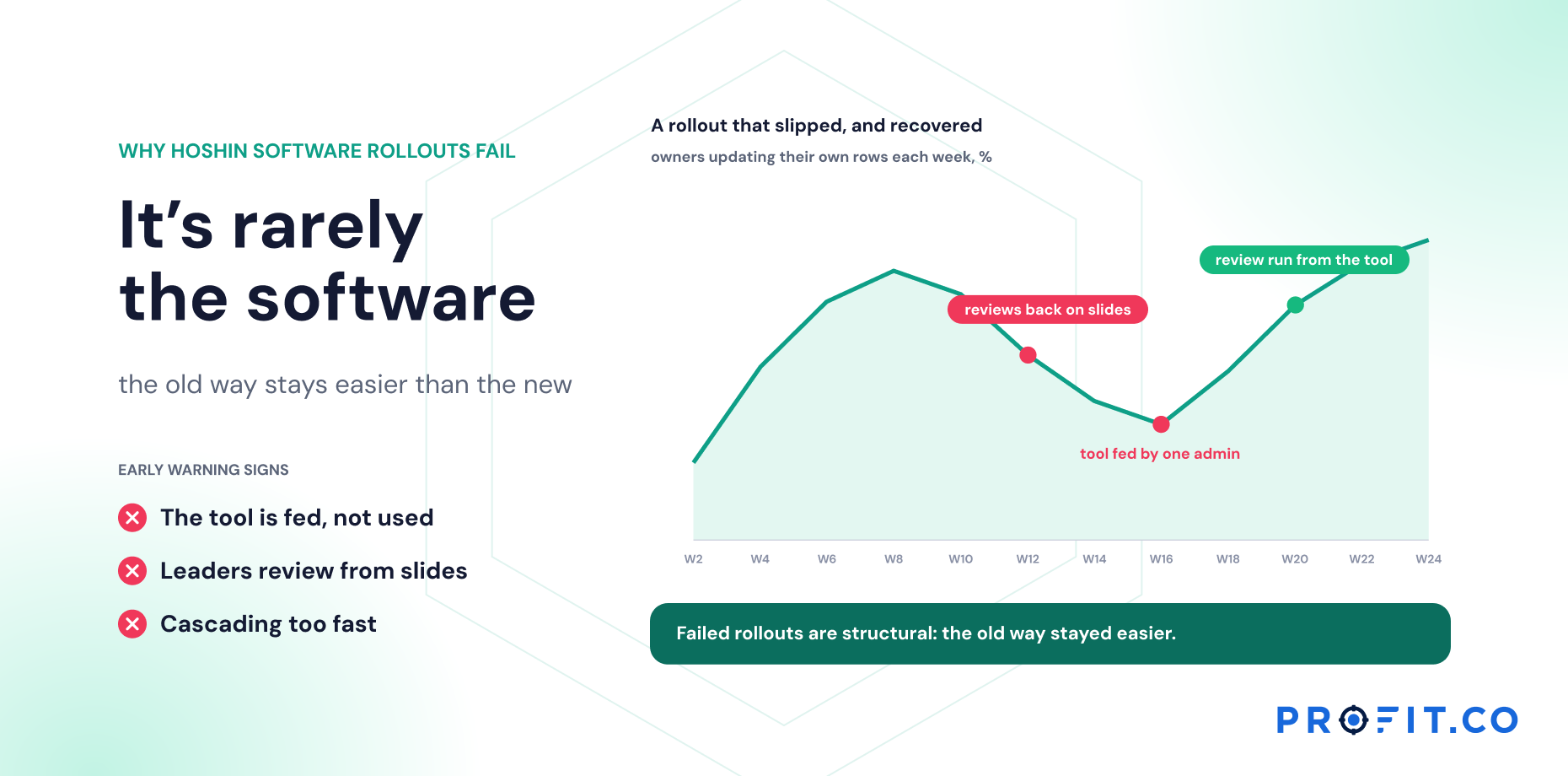
- →The chair running the review from live data does more for adoption than any training. Open a deck and owners update the deck.
- →The cadence is the hardest thing to retrofit. Check whether a tool supports four rhythms before buying, not after the first quarter.
Monthly, quarterly and annual hoshin reviews each answer a different question. When one meeting tries to answer all three, it answers none of them well, and the people in the room can feel it.
One meeting, three questions
A common hoshin review runs monthly and has a long agenda. It walks the bowler, debates a few red rows, revisits whether one of the priorities still makes sense, and sometimes drifts into whether the strategy itself is right. It runs over time. People leave unsure what was decided.
The problem isn’t the people or the facilitation. Three different questions are being asked at three different altitudes, and each needs different inputs, different attendees and a different kind of decision.
Four rhythms, four questions
| Rhythm | Question it answers | Typical decisions |
|---|---|---|
| Check-ins (weekly or monthly) | Where does each objective stand, and why? | None. Owners record progress, status and a comment |
| Monthly review | Is each bet working? | Countermeasures, escalations, send-backs for missing causes |
| Quarterly review | Should we change the bets? | Regrade correlations, retire or add priorities, reallocate people and budget, reopen targets through catchball |
| Annual reset | Are these the right breakthroughs, and what must be true next year? | Annual objectives and targets; occasionally a change to a breakthrough |
Check-ins aren’t meetings. They’re the input every meeting depends on.
Separating them makes each meeting shorter and each decision clearer. The monthly review stops debating strategy, because there’s a place for that. The quarterly review stops walking the bowler, because the monthly review already did.
The monthly review
Inputs: current bowler rows with countermeasures on every red; the list of objectives in outcome lag; primary correlations whose lag windows have closed.
Agenda: outcome-lag cases first, diagnosed with the LAGS sequence. Then red rows that have been red for two months or more. Then anything an owner has flagged for help. Green and amber rows with countermeasures in place aren’t discussed.
Attendees: priority and KPI owners at the level the matrix covers, chaired by the executive who owns the matrix.
Output: recorded decisions per exception. If a decision would change a priority or a target, it goes to the quarterly review or to catchball, not resolved in the room.
The quarterly review
Inputs: three months of monthly decisions; correlation grades and their evidence; resource allocation by priority.
Agenda: which bets should change? Correlations to regrade (see grading X-matrix correlations). Priorities to retire, with their people and budget redirected. New priorities that have passed the planning gate. Targets reopened through catchball.
Output: a revised matrix, with every change dated and explained. This is the meeting where the hoshin plan is actually managed, rather than monitored.
If the matrix in December is identical to the matrix in January, the quarterly reviews didn’t happen, whatever the calendar says.
The annual reset
Inputs: the year’s record. Which priorities delivered, which correlations held, which targets changed and why, and how far each breakthrough has moved.
Agenda: breakthroughs first, then next year’s annual objectives worked back from the trajectory, then priorities and correlations through the full planning gate, then catchball.
The reset works far better when the year’s history is in one place. (See Breakthrough and Annual Objectives in One System.)
Keeping the rhythm alive
- Check-ins arrive before the review, on a fixed cadence, so nobody builds data in the meeting.
- Each review has its own question, written at the top of the agenda.
- Decisions are recorded where the objective lives, not in separate minutes.
- The chair runs the review from the live data, not from a slide deck prepared from it.
The last condition does more for adoption than any training. When the person who chairs the review opens the live matrix, owners keep it current. When they open a deck, owners update the deck.
A worked example: one quarter of reviews
| Review | Question | What came up | Decision |
|---|---|---|---|
| January monthly | Is each bet working? | Pricing tool live but only 20% of quotes use it | Adoption gap: replace the launch measure with share of quotes priced in the tool |
| February monthly | Is each bet working? | Two sites red for a second month on maturity audits | Owners to run A3s before March |
| March monthly | Is each bet working? | Services KPI flat in two territories after a competitor price cut | Flagged as possible swamping; to quarterly review |
| Q1 quarterly | Should we change the bets? | Pricing adoption recovering; services swamping confirmed by territory comparison | Keep both bets; reopen North America services target through catchball; regrade one partial correlation |
Illustrative quarter.
Notice what each meeting didn’t do. The monthly reviews didn’t debate whether services was still the right strategy; they diagnosed and escalated. The quarterly review didn’t walk the bowler; it took three months of monthly decisions and changed the plan where the evidence said it should.
What four rhythms need from the software
Cadence is the part of hoshin that looks like a calendar problem and turns out to be a data problem. It is also the hardest thing to retrofit, because by the time a tool proves it cannot support four rhythms, a year of history is already inside it. Six things are worth testing before that.
| What the cadence needs | Why it matters | How to test it in a demo |
|---|---|---|
| Check-ins on their own schedule | They are an input, not a meeting, and must arrive before it without chasing | Ask what happens when an owner misses a check-in window |
| An exception queue, not a full list | A monthly review that walks every row has already lost its agenda | Ask to see only the rows that would be discussed this month |
| Decisions recorded on the objective | Separate minutes are where the quarterly review’s inputs go missing | Ask to read a decision made six months ago, from the objective |
| Different views per rhythm | Monthly needs the bowler; quarterly needs correlations and resourcing | Ask what the quarterly review opens that the monthly one does not |
| A change history on the matrix | “Every change dated and explained” is a feature, not a habit | Ask to see what changed on the matrix between two quarters |
| Live enough to chair from | If the chair needs a deck, owners will maintain the deck instead | Ask whether anyone prepares anything before the monthly review |
The last row is the adoption test. Everything else follows from it.
Two of these are worth more than the rest. The exception queue is what makes a monthly review finish on time, and most tools do not have one because a dashboard that shows everything is easier to build and demonstrates better. The change history is what makes a quarterly review possible at all, because without it the meeting opens with an argument about what was decided last time.
Worth noting what this is not. The “business review software” category sold around quarterly business reviews is built for customer-facing account reviews, which is a different job with a different audience. What a hoshin cadence needs is closer to OKR software check-in mechanics joined to a matrix that keeps its own history. The seven pass/fail tests cover the matrix side; the six rows above cover the cadence side.
Cadence in Profit.co
Profit.co’s check-ins and review cadences come from the same engine that runs its OKR and Balanced Scorecard programs. Owners check in on their objectives and key results, each check-in records progress, status and a comment, and the bowler chart and four-quadrant chart are current when the review opens.
Each rhythm has its own input. The monthly review works from the exception queue and the bowler. Countermeasure A3s come back to the review for agreement and, after their lag, for their verdict. The quarterly review acts on correlations, and every Act decision is written to that correlation’s strength history. More on the hoshin kanri software overview.
Because Hoshin Kanri, OKRs and Goals and Balanced Scorecard share the Essentials plan and one check-in engine, a team running quarterly OKRs and a leadership team running a monthly hoshin review are working from the same updates rather than two cadences that have to be aligned by hand. A board view built on balanced scorecard software elsewhere would add a third cadence to keep in step; here it reads the same check-ins. The 30-day free trial covers a full monthly cycle, which is the shortest honest test of whether a cadence holds.
Free Product Demo
Run your next monthly review from live data
A 30-minute walkthrough, tailored to your team.
Book a free demo
What happens in the call
How your teams set goals, track progress and review results.
Strategy, performance, projects and engagement on one platform, with AI.
A practical path to align teams, execute faster and drive results.
Questions this article answers
Owners check in monthly or more often, the leadership team reviews exceptions monthly, the plan itself is revised quarterly, and the breakthroughs and annual objectives are reset yearly.
Exceptions only: objectives in outcome lag, rows red for two or more months, and items owners have flagged. Rows that are on plan, or have a countermeasure in place, aren’t discussed.
Whether to change the bets: regrade correlations, retire or add priorities, reallocate people and budget, and reopen targets through catchball.
Take check-ins on their own schedule, show an exception queue rather than every row, record decisions on the objective, give each rhythm its own view, and keep a dated change history on the matrix.
No. That category is built for customer-facing account reviews. A hoshin cadence needs check-in mechanics joined to a matrix that keeps its own change history, which is a different job and a different audience.
You can, but owners will maintain the slides rather than the plan. If the chair opens the live matrix instead, the matrix stays current, which does more for adoption than any amount of training.