












In this guide
- The category decision comes first
- Three categories, not two
- When a purpose-built tool is the better choice
- When a platform is the better choice
- Questions that settle it
- A worked example: two organizations, two answers
- The cost difference the comparison usually misses
- Test hoshin depth either way
- Questions this article answers
Key Takeaways
- →Choose the category before the vendor. Comparing a specialist against a platform on a feature checklist produces a confusing result every time.
- →There are three categories, not two. Visual boards, PPM and BI tools are excellent at their own jobs and none of them holds correlations.
- →A specialist wins when hoshin is the whole management system, lean maturity is high and operational excellence owns the tool.
- →A platform wins when hoshin is one layer of three. Strategy execution software that holds all three removes the monthly reconciliation, which is the matrix keeper problem at a larger scale.
- →Price the route, not the license. The specialist route usually carries a second goal management software subscription and a third for scorecard reporting.
- →Run the same seven tests on both categories. Breadth is no excuse for a thin X-matrix.
Before choosing a vendor, choose a category. Dedicated hoshin tools and broader strategy execution platforms solve different problems, and the right one depends less on hoshin itself than on where the rest of your goals already live.
The category decision comes first
Buyers searching for hoshin kanri software find two kinds of product. Some are built for hoshin and little else: the X-matrix is the center of the product, and the vocabulary is lean throughout. Others are strategy execution platforms that run hoshin kanri as one method among several, alongside OKRs, Balanced Scorecards and, sometimes, performance management.
Comparing a tool from one category with a tool from the other on a feature checklist produces confusing results. The dedicated tool usually wins on hoshin depth; the platform wins on breadth. The real question is which shape of problem you have.
A note on bias: Profit.co is a platform. We’ve tried to describe both categories fairly, including the cases where a dedicated tool is the better choice.
Three categories, not two
| Category | Typical strengths | Typical limits |
|---|---|---|
| Purpose-built hoshin tools | Deep X-matrix and lean method support; vocabulary practitioners recognize; often shaped by lean consultancy experience | Hoshin is the whole model, so OKRs, scorecards or team goals live elsewhere; integration is the buyer’s problem |
| Strategy execution platforms | Hoshin, OKRs and scorecards on one data model; one check-in and review process across methods; reaches teams below the hoshin level | Breadth can mean less lean-specific depth; buyers should test hoshin features as carefully as they would in a dedicated tool |
| Adjacent tools: visual boards, PPM, BI | Excellent at their own job: daily management boards, project delivery, reporting | None is built to hold correlations between priorities and KPIs; using them for hoshin recreates the spreadsheet problem |
Generalizations; individual products vary. Test, don’t assume.
When a purpose-built tool is the better choice
A dedicated hoshin tool is likely the right answer if most of these are true:
- Hoshin is the management system. It runs from the executive team to the shop floor, and there’s no separate goal-setting method at team level.
- Lean maturity is high. Teams already practice PDCA, A3 thinking and daily management, and want software that mirrors the method closely.
- No scorecard or OKR program exists, or the existing one is being retired.
- The buyer is operational excellence, and the tool will be owned and administered by that function.
In that situation, depth of method support matters more than breadth, and there’s little to reconcile.
When a platform is the better choice
The case flips when hoshin is one layer of a wider goal system. That’s common: leadership deploys a handful of breakthrough objectives through hoshin, functions and teams run OKRs, and finance or the board reports through a scorecard.
If those live in separate tools, someone reconciles them every month. Team key results are reported in one place, the hoshin priorities they serve in another, and the scorecard view is assembled from both. The reconciliation is the matrix keeper problem again, at a larger scale.
The question isn’t which tool has the best X-matrix. It’s how many systems a single number has to pass through before the review sees it.
A platform is likely the better fit if teams below the hoshin level already set goals in another format, if a scorecard is part of governance, or if strategy and operations share ownership of the program with other functions such as HR or finance.
Questions that settle it
- Where do teams below the hoshin level set and track their goals today, and will that change?
- Does anyone report through a Balanced Scorecard, and who consumes it?
- Who will own the tool in two years: operational excellence, strategy, finance, or a mix?
- When a team’s key result moves, how many systems should that number pass through before the hoshin review sees it?
If the honest answers point to one method and one owner, look hard at dedicated tools. If they point to several methods and several owners, a platform will save the integration work.
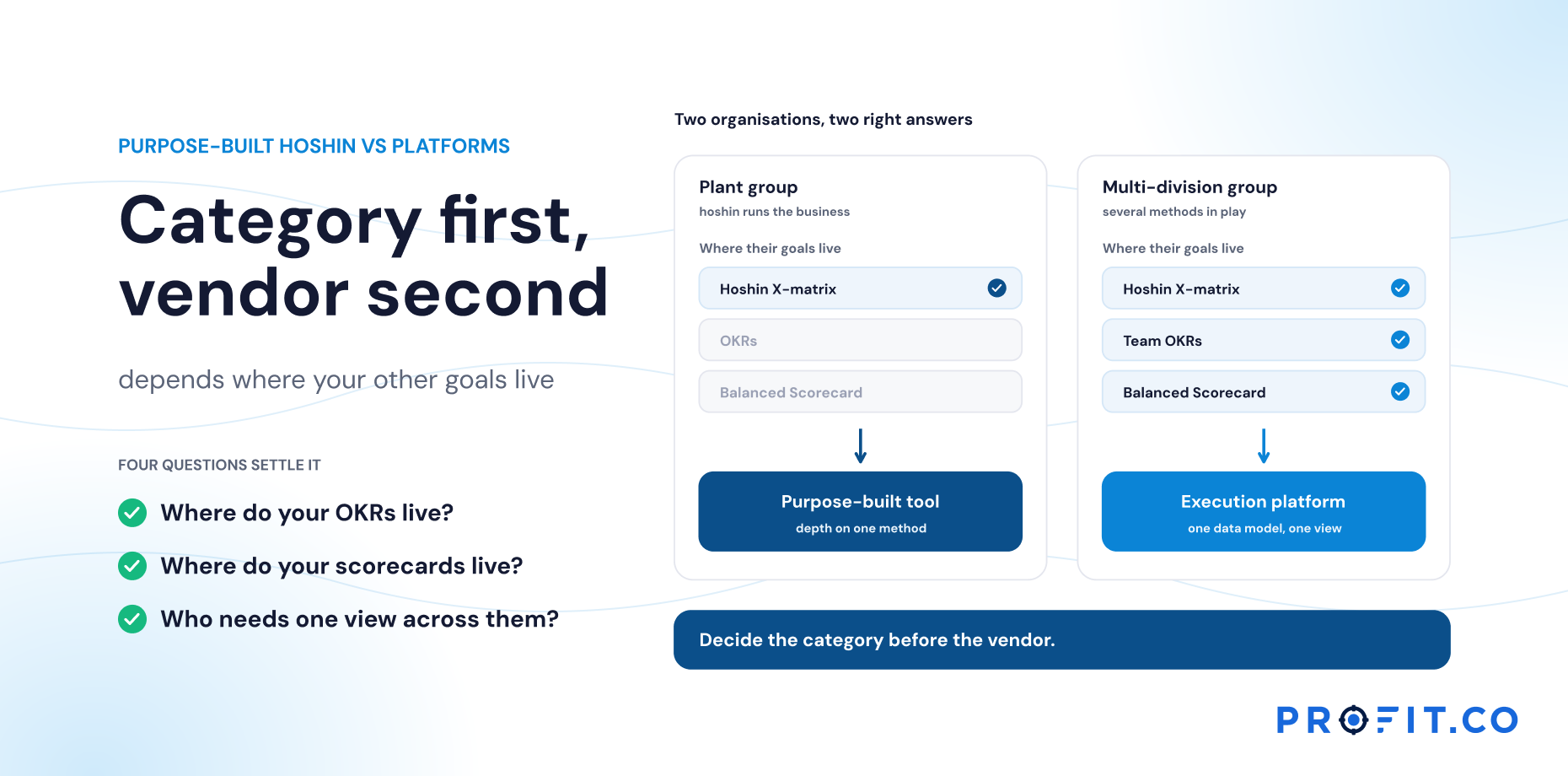
A worked example: two organizations, two answers
Two illustrative organizations answer the same four questions and reach different conclusions.
| Question | Organization A | Organization B |
|---|---|---|
| Where do teams below hoshin set goals? | Nowhere separately. Hoshin runs from the executive team to shop-floor boards | Sales and R&D run quarterly OKRs; operations runs hoshin |
| Does anyone report through a scorecard? | No | Yes, the board pack is a Balanced Scorecard |
| Who owns the tool in two years? | Operational excellence | Strategy office, with finance and HR as users |
| How many systems does a team result pass through? | One | Three today: OKR tool, hoshin spreadsheet, board pack |
Illustrative.
Organization A is a single-business manufacturer with mature lean practice and one method. A purpose-built hoshin tool fits it well, and there’s nothing to reconcile.
Organization B is a multi-division group where hoshin is one layer of three. Every month, a strategy analyst matches sales and R&D key results to hoshin priorities and rebuilds the scorecard view from both. For B, the deciding factor isn’t X-matrix depth; it’s removing that monthly reconciliation. A platform that runs all three methods on one data model fits better, provided it passes the same hoshin tests as a specialist tool.
The same features can be the right purchase for one organization and the wrong one for another. The deciding question is where the rest of your goals live.
The cost difference the comparison usually misses
Category choice is argued on capability and decided on price, and the price comparison is almost always scoped wrong. A purpose-built tool gets compared against a platform on license cost alone, which flatters the specialist, because that license is only one line of what the specialist route actually costs.
| What the route requires | Specialist route | Platform route |
|---|---|---|
| Hoshin kanri software | One subscription | Included |
| Where team goals live | A separate OKR software or goal management software subscription | Same subscription |
| Board and governance reporting | Balanced scorecard software, or assembled by hand each cycle | Same subscription |
| Integration between them | Built and maintained by you, or done manually every month | Not required |
| The monthly reconciliation | An analyst’s time, every month, indefinitely | Removed |
| Renewal exposure | Three vendors, three uplifts, three renewal dates | One |
Scope both quotes across every row the route requires, not just the first one.
Organization B in the example above already pays for three of those rows and does the fourth by hand. Its specialist quote would have to be substantially cheaper than the platform quote to come out ahead, and that is before the analyst’s monthly time is counted at all.
The comparison runs the other way just as honestly. Organization A pays for exactly one row. For A, a platform’s extra breadth is capability it will never use, and a specialist strategy management software license is both the cheaper and the better answer. The route decides the number, not the category.
One scoping question settles most of it: if we add OKRs or a scorecard in two years, is that the same subscription or a new vendor? In Profit.co, Hoshin Kanri, OKRs & Goals, Balanced Scorecard and Strategy Roadmap sit inside the Essentials plan, which carries a 30-day free trial, so for us that answer is the same subscription. Ask every specialist the same question and write the answer into the comparison.
Test hoshin depth either way
Whichever category you lean towards, run the same seven pass/fail tests for choosing hoshin kanri software on every shortlisted product. Platforms in particular should be held to the same standard as specialists on correlation strength, outcome lag and catchball, because breadth is no excuse for a thin X-matrix.
Profit.co runs hoshin kanri, OKRs and Balanced Scorecards on one data model, so a team key result checked in by its owner updates the hoshin objective it contributes to and the scorecard perspective that objective sits under. The hoshin module itself is described on the hoshin kanri software overview.
What one data model removes
| Monthly job on separate tools | What replaces it on one model |
|---|---|
| Matching team key results to the hoshin priorities they serve | The key result already contributes to its objective; no matching step exists |
| Rebuilding the scorecard view from two sources | The objective sits under its scorecard perspective already |
| Chasing owners across two systems for one review | One check-in cadence covers both, through the same engine |
| Reconciling which number is current | The audit history records every change with a timestamp |
Free Product Demo
See hoshin, OKRs and scorecards on one model
A 30-minute walkthrough, tailored to your team.
Book a free demo
What happens in the call
How your teams set goals, track progress and review results.
Strategy, performance, projects and engagement on one platform, with AI.
A practical path to align teams, execute faster and drive results.
Questions this article answers
Purpose-built hoshin tools center on the X-matrix and lean method. Strategy execution platforms run hoshin alongside OKRs, Balanced Scorecards and sometimes performance management on one data model.
They are excellent at their own jobs, but none is built to hold correlations between priorities and KPIs. Using them for hoshin usually recreates the spreadsheet problem of comparing progress by hand.
Yes. Run the same tests on both: correlation strength, outcome lag, catchball, bowler, horizons, drill-down and check-in cadence. Breadth doesn’t excuse a thin X-matrix.
It depends on the route, not the license. If the specialist route also needs OKR software and balanced scorecard software, the platform is usually cheaper. If hoshin is your only method, the specialist is.
Only if hoshin stops above team level. When teams set quarterly goals in another format, those goals and the hoshin priorities they serve must either share a data model or be reconciled by someone every month.
Every subscription the route requires, the integration work between them, implementation, and the renewal exposure across however many vendors it leaves you with. Comparing first-line license costs alone flatters whichever route needs the most tools.