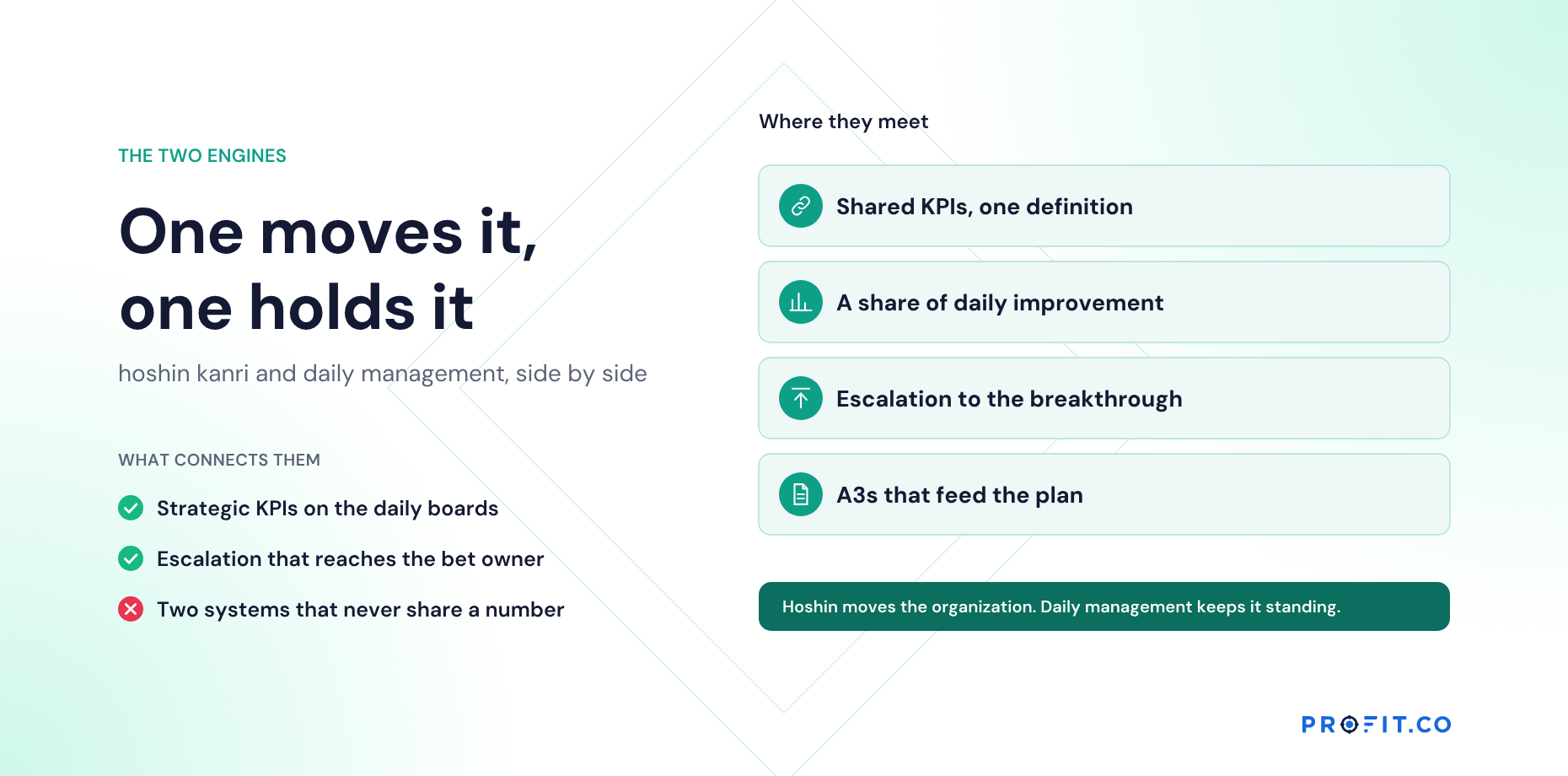













Lean Six Sigma programs are disciplined about measurement inside each project and often loose about how projects connect to the strategy. The result is a portfolio of successful projects and a strategy that hasn’t moved.
In this guide
Key Takeaways
- →Alignment breaks at four stages: selection, charter, review and closure.
- →Six Sigma already has the tool: apply Y = f(x) at the strategic level.
- →Select projects on the drivers with the largest gaps, not from a list of ideas.
- →Five lines in a charter: project Y, strategic KPI, contribution, lag, how it is checked.
- →Judge on benefits at closure and on KPI movement after the expected lag.
- →Projects should keep their promises; promises should add up to the strategy.
Where alignment breaks
The gap is never in the rigour of the projects. It opens at four specific handovers, each of which looks complete on its own terms.
Read the right-hand column downward and the pattern is the same each time: something was measured carefully, and it was not the strategy.
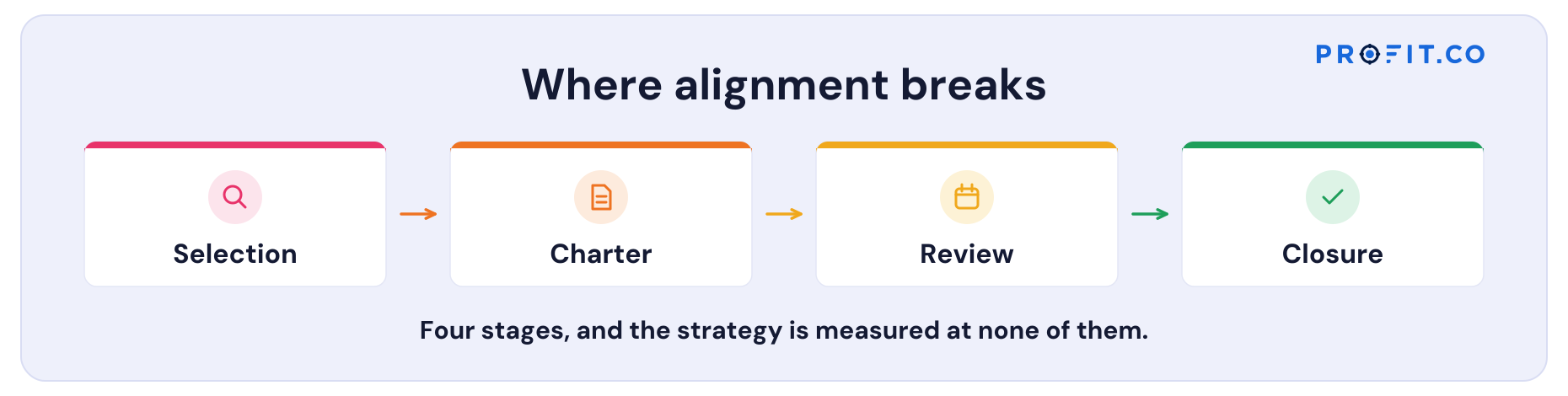
| Stage | Common practice | Gap |
|---|---|---|
| Selection | Projects proposed bottom-up or by belts needing certification projects | Few start from the strategic KPIs |
| Charter | Project metric (the project Y) and savings | No link to the strategic KPI |
| Review | Tollgates on DMAIC phases | No view of the strategy |
| Closure | Savings validated by finance | No check that the strategic KPI moved |
Selecting from the strategy down
Six Sigma thinking already has the right tool: the idea that an outcome is a function of its drivers, often written Y = f(x). Apply it at the strategic level. For each strategic KPI, ask what drives it, and select projects on the drivers with the largest gaps. That turns the hoshin plan into the project pipeline rather than a separate list.
A project portfolio selected from the strategy can’t drift from it. One selected from a list of ideas usually does.
A charter that names the strategy
- Project Y, as usual.
- The strategic KPI the project Y should move.
- Expected contribution to that KPI.
- Expected lag before the KPI should respond.
- How the effect will be checked after closure.
Four of those five lines already exist in some form. The one that is genuinely new is the expected lag, and it is the one that makes the rest testable: without a stated date, “it should feed through eventually” can never be wrong, so no charter is ever disproved.
Judging closed projects
| Dimension | Benefits view | Strategy view |
|---|---|---|
| Question | Did the project deliver its savings? | Did the strategic KPI move? |
| When | At closure | After the expected lag |
| Why both | Projects should keep their promises | Promises should add up to the strategy |
Note that the two views are not in competition and do not share a date. A project can pass the first in March and fail the second in September, and both results are worth having: the first says the team did what it said, the second says the theory behind the charter was wrong.
A worked example: eight projects, two views
Here are hypothetical projects viewed two ways, by the savings validated and by whether the strategic KPI moved:
| Project | Savings validated | Strategic KPI | KPI moved? |
|---|---|---|---|
| Reduce changeover time, line 2 | Yes | On-time delivery | Yes |
| Warehouse picking accuracy | Yes | On-time delivery | Yes |
| Invoice error reduction | Yes | None named | — |
| Service dispatch routing | Partly | Services attach rate | Yes, after lag |
| Scrap on press 4 | Yes | Scrap rate | No: other presses got worse |
Every project but one passed on benefits. The strategy view adds two findings: one project had no strategic link at all, and the scrap project improved one press while the KPI was driven by others, which points the next project at the right press.
The service dispatch row is the one to keep. It was the weakest project on its own terms and the clearest win on the strategy’s, which is exactly the result a benefits-only review would have buried.
What a well-run portfolio can cost
A Lean Six Sigma program is among the most expensive improvement structures an organization can run: trained belts, project time, tollgate reviews and a finance function validating savings. All of that is justified by a portfolio of projects that keep their promises, and in the table above, they do. The cost is not waste in the usual sense. It is that a disciplined, expensive machine spent a year pointed by a list of ideas rather than by the plan, and nothing in its own reporting could say so.
Two rows make the number concrete. Invoice error reduction consumed a full belt project with no strategic link; scrap on press 4 consumed another and improved a press the KPI was not driven by. On a portfolio of eight, that is a quarter of the program’s capacity, delivered successfully, against measures the strategy did not need. Selecting from the strategy down costs nothing extra and removes most of that.
Among published alternatives for holding both views, OnStrategy lists $200 per month for unlimited users and i-nexus publishes a free Starter tier for up to five users with $28 per user per month at its Standard tier. The capability to test is specific: can a project carry the strategic KPI it should move and the expected lag, and will the system tell you, after that lag, whether the KPI responded? A tollgate tracker that shows DMAIC phases will not.
Profit.co publishes two plans, Essentials and Enterprise, quoting against modules and scale rather than a public seat rate, which suits a belt population measured in dozens rather than thousands. Hoshin Kanri, OKRs and Goals and Balanced Scorecard sit in Essentials, and the 30-day free trial is enough to load a closed portfolio and produce the two-view table above from your own projects.
Delivery and effect on one objective
In Profit.co, projects can run as initiatives linked to the strategic KPI they should move, with the expected lag on the correlation, so a closed project’s effect appears beside its delivery on the same objective. See the lean strategy software page.
Holding both on one record changes what the portfolio review can conclude:
- A project with no strategic KPI is visible at charter time, not discovered at year end when the pipeline is already spent.
- The lag has a date attached, so the check after closure happens rather than being remembered.
- A failed theory is recorded, not argued. Scrap on press 4 becomes a finding about which press to target next, because the charter said what it expected.
The same discipline applied to everyday improvement rather than formal projects is in Linking Kaizen and CI Projects to Strategic KPIs, and choosing how much capacity to point this way is in Steering Improvement Capacity Toward Breakthroughs, Without Killing Kaizen.
Free Product Demo
Connect your project portfolio to your strategy
A 30-minute walkthrough, tailored to your team.
Book a free demo
What happens in the call
How your teams set goals, track progress and review results.
Strategy, performance, projects and engagement on one platform, with AI.
A practical path to align teams, execute faster and drive results.
Questions this article answers
Select projects from the strategic KPIs and their drivers, name the strategic KPI and expected lag in each charter, review the portfolio with the hoshin plan, and check KPI movement after closure.
The strategic KPI the project Y should move, the expected contribution, the expected lag and how the effect will be checked.
Because projects are often selected bottom-up and judged on their own benefits, not on whether they move the strategic KPIs.
Sometimes, for compliance or a genuine base problem. The point is that it is a visible decision at charter time rather than something noticed at year end.
That is a finding, not a failure. It usually means the driver chosen was not the one the KPI depends on, which tells you where the next project belongs.