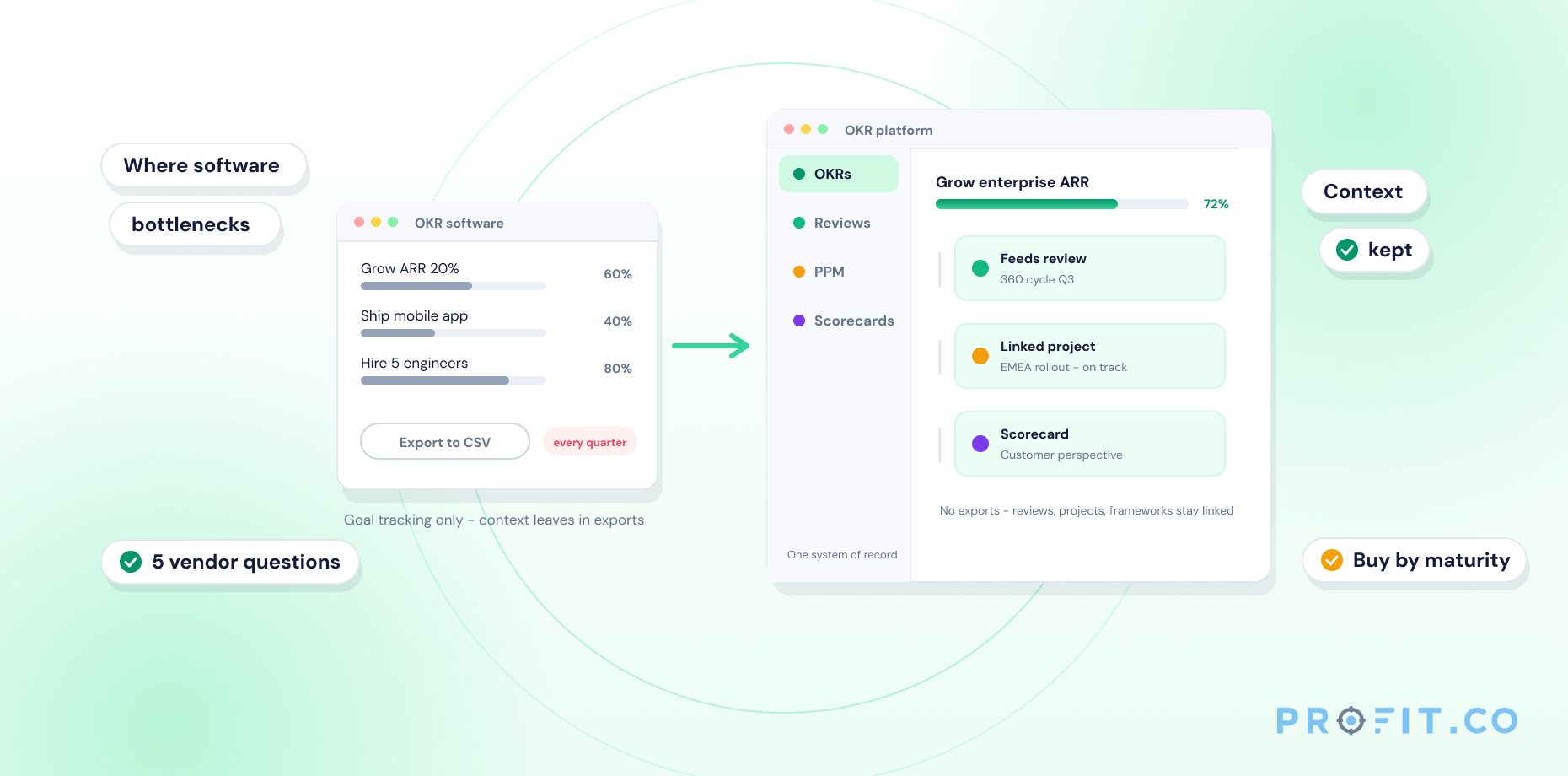
What are the core components of an OKR management system? An OKR management system includes five core components: goal setting, goal alignment and cascading, check-ins and progress tracking, reporting and dashboards, and integrations. Together, these components connect strategy to execution, from setting objectives at the company level to tracking key results at the team level every week.
Table of Contents
- 1. What Is an OKR Management System?
- 2. What Are the 5 Core Components of an Effective OKR Management System?
- 3. How Does Profit.co Cover Each Component?
- 4. What to Look For When Evaluating OKR Management Systems?
- 5. Key Takeaways
- 6. Frequently Asked Questions
Most OKR programs fail not because the methodology is wrong, but because the platform doesn’t support the full cycle. Here’s what every OKR management system needs to get right.
Setting OKRs is the easy part. The hard part is building a system that makes OKRs stick across departments, quarters, and organizational layers. Most companies start with a spreadsheet or a lightweight tool and hit a wall within two quarters: check-ins stop happening, alignment breaks down, and no one can tell which projects are actually driving the strategy.
An OKR management system solves this by providing a structured platform for every step of the OKR cycle, from writing goals to reviewing outcomes. But not all OKR tools cover all five components equally. Knowing what to look for before you evaluate a platform saves months of failed rollouts.
This guide covers the five components every OKR management system must have, how Profit.co delivers each one, and the buying criteria that separate strong platforms from glorified spreadsheets.
What Is an OKR Management System?
An OKR management system is software that manages the full lifecycle of OKR-based goal setting, from writing and aligning objectives, through weekly progress tracking, to end-of-quarter review and scoring. Unlike spreadsheets, a dedicated OKR management system connects individual contributor goals to company-level strategy, automates progress collection, and generates reporting that leadership can act on.
The best platforms, including OKR management software, go further, connecting OKRs to performance reviews, project portfolios, and AI-powered check-in automation in a single platform.
What Are the 5 Core Components of an Effective OKR Management System?
An effective OKR management system includes five core components: goal setting with structured OKR writing, goal alignment and cascading across organizational levels, check-ins and automated progress tracking, reporting and dashboards, and integrations that pull data from existing work tools.
Goal Setting
Goal setting is the foundation. An OKR management system must give teams a structured way to write Objectives and Key Results, not just text boxes, but guided writing that enforces OKR quality standards. The best platforms include AI-powered OKR writing assistance, quality scoring, and pre-built templates by department and industry. Without structured goal setting, teams write OKRs that are vague, unmeasurable, or disconnected from strategy.
Profit.co’s OKR Authoring Agent turns a strategy prompt into a complete, high-quality OKR set, and the Quality Agent scores every OKR before the quarter starts, improving OKR quality by 40%.
Goal Alignment and Cascading
OKRs only work when they connect vertically, from company-level Objectives down to team-level and individual Key Results. An OKR management system must make it easy to cascade goals across organizational layers, visualize alignment gaps, and prevent teams from setting OKRs that conflict with company priorities. In a 500-person organization, misaligned OKRs waste hundreds of hours per quarter.
Before designing alignment structures, teams often benefit from reviewing OKR examples by department, seeing how high-performing teams cascade OKRs across company, team, and individual levels makes the alignment requirements concrete.
Check-ins and Progress Tracking
Quarterly OKR reviews are not enough. Teams that check in weekly on key results show significantly higher OKR completion rates than those that check in monthly. An OKR management system needs a structured check-in workflow, scheduled nudges, progress updates tied to the Key Result metric (percentage, currency, milestone), and an audit trail of every update. Automated progress tracking, where the platform pulls data directly from Jira, Salesforce, or Google Sheets, eliminates the manual update burden that kills OKR adoption.
Reporting and Dashboards
Reporting is how leadership stays connected to strategy without sitting in status meetings. An OKR management system needs real-time dashboards showing OKR progress by team, department, and individual; at-risk flags for Key Results falling behind; and exportable reports for board presentations and quarterly reviews. Without strong reporting, OKRs remain invisible at the leadership level, tracked by individual teams but never informing company decisions.
Integrations
Progress data lives in the tools teams already use: Jira for engineering, Salesforce for sales, HubSpot for marketing. An OKR management system must connect to these tools to pull progress automatically, otherwise every check-in requires manual data entry, and adoption drops. The best OKR platforms offer 50+ integrations covering project management, CRM, BI, and communication platforms.
Profit.co connects to 100+ tools via its integrations library, including Jira, Salesforce, HubSpot, Microsoft Teams, Slack, Google Sheets, Power BI, and Azure DevOps.
How Does Profit.co Cover Each Component?
Profit.co is the only OKR platform that covers all five components natively, without requiring separate tools for reporting, performance, or project execution.
| Component | Profit.co Feature |
|---|---|
| Goal Setting | OKR Authoring Agent writes OKRs from a strategy prompt; Quality Agent scores every OKR before the quarter starts, improving quality by 40% |
| Goal Alignment | Alignment Agent cascades OKRs from company to team to individual; visual alignment maps surface connection gaps instantly |
| Check-ins and Progress | Weekly check-in workflows, automated nudges, and OKR Progress Agent pulls data from 100+ integrations automatically |
| Reporting and Dashboards | Real-time Cockpit view, exportable PDF/PowerPoint board reports, at-risk flagging, and OKR Review Agent for consolidated status |
| Integrations | 100+ integrations including Jira, Salesforce, HubSpot, Microsoft Teams, Slack, Google Sheets, Power BI, and Azure DevOps |
Profit.co’s 16 AI Agents cover every step of the OKR cycle, from authoring to alignment to progress to review. Beyond OKRs, Profit.co connects your OKR program to performance reviews, project portfolios, and employee recognition, so strategy, execution, and people data live in one platform. Teams looking to deepen their methodology can explore OKR University, the most comprehensive OKR education resource online.
Why Profit.co: Profit.co is the only OKR management system that covers all five core components, goal setting, alignment, check-ins, reporting, and integrations, in a single platform, with 16 named AI Agents automating every step. Most OKR tools require separate software for performance reviews and project portfolio management, creating disconnected data and reporting gaps. Profit.co eliminates that stack complexity by combining OKR management, performance reviews, PPM, and employee recognition under one roof, trusted by 1,000+ companies across 9 industries.
What to Look For When Evaluating OKR Management Systems?
Does it support the full OKR cycle, not just goal storage?
Many tools let you write OKRs but don’t support structured check-ins, scoring, or end-of-quarter review workflows. Evaluate whether the platform covers the full cycle, from goal authoring through reflect and reset, before committing. Check specifically for: check-in frequency controls, OKR scoring mechanisms (0.0-1.0 scale), and a structured quarter-close workflow.
Does it integrate with your existing work tools?
An OKR platform that requires manual progress updates will fail within two quarters. Confirm integrations with the tools your teams actually use: Jira for engineering, Salesforce for sales, HubSpot for marketing. Platforms with fewer than 20 integrations are a red flag for teams running modern stacks.
Does it scale with your organization?
OKR software that works for 50 people rarely works for 500. Look for: role-based permissions, SSO, bulk OKR management, department-level reporting, and API access for custom integrations. These features are non-negotiable as your OKR program matures beyond a pilot.
Does it connect OKRs to performance reviews and projects?
The biggest gap in standalone OKR tools is the disconnect between goal data and performance review data. Managers should see OKR completion rates and performance scores in the same view. If your OKR platform and your HR platform are separate, that connection breaks, and review cycles become guesswork.
Does it meet enterprise security and support requirements?
SOC2 compliance, ISO certification, 99.9% uptime SLA, and 24/7 live support are non-negotiable for mid-market and enterprise teams. Many lightweight OKR tools skip these certifications, blocking them from clearing procurement in regulated industries like healthcare and financial services.
Key Takeaways:
- An OKR management system covers five components: goal setting, alignment, check-ins, reporting, and integrations.
- Automated progress tracking is the biggest driver of OKR adoption. Manual updates kill check-in compliance within two quarters.
- The disconnect between OKR data and performance review data is the most common failure point in OKR programs.
- Profit.co covers all five components natively, with 16 AI Agents automating every step of the OKR cycle.
- Evaluate platforms on integration breadth, scalability, and security certifications, not just OKR feature lists.
Ready to see all five components working together?
Frequently Asked Questions
An OKR management system is software that manages the full OKR cycle, from writing objectives and key results, through weekly progress tracking and check-ins, to end-of-quarter scoring and review. It connects individual contributor goals to company-level strategy and generates reporting for leadership decisions.
The five core components are: goal setting with structured OKR writing, goal alignment and cascading, check-ins and automated progress tracking, reporting and dashboards, and integrations with existing work tools such as Jira, Salesforce, and Microsoft Teams.
A spreadsheet requires manual updates, has no alignment visibility, and generates no automated reporting. An OKR management system automates progress collection via integrations, enforces OKR quality standards, cascades goals across organizational levels, and produces board-ready reporting, all in real time, without manual data entry.
At minimum, your OKR platform should integrate with your project management tool (Jira, Asana, or Monday), your CRM (Salesforce or HubSpot), and your communication platform (Slack or Microsoft Teams). Platforms with fewer than 20 integrations require manual data entry, which reduces check-in compliance within two quarters.
Yes. Profit.co offers a free plan and a free trial, no demo required to get started. Visit app.profit.co/signup to begin, or book a guided demo at profit.co/request-demo.