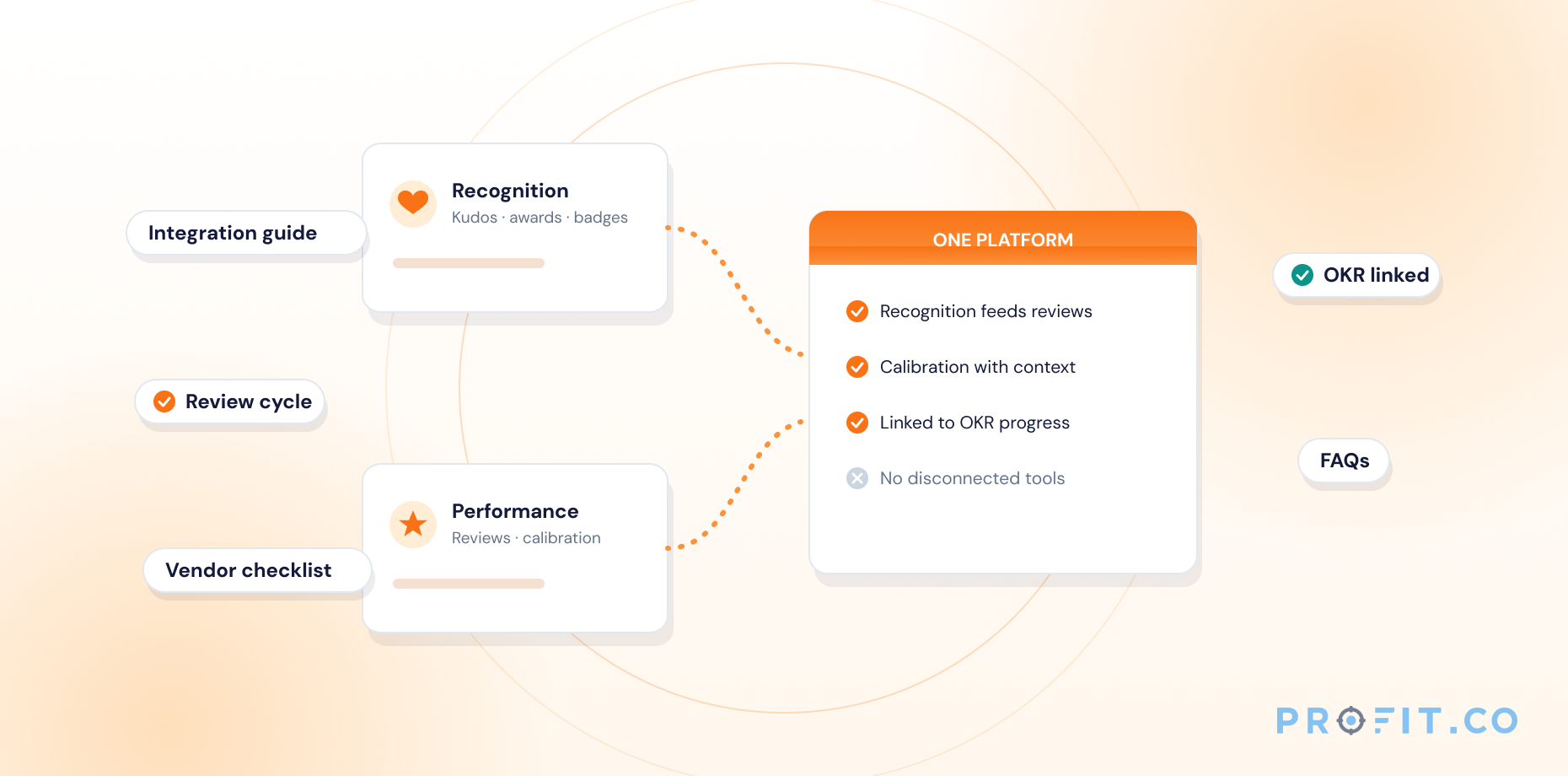
Employee recognition and performance management work best when integrated in a single platform, where recognition data automatically informs reviews, calibration, and OKR tracking instead of living in a disconnected tool. Most companies run the two as separate processes with separate data, which means recognition doesn’t inform decisions and performance reviews miss half the picture. This guide covers why integration matters, what a fully integrated platform includes, and how to evaluate vendors.
In this guide
- Why Employee Recognition and Performance Management Are Stronger Together
- What a Fully Integrated Recognition and Performance Platform Includes
- How to Integrate Employee Recognition Into Your Performance Review Cycle
- Connecting Recognition to OKRs: Making Recognition Strategic
- Platform Evaluation: 10 Questions to Ask Any Vendor
- Frequently Asked Questions
Why Employee Recognition and Performance Management Are Stronger Together
Most companies run recognition and performance management as completely separate processes: separate tools, separate data, separate review cycles. A manager might see six months of peer recognition for an employee and still walk into a performance review with no idea it exists, because the two systems never talk to each other. That disconnect is costly: it means recognition doesn’t inform decisions, and performance reviews miss half the picture. For a deeper look at this specific gap, see the missing link between motivation and results.
Recognition data reveals who is performing well and how, the specific behaviors, collaborations, and moments that made the difference. Performance data shows what goals are being hit. Neither is complete alone.
Three real consequences of running these separately: managers under-recognize employees whose contributions are cross-functional and invisible in their own goal tracker; calibration sessions rely on recency bias because nobody has a record of contributions from four months ago; and high performers who aren’t self-promoters get passed over for advancement because their manager’s mental model of their year is incomplete. Recognition data is a genuine retention signal in its own right, an employee whose contributions are consistently visible and acknowledged has a documented reason to feel their work matters, not just a vague sense that it might.
What a Fully Integrated Recognition and Performance Platform Includes
| Capability | Integrated Platform | Separate Recognition + Performance Tools |
|---|---|---|
| Recognition visibility in reviews | Appears automatically inside the review | Manager must search a separate tool, if they remember to |
| Link to goals/OKRs | Every recognition event ties to a specific objective | Recognition is generic, with no goal context |
| Calibration input | Recognition data is a structured, comparable input | Relies on manager memory and recency bias |
| Milestone triggers | Automated based on tenure and goal data | Depends on a manager remembering the date |
| Analytics | Recognition-to-retention correlation reporting built in | No connection between the two data sets |
1. Recognition events linked to specific goals or OKRs. Every recognition entry references the objective or key result it relates to, so recognition has context instead of being a generic “great work” note. A recognition tied to “reduced average discount from 18% to 11%” is evidence a manager can use in calibration; “great work” is not.
2. Recognition data surfaced inside performance reviews. When a manager opens a review, recognition history for that period appears automatically, no searching a separate tool or asking HR to pull a report. This is the single change that most reliably gets recognition data actually used at review time.
3. Milestone recognition tied to tenure and performance milestones. Years-of-service and goal-completion milestones trigger recognition prompts automatically, so nothing depends on a manager remembering a date buried in an HRIS. A five-year anniversary or a completed stretch OKR triggers the same way, automatically, not manually.
4. Manager visibility into team recognition patterns. Managers can see who on their team is under-recognized relative to their contribution, catching quiet high performers before calibration instead of after a departure. This surfaces the employee who consistently delivers but never self-promotes.
5. Peer recognition usable in calibration. Peer recognition volume and content become a legitimate, structured input to calibration discussions, not an HR-only metric nobody references in the room. Calibration conversations grounded in recognition data are harder to derail with recency bias.
6. Recognition analytics showing correlation with retention. Leaders can see, by department, whether recognition frequency correlates with retention and engagement scores, turning recognition from a feel-good initiative into a measurable retention lever. For the specific metrics worth tracking, see recognition program KPIs.
7. Single platform, not duct-taped integrations. Recognition and performance data live in one system rather than being reconciled after the fact between two vendors, which removes the export-and-match step most teams quietly skip under deadline pressure.
See Recognition and Performance Data in One Platform
How to Integrate Employee Recognition Into Your Performance Review Cycle
1. Define recognition-worthy behaviors in terms of goals or OKRs. Recognition should reference specific outcomes, not general enthusiasm, tie the criteria explicitly to what the team is trying to achieve. A criterion like “unblocked a cross-team dependency before it delayed a KR” is usable; “shows great attitude” is not, because it can’t be tied to anything measurable later.
2. Choose a platform that links recognition to goal progress natively. If recognition and OKRs live in separate systems, this step becomes a manual export-and-match exercise every cycle, and most teams quietly drop it the first time a deadline gets tight. Native linking means a recognition event is created directly against the OKR it relates to, with no reconciliation step required.
3. Train managers to use recognition data during review prep. Make pulling up an employee’s recognition history a standard step in review preparation, not an optional add-on that depends on the manager remembering to look. A five-minute habit, check recognition history before drafting the review, closes most of the gap between what happened and what gets written down.
4. Include a recognition summary in the review template. Add a dedicated field so recognition is visible in the same document as goal progress, not a footnote or a separate attachment. When the field is part of the template itself, filling it in becomes part of the review process rather than an afterthought a manager has to remember unprompted.
5. Use recognition patterns in calibration to identify under-visible high performers. Cross-reference recognition volume against goal completion to catch employees whose contributions are real but quiet, high goal completion paired with low recognition volume is a specific, actionable signal. This turns calibration into a data-informed conversation instead of a debate driven by whoever advocates loudest in the room.
Connecting Recognition to OKRs: Making Recognition Strategic
Recognition tied explicitly to OKR progress stops feeling performative and starts feeling earned. When a recognition message says “closing the Meridian Software renewal moved our retention KR from 82% to 89%” instead of “great work this quarter,” it becomes evidence of contribution rather than a pleasant but forgettable gesture, and it’s the kind of specific note that holds up months later in a calibration conversation.
OKR check-in moments are a natural recognition trigger, the weekly or bi-weekly check-in is when progress becomes visible, and that’s the moment recognition should happen, not months later at review time when the context has faded.
Profit.co connects recognition natively to OKR milestones, so a completed key result can trigger a recognition prompt automatically instead of relying on a manager to remember weeks after the fact. That automation matters most for exactly the contributions most likely to go unnoticed, the quiet unblock, the cross-team assist, the fix that prevented a bigger problem no one saw.
Platform Evaluation: 10 Questions to Ask Any Vendor
- Does recognition data appear directly in manager review dashboards, or does it require a separate login?
- Can a recognition event be tied to a specific OKR or key result?
- Is milestone recognition automated based on tenure and goal data, or fully manual?
- Does the platform provide recognition analytics broken down by department?
- Is peer recognition weighted as an input in calibration discussions?
- Can you track the correlation between recognition frequency and retention?
- Are performance reviews and recognition managed in the same platform?
- Can managers see a team member’s full recognition history before writing a review?
- Is there a built-in report showing recognition-to-performance correlation?
- How is recognition data privacy and visibility handled, who can see what?
Profit.co connects recognition, OKR progress, and performance reviews in a single platform, so none of these questions require a workaround. See how it works.
See How Profit.co Connects Recognition, OKRs, and Performance Reviews
Frequently Asked Questions
Recognition captures the specific behaviors and contributions behind performance; performance management tracks goal outcomes. Together they give a complete picture, separately, each misses half the story.
Yes, when possible. Keeping them separate forces managers to manually reconcile recognition history with goal data at review time, which most skip under time pressure.
Add a dedicated recognition summary field to the review template, train managers to check recognition history during review prep, and use a platform where recognition links directly to goals.
It links recognition events to specific OKRs, surfaces that history inside reviews automatically, and gives managers analytics on recognition patterns across their team.
Regular, specific recognition tied to real outcomes correlates with higher engagement and retention, and helps managers identify high performers who might otherwise go unnoticed in goal-only tracking.