












A cascade is efficient: targets flow down in days and every goal links to the one above. It’s also why so many targets are disputed by March and quietly abandoned by June. Negotiation takes a few weeks longer and produces targets people actually own.
In this guide
Key Takeaways
- →Cascades are fast and guarantee every goal links upward. They also assume the top knows each level’s situation.
- →Three failure modes: targets nobody believes, hidden dependencies, and lost reasoning.
- →Negotiation records the number and the reasoning, so a September review discusses the cause rather than memories.
- →Two to four weeks in dated rounds, not an open debate: each level counters only its own number.
- →Commitments below have to be checked against the target above before anything is agreed.
- →In hoshin kanri this is called catchball, but the mechanics matter more than the name.
What a cascade does well
Cascades are popular for good reasons. They’re fast. They guarantee every goal links to something above it. They’re easy to explain and easy to put in software: copy the parent goal, add a child goal, repeat.
They also embed an assumption: that the people setting targets at the top know enough about each level’s situation to set the right number. Sometimes they do. Often they don’t, and the cascade has no mechanism for finding out.
Three ways cascades fail
Targets nobody believes
A division receives a number it considers unreachable. It doesn’t say so, because there’s no forum, or says so and is told to try harder. The target stays on the system and is quietly treated as aspirational.
Hidden dependencies
A target depends on another function’s work that was never agreed. The division commits to a result it doesn’t control and discovers the dependency when it fails.
Lost reasoning
Months later, when the target is missed, nobody remembers why it was set where it was or what it assumed. The review becomes a contest of memories.
What negotiation adds
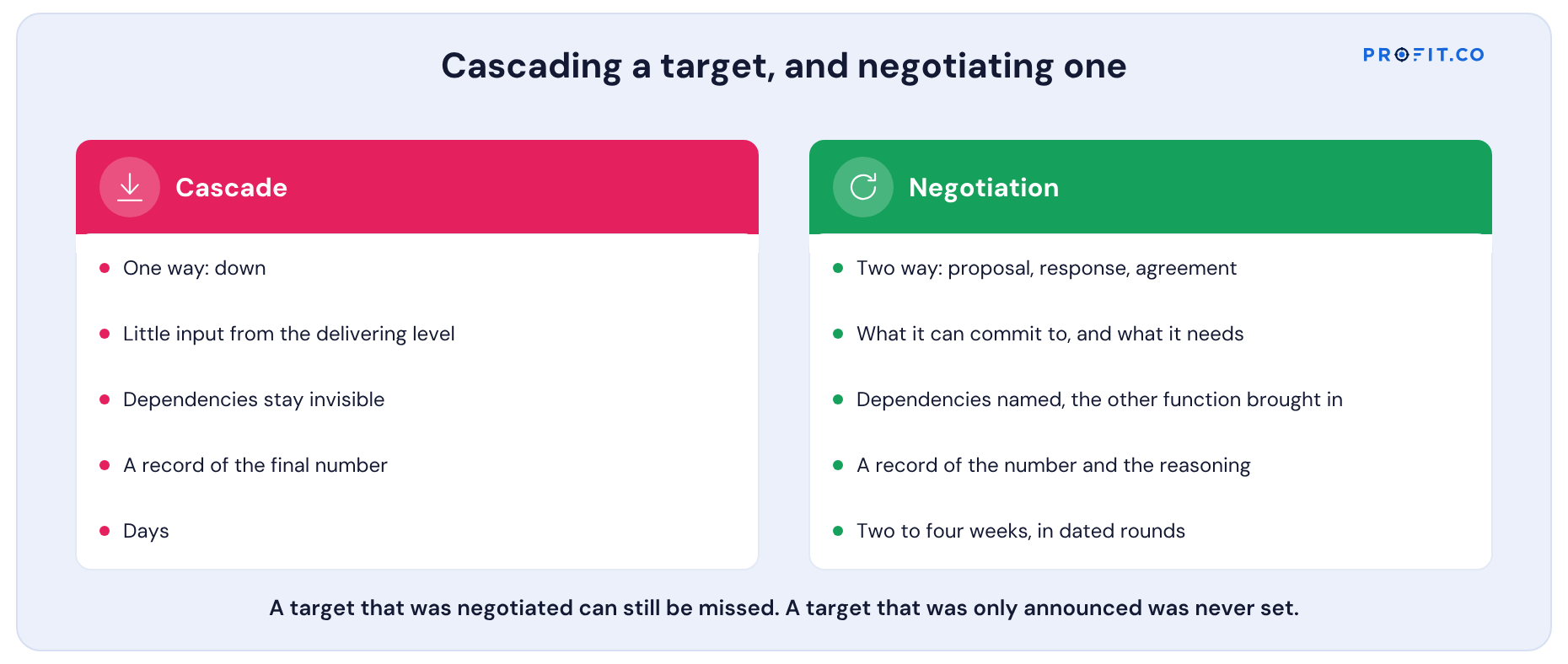
Five questions, answered one way by a cascade and another by a negotiation.
| Cascade | Negotiation | |
|---|---|---|
| Direction | One way: down | Two way: proposal down, response up, agreement |
| Input from delivering level | Little or none | What it can commit to, what it needs, what it assumes |
| Dependencies | Invisible | Named, and the other function brought in |
| Record | The final number | The number and the reasoning |
| Time | Days | Two to four weeks, in dated rounds |
In hoshin kanri this negotiation is called catchball. Organizations that don’t use the term can run the same process: the mechanics are what matter. See Running Catchball Rounds in Hoshin Planning: How Many, How Long.
Negotiating without endless debate
- Dated rounds. Usually two, three at most, each closing on a fixed date.
- Each level counters only its own number. Not everyone else’s.
- Commitments must add up. The targets below are checked against the target above before agreement.
- Escalate deadlocks, rather than running another round.
A target that was negotiated can still be missed. A target that was only announced was never really set.
A worked example: one target, cascaded and negotiated
Here is a hypothetical target, cascaded to each region and negotiated from week 1 to September:
| Step | Cascade | Negotiation |
|---|---|---|
| Week 1 | Group sets each region’s services target at 36% | Group proposes 36% to each region with its reasoning |
| Week 2 | Regions acknowledge | North America responds: 30% without the new contract model; 36% with it by Q2 |
| Week 3 | – | Commercial brought in; commits to the contract model by March |
| Week 4 | – | Agreed: 31%, rising to 36% if the model is live by 31 March |
| September | North America at 31%; target “missed”; dispute | North America at 31%; contract model slipped; target was conditional; the review discusses the contract model |
Same region, same result. In one column the September review is an argument; in the other it’s a conversation about the actual cause.
What a disputed target costs
The cost of a cascade isn’t the four weeks it saves in planning season. It’s the months afterwards: review meetings spent re-litigating numbers, an owner who never believed the target managing expectations instead of the result, and a year-end judgment that can’t separate a bad target from bad delivery.
Among published alternatives for holding the negotiation itself, OnStrategy lists $200 per month for unlimited users. i-nexus publishes a free Starter tier for up to five users and $28 per user per month at its Standard tier. The test for either is narrow: when a level counters a proposed target, is the counter and its reasoning kept with the target, or does it live in email?
Profit.co publishes two plans, Essentials and Enterprise, quoting against modules and scale rather than a public seat rate. Catchball sits in Essentials with OKRs and Goals, Balanced Scorecard, Hoshin Kanri and Strategy Roadmap. What Drives the Cost of Hoshin Kanri Software lists the rest to total, and the 30-day free trial is long enough to run one real round of negotiation.
Negotiating targets in Profit.co
In Profit.co, targets are negotiated in catchball sessions: a thread, a change table, agreement from every participant, each participant countering only their own number, and a balance constraint so cascaded targets add up before the session can close. See the strategy deployment software page.
Three details matter more than the feature list:
- The reasoning is stored with the number. When September’s review opens the target, the conditions it was agreed under open with it.
- A dependency pulls in the function it depends on. Commercial has to agree to the contract model before the region’s conditional target can close.
- The session cannot close unbalanced. If the regions’ commitments don’t add to the group target, the gap is visible in planning season rather than in September.
How a negotiation becomes a durable record rather than a thread nobody reopens is covered in Catchball in Software: Turning Negotiation Into a Record.
Free Product Demo
Negotiate your next targets on the record
A 30-minute walkthrough, tailored to your team.
Book a free demo
What happens in the call
How your teams set goals, track progress and review results.
Strategy, performance, projects and engagement on one platform, with AI.
A practical path to align teams, execute faster and drive results.
Questions this article answers
Cascades copy targets down with little input from the levels that must deliver them. The result is alignment without ownership, hidden dependencies and no record of why targets were set.
Propose a target with its reasoning, let the receiving level respond with what it can commit to and what it needs, bring in any function it depends on, and agree in two or three dated rounds.
It typically takes two to four weeks rather than days, which is usually recovered many times over in fewer disputes later in the year.
The hoshin kanri name for negotiating targets between levels: a proposal goes down with its reasoning, a response comes back with what the level can commit to, and the two sides agree. Organizations that don’t use the term can run the same process.
Four rules: dated rounds, usually two; each level counters only its own number; commitments below are checked to add up to the target above; and deadlocks are escalated rather than run through another round.