











Each strategy deployment framework was built to solve a particular problem, and each is excellent at it. None covers all three directions on its own. Most mature organizations end up combining two or three.
In this guide
Key Takeaways
- →Hoshin kanri: a few breakthrough bets, tested and corrected. Can feel heavy outside lean cultures.
- →OKRs: team focus and ambition. Little multi-year structure, and key results that drift into activity.
- →Balanced Scorecard: balance across perspectives. Can become a measurement catalogue.
- →4DX: weekly accountability on lead measures. Narrow by design.
- →No single framework covers down, up and across well, which is why combinations are common.
- →The risk of a combination is three tools and a monthly reconciliation.
Four frameworks at a glance
Read the last row first. Each framework’s blind spot is roughly what one of the others was built for.
| Hoshin kanri | OKRs | Balanced Scorecard | 4DX | |
|---|---|---|---|---|
| Origin | Japanese quality management | Popularized in technology companies | Kaplan and Norton, early 1990s | McChesney, Covey and Huling |
| Best at | A few breakthrough bets, tested and corrected | Team focus and ambition | Balance across perspectives | Weekly accountability on lead measures |
| Distinctive device | X-matrix, catchball | Objectives with key results | Four perspectives, strategy map | Wildly important goals, lead measures, scoreboard |
| Horizon | Multi-year and annual | Quarterly | Annual and multi-year | Annual, managed weekly |
| Blind spot | Can feel heavy outside lean cultures | Little multi-year structure; activity key results | Can become a measurement catalogue | Narrow by design; few goals at a time |
None of those blind spots is fatal on its own. They become a problem when an organization treats one framework as the whole answer.
Which direction each covers
| Framework | Down | Up | Across |
|---|---|---|---|
| Hoshin kanri | Strong: catchball | Strong: correlations, monthly review | Partial: horizontal catchball |
| OKRs | Moderate: alignment | Moderate: key result progress | Weak unless added |
| Balanced Scorecard | Moderate: cascading scorecards | Moderate: measures by perspective | Weak |
| 4DX | Moderate: goals per team | Strong on lead measures | Weak |
A generalization; practice varies by organization. The three directions themselves are defined in What Is Strategy Deployment? A Definition Without the Jargon.
No single framework covers all three directions well. That’s why combinations are common, and why one model underneath them matters.
Common combinations
| Combination | How it works |
|---|---|
| Hoshin at the top, OKRs below | Breakthroughs and priorities on the X-matrix; teams run quarterly OKRs that contribute to them |
| Scorecard for the board, OKRs for teams | Perspectives keep balance in governance; OKRs drive team work |
| Hoshin with scorecard perspectives | Perspectives sit on the X-matrix as a balance check |
| Any framework with 4DX-style lead measures | Weekly focus on the leading indicators the other framework identified |
How hoshin and OKRs divide the work is covered in detail in Hoshin Kanri and OKRs on One Platform: Where Each Belongs, and hoshin with the scorecard in Hoshin Kanri and the Balanced Scorecard: Perspectives on the Matrix.
Choosing a starting point
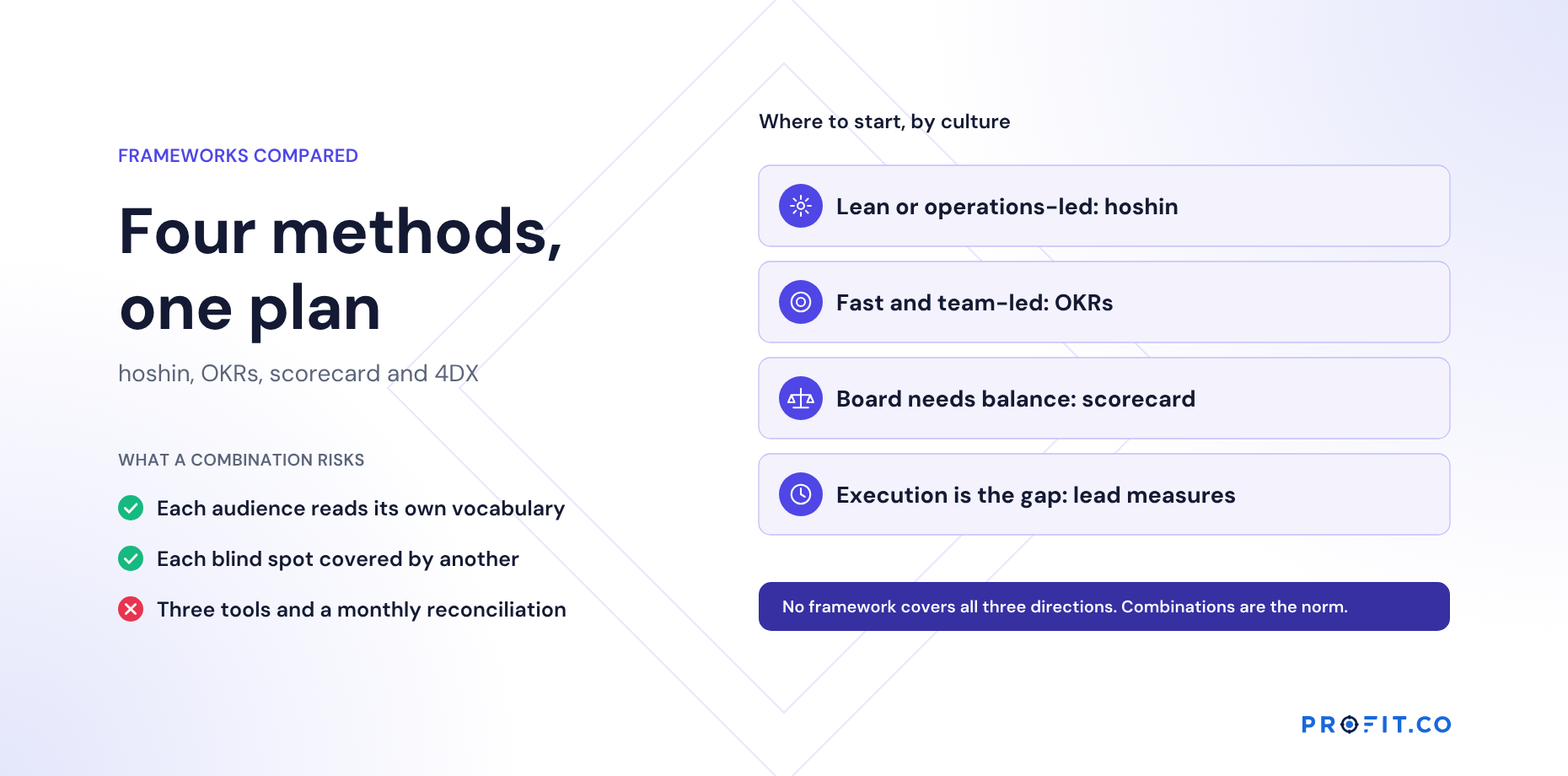
- Lean culture, manufacturing or operations-led: start with hoshin.
- Fast-moving, team-led, technology or product: start with OKRs.
- Board and governance need balance: start with the scorecard.
- Execution discipline is the main gap: add lead measures and a weekly cadence.
A worked example: one strategy, three frameworks
Here is a hypothetical organization with three audiences and three vocabularies for the same plan:
One organization, three audiences, three vocabularies for the same plan.
| Level | Framework used | What it holds |
|---|---|---|
| Board | Balanced Scorecard | Four perspectives; services share, margin, NPS, capability |
| Executive team | Hoshin kanri | Three breakthroughs; seven priorities; graded correlations |
| Teams | OKRs | Quarterly objectives contributing to hoshin priorities |
Three vocabularies, one plan. The risk is three tools and a monthly reconciliation.
What running three frameworks costs
Rarely three subscriptions. Usually one analyst, every month, matching a board measure to an executive priority to a team key result, because the three live in different places and nobody can be sure they still mean the same thing. The cost is the reconciliation, and the loss of confidence when two versions of one number disagree in front of the board.
Among published alternatives, OnStrategy lists $200 per month for unlimited users. i-nexus publishes a free Starter tier for up to five users and $28 per user per month at its Standard tier. For a combination, the question to put to either is whether a scorecard measure and a team key result can be the same record, or two records someone keeps in step.
Profit.co publishes two plans, Essentials and Enterprise, quoting against modules and scale rather than a public seat rate, which suits an organization running different frameworks at different levels. OKRs and Goals, Balanced Scorecard, Hoshin Kanri and Strategy Roadmap sit in Essentials on one data model. What Drives the Cost of Hoshin Kanri Software lists the rest to total, and the 30-day free trial is enough to load one objective and read it three ways.
Three frameworks, one model
Profit.co runs OKRs, the Balanced Scorecard and hoshin kanri on one data model, so a team’s key result updates the hoshin priority and the scorecard perspective above it. Teams that want lead-measure discipline can track leading key results with weekly check-ins on the same platform. See the strategy deployment software page.
In practice that removes the three costs of a combination:
- No reconciliation. The board’s services share and the team’s key result are the same record seen from two heights.
- No vocabulary argument. Each audience reads the plan in the words it already uses, and nobody has to convert.
- No lost blind spot. Hoshin’s correlations supply the upward direction that OKRs and the scorecard are weakest at.
Where to start if you are adding a second framework rather than replacing the first is set out in How to Integrate Hoshin Kanri With Other Management Systems.
Free Product Demo
See one strategy in several frameworks
A 30-minute walkthrough, tailored to your team.
Book a free demo
What happens in the call
How your teams set goals, track progress and review results.
Strategy, performance, projects and engagement on one platform, with AI.
A practical path to align teams, execute faster and drive results.
Questions this article answers
Hoshin kanri, OKRs, the Balanced Scorecard and the 4 Disciplines of Execution are the most widely used.
None is best for everything. Hoshin is strongest at testing a few breakthrough bets, OKRs at team focus, the scorecard at balance and 4DX at weekly accountability.
Yes, and mature organizations often do: for example a scorecard for the board, hoshin for the executive team and OKRs for teams, ideally on one data model.
Hoshin in a lean, manufacturing or operations-led culture; OKRs in a fast-moving, team-led one; the scorecard when the board needs balance; and lead measures with a weekly cadence when execution discipline is the gap.
Three tools and a monthly reconciliation. The combination only works if a board measure, an executive priority and a team key result can be the same record rather than three that someone keeps in step.