Strategy doesn’t die in the boardroom. It dies in the silence between your last review and your next one.
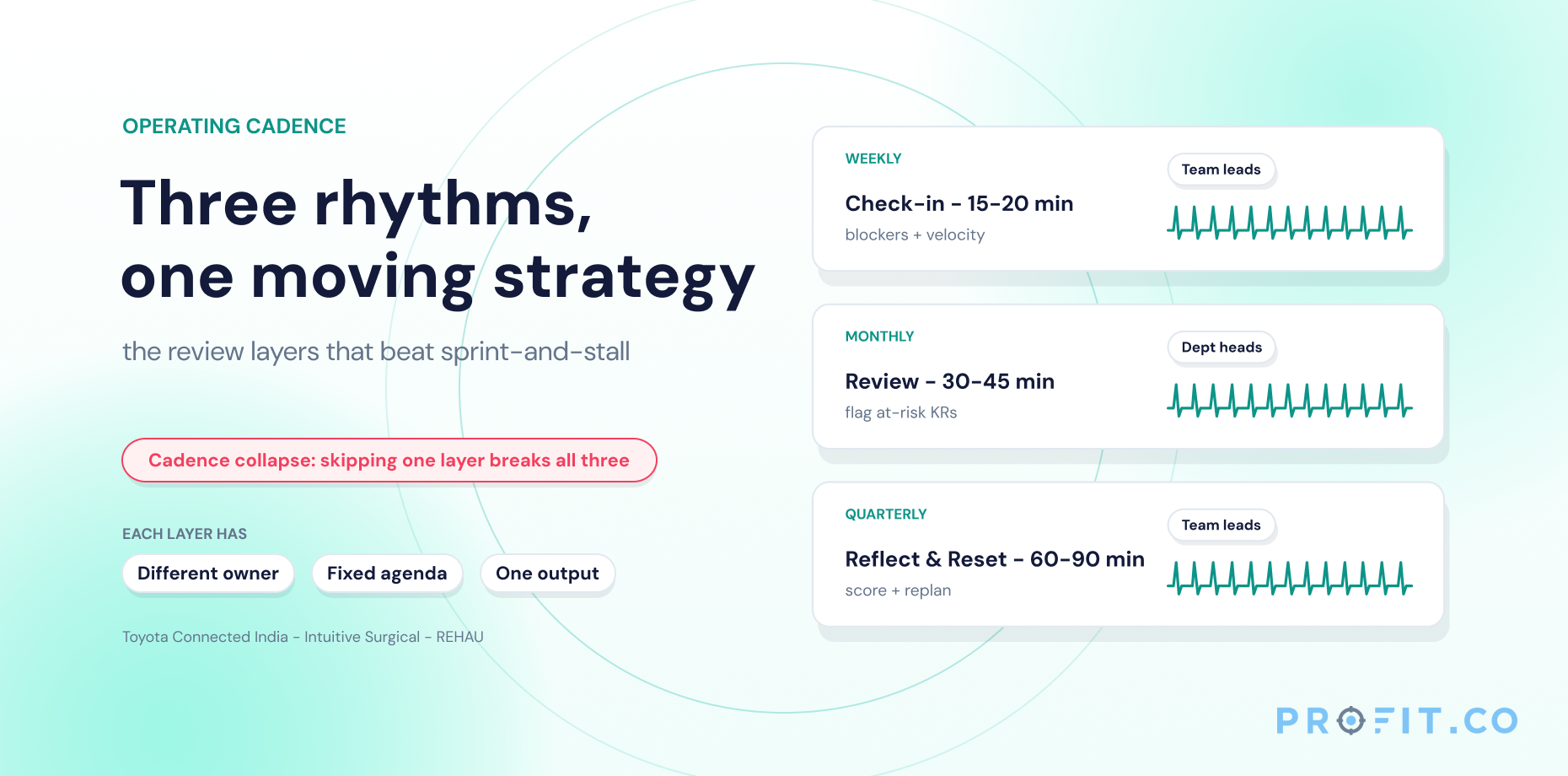
An operating cadence for execution is the structured, recurring schedule of weekly, monthly, and quarterly reviews that keeps strategy connected to day-to-day work. It creates predictable checkpoints where blockers surface, progress is measured, and decisions are made, before problems compound for 90 days unseen. The three core cadences are: weekly check-ins (15 to 20 minutes, tactical alignment), monthly reviews (30 to 45 minutes, OKR health signals and course correction), and quarterly Reflect & Reset sessions (60 to 90 minutes, OKR scoring and next-quarter planning). Organizations with a defined execution cadence replace reactive firefighting with a compounding rhythm of accountability.
Table of Contents
In this article
- What Is an Operating Cadence for Execution?
- The Cost of No Cadence: The Cycle of Sprinting and Stalling
- The Three Cadences That Drive Execution
- The Cadence Design Table
- How to Design Your Cadence: Roles, Agendas, and Authority
- The Five Cadence Mistakes That Kill Execution
- Worked Examples: Cadence in Action
- How Profit.co Operationalizes Execution Cadence
- FAQ
Key Takeaways
- Cadence is the operational backbone of strategy execution: it replaces reactive firefighting with three predictable, purpose-built review rhythms.
- The most dangerous failure is “cadence collapse”: treating a single quarterly review as the entire strategy process and letting problems compound for 90 days.
- Each cadence layer has different owners, decision authority, and output: conflating weekly stand-ups, monthly reviews, and quarterly sessions undermines all three.
- Meetings must end with named owners and deadlines, not intentions: a decision without an owner will replay itself on the next agenda.
- The quarterly Reflect & Reset is the mechanism most organizations skip, and the one that prevents the same structural problems from repeating.
- Profit.co connects every recurring review to live OKR data, shared agendas, and AI-generated action tracking, so cadence becomes a system, not a calendar obligation.
1. What Is an Operating Cadence for Execution?
An operating cadence for execution is the structured, recurring schedule of reviews and checkpoints that connects strategic goals to the work happening in teams every week. It is not a calendar of status updates. It is the rhythm that forces decisions, surfaces blockers, and holds progress accountable, at the right frequency, with the right people, and with the authority to act. To understand why cadence is foundational to what strategy execution actually requires, it helps to think of it the way a conductor thinks of tempo: not as a rigid command, but as the steady beat that keeps an ensemble in time.
Without a shared tempo, even a talented team drifts. Goals set in January become invisible by March. Dependencies go untracked. Blockers compound quietly until they become crises. A well-designed cadence replaces that drift with a system where issues surface early, when they are still solvable.
In execution terms, the cadence operates at three levels:
- Weekly: Short, focused check-ins on tasks, blockers, and team velocity (15 to 20 minutes).
- Monthly: OKR health reviews that flag at-risk key results before they become unrecoverable (30 to 45 minutes).
- Quarterly: Full score reviews, Reflect & Reset sessions, and next-quarter planning (60 to 90 minutes).
Each level has a different purpose, a different audience, and different decision authority. Treating all three the same, or worse, collapsing them into a single quarterly meeting, is the most common structural failure in strategy execution programs that underperform.
2. The Cost of No Cadence: The Cycle of Sprinting and Stalling
Without a cadence, organizations fall into a predictable pattern. In January, there is energy and ambition. Big goals are set. Plans are detailed. Everyone commits. For the first few weeks, maybe the first couple of months, there is genuine momentum.
Then reality intervenes. People get pulled in multiple directions. Urgent work crowds out important work. Small problems go unreported because there is no structured moment to surface them. By June, teams are firefighting. By September, there is panic about year-end targets. A frantic sprint to the finish leaves everyone exhausted, and the same cycle begins again in January.
As Profit.co’s research on how consistent cadence keeps performance aligned notes, organizations without governance rhythms pay a heavy price, not just in missed goals, but in the time consumed by emergency alignment sessions, avoidable rework, and post-mortems on failures that better cadence would have prevented.
Good cadence does not mean more meetings. It means the right conversations happen at the right moment, with the right data, and the right authority to act. Organizations with defined review rhythms report spending significantly less time in emergency crisis management and significantly more time on decisions that actually move strategy forward.
A critical distinction: cadence is not about checking in on people. It is about surfacing the information that allows decisions to be made. Why smart enterprises still struggle with alignment often comes down to this exact problem: the information exists somewhere in the organization, but there is no structured moment for it to reach the people with the authority to act on it.
3. The Three Cadences That Drive Execution
3.1 Weekly: The Execution Pulse (15 to 20 minutes)
The weekly check-in is the fastest-moving layer of the cadence. Its job is not strategy, it is velocity. The weekly check-in exists to answer three questions: What moved since last week? What is blocked? What will move this week?
Three rules govern an effective weekly check-in:
- Duration: 15 to 20 minutes maximum. The moment a weekly runs to 60 minutes, it becomes a strategy meeting in disguise, and people begin avoiding it.
- Focus: Blockers, progress, and priorities for the next week only. Cross-functional resource debates and strategic pivots belong in the monthly or quarterly cadence.
- Escalation: Any blocker that cannot be resolved by the team lead within 48 hours gets flagged for the monthly review. Nothing compounds in silence.
Weekly check-ins are also the rhythm that reinforces psychological safety around surfacing problems early. When blockers are discussed weekly, the stigma of “being behind” diminishes. Problems become facts to resolve, not confessions to manage.
3.2 Monthly: The Progress Signal (30 to 45 minutes)
The monthly review is where execution data gets translated into organizational decisions. Its job: evaluate key result progress against monthly milestones, flag at-risk OKRs, and make the tactical resource shifts that keep the quarter on track. The research from running reviews that actually change execution is clear: without monthly check-ins between quarterly reviews, problems compound for 90 days before leadership sees them, and by the time the quarterly review arrives, recovery is expensive or impossible.
Monthly review discipline requires four things:
- Pre-read distributed 48 hours before: OKR progress data shared in advance so the meeting opens on analysis, not information transfer.
- Focus on red and amber: Key results scoring below target get dedicated time. Green key results are acknowledged and passed. The room’s attention is the most constrained resource in any review, allocate it to the gaps.
- Root cause, not just report: For every at-risk KR, the discussion asks why it is off track, not just by how much. Diagnosis is what produces actionable output.
- Named actions before the meeting closes: Every root cause diagnosis must close with a named person, a named action, and a named deadline. “We should address that” is not an output.
The biggest failure mode in monthly reviews: treating them as status sessions. When the first 80% of the meeting is spent listening to progress updates, the last 20%, the actual decisions, gets rushed or abandoned. Why most enterprise OKR programs fail in year two frequently traces back to this exact pattern: leadership is informed but never forced to decide.
3.3 Quarterly: Reflect, Reset, and Re-Commit (60 to 90 minutes)
The quarterly session is the strategic anchor of the cadence. It sits above weekly and monthly reviews in both authority and scope. Its job: score the OKRs from the closing quarter, reflect on what the scores reveal, and reset direction for the next 90 days.
The quarterly review is not a reporting ceremony. It is a learning and decision session structured to produce three distinct outputs:
- Scored OKRs: Every key result receives a final score (0.0 to 1.0). This is factual, not interpretive. A score of 0.3 on a KR expected to reach 0.7 is not a matter of opinion, it is a gap that requires a diagnosis.
- Diagnosis: What the scores reveal about goal quality, execution, and the assumptions made at the start of the quarter. This is the learning layer most organizations skip.
- Commitment: Draft objectives for the next quarter, seeded while the lessons from the closing quarter are still fresh, not two weeks later when momentum has dissipated.
Closing the quarterly review with a structured Reflect and Reset cycle is what separates organizations that improve quarter-over-quarter from those that repeat the same structural problems with new numbers. Teams that skip this step carry their undiagnosed failures into the next quarter’s planning assumptions.
A 50-minute quarterly agenda that works:
- 0 to 5 min: Confirm all attendees reviewed the pre-distributed OKR scorecard. No data walkthrough during the meeting itself.
- 5 to 20 min: At-risk key results (scoring below 0.4). Root cause discussion only, what broke, what was misunderstood, is the target still valid?
- 20 to 35 min: Cross-functional blockers that team leads cannot resolve, resource conflicts, priority clashes, dependency failures. This is the highest-leverage 15 minutes in the meeting.
- 35 to 45 min: Next-quarter OKR preview. Directional statements only, not finished OKRs, but the commitments that seed the planning cycle.
- 45 to 50 min: Decision log. Every decision made in the meeting is named, assigned to a single owner, and given a deadline. No decision without an owner. No owner without a deadline.
For a practical guide to structuring the quarterly session, the quarterly business review guide covers agenda design, OKR scoring mechanics, and how to connect review outputs to next-cycle planning.
4. The Cadence Design Table
The three cadences are not variations of the same meeting, they serve different purposes, require different participants, and produce different outputs. Collapsing them is the most common mistake in cadence design.
| Cadence | Duration | Primary Purpose | Who Attends | Key Output |
|---|---|---|---|---|
| Weekly Check-In | 15–20 min | Sprint-level execution: tasks, blockers, team velocity | Team lead + team members | Blocker removed or escalated |
| Monthly Progress Review | 30–45 min | OKR health check: key result progress against milestones | Department heads + their leads | At-risk KRs flagged; resource shift confirmed |
| Quarterly Reflect & Reset | 60–90 min | Full OKR score review; Reflect & Reset; next-quarter planning | Full leadership team | OKR scores locked; next-quarter OKRs committed |
One principle governs all three: the meeting that owns a decision must have the authority to make it. Weekly stand-ups cannot reallocate headcount. Quarterly reviews should not be debugging individual task boards. When authority and cadence are mismatched, neither conversation can close, and both become a waste of the room’s time.
Ready to build a cadence that actually drives execution?
5. How to Design Your Cadence: Roles, Agendas, and Authority
Five design decisions determine whether a cadence works in practice or becomes ceremonial:
Decision 1: Match Frequency to Rate of Change
Weekly is appropriate for work that changes daily, sprint delivery, customer escalations, sales pipeline. Monthly is appropriate for OKR health signals that need a mid-quarter view. Quarterly is appropriate for strategic portfolio decisions and project portfolio-level priorities that require full leadership alignment.
Decision 2: Duration Enforces Discipline
Set maximum durations and hold them. A 15-minute weekly check-in that routinely runs to 45 minutes will eventually be skipped. The discipline of the time limit signals what the meeting is actually for, and what it is not.
Decision 3: Fewer Participants, Clearer Accountability
The monthly review does not need the whole organization. It needs the people with the authority to act on what the data reveals. The quarterly review needs the leadership team, and a strategy roadmap that shows where each OKR connects to strategic priorities, so decisions are made in context rather than in isolation.
Decision 4: Pre-Reads Are Not Optional
Every review that begins with data presentation wastes leadership attention on information transfer. Distributing the OKR scorecard 48 hours before shifts the meeting from reporting to analysis. The pre-read is the single highest-leverage change most organizations can make to their review quality without adding a single minute to the meeting.
Decision 5: The Decision Log Is the Output
Every session must produce a documented log of what was decided, by whom, and by when. This is not administrative overhead, it is the accountability mechanism that converts a discussion into a commitment. Organizations that skip the decision log will replay the same agenda next month.
6. The Five Cadence Mistakes That Kill Execution
Mistake 1: The Cadence Collapse
The most common mistake: treating one quarterly review as the entire execution system. Without monthly check-ins between quarterly reviews, problems compound for 90 days before leadership sees them. By the time the quarterly review surfaces a stalled initiative, three downstream teams may have built weeks of work on a broken assumption. A single monthly check-in in the middle of that quarter would have surfaced the problem when it was still recoverable. This pattern, the “cadence collapse,” is the reason execution programs that look robust on paper still fail to move strategy.
Mistake 2: Reporting, Not Deciding
Reviews that open with a data walkthrough waste the room’s time on information transfer rather than analysis and decision. By the time the discussion reaches a point where a decision is possible, the meeting has already run out of time, and the “decision” gets deferred to the next session, where the same walkthrough will consume the first 20 minutes again. Pre-reads exist to prevent this. Make reviewing the pre-read a pre-condition of attendance.
Mistake 3: Authority Mismatch
Weekly teams should not be debating resource reallocation. Quarterly reviews should not be debugging individual task assignments. When the decision authority doesn’t match the cadence level, neither conversation can close. Weekly handles blockers. Monthly handles resource shifts. Quarterly handles strategic pivots. Keep those levels clean, and enforce them.
Mistake 4: Decisions Without Named Owners
“We should address that” is not a decision. “Sarah will resolve the vendor dependency by Friday” is a decision. Every discussion that requires action must close with a named person, a named action, and a named date. A meeting that ends with unowned action items will replay the same conversation at the next session, and every session after that until someone finally owns it.
Mistake 5: Skipping the Reflect and Reset
The quarterly review scores the OKRs. The Reflect and Reset cycle turns those scores into organizational learning. Many leadership teams score the quarter and immediately begin planning the next one, without pausing to ask why the quarter scored as it did. Without diagnosis, the next quarter inherits the same structural problems with fresh names. The Reflect and Reset is the mechanism that prevents execution from becoming a treadmill.
7. Worked Examples: Cadence in Action
Example 1: The Technology Company That Added a Monthly Review
A 500-person software company ran quarterly reviews but no monthly check-ins. In Q1, a stalled product delivery was scored and diagnosed in March, two months after the midpoint. By then, three downstream teams had built four weeks of work on the assumption the product was complete.
In Q2, they introduced a monthly OKR review. The same delivery delay surfaced in February, six weeks earlier. Dependent teams redirected their work in time. The monthly review cost 45 minutes. The rework it prevented cost four weeks. The cadence change paid for itself in the first cycle.
Example 2: The Professional Services Firm That Fixed the Weekly
A 100-person firm’s weekly check-ins had expanded into 90-minute all-hands status sessions. Attendance was declining. People described the meetings as “bureaucratic.” They reset the weekly to 20 minutes with three standing questions: What moved? What’s blocked? What’s next? Anything requiring more than 5 minutes of discussion was rescheduled to the monthly review.
Within eight weeks, attendance climbed, the monthly review became more substantive (blockers were already resolved or escalated), and the team reported that the weekly felt useful for the first time in a year.
Example 3: The Manufacturing Company That Introduced Structured Reflection
A global manufacturer ran quarterly Reflect & Reset sessions but skipped the structured reflection questions, moving directly from OKR scores to next-quarter planning. Over three cycles, their OKR quality improved modestly, but the same execution patterns kept recurring.
When they introduced structured reflection questions, “What assumption turned out to be wrong? What systemic factor limited this result? What would we do differently from the first week of next quarter?”, they began catching repeating failure patterns before those patterns reappeared. For more on the mechanics of this practice, see how high-performing teams turn plans into results. By cycle five, their OKR scores had improved measurably, not because they set better goals, but because they had started diagnosing the right problems.
8. How Profit.co Operationalizes Execution Cadence
Most organizations know they need a cadence. The challenge is operationalizing it without adding administrative burden. Profit.co’s Meetings module is built around the exact problem that breaks cadence in practice: most meetings end with good intentions and no follow-through. Preparation is skipped. Accountability is absent. The same issues surface week after week.
Profit.co addresses this structurally across four capabilities:
Four Native Meeting Types
Profit.co allows teams to schedule 1:1 meetings, Team meetings, Weekly Progress meetings, and Quarterly Progress meetings directly within the platform. The cadence is built into the workflow, not left to calendar improvisation. Super Users can configure meeting access and scheduling permissions, and participants receive notifications through the Action Center the moment a meeting is scheduled.
Shared Agenda Builder With Pre-Read Support
The Agenda Builder allows both participants to add topics, attach documents, and format content throughout the week before the meeting starts. Everyone arrives with the same preparation. Documents and slides are accessible during the meeting itself. The result: meetings open on analysis rather than orientation.
Live OKR Integration
For any review in Profit.co’s OKR management platform, select the OKRs relevant to the session and they surface automatically, with live progress data, talking points based on current scores, and visibility into any KR that has fallen below threshold. Teams stay focused on what matters most without switching context or manually pulling data.
Action Item Tracking and AI-Powered Follow-Through
Every commitment created in a Profit.co meeting gets an assigned owner, a due date, and a direct link to the task board. Tasks built from meeting notes land on workspace boards and sync in both directions. When the meeting closes, Profit.co generates and sends an automatic email recap to every participant, notes, assigned tasks, and next steps. Unresolved tasks resurface automatically in the following session. Each meeting continues where the last one left off.
Profit.co’s AI Agents, including the Meetings Agent, capture key actions from discussions and turn them into real follow-through without requiring manual note-taking. The combination of structured agendas, live OKR data, and automated action tracking means that the cadence is maintained not through discipline alone, but through a system that makes the right behavior the easiest one.
Reflect and Reset: Closing the Quarter on Learning
At the end of each quarter, Profit.co’s built-in Reflect/Reset feature allows teams to answer structured reflection questions as part of the OKR close-out process: What contributed to success? What challenges emerged? What assumptions proved wrong? What needs to change for the next quarter? These learnings feed directly into the next quarter’s OKR authoring, so each cycle starts with the lessons of the last, not a blank page.
Customer Results
Toyota Connected India’s team saw employee goal participation rise from 60% to 80% and review cycles become 40% faster after implementing Profit.co. Intuitive Surgical reduced time spent on reviews by 75% and executive PPT preparation time by 84%. REHAU’s team achieved nearly 90% of their high-level objectives, calling them “direct lead indicators to the success of the business.”
Build your execution cadence on a platform that makes every review count
Frequently Asked Questions
An operating cadence for execution is the structured, recurring schedule of weekly, monthly, and quarterly review meetings that keeps strategy connected to day-to-day work. Each cadence layer serves a different purpose: weekly check-ins maintain team velocity and surface blockers early; monthly reviews assess OKR health and enable mid-quarter course corrections; quarterly sessions score objectives, diagnose root causes, and reset direction for the next 90 days.
OKR reviews should happen at three frequencies simultaneously, not as a single event. Weekly team check-ins (15 to 20 minutes) keep execution moving and catch blockers before they compound. Monthly reviews (30 to 45 minutes) assess key result progress against milestones and make tactical resource decisions. Quarterly sessions (60 to 90 minutes) score the full OKR set, run the Reflect & Reset cycle, and commit to next-quarter direction. The common mistake is relying on the quarterly review alone, leaving 90 days between real decision points.
Cadence collapse happens when an organization treats one quarterly review as its entire strategy process. Without monthly check-ins between quarterly reviews, problems compound invisibly for 90 days. By the time the quarterly review surfaces a delayed initiative or a drifting key result, downstream teams may have spent weeks working on broken assumptions. A single monthly review mid-quarter would have surfaced the problem when it was still recoverable.
Every cadence meeting should close with a documented decision log: what was decided, who owns it, and by when. This is the most commonly missing element in execution cadence design. Discussions without named owners produce intentions, not commitments. A weekly check-in must close with escalated blockers assigned to someone. A monthly review must close with at-risk KRs assigned a course-correction owner. A quarterly session must close with every action from the Reflect & Reset cycle assigned before the room disperses.
The Reflect and Reset is the structured learning cycle that closes each quarter before the next one begins. Teams review what worked, what failed, and, critically, why. Structured reflection questions surface systemic patterns that raw OKR scores alone do not reveal. Without Reflect & Reset, organizations carry undiagnosed execution problems into the next quarter’s planning, ensuring the same failures recur under new goal names.
Profit.co supports all three cadence layers natively. The Meetings module allows teams to schedule 1:1, Team, Weekly Progress, and Quarterly Progress meetings directly within the platform, with shared agenda builders, availability checking, and document attachment. During every meeting, live OKR data surfaces automatically. Action items are assigned with owners and due dates the moment they are created, and an AI-generated summary is distributed automatically when the meeting closes. Unresolved items resurface in the next session, so nothing disappears between reviews.
Yes, when it expands beyond its purpose. A weekly check-in that becomes a 90-minute all-hands status session replaces the focused problem-surfacing function with a reporting theater that people begin to dread and avoid. The fix is structural: hold the 15 to 20 minute limit strictly, restrict the agenda to three questions (what moved, what’s blocked, what’s next), and escalate anything requiring extended discussion to the monthly review. The weekly should feel useful, not burdensome, and enforcing the time limit is what creates that feeling.